Picture this: You have your paddle in hand, you’ve watched a few YouTube tutorials, and you’re itching to play. You drive to the local courts, but as you park your car, hesitation sets in. You see dozens of people laughing, high-fiving, and rotating courts in a system that looks vaguely like organized chaos. You’re alone. You don’t know the secret handshake. Do you just walk in? Do you need a reservation?
If this anxiety sounds familiar, you aren’t alone. This is the biggest hurdle for new players.
Welcome to the world of pickleball open play. This unique social format is the heartbeat of the sport and the main reason pickleball has exploded in popularity. Unlike tennis or golf, where you often need to arrange a game beforehand, open play allows you to show up, paddle in hand, and jump into a game with strangers who often become friends by the end of the match.
In this comprehensive guide, we will break down exactly what is open play in pickleball, decode the mysterious “paddle stacking” system, and walk you through the unspoken etiquette that will make you a welcome addition to any court.
What Exactly is Open Play in Pickleball?
At its core, open play pickleball is a format where players show up during designated times to play pick-up games with whoever else is there. There are no set teams, no fixed schedules, and usually no referees. It is the ultimate “mix and match” experience.
During open play sessions, the goal is to maximize court time for everyone. Winners might split up, losers might sit out, and new players rotate in. It creates a dynamic environment where you might play with a retired teacher in one game and a college athlete in the next.
Open Play vs. Drop-In vs. Reserved Courts
To avoid confusion at your local facility, it’s helpful to understand the terminology:
- Open Play: Usually organized by the facility or a club. Rules for rotation are enforced (either by a court monitor or player honor code). You simply show up.
- Drop-In: Often synonymous with open play, but sometimes implies a fee (e.g., “Drop-in fee is $5”).
- Reserved/Private Court: You book a specific court for a specific hour. You bring your own four players, and no one rotates in with you.
If you are still learning the basics, you might want to read up on what is pickleball and the fundamental pickleball rules before heading to a competitive open play session.
Do I Need a Partner for Open Play?
The short answer is: No.
In fact, showing up solo is the norm. One of the distinct advantages of pickleball open play is that it eliminates the “I don’t have anyone to play with” excuse. When you arrive, you will place your paddle in a queue (more on that shortly). When your turn comes up, you will be paired with the next available player.
However, if you do bring a friend, you can certainly play together, but be prepared for the local culture. In some highly social open play environments, there is an expectation to mix partners to keep the games balanced and friendly.
Mastering the Logistics: Rotation and Paddle Stacking
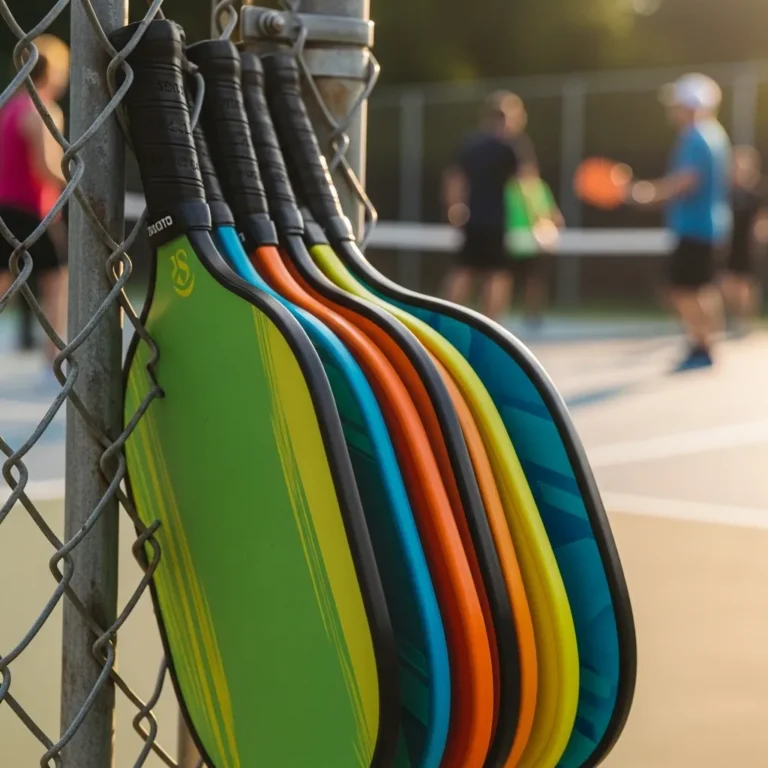
This is the part that confuses beginners the most. You walk up to the courts and see a fence lined with paddles, or perhaps a plastic bin with color-coded slots. This is the queue. Understanding how to “stack” your paddle is your ticket to getting on the court.
The Paddle Rack System
Most courts use a “paddle rack” or simply line paddles up on the ground or a table. The rule is simple: Left to Right, Top to Bottom.
- Arrival: When you arrive, find the end of the line of paddles. Place your paddle there.
- The Wait: As games finish, the players coming off the court will shout “Open Court!” or “Next four!”
- The Rotation: The owners of the next four paddles in line grab their gear and head to the empty court.
If you are looking to buy your first paddle so you can join the stack, check out this guide on how to pick a pickleball paddle.
Common Rotation Formats
Depending on how crowded the courts are, different rules apply. Always ask a local, “What’s the rotation today?” Here are the standard answers:
1. 4-On-4-Off (The Fairest Format)
This is used when the courts are very busy (e.g., 8+ people waiting). When a game ends, all four players leave the court, and the next four people in the queue go on. This ensures the line moves quickly.
2. 2-On-2-Off (Winners Stay)
Common in more competitive settings. The winning team stays on the court, and the losing team comes off. Two new challengers enter from the queue to play the winners. Usually, winners are limited to 2 or 3 consecutive games before they must vacate to give others a chance.
3. Winners Split
In this social variation, the winners stay on the court but split apart. Two new players come on, one partnering with each of the previous winners. This is excellent for community building and balancing skill levels.
Pro Tip: If you are waiting, keep your warm-up short. If there are people waiting behind you, limit your warm-up to 2-3 minutes before starting the match.
The Unspoken Rules: Open Play Etiquette
Knowing how to play pickleball is different from knowing how to behave during open play. Violating these unspoken rules is the fastest way to get labeled as “that person.”
The “Goldilocks” Rule (Playing Down)
In open play, you will inevitably play against someone with a lower skill level than you. Perhaps they have poor mobility or are just learning pickleball scoring.
Do not smash the ball at them.
If you are a 4.0 player facing a 2.5 player, the etiquette is to work on your soft game (dinking and drops). Keep the ball in play. If you smash an overhead slam at a beginner grandma, you aren’t winning; you’re losing the respect of the court.
The Clique Issue: Mixing vs. Sticking Together
A common question on forums like Reddit is: “Is it rude to only play with my partner?”
In a true “Open Play” session, strict adherence to your partner can be frowned upon, especially if the format is “Winners Split.” If you refuse to split, it disrupts the flow. If you desperately want to practice only with your partner, try to find a court that isn’t using a rotation system, or wait for a designated “challenge court.”
Calling the Score and Lines
Because there are no referees, you must call the score loudly before every serve. This prevents disputes later. Regarding line calls: When in doubt, call it “in.” If you didn’t see the ball clearly land out, the point goes to your opponent. Generosity is the currency of open play.
For more on fair play, reviewing official pickleball kitchen rules is essential to avoid foot-fault arguments.
FAQs: Detailed Answers for the Nervous Newcomer
We scoured Google, Bing, and Reddit to find the specific questions players ask but rarely get answers to.
How do I handle an awkward number of players (e.g., 5 or 6)?
This happens often. If there are 5 players (4 playing, 1 waiting), usually the players will agree to play to 9 points instead of 11 to rotate the solo waiter in faster. Alternatively, the waiting player can “stack” their paddle to save a spot for the next game. Never hover on the sideline pressuring the game to end; wait in the designated area.
How do I politely decline a game if the skill gap is too massive?
This is tricky. In “All Play” sessions, you generally can’t decline. The spirit of open play is inclusivity. However, if you are looking for better matches, look for courts designated by skill level. If a beginner asks you to play a private game, you can politely say, “I’m trying to get a competitive game in with this group right now, maybe next time!”
What gear do I need to bring?
Bring your paddle, plenty of water, and proper court shoes. Do not wear running shoes, as the lateral movement can cause ankle rolls. Invest in specific pickleball shoes or tennis shoes. Also, bringing your own pickleball balls is appreciated, as balls crack frequently.
What is a “Challenge Court”?
In large facilities, one or two courts might be designated as “Challenge Courts.” These operate differently from standard open play. Usually, it is a “Winners Stay” format, and it attracts the highest-level players in the session. If you aren’t confident in your pickleball ratings, watch a game first to see if you match the speed.
How to Find Open Play Sessions Near You
You’re ready to play, but where do you go? Simply showing up to a tennis court hoping for pickleball lines isn’t the best strategy.
1. Use Scheduling Apps
Technology has made this easy. The most popular app is PlayTime Scheduler. It allows users to create sessions (e.g., “Intermediate Open Play, 9 AM @ Central Park”). You can see exactly how many people are signed up before you leave your house. Another popular option is the TeamReach app, often used by local clubs to communicate codes and times.
2. Check Local Rec Centers
Most municipal recreation centers have specific hours for indoor pickleball. Check their websites for “Drop-In Pickleball” schedules. Be aware that indoor courts have different dimensions and surfaces; check the pickleball court dimensions and net setups if you are setting up portable nets.
3. USA Pickleball Places to Play
For a comprehensive database, you can use the official USA Pickleball Places to Play tool. This is a reliable resource for finding verified courts across the country.
Conclusion: Just Show Up!
The first time you walk onto an open play court, your heart might race a little. You might worry about hitting the ball into the net or not understanding the rotation. But remember this: every single person on those courts was once a beginner standing exactly where you are.
Pickleball is unique because the community prioritizes fun and socialization almost as much as the score. By understanding the logistics of paddle stacking and respecting the etiquette of the rotation, you will be welcomed with open arms. So, grab your gear, check your local pickleball tips, and head to the courts. The best way to learn open play pickleball is simply to play it.