cross strategy pickleball
The sound of a plastic ball meeting a paddle—pop, pop, pop—is becoming the soundtrack of parks everywhere. If you’ve spent any time on the courts recently, you know that pickleball is deceptively simple. It looks like just hitting a ball back and forth, but beneath that friendly surface lies a deep, strategic chess match. And the king of that chess match? The cross strategy pickleball game.
Whether you are a converted tennis player or someone picking up a paddle for the first time, realizing the power of the diagonal game is usually your “aha!” moment. It’s the difference between flailing around at the baseline and commanding the Kitchen line like a seasoned pro.
A lot of newcomers ask, “Can you play tennis on a pickleball court?” While you physically can squeeze some tennis drills into that space or use temporary lines, the strategies couldn’t be more different. Tennis rewards power and passing shots down the line. Pickleball? It rewards patience, angles, and the geometry of the cross-court dink. Let’s grab a Gatorade, sit down, and really unpack why going diagonal is the secret sauce to leveling up your game.
The Basics of Cross-Court Strategy
When we talk about strategy, we aren’t talking about memorizing a textbook. We are talking about playing the percentages. If you watch the pros play, you’ll notice they aren’t just hitting the ball to an empty spot; they are meticulously constructing points, and that construction almost always starts cross-court.
What is a cross-court dink in pickleball and why is it the “standard” shot?
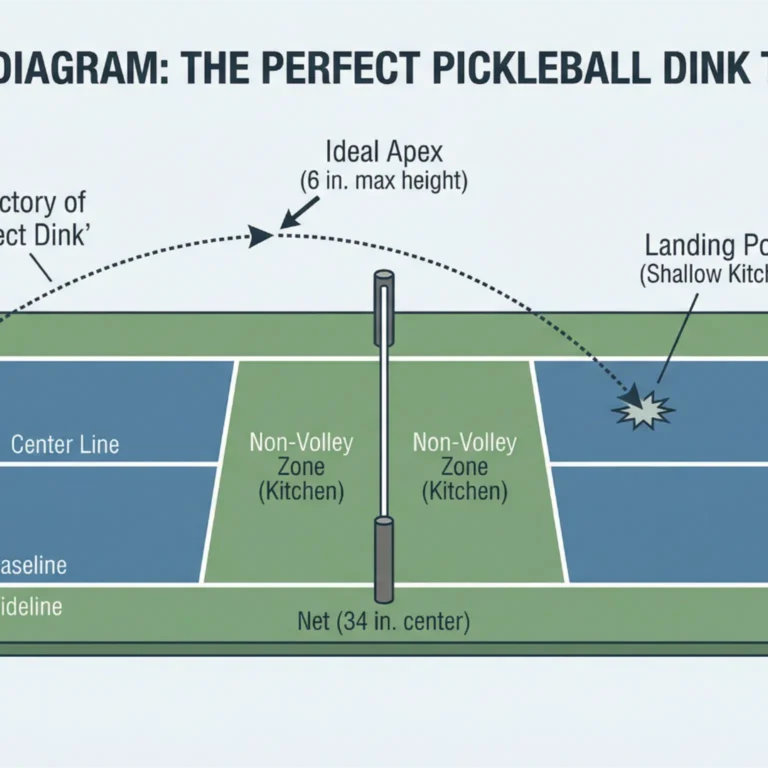
Think of the cross-court dink as your home base. It’s your safe haven. A cross-court dink is simply hitting the ball softly from your side of the Kitchen (Non-Volley Zone) diagonally into your opponent’s Kitchen.
Why is it the standard? Imagine you and I are rallying. If I hit the ball straight across to you, the ball travels a shorter distance. That sounds good, but it actually gives me less time to recover. When I hit it diagonally, the ball travels through the air longer. That extra fraction of a second allows me to reset my feet, take a breath, and get ready for your next shot. It is the heartbeat of high-level play. It establishes a rhythm. You aren’t trying to win the point with every single dink; you’re trying not to lose it while waiting for the other team to mess up.
How does the geometry of the court favor cross-court shots over down-the-line shots?
Let’s get a little geeky for a second, but I promise to keep it simple. It’s all about the net. You might not notice it in the heat of battle, but the pickleball net isn’t a perfect rectangle. It hangs at 36 inches high on the sidelines (the posts) but dips down to 34 inches in the exact center.
That two-inch difference might not sound like much, but when you are trying to feather a ball over the net with topspin, two inches is the Grand Canyon. By hitting cross-court, you are naturally hitting over the lowest part of the net. It’s basically the court giving you a helping hand.
Furthermore, the diagonal line across the court is the longest possible distance you can hit the ball and still keep it “in.” This gives you a bigger margin for error. If you hit a down-the-line shot a little too hard, it sails long. If you hit a cross-court shot with that same power, the extra distance keeps it safely within the baseline.
What is the difference between a cross-court dink and a straight (down-the-line) dink?
The difference is mostly about intent and risk. A straight dink is often aggressive or serves as a “change-up.” When you dink straight across, you are challenging the person directly in front of you. It reduces their reaction time, but—and here is the catch—it also reduces your reaction time.
If I dink straight to you, you can blast it right back at my body before I can blink. The cross-court dink is a conversation; the straight dink is an argument. You usually stick to the conversation (cross-court) until you are sure you can win the argument.
Strategic Advantages (The “Why”)
So, we know the net is lower in the middle, but why else should you commit to this strategy? It really comes down to control. When you play cross-court, you are dictating the pace of the game rather than letting the game happen to you.
Why is the cross-court shot considered a “high-percentage” play in pickleball?
“High percentage” is just sports talk for “the smart play that rarely fails.” In pickleball, unforced errors lose more games than winners win them. We’ve all played against that guy who tries to smash everything. He might hit one spectacular winner, but he hits five into the net.
The cross-court shot is high-percentage because it minimizes variables. You have more court to work with, a lower net to clear, and you are generally hitting to the opponent’s forehand or backhand in a predictable pattern. It removes the chaos. By sticking to the cross-court pattern, you force your opponents to hit a perfect shot to beat you, rather than handing them points on a silver platter.
How does hitting cross-court give you more time to react and recover?
Let’s visualize this. You are at the Kitchen line. You hit a ball cross-court. The ball has to travel roughly 20+ feet to get to the opponent. Then, they have to hit it 20+ feet back. That is a lot of air time.
During that time, you can check your positioning. Are your feet planted? Is your paddle up? If you hit down the line, the distance is shorter. The ball comes back faster. By playing cross-court, you are essentially buying yourself time. It’s like hitting the “slow-motion” button on the game, allowing you to process what is happening and make better decisions.
Why do pro players hit the majority of their dinks and drops cross-court?
If you turn on a PPA or MLP match on YouTube, watch the dink rallies. They can go on for 20, 30, sometimes 50 shots. And 90% of them are cross-court. Why? Because pros hate unnecessary risk.
Pros know that if they change direction (go down the line) without a perfect opportunity, they open up gaps. If I go down the line and don’t hit a perfect shot, my opponent can slam it diagonally through the middle of the court—a space my partner and I have left open. Pros play cross-court to keep the court “closed.” It’s a defensive shield that frustrates opponents into making a mistake.
How can cross-court dinking help neutralize an aggressive opponent?
We all have that nemesis who loves to speed up the ball (hit it hard) at every opportunity. It can be terrifying standing at the net knowing a heater is coming. The cross-court dink is your best defense against the “banger.”
By dinking cross-court, you force the aggressive player to move laterally. It is very hard to generate power when you are reaching sideways for a ball. Also, if you keep the cross-court dink low, they can’t attack it without hitting it into the net or hitting it long. You are essentially putting them in a cage, forcing them to play a soft game they probably aren’t comfortable with.
Execution & Mechanics (The “How”)
Okay, knowing the strategy is one thing; pulling it off is another. You don’t need to be an athlete in your prime to master this, but you do need to understand how your body and paddle work together.
What is the proper footwork for sustaining a long cross-court dink rally?
Footwork in pickleball isn’t about running; it’s about shuffling. When you are locked in a cross-court battle, imagine your feet are tied together with a short rope. You want to take small, efficient steps parallel to the kitchen line.
Don’t cross your feet over each other if you can help it. Stay low in a squat position—legs loaded. This burns the quads, I know! But if you stand straight up, you lose reach and stability. You want to slide side-to-side, always keeping your chest facing the action. Think of yourself as a goalie; you are guarding your zone.
Where should I aim when hitting a cross-court dink to avoid an ATP (Around the Post) attack?
This is a huge one. The “ATP” is when your opponent hits the ball around the net post (legally!) because you hit a shot too wide. It’s the most embarrassing way to lose a point.
To avoid this, don’t aim for the sideline. That is a trap. Instead, aim for your opponent’s inside foot—the foot closest to the center line. If you aim for the middle of their designated box, even if you miss slightly, the ball is still in play and safe. If you aim for the sideline and miss by an inch, you either hit it out or give them that juicy ATP angle. Play it safe; aim for the shoelaces of their inner foot.
How do I generate the right amount of topspin for an aggressive cross-court roll?
The “roll” volley is a game-changer. Instead of just blocking the ball back, you gently brush up on it. This puts topspin on the ball, causing it to dive down at your opponent’s feet.
The mechanics are subtle. You don’t need a big tennis swing. Start with your paddle slightly below the ball. As you make contact, lift your arm and flick your wrist gently upward, like you are turning a doorknob. The motion is “low to high.” This brushing motion grips the ball. The result? You can hit the ball a little harder, but the spin brings it down safely inside the court. It pressures your opponent without risking a pop-up.
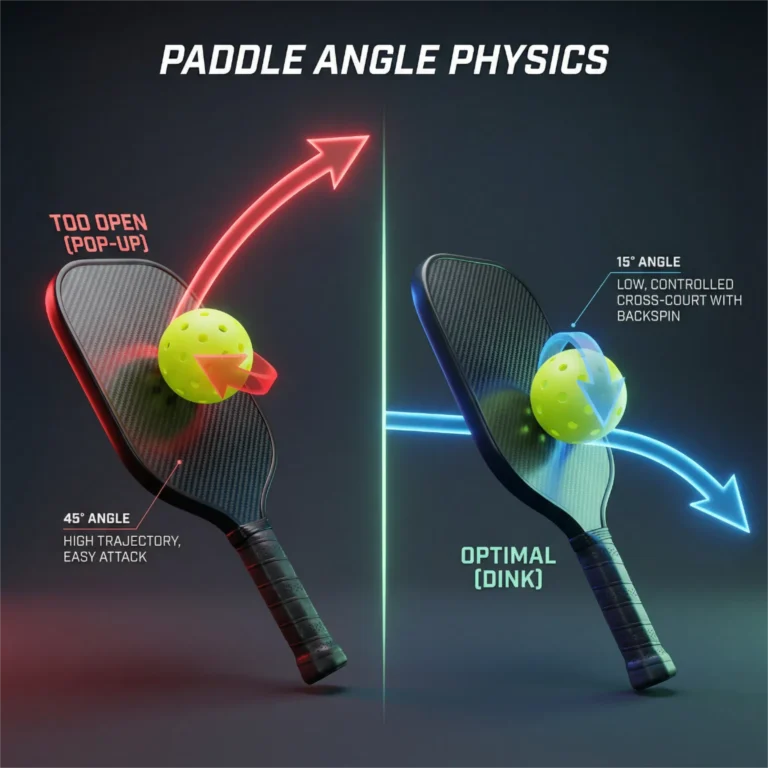
What is the best paddle angle to keep cross-court shots low and unattackable?
The face of your paddle tells the ball where to go. If your paddle face is open (pointing up toward the sky), the ball will pop up. If it’s closed (pointing down), the ball hits the net.
For a solid cross-court dink, you want a slightly open face, but not too much. Think of your palm. If you were catching the ball with your palm, you’d cushion it. Treat the paddle the same way. Soft hands are key. You want to absorb the pace of the incoming ball. Don’t jab at it. Hold the paddle firmly enough so it doesn’t twist in your hand, but loosely enough that you can feel the impact. A relaxed grip usually leads to a lower, more dangerous dink.
Tactical Situations (When to Use It vs. Switch It)
Strategy is fluid. You can’t just go out there and be a robot. You have to read the room (or the court). The cross-court game is your foundation, but you need to know when to break the pattern.
When should I switch from cross-court dinking to a down-the-line attack (speed-up)?
This is the million-dollar question. You switch when your opponent makes a mistake. Look for a “dead dink”—a ball that bounces high and has no spin. If they float a dink that sits up above the net, that is your green light.
However, be careful. The “speed-up” works best when you catch them off guard. If they are balanced and ready, they will block your speed-up right back at you. Look for cues: Are they leaning the wrong way? Did they stumble? If they are off-balance, you can flick that ball down the line to the open court. But if they are set, stick to the cross-court grind.
Is it better to return a serve cross-court or down the line in doubles?
In doubles, the cross-court return is king. Why? Because it keeps the ball away from the net player (the server’s partner) who is looking to poach.
If you return down the line, you are hitting right near the person standing at the kitchen line ready to smash it. By returning deep and cross-court, you force the server to let the ball bounce, and you force them to hit a harder third shot (usually a drop). It also gives you plenty of time to run up to the Kitchen line yourself. It is the safest, smartest entry into the point.
How do I use a cross-court drop shot to make my way to the kitchen line?
The “third shot drop” is the hardest shot in pickleball, but aiming cross-court makes it easier. Remember that court geometry? You have more distance to work with.
If you are stuck at the baseline, aiming a drop shot cross-court gives you a larger landing zone. It also forces the opponent to move. As soon as you hit that high-arcing drop shot, follow it in. Don’t admire your shot. Move! The goal of the drop is simply to buy your ticket to the Kitchen line. It doesn’t have to be a winner; it just has to be unattackable.
What should I do if my opponent starts “stacking” or poaching my cross-court shots?
So, you’re playing a savvy team, and the net player starts poaching (cutting across) to intercept your cross-court dink. This is annoying, but you can fix it.
First, acknowledge it. “Okay, they are hunting my cross-court shot.” You have two options. One, you can hit behind them. As they move to the middle to poach, hit it down the line to the spot they just vacated. You only have to do this once or twice to keep them honest. Two, hit your cross-court shot wider. Make them reach so far that they pull themselves out of position. But the best counter is deception: look cross-court with your eyes and body, but flick the ball straight at the last second.
Troubleshooting & Common Mistakes
Even the best of us mess up. When your cross-court game falls apart, it’s usually due to one of a few common culprits. Let’s troubleshoot.
What are the most common mistakes players make during cross-court rallies?
The biggest mistake is impatience. We get bored! We hit three good dinks, and then we think, “Okay, time to win this,” and we try a crazy shot that isn’t there.
Another mistake is not resetting to the “ready position.” After you hit your shot, get your paddle back up in front of your chest. If you leave your paddle hanging by your knees, you won’t be ready for the next ball. Stay engaged. Treat every dink like it’s match point.
Why do my cross-court dinks keep popping up high enough for opponents to smash?
Pop-ups usually happen for two reasons: gripping the paddle too tight or hitting flat-footed.
When you panic, you squeeze the paddle handle. This turns your hand into a brick wall. The ball hits it and bounces off hard and high. Loosen that grip! On a scale of 1-10, your grip pressure should be a 3. Also, make sure you are bending your knees. If you are stiff-legged, you tend to lift the ball with your shoulder rather than guiding it with your body.
How can I stop being predictable with my cross-court pattern?
If you hit the exact same spot every time, your opponent will just camp out there. To stop being predictable, vary the depth and the spin.
Hit one dink deep to their feet. Hit the next one short and wide. Slice one; roll the next one. You are still playing cross-court, but you are changing the texture of the shot. It keeps them guessing. They won’t know if they need to step forward or back, and that hesitation causes errors.
Is it risky to hit a cross-court speed-up? (The geometry of the “high part” of the net).
Yes, it is very risky. Remember, the net is higher at the sidelines. If you try to speed up a ball cross-court, you have to clear that higher part of the net, and because you are hitting it hard, the ball doesn’t have time to drop.
Physics is against you here. A cross-court speed-up often sails wide out of bounds. If you want to speed up, going straight ahead (down the line) or toward the middle of the opponent’s body is usually safer. The cross-court angle is designed for soft play, not power play. Respect the geometry, and you’ll win more points.
Mastering the cross-court strategy isn’t about being flashy. It’s about being disciplined. It’s about understanding that pickleball is a game of errors, and the player who makes the fewest errors wins. By trusting the diagonal, using the lowest part of the net, and buying yourself reaction time, you become a wall that your opponents just can’t break down. So next time you’re out there, resist the urge to blast everything. Dink it cross, be patient, and watch your win rate climb.