The rules of the court are changing, and it all comes down to aerodynamics. Standard paddles catch the air, slowing your reaction time by milliseconds—the exact margin between a winning dink and a missed opportunity. If you’ve noticed players dominating the kitchen with lightning-fast hand speed, they’ve likely already switched to a pickleball paddle with holes. This design isn’t just a visual trend; it’s a mechanical evolution engineered to cut through air resistance and redefine your power game. Let’s break down the top-tier options dominating the US market right now.
Aerodynamic Pickleball Paddles
Hole Style · Core · Weight · USAPA · Price
As the sport undergoes rapid growth across the country, competitive environments require a deeper understanding of equipment technology. Moving past old-school wooden gear to understand advanced composites is essential for anyone trying to master how to play pickleball at a high level. Let’s dive deep into the specific engineering that makes these advanced models so popular.
Best Pickleball Paddle with Holes: Advanced Market Reviews
The engineering core of any modern pickleball paddle with holes is built to solve a simple physical problem: drag coefficient. When executing a fast-paced defensive block or preparing for a sudden offensive drive, traditional widebody paddles act like wind sails, slowing down the hand speed of players near the kitchen line.
A comprehensive pickleball paddle with holes review reveals that current designs have moved far beyond basic aesthetic marketing to offer measurable game benefits:
- Aerodynamic Power Delivery: By removing physical mass from non-striking zones, these designs allow players to generate massive paddle head speed. This speed translates directly into heavier topspin and aggressive baseline drives.
- Increased Dwell Time: Premium options combine throat flex technology with high-end composite faces, allowing the ball to compress deeply on the surface before rebounding with explosive exit velocity.
- Reduced Arm Stress: The continuous flow of air through the paddle frame dampens the structural vibrations that typically travel up the handle, offering a comfortable experience for players suffering from tennis elbow.
For players searching for the best pickleball paddle with holes, selecting a model like the Luxe LX Premium or Selkirk Vanguard Power Air ensures tournament compliance while drastically increasing your reflex speed during fast-paced hand battles. If you are selecting a new model to match your style, reviewing our guide on top pickleball paddles provides crucial context before you buy.
Check the Official USA Pickleball Equipment List
USA Pickleball Compliance and the 2026 Regulatory Divide
To preserve the core tactical identity of the sport, USA Pickleball maintains strict equipment guidelines managed by the Equipment Evaluation Committee. The 2026 rulebook has introduced mandatory pre-match verification rules to eliminate illegal “hot” paddles from competitive play. Under USA Pickleball Rule 2.E.2, the active hitting surface of any paddle must be completely free of holes, cracks, delamination, or specialized rough textures that allow players to impart excessive, unpredictable spin on the ball.
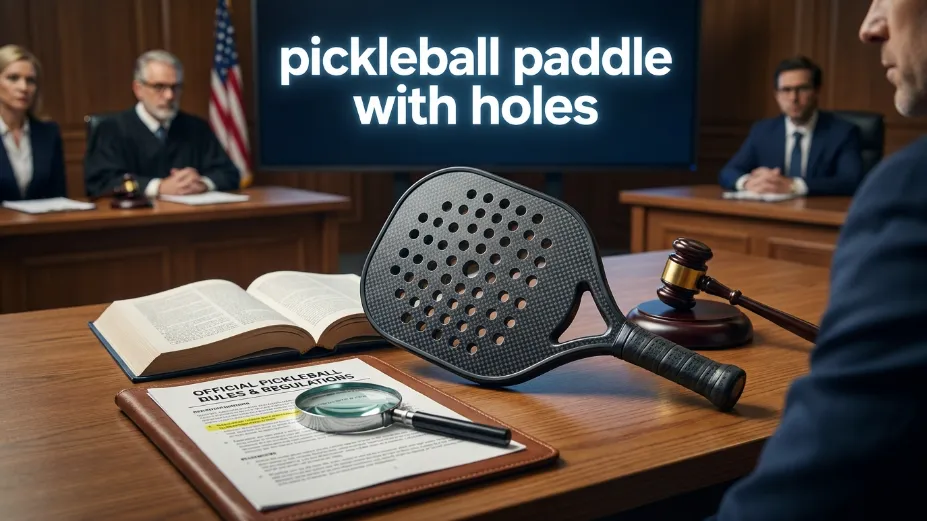
This rule creates a strict regulatory divide for any pickleball paddle with holes in it. Throat cutouts (such as Selkirk’s Air Dynamic Throat or Onix’s open bridge) are legal because the throat is classified as a transition zone rather than part of the active playing surface. These models are fully certified and appear on the official USA Pickleball approved paddle list.
Conversely, paddles with fully perforated faces—where holes are drilled directly through the sweet spot of the hitting surface—are strictly banned in tournament play. This is why the Diadem Vice Concept, despite its outstanding performance, is prohibited from sanctioned tournaments. The rulebook also maintains a total ban on 100% EVA foam cores to limit excessive ball deflection. To maintain fairness, competitive players must check the pickleball rules regarding core composition and paddle deflection limits before making an investment.
The Physics of Drag, Velocity, and the Twist Weight Penalty
From a mechanical perspective, integrating a pickleball paddle with air hole designs alters the paddle’s structural dynamics. The main aerodynamic benefit is a reduction in drag during the swing path, allowing for faster wrist acceleration. This is a game-changing advantage when executing a precise pickleball dink, where milliseconds determine whether you clear the net or pop the ball up to an aggressive opponent.
However, removing structural mass from the throat introduces a mechanical trade-off known as the Twist Weight Penalty. When mass is removed from the lower center of the paddle, the paddle’s resistance to rotational twisting (twist weight) decreases. This makes the paddle less stable on off-center hits, causing the sweet spot to shrink toward the center of the face.
To combat this, premium brands utilize thermoformed unibody molds and inject high-density perimeter foam into the outer edges. This foam injection restores the lost twist weight, widening the sweet spot and providing structural stability against heavy baseline drives. Rather than letting the throat flex wildly, advanced models use carbon-fiber power frames to ensure the face remains rigid, maximizing energy transfer without erratic launch angles.
Padel Rackets vs. Pickleball Paddles: The Mechanical Truth
A common question among crossover athletes is why padel rackets are covered in drilled holes while competitive pickleball paddles must remain solid. Understanding is padel the same as pickleball requires looking at the vastly different ball physics of each sport.
Padel is played with low-pressure, heavy rubber tennis-style balls on an enclosed glass-walled court. Because padel rackets are incredibly thick (38mm) and heavy, they require fully drilled faces to reduce weight and swing drag. If a padel racket were solid, it would be virtually unswingable for the average club player.
Pickleball, however, uses a lightweight, hollow plastic ball with 26 to 40 molded holes. If you hit a perforated ball with a fully drilled pickleball paddle with hole surfaces, a phenomenon called “interlocking holes” occurs. The holes on the ball catch against the edges of the holes on the paddle face, causing highly unpredictable ball trajectories, deadened energy transfer, and a complete loss of shot consistency. Furthermore, because pickleball paddles are thin (typically 13mm to 16mm), they do not experience enough drag on the face to justify ruining consistent ball contact with drilled holes.
Head-to-Head: Selkirk Vanguard Power Air vs. Luxe LX Premium
For players trying to choose between the leading aerodynamic paddles in the United States, the decision comes down to a fundamental split in design philosophy. Both models utilize open throats to reduce drag, but they handle weight and core thickness from completely opposite angles.
For a detailed comparison of how these premium options match up on the court, consider the performance parameters below:
- Core Thickness and Ball Feel: The Selkirk Vanguard Power Air features a thin, rigid 13mm polymer honeycomb core. This setup offers extreme pop and explosive power, making it a favorite for aggressive players. Conversely, the Luxe LX Premium employs a thicker 16mm core, yielding a much softer feel, superior vibration absorption, and added control in the transition zone.
- Sweet Spot and Forgiveness: The Selkirk model has a demanding sweet spot, meaning off-center hits will feel dead and may spin out of control. Luxe solves this issue by incorporating foam-filled edges, giving the LX a significantly larger and more forgiving sweet spot for defensive blocks and resets.
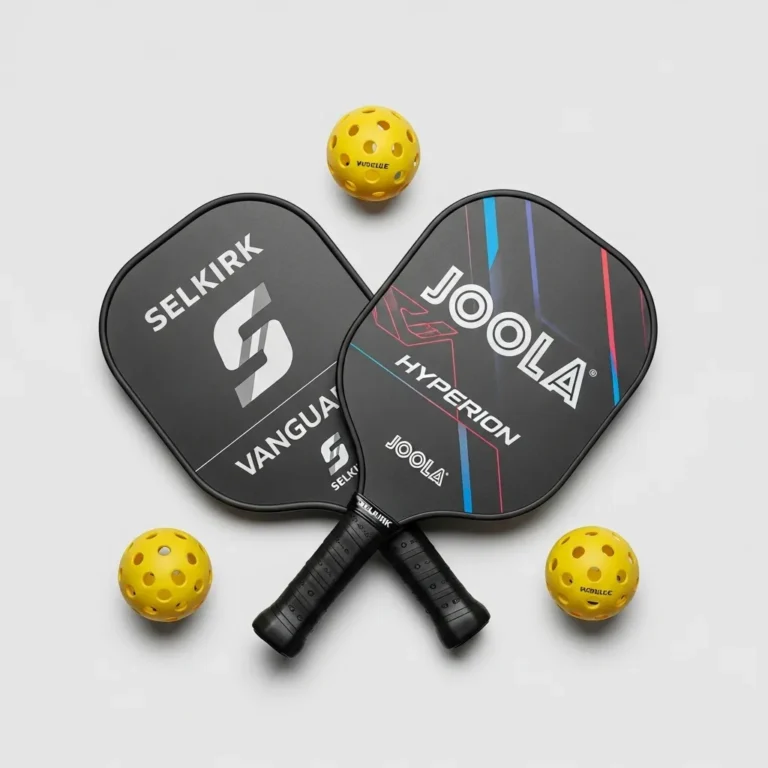
- Spin and Surface Texture: Both models leverage high-end carbon fiber. While Selkirk relies on their QuadFlex hybrid face, the Luxe LX features a raw T700 carbon fiber pickleball paddle surface. For players comparing performance profiles, reading our analytical look at the Selkirk Vanguard vs. JOOLA Hyperion offers deep insight into how raw carbon fiber compares to hybrid fiberglass faces.
Actionable Customization: Lead and Tungsten Tape Calibration
Because aerodynamic paddles with throat cutouts have less mass in the throat area, they can occasionally feel head-heavy or exhibit high vibration levels. For competitive players, customizing the weight distribution of a pickleball paddles with holes setup is a common way to optimize on-court playability:
- Lower Throat Corner Placement: Applying small strips of lead or tungsten tape directly to the lower corners of the open throat stabilizes the paddle frame. This weight addition helps absorb shock and dampens impact vibrations before they travel into your arm.
- The 3 and 9 O’clock Positions: Adding tape to the lateral edges of the paddle face increases the twist weight of the paddle. This expands the sweet spot and prevents the paddle from twisting in your hand when blocking hard drives from baseline bangers.
- Avoiding the 12 O’clock Position: You must avoid adding heavy tape to the very top (head) of an aerodynamic paddle. Doing so significantly raises the swing weight, completely destroying the hand-speed advantage of the open-throat design.
The Verdict: Choosing Your Aerodynamic Weapon
Ultimately, upgrading your gear depends on your personal player rating, style of play, and budget:
- Who Should Buy: Aggressive players who want to dominate the kitchen line with fast hand speed, singles players looking for maximum swing velocity, and tournament players seeking a legal aerodynamic edge.
- Who Should Avoid: Beginners who need a basic, oversized sweet spot, and conservative players who prefer the classic, solid-face aesthetics of traditional paddles.
Frequently Asked Questions (FAQ)
Do paddles with open throats make a whistling sound during fast swings?
No. While it seems logical that swinging a paddle with an air hole would create a wind whistle, high-end manufacturers bevel and round the inner edges of the cutout. This aeroacoustic design prevents air from shearing sharply over flat, hard edges, ensuring the paddle remains whisper-quiet on the court.
What is the political history behind the approval of throat cutouts?
The open-throat design was originally engineered by a Chinese manufacturing plant (Zeus Factory) and presented to Paddletek, but it was initially rejected. The factory then brought the concept to Selkirk Sports. Backed by Selkirk’s massive commercial leverage, USA Pickleball approved the “throat” design, classifying it as part of the handle transition rather than a modification of the actual hitting surface.
Do throat cutouts increase the rate of mishits?
No. The throat of any paddle is functionally a dead zone, meaning that hitting the ball near the handle yields a failed, deadened shot regardless of whether there is a hole. Because no player intentionally strikes the ball in the throat, converting this useless, non-responsive space into an aerodynamic opening has zero impact on active mishit rates.
Do holes help with court noise complaints in the United States?
No, open-throat cutouts do not mitigate court noise. The loud, high-frequency “pop” of a pickleball impact—which often exceeds 85 decibels—is caused by the membrane vibration of the solid face. For a paddle to reduce noise through hole-drilling, the entire face would need to be perforated (like a tennis racket or a padel racket), a design that is currently illegal under tournament guidelines.