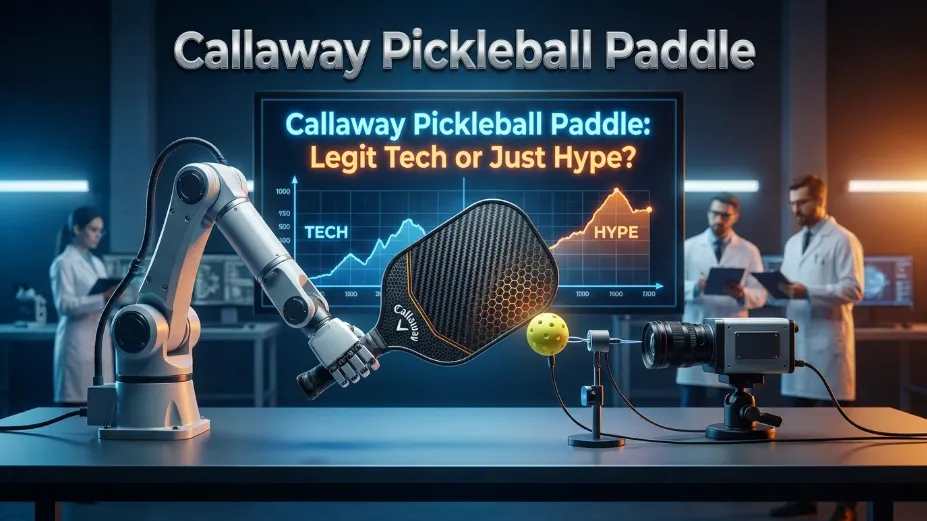
The golf courses of America have long been dominated by one name, but their sudden crossover into the pickleball courts left the entire community skeptical. When a titan of turf engineering launches the callaway pickleball paddle, players don’t just look for style—they demand elite performance. The question shifting across US courts isn’t whether this gear looks good, but whether Callaway’s legendary engineering actually translates into tournament-winning spin and power, or if it’s just clever branding.
Callaway Inertia — Control vs Power Setup
Side-by-Side Feature Specification Comparison
For tournament and club players navigating highly competitive schedules across the United States, the best option depends strictly on your playstyle and touch preferences. If you prioritize maximum shot-to-shot forgiveness, elite-level reset control, and want a completely risk-free 30-day play-test, the Callaway Inertia is a premium, top-tier choice. However, players seeking explosive, springy pop or massive vertical putaway power out of the box will find much better long-term value in specialized all-court models like the Honolulu J2NF or the RPM Friction Pro.
callaway pickleball paddle review: The Core Player Experience
The engineering core of the callaway pickleball paddle review centers upon its non-traditional approach to perimeter stabilization. While legacy racquet sports brands entering pickleball often rely on basic off-the-shelf Chinese manufacturing designs, Callaway has leveraged its advanced Carlsbad-based golf research and development labs. The absolute focus is on preventing rotational paddle twisting on impact—a direct translation of golf club forgiveness technology brought to a 20 by 44-foot court footprint.
During competitive play, this structural focus manifests in an exceptionally deadened, stable feel. Standard carbon fiber paddles without advanced perimeter weighting can twist aggressively in a player’s hand when a ball is struck near the edge, causing short, high, and erratic pop-ups. In contrast, the Callaway Inertia behaves with linear, predictable composure. For players searching for the best setup, understanding how to pick a pickleball paddle that matches this defensive touch is critical to long-term skill progression.
Check Official Callaway Pickleball Website
Deep-Dive Physical Specs of the Callaway Inertia
Analyzing the physical architecture of the callaway inertia pickleball paddle reveals an intentional balance of reach and geometric forgiveness. Rather than selecting an elongated 16.5-inch footprint that narrows the face, Callaway implemented a balanced hybrid shape measuring 16.25 inches in length and 7.66 inches in width. This shape preserves a wider horizontal sweet spot while offering enough leverage to handle deep baseline returns.
- The Handle & Grip Geometry: Featuring a highly versatile 5.5-inch handle length, the Inertia is purpose-built to accommodate two-handed backhand players. The grip is wrapped in a high-performance Karakal wrap with a 4.2-inch circumference, delivering a tacky, secure hold even in high-humidity court environments.
- Composite Face Layup: The hitting surface utilizes a unidirectional Toray T700 raw carbon fiber sheet. Unlike a pure carbon face, Callaway has reinforced this layer with an underlying fiberglass stabilizing sheet. This adds vital structural durability and a touch of crisp feedback, placing it on the USA Pickleball approved paddle list for tournament use.
- Core Cell Engineering: The 16mm thick core is built from a specialized polypropylene honeycomb. By tightly controlling core thickness tolerances and ensuring the round honeycomb cells are perfectly uniform, Callaway has actively eliminated the “missing cell” manufacturing defects common in budget paddles, preventing core crushing and long-term softening.
The Physics of “Power Edge” Technology & Perimeter Weighting
The defining innovation of Callaway pickleball paddles is the patent-pending Power Edge Technology. In physics, when an object rotates, the distribution of its mass determines its resistance to rotational acceleration. This is governed by the moment of inertia (I) equation:
Where m represents the mass and r is the distance of that mass from the axis of rotation. By placing four highly dense, weighted corner inserts inside the outer edge guard, Callaway maximizes the distance r from the central vertical axis of the paddle face. This results in a lab-verified, record-breaking twist weight of 7.33 kg·cm²—the highest recorded value for any 16mm hybrid-shaped paddle in the modern database.
In real-world court conditions, this elevated twist weight means the paddle face refuses to yield when struck off-center. When defending a hard-driven ball at the non-volley zone, the perimeter weights absorb the kinetic energy and evenly redistribute the forces. This creates a uniform, expansive sweet spot that covers nearly 95% of the face, keeping off-center shots reliable, low, and perfectly on target.
Exposing the DIY Lead Tape Myth vs. Integrated Power Edge Weights
A major missing angle overlooked by generic review sites is the common community debate on Reddit: Why pay $250 for a pre-weighted paddle when you can buy a $5 roll of lead tape and customize your own? While adding weighted tape is a staple among advanced players, haphazard manual customization has serious hidden costs.
When you apply lead tape to a standard paddle, you are increasing both the twist weight (TW) and the swing weight (SW). If you place the tape too high on the head (at the 10 and 2 o’clock positions), you drastically elevate the swing weight, raising it past 120 kg·cm². This makes the paddle feel head-heavy, severely slowing down your reaction speed in fast kitchen battles and placing intense physical strain on your forearm tendons, often leading to chronic tennis elbow.
Callaway’s engineering team solved this mechanical equation. By housing precisely calibrated weights in all four corners, they managed to push the twist weight to a massive 7.33 while keeping the swing weight at an exceptionally maneuverable 113 kg·cm². This optimal swing-weight-to-twist-weight ratio allows you to maintain elite hand speed during lightning-fast volley exchanges while benefiting from maximum rotational stability—an engineering balance that is almost impossible to replicate with DIY lead tape setups.
The Thermoforming Controversy: Gen 1 Cold-Layered or Gen 2 Core?
For serious equipment enthusiasts, Callaway’s lack of transparent communication regarding its inner manufacturing assembly has generated extensive debate. The company’s official specs do not explicitly state whether the Inertia utilizes modern thermoforming techniques or traditional cold-layered assembly.
Independent teardowns and laboratory analysis reveal that the Callaway Inertia is built as a highly refined Gen 2 thermoformed core, but with a critical twist: it features no foam edge injection. Standard thermoformed paddles inject a dampening polyurethane foam around the inner perimeter to seal the core. While this foam increases pop, it often creates a stiff, hollow, and volatile response that makes delicate dinking highly unpredictable.
By opting for a thermoformed polypropylene core without edge foam, Callaway has prioritized pure, predictable control. The paddle delivers a plush, dense, and soft feel that mimics the touch of classic Gen 1 cold-layered control paddles, but with the immense structural durability of thermoformed edge sealing. This hybrid assembly makes it a standout choice for control-minded players, placing it among the top pickleball paddles for defensive dink battles.
On-Court Playability: Resets, Pop Levels, and the Overheads Humour
The on-court execution of the callaway inertia pickleball paddle review highlights a clear divide between beginner and professional expectations. When intermediate players first step onto the court with the Inertia, they frequently praise its “incredible power.” However, this is largely a cognitive bias caused by the paddle’s massive sweet spot; hitting a ball off-center still produces a clean, deep shot, which feels powerful compared to a traditional paddle where off-center hits simply die.
For advanced players, lab data confirms that the Inertia is strictly a control-oriented tool. Power output sits at a modest 75%, and pop is measured at 78%. There is very little “free power” here. The ball pockets deeply into the unidirectional raw carbon face, maximizing dwell time and generating a reliable, predictable spin rate of approximately 2,200 RPM. This is not a weapon for baseline bangers; it is a precision instrument designed for soft resets, un-attackable third-shot drops, and patient, grinding dink rallies.
The golf-heritage branding has also introduced a unique, lighthearted culture on US courts. Reddit communities have popularized a running joke for players wielding this paddle: whenever you get a high pop-up and execute a massive overhead slam, you are culturally obligated to yell “Mashed Potatoes!“—honoring the famous, boisterous crowd chant heard on the PGA Tour. It’s a playful nod that perfectly bridges Callaway’s golf legacy with the social joy of pickleball.
Head-to-Head Competitor Shootout: Callaway Inertia vs. The Elite Alternatives
To justify a premium $249.99 investment, the Callaway Inertia must stand up against the most respected specialized paddles in the industry. Below is a head-to-head comparison with the market leaders in this price bracket:
- Honolulu J2NF vs. Callaway Inertia: The Honolulu J2NF is widely considered the gold standard for balanced, cost-effective control. It utilizes a premium raw carbon face backed by a unique blue crystal endurance grit. While the J2NF offers a slightly more crisp, all-court response at a more accessible $195 price, it cannot match the extreme perimeter stability and twist weight (7.33 vs 6.5) of the Callaway Inertia.
- RPM Friction Pro 16mm Elongated vs. Callaway Inertia: The RPM Friction Pro is a spin-heavy powerhouse featuring a high-friction CarbonBite face and a dense Tri-Density core. The RPM excels at heavy topspin drives and raw putaway power. However, its elongated shape results in a higher swing weight, making it feel slightly head-heavy and less maneuverable at the net compared to the quick 113 swing weight of the hybrid Callaway.
- 14mm vs 16mm Considerations: Players deciding between thickness profiles should note that the Callaway Inertia is offered exclusively in a 16mm profile. If you are comparing a 14mm vs 16mm pickleball paddle, the 16mm core of the Inertia excels at absorbing pace, whereas a thinner 14mm alternative would provide faster ball exit speed (pop) at the direct expense of sweet spot size and defensive forgiveness.
The Warranty Discrepancy & Lenient Return Policy Loopholes
One of the most critical consumer protection angles that major reviews fail to mention is the massive discrepancy between Callaway’s famous golf equipment coverage and its newly established pickleball policies. Golfers purchasing a premium Callaway driver are accustomed to a robust, worry-free 2-year warranty. However, Callaway’s official terms explicitly state that pickleball paddles are exempt from this extended coverage, carrying a much shorter 6-month limited warranty against manufacturing defects.
Fortunately, Callaway completely makes up for this short warranty with one of the most generous, customer-friendly return policies in the entire sports industry. Most specialized pickleball brands advertise a “30-day trial,” but bury strict terms in the fine print requiring the paddle to be returned in brand-new, unplayed condition. If you hit a single ball with a Honolulu paddle and try to return it, you face a minimum 20% restocking fee, and heavily worn paddles are rejected outright.
Callaway takes a completely different approach. Under their “100% Performance Guarantee,” players are actively encouraged to take the Inertia to the courts and play with it for a full 30 days. If you are not satisfied with its on-court performance after intensive play, you can return the used paddle for a 100% refund in the form of a Callaway Golf Gift Card with no expiration date. This gift card can be redeemed directly on their site for premium golf clubs, balls, apparel, or Ogio gear. This unique loophole makes purchasing the Inertia a completely risk-free trial for anyone who also plays golf.
Strategic Future: Callaway’s Pickleball Road Map (2027-2028)
The launch of the Inertia is not a brief marketing gimmick; it is the foundation of a long-term, multi-year strategic expansion into court sports. Callaway’s corporate road map outlines an aggressive product timeline designed to establish them as a dominant force by 2028.
- Full Product Catalog Expansion (2027): In partnership with OGIO, Callaway will launch a premium line of specialized court gear, including traction-focused footwear, high-performance outdoor pickleballs, performance apparel, and custom tournament bags.
- The “Inertia Pro” Series: Scheduled for release in late 2027, the Pro edition will feature adjustable, interchangeable Power Edge corner weights. This technology, directly inspired by adjustable golf drivers, will allow players to manually tune and customize their paddle’s swing weight and balance point on the fly.
- DTC Customization: Callaway’s direct-to-consumer online platform will introduce personalized engraving, custom colorways, and bespoke grip sizing, giving tournament players a fully tailored, tour-level equipment experience.
Buying Verdict: Is the Callaway Inertia Worth Your Money?
The final purchasing decision comes down to a clear assessment of your physical needs on court and your financial relationship with the Callaway brand.
You should buy this paddle if: You are a control-minded player who struggles with off-center mishits, you prioritize defensive blocks and dink consistency over raw power, or you are a crossover golfer with Callaway rewards points or gift cards looking for a risk-free 30-day play-test.
You should pass on this paddle if: You rely on explosive pop and effortless power to finish points, you prefer the crisp, springy feel of foam-injected paddles, or you want a premium 1-year warranty without paying a $250 brand-name premium.
Frequently Asked Questions (FAQ)
Is the Callaway Inertia paddle fully approved for official tournament play?
Yes. The Callaway Inertia 16mm paddle is fully approved by USA Pickleball (USAP) and is listed on the official approved paddle directory, making it legal for all local, regional, and national tournament divisions in the United States.
Can I use a standard washing machine or golf club cleaner to clean the carbon face?
Absolutely not. Utilizing harsh chemical cleaners, wire brushes, or high-temperature washing machines will permanently degrade the delicate Toray T700 raw carbon texture and ruin the underlying fiberglass stabilizing layer. To clean the face, simply use a specialized rubber paddle eraser or a damp microfiber cloth.
How does the lack of injected edge foam affect the paddle’s lifespan and performance?
While the lack of perimeter foam edge injection slightly lowers the paddle’s explosive pop, it significantly increases touch predictability and eliminates the risk of “core rot” or localized hollow spots over time. The uniform round-cell honeycomb core ensures the paddle maintains a consistent, reliable feel for hundreds of hours of play.