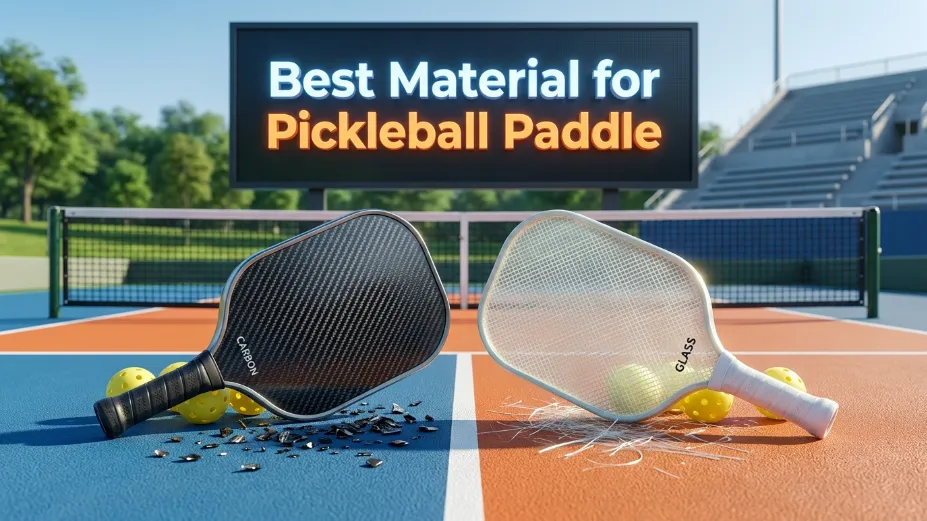
The physics of a pickleball court comes down to a fraction of a second, and that fraction is decided by the best material for pickleball paddle construction. Every drive, dink, and overhead smash relies heavily on what happens beneath the surface of your gear. Choosing blindly usually means sacrificing your elbow or your win-rate. Whether you need the explosive pop of fiberglass or the surgical precision of carbon fiber, understanding the raw components is what separates frustrating unforced errors from effortless court control.
Pickleball Paddle Materials — Comparison
Component · Performance · Skill Level · US Price Range
As pickleball spreads rapidly across the United States, understanding how different pickleball paddle materials behave under stress has become essential to advancing on-court strategy. Finding a paddle with the right structural design can dramatically widen your sweet spot and prevent premature equipment breakdown. Let’s analyze how these raw materials are engineered to dictate power, spin, and comfort.
What is the Best Material for Pickleball Paddle Performance?
To determine the best pickleball paddle material for your specific playstyle, you must evaluate the dynamic interaction between the outer face and the inner core. Leading manufacturers utilize high-precision material configurations to cater to different segments of the market. For instance, Six Zero pickleball paddles have taken the US market by storm by introducing premium raw carbon fiber weaves and 100% DuPont Kevlar faces. Their highly acclaimed Ruby pickleball paddle utilizes a pure aramid fiber face that maximizes dwell time and dampens hard vibrations before they reach your wrist.
Similarly, the standard-setting Vatic Pro pickleball paddle line offers high-performance Toray T700 raw carbon surfaces that excel at generating consistent topspin. Their budget-friendly Vatic Pro Prism Flash is often cited as the gold standard for intermediate control, featuring structural edge foam and polyurethane handle inserts to minimize shock. For players seeking elite-tier control or maximum power, brands like Selkirk pickleball paddles offer highly engineered lineups. The Vanguard Pro incorporates multiple layers of 12K carbon fiber to enhance rigidity and energy transfer. Meanwhile, the Joola pickleball paddle line features advanced “Charged Carbon” faces and specialized propulsion cores designed for aggressive baseline play.
Comprehensive Guide to Pickleball Paddle Surface Materials
The paddle’s face controls the initial ball “bite” and determines the maximum spin potential you can generate. Let’s break down the physical characteristics of the four primary surface materials used in the industry today:
- Raw Carbon Fiber (Toray T700/T800): The undisputed standard for competitive play. This pickleball paddle material features woven carbon threads interlinked in microscopic patterns (such as plain, twill, or satin weaves) that distribute impact energy uniformly. Toray T700 carbon fiber is highly durable and resists structural fatigue, maintaining its stiff, responsive feel over thousands of high-impact cycles. Raw carbon provides a highly textured surface that grabs the ball’s outer skin to generate massive topspin.
- Fiberglass (Composite): Unlike rigid carbon fiber, fiberglass is highly flexible. When a ball impacts a fiberglass pickleball paddle, the surface deforms slightly and rebounds like a trampoline, propelling the ball deep into the opponent’s court. Because it does a lot of the work for you, fiberglass is the best pickleball paddle material for beginners who are still developing their swing speed and physical power.
- Graphite: Consisting of ultra-thin layers of carbon pressed into sheets measuring less than 1 mm thick, graphite provides a stiff, responsive, and incredibly lightweight surface. This material offers minimal dwell time, delivering instantaneous tactile feedback on every strike. Graphite faces are highly favored by tactical players who rely on quick reaction speeds and precise ball placement.
- DuPont Kevlar & Acoustene: Representing the cutting edge of defensive play. Kevlar is a highly dynamic aramid fiber that distributes impact energy efficiently, providing a soft, plush, and muted feel. Acoustene surfaces offer a velvet-like texture that significantly dampens the sharp, loud “crack” of ball contact, making it a favorite for noise-restricted neighborhoods.
Head-to-Head Comparison: Carbon Fiber vs. Fiberglass vs. Graphite
Understanding how these three dominant materials compare directly under identical playing conditions is crucial to optimizing your setup. Below is an on-court behavioral analysis of their performance profiles:
1. Dwell Time and Spin Potential
Carbon fiber dominates this category. Under a microscope, raw carbon has a textured, woven pattern that acts like miniature teeth grasping the plastic ball. This increases dwell time (the fraction of a second the ball stays in contact with the paddle), allowing you to shape and roll your shots with heavy topspin. Fiberglass is also naturally grippy and flexible, but its smooth composite resins gradually wear down, losing spin potential faster than raw carbon. Graphite is naturally slick and rigid, relying almost entirely on the player’s quick hand speed and wrist snap to generate rotation.
2. Power Generation vs. Ball Control
If you want effortless depth and power, fiberglass composite is the clear winner. Its natural flex absorbs the ball’s kinetic energy and releases it quickly, catapulting deep baseline drives with minimal physical effort. However, this trampoline effect can make delicate net play or resets highly inconsistent. Carbon fiber and graphite offer a far stiffer face, meaning you must generate your own swing power. In exchange, you gain surgical control over dinks and third-shot drops, as the ball responds predictably to the speed of your arm.
3. Structural Durability and Financial Investment
Carbon fiber paddles are an investment in longevity. The woven fibers are highly resistant to cracking, micro-damage, and edge chipping, easily maintaining their performance profile for over a year of heavy play. Conversely, graphite faces are thin and brittle, making them more susceptible to edge denting or dead spots if scraped against the court surface. Fiberglass is tough and affordable, but its rebound elasticity can degrade over time as the inner fibers “pack down” under repetitive stress. This is reflected in US retail pricing: premium raw carbon paddles command $130 to $220, whereas graphite and fiberglass composite models are highly accessible at $60 to $130.
Paddle Core Physics: Power, Pop, and Vibration Mitigation
If the surface face is the paddle’s steering wheel, the inner core is the engine. The core determines the thickness, sweet spot stability, and shock absorption of your paddle. Here is a review of the primary core options:
- Polypropylene Honeycomb (PP): Composed of plastic honeycomb tubes, PP is the gold standard for modern paddle cores. It is lightweight, highly durable, and excels at absorbing hard impact forces to reduce arm fatigue. Furthermore, its flexible structure produces a quiet, subdued sound that complies with noise-sensitive club regulations.
- Nomex Honeycomb: Constructed from rigid aramid paper dipped in phenolic resin, Nomex is incredibly stiff and dense. It transfers kinetic energy with near-perfect efficiency, creating explosive rebound speeds accompanied by a loud, crisp “pop”. However, Nomex cores have a tiny sweet spot and transfer intense shock waves directly to the player’s wrist.
- Advanced Foams (EPP, EVA, and Supercritical Nitrogen): To enhance stability, manufacturers now integrate premium foam technologies. Ethylene Vinyl Acetate (EVA) foam offers incredible shock dampening and power, but its soft, springy trampoline effect has led to a strict ban by the USA Pickleball Association (USAP) for use as a 100% core material. It is now legally used as a perimeter foam ring (such as Joola’s propulsion core or Selkirk’s ReactCore) to stabilize the edges and expand the sweet spot. Expanded Polypropylene (EPP) and supercritical nitrogen-expanded foams offer lightweight, highly stable structural support without violating USAP rigidity guidelines.
Exposing the Information Gaps: Real-World Wear and Tear Gaps
While marketing sheets focus heavily on brand buzzwords, independent testing reveals three critical material science gaps that directly affect your wallet and your joints:
1. The Peel-Ply Resin Myth and Spin Loss
Many players believe that the gritty texture on a raw carbon fiber face is the actual carbon fiber thread grabbing the ball. This is a material misconception. During hot-press manufacturing, a textured polyester film called “peel-ply” is applied over the raw carbon sheet and saturated with liquid epoxy resin. When the resin cures and the peel-ply is pulled away, it leaves behind microscopic ridges in the hardened resin layer. Therefore, your ball is actually contacting a molded resin pattern, not carbon fiber. Over $50$ to $100$ hours of intense play, the hard plastic pickleball acts like sandpaper, flattening these resin ridges and reducing your spin rate by up to 50%.
To combat this, advanced brands are introducing diamond-infused resin (Six Zero’s Diamond Tough) or premium additive bonding (Selkirk’s InfiniGrit) to extend spin life.
2. Climate-Induced Delamination on US Courts
Traditional paddles are “cold-pressed,” meaning the face is glued to the polypropylene core at room temperature using liquid adhesives. In extremely hot and humid US regions—such as outdoor courts in Florida or Arizona—the differences in the coefficients of thermal expansion between carbon fiber and polypropylene put intense shear stress on the glue layer. Over time, this adhesive weakens, causing the face to detach from the core (delamination) or causing the core cells to collapse (core crushing). This creates a dangerous “hot” trampoline effect that launches balls unpredictably. Choosing a “thermoformed” unibody paddle avoids this failure, as the face, core, and edges are thermally fused together under high heat to form a seamless, molecular bond.
3. Kinetic Shock Transfer and Tennis Elbow
Stiff surface materials like graphite and thin 13mm cores are terrible at absorbing impact energy, transmitting high-frequency shock waves directly down your forearm muscles. If you suffer from joint fatigue or tennis elbow, you need a paddle engineered for shock mitigation. Pairing a thick, energy-absorbing 16mm core with a naturally plush DuPont Kevlar face (such as the Six Zero Ruby) helps disperse these harsh vibrations throughout the paddle frame. Adding ergonomic silicone handle wraps (like a Hesacore grip) further isolates your wrist and elbow from repetitive impact strain.
USA Pickleball (USAP) Regulatory Standards and Lab Testing
To maintain a fair playing field, the USA Pickleball Equipment Standards Committee subjects all submissions to rigorous laboratory testing. A paddle must be listed on the official USA Pickleball approved paddle list to be legal for sanctioned tournament play. Independent testing labs check the following physical metrics:
- Surface Roughness Limits: To prevent extreme, unreturnable spin, surface roughness is checked in multiple directions. The average maximum peak-to-valley height (Rz) must not exceed 30 μm (micrometers), and the total roughness (Rt) must remain below 40 μm. Additionally, the kinetic Coefficient of Friction (COF) cannot exceed 0.1875.
- Static Deflection Thresholds: Labs apply a 3 kg load to the center of the paddle face. The static bend or deflection must not exceed 0.005 inches (or 0.010 inches under a 5 kg load) to ensure the paddle remains rigid and non-compressible.
- Dynamic PBCoR Testing: Because manufacturers designed elastic, “hot” paddles that passed static stiffness tests, USAP implemented the Paddle-Ball Coefficient of Restitution (PBCoR) test. An air cannon shoots a certified ball at 60 MPH at the paddle, and laser sensors measure the inbound and outbound speeds to calculate the Ball Exit Speed Ratio (BESR). Paddles that exceed the dynamic rebound threshold are immediately delisted.
Buying Advice: How to Choose Based on Your Skill Level
To avoid spending money on a mismatched paddle, align your material choices with your technical ability:
- The Developing Player (Beginner to 3.0): Focus entirely on expanding your sweet spot and finding control. Opt for a thick 16mm polypropylene honeycomb core paired with a flexible fiberglass or composite surface. This combination cushions the ball on impact, helping you maintain control over dinks and resets while providing enough rebound power to clear the net. High-value, durable options in this category include the best beginner pickleball paddles like the SLK Halo Control or the Vatic Pro Prism Flash.
- The All-Court Competitor (3.5 to 4.5): Prioritize spin generation and unibody durability. Search for a thermoformed, hot-molded paddle featuring a Toray T700 raw carbon fiber face and a 14mm or 16mm core. This setup provides the grit needed for rolling topspin drives and the structural integrity to prevent core crushing during intensive daily drilling sessions. Premium choices include the Six Zero Double Black Diamond or the Vatic Pro Flash.
- The Power Specialist (4.5+): Look for advanced, thin-profile 14mm paddles featuring “Charged Carbon” or perimeter foam inserts. These paddles offer incredibly fast hand speed at the net and explosive putaway power from the baseline, though they require excellent personal swing mechanics to control. The Joola Magnus 3S or the Selkirk Project Boomstik represent the peak of high-velocity, professional-grade engineering.
Best Material for Pickleball Paddle – FAQ
How does a raw carbon fiber face generate more spin than a standard painted face?
Standard painted faces rely on sand or rubber particles sprayed onto the surface, which easily scrape off within a few weeks of competitive play. Raw carbon fiber utilizes a microscopic texture formed directly into the durable resin layer during curing, providing a much rougher, long-lasting grip on the ball.
Why did USA Pickleball ban 100% EVA foam core paddles?
Ethylene Vinyl Acetate (EVA) is highly elastic and compressible . Under high-velocity contact, a 100% EVA core deforms and snaps back aggressively, creating an illegal “trampoline effect” that launches the ball at speeds that pose safety risks for players at the kitchen line.
Does a 14mm or 16mm core thickness affect ball control?
Yes, significantly. A 14mm vs 16mm pickleball paddle thickness determines the balance of power and feel. Thicker 16mm cores absorb more kinetic energy, providing a soft, plush feel that maximizes control for dinks and resets . Thinner 14mm cores are stiffer, offering more rebound “pop” and faster hand speeds.