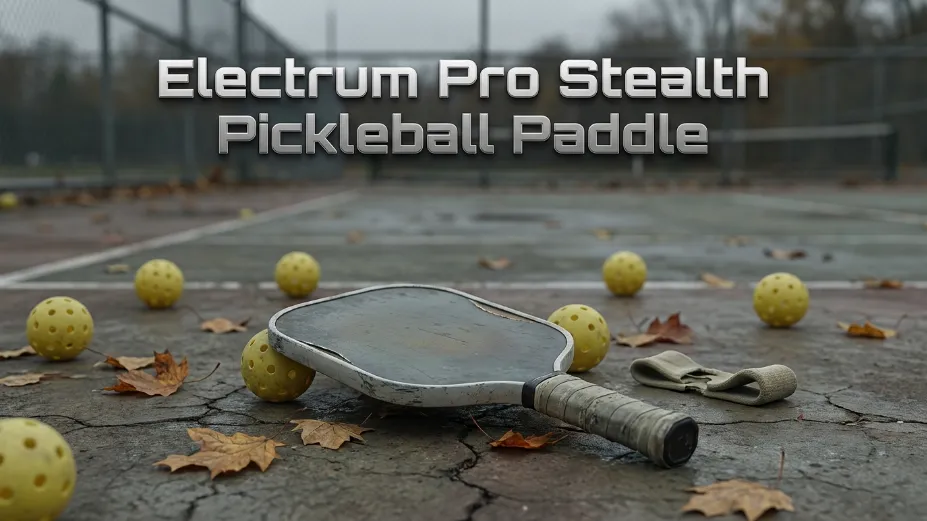
The pickleball court doesn’t care about marketing hype; it only responds to spin, reset control, and raw power. If you have noticed top-tier players transitions from standard carbon fiber to a darker, more menacing texture at your local courts, you are likely looking at the electrum pro stealth pickleball paddle. This isn’t just another product refresh—it is an engineered attempt to solve the sport’s ultimate paradox: delivering crushing power without sacrificing the delicate touch needed for the perfect third-shot drop.
Electrum Pickleball Paddle Series
Core & Face · Weight · Control/Power · Price · Rating
If you want to maximize your hand speed up close, the widebody electrum pro stealth pickleball paddle is the best in-stock option available directly from the Electrum Pickleball Official Website. For players who prefer an extended reach or a thicker core for control, the currently sold-out Pro II Stealth and Model E Stealth models are highly sought-after, making the active used pickleball paddles market your most viable acquisition route.
The Mechanical Paradox: Investigating the “Zero Pop” and “Wooden” Feel
A common complaint circulating within the competitive community regarding the 12mm Stealth series is a dead, rigid response off the face, with players frequently stating the paddle has “zero pop” or feels like a rigid wooden pickleball paddle. To understand this phenomenon, we must look directly at the paddle’s core metrics outlined in the official electrum pro stealth pickleball paddle specs.
The core uses a highly compressed, 12mm condensed polymer honeycomb layout. Unlike thicker 16mm models that allow the ball to sink deep into the core to absorb kinetic energy and spring back, a ultra-thin 12mm core provides practically zero dwell time. The ball makes instantaneous contact with the stiff carbon face and immediately bounces off without any localized elastic deformation from the core. Without core compression, passive blocks or short stroke paths cause the ball to die instantly, often dropping straight into the net at your feet.
This means players must adjust their mechanical swing paths. To generate baseline depth or push opponents back, you cannot rely on the paddle to do the work; you must commit to a full, accelerated swing. While this thin profile accelerates your hand speed during rapid kitchen exchanges, it demands precise physical input on every single shot to maintain depth.
Torsional Instability & Customization: Optimizing Twist Weight on Edgeless Frames
The defining aesthetic feature of this series is its fully edgeless unibody profile. To protect the raw honeycomb from lateral impact, Electrum developed its specialized FoamFit technology, injecting dense polymer foam around the perimeter, reinforced with carbon strip edges. However, removing the traditional plastic bumper guard to create edgeless pickleball paddles creates a serious secondary engineering issue: torsional instability.
Because the stock weight of the wide-body Pro Stealth is exceptionally light (starting at a mere 7.2 ounces), it suffers from a very low twist weight. When a high-velocity ball strikes the face outside of the precise center sweet spot, the paddle naturally twists in the player’s hand. This instability can be neutralized using aftermarket lead or tungsten adhesive tape. However, because there is no outer plastic bumper to protect applied weights from court scrapes, customization must be applied carefully:
- The 3 and 9 O’Clock Positions (Lateral Midpoints): Applying 3 to 5 grams of tape on the side walls dramatically raises the twist weight, expanding the sweet spot and preventing the paddle from rotating during off-center kitchen dinks. This is highly recommended to make these thin cores feel as forgiving as premium thermoformed pickleball paddles.
- The 4 and 8 O’Clock Positions (Lower Corners): Placing weight on the lower corners adds moderate stability and solidifies your defense against aggressive drives without slowing your hands down up close.
- Protection Protocol: Because edgeless frames scrape directly against the court, always cover your lead tape with a layer of high-durability polymer edge guard tape to prevent the weighted strips from tearing or peeling away.
Surface Tribology: Why Raw Carbon Fiber “Loses” Spin (And How to Fix It)
Electrum pioneered the industry’s very first carbon fiber pickleball paddle back in 2018, changing the landscape of spin dynamics. But a persistent myth highlighted in many electrum pro stealth pickleball paddle reviews is that the carbon surface permanently wears flat after just a few weeks of consistent match play.
This is a fundamental misunderstanding of surface physics. The texture on these paddles is woven directly into the Toray T700 raw carbon face—it is not a painted-on grit that simply flakes off. The drop in spin is rarely caused by the raw fiber wearing flat; instead, the microscopic grooves of the raw carbon weave are getting clogged with plastic residue sheared directly off the soft outer skin of plastic pickleballs during high-velocity topspin shots.
To restore your spin back to tournament-grade levels, you must implement a simple cleaning protocol. Gently wiping down the face with a damp microfiber cloth after your sessions helps prevent light residue from drying. For heavy buildup, using a dedicated raw carbon rubber eraser block pulls the deep-set plastic debris out of the weave, instantly bringing your RPMs back to their original maximum potential.
Graphene Legal Disputes and the Materials Pivot
An overlooked chapter in Electrum’s history that shaped their material design occurred on June 23, 2023. Electrum published a formal legal notification stating they had been informed that Head Sport GmbH owned patented technology regarding the use of graphene within sports equipment, including rackets and paddles. Consequently, Electrum was forced to permanently stop offering any paddles incorporating graphene composites.
This sudden shift forced their research and development team to immediately abandon graphene-infused fibers. Because graphene is historically prized for its unmatched strength-to-weight ratio, its forced removal meant the brand had to rely on denser polymer composites and thicker raw carbon layers to maintain structural stiffness. This material change directly contributed to the changing, highly rigid face feel noticed by players transitioning to the modern Stealth models.
Direct Purchase Risks vs. Smart Secondary Market Calibration
For players trying to secure an electrum pro stealth pickleball paddle used or new, where you buy is just as important as how you play. A major point of frustration echoed across online forums is the severe decline in Electrum’s direct-to-consumer fulfillment and customer service. Since late 2024, many buyers purchasing directly from their site reported shipping labels printed with zero movement for weeks, along with completely unresponsive support channels regarding returns or their advertised 21-day trial guarantee. To avoid these issues, we strongly advise buying only through major authorized third-party retail channels or verified secondary marketplaces.
If you are exploring the used market to secure a model at an attractive electrum pro stealth pickleball paddle price (typically dropping from the $199.99 RRP down to $71.00 – $99.00 on auction sites), you must perform a strict structural inspection before stepping on court:
- The Acoustic Bounce Test: Core crushing occurs when the inner polypropylene walls collapse or pull away from the outer carbon sheets due to impact fatigue. To check for this, bounce a ball across different sections of the face. A healthy core produces a crisp, consistent pop; a crushed core will emit a dull, hollow, or rattling “knocking” sound, and the ball will die immediately.
- Perimeter Shear Inspection: Carefully examine the outer raw edges for micro-cracks or areas where the face plates have begun to split or delaminate due to ground contact.
When compared to other elite market offerings, a healthy Stealth paddle remains a formidable weapon. For a broader overview of how raw carbon stack heights compare to other premium models, exploring our definitive guide to the top pickleball paddles will give you the complete technical background needed to make an informed choice.
Frequently Asked Questions (FAQ)
Is the Electrum Pro Stealth USAPA Approved?
Yes, the paddle meets all technical standards for sanctioned tournament play. However, because of the brand’s current inventory and operational challenges, always verify that your specific serial number remains listed on the active USAPA approved paddle database before playing in regional tournaments.
How can I protect my edgeless paddle from scraping on hard outdoor courts?
Since edgeless paddles lack a thick plastic bumper, applying a specialized, thick protective edge guard tape along the upper perimeter is highly recommended to absorb friction during low defensive dinks and prevent structural splitting.
Should I choose the 12mm Pro Stealth or the 16mm Model E Stealth?
If your game is built on lightning-fast hand speed and aggressive baseline drives, the thin 12mm Pro Stealth is the ideal choice. If you prioritize soft dink control, third-shot drops, and maximum vibration dampening for your elbow, the thicker 16mm Model E Stealth is the superior alternative.