
What is Rally Pickleball?
If you have spent any time on the courts lately, you have probably noticed that the language of the game is shifting. We aren’t just talking about new paddle tech or the latest carbon fiber surfaces. We are talking about the fundamental way we count to 11 (or 15, or 21). For years, the rhythm of “side-out” scoring was the heartbeat of the sport. But recently, a faster, more TV-friendly, and frankly, more intense format has taken center stage: rally pickleball.
It started in the pros, specifically with Major League Pickleball (MLP), but it is trickling down to local leagues and recreational play at lightning speed. Suddenly, you don’t just lose the serve when you make a mistake; you lose a point. The stakes are higher, the games are faster, and the confusion—let’s be honest—is real.
Whether you are preparing for a tournament in rally pickleball charlotte or just trying to convince your Saturday morning crew to try something new, understanding this system is crucial. It changes everything from your serve selection to your third-shot drop strategy. So, let’s leave the “1-1-2” confusion behind and dive into the high-octane world of rally scoring in pickleball.
The “Freeze” Rule & Endgame Scenarios
This is the big one. This is the moment in the match where everyone stops, looks at the referee (or the most confident person on the court), and asks, “Wait, are we frozen?” It is easily the #1 source of confusion for players transitioning to this format. The “Freeze” is a unique mechanic designed to prevent a team from winning purely on the opponent’s unforced errors, ensuring the winning point is earned on an offensive serve.
Does the ‘Freeze’ apply to both teams simultaneously, or only the team at game point?
This is the most common misconception. Players often assume that once the “Freeze” is activated, the entire game reverts to side-out scoring for everyone. That is not the case.
Here is how it actually works: The freeze usually applies only to the team that has reached the designated threshold (usually match point or a set number like 20). If Team A reaches 20 points (in a game to 21), they are “frozen.” This means Team A can only score their final point while they are serving. If they win a rally while receiving, they simply get the ball back—they don’t get the point.
However—and this is critical—Team B, who might be trailing at 16 points, is not frozen. Every time Team B wins a rally, they get a point, regardless of whether they are serving or receiving. They can continue to rally pickleball score their way back into the game until they also hit the freeze threshold.
What happens if the score is tied at the freeze point (e.g., 20-20)? Are both teams frozen?
This is the classic nail-biter scenario. If Team B fights all the way back and ties the game at 20-20, both teams have now crossed the threshold. In this specific edge case, both teams are frozen.
This effectively turns the end of the match into “sudden death” traditional scoring. To win, you must have the serve, and you must win the rally. If the score goes to 20-20, the receiving team essentially plays defense to get the ball back, knowing that winning the rally won’t end the game immediately. It creates incredibly tense, long exchanges because the “easy point” mechanic is turned off for both sides.
Why do some formats freeze at 20 and others at 18?
If you play in different leagues, you might notice the rules shifting under your feet. Major League Pickleball generally plays to 21 with a freeze at 20. However, some local tournaments or club ladders freeze at 18.
The difference usually comes down to time management and skill level. A freeze at 18 allows for a slightly longer “earned” endgame, reducing the variance of luck. It forces the leading team to execute high-quality serves and third shots for a longer stretch to close out the match. In contrast, freezing at 20 (game point) keeps the fast-paced nature of pickleball rally scoring alive for as long as possible, which is great for keeping tournament schedules on track.
Is it statistically harder to make a comeback under the freeze rule compared to traditional scoring?
This is a deep strategic debate. On the surface, rally scoring seems faster, which might suggest comebacks are harder because the game whizzes by. However, the freeze rule is a massive equalizer. Because the leading team is forced to switch gears back to traditional scoring to close it out, while the trailing team gets “free” points on side-outs, the pressure shifts heavily to the leaders.
We often see “choking” scenarios where a team leads 20-14, hits the freeze, and suddenly tightens up. meanwhile, the trailing team, playing loose with nothing to lose, racks up rally points quickly. So, while the game is faster, the finish favors a gritty team that refuses to give up.
Serving Mechanics & Rotation Logic
Forget “Server 1, Server 2.” Forget “Side Out.” Practical “how-to” questions arise immediately when players step on the court for a rally game. The physical movement—or lack thereof—is the biggest adjustment.
If we don’t switch sides, how do we determine who serves?
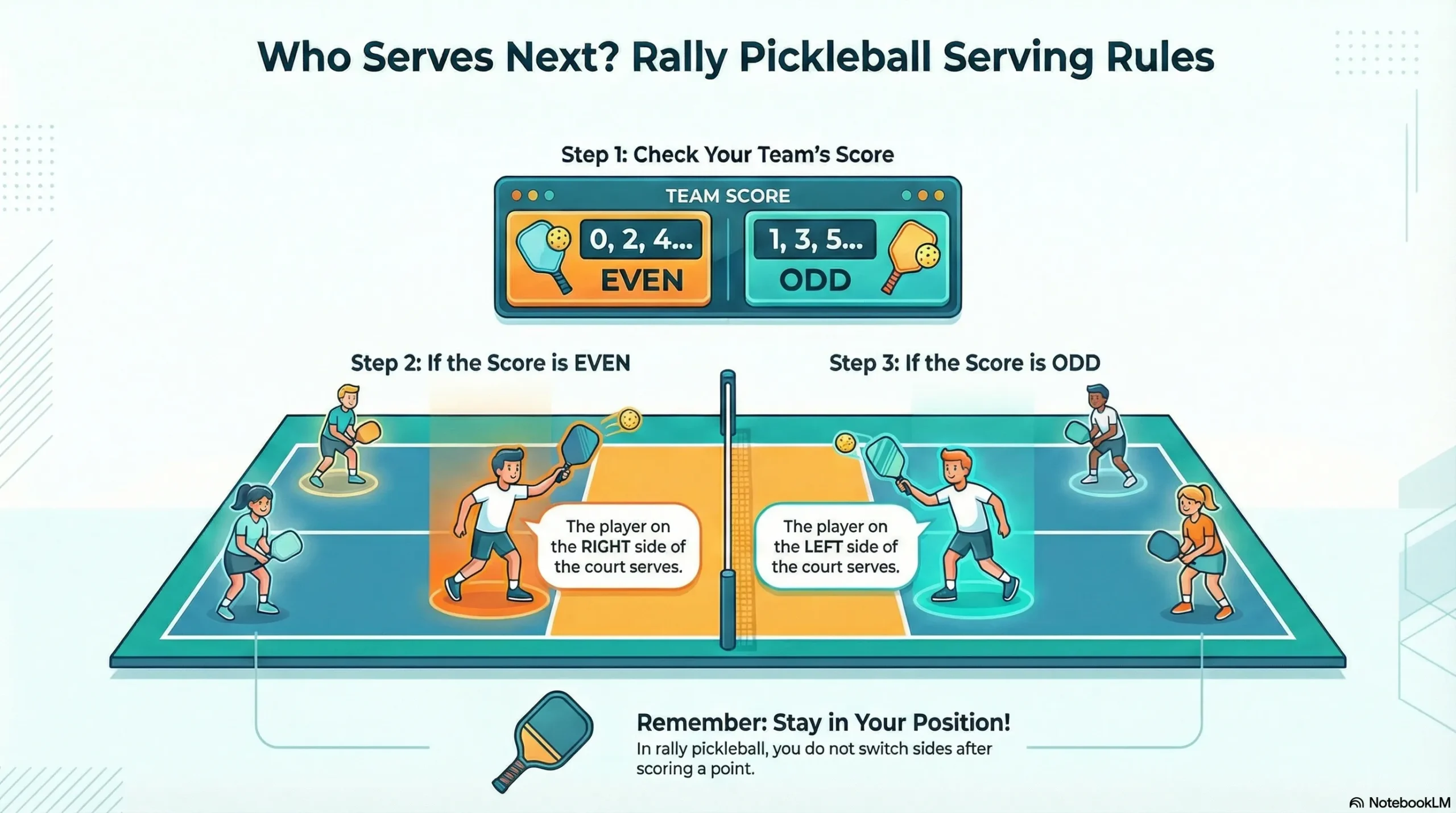
In traditional pickleball, you switch left and right sides with your partner every time you score a point. In rally pickleball, you generally stay put. You pick a side (Left or Right) at the start of the game, and you live there. This is often called “fixed” positioning.
So, who serves? It comes down to basic math. The score dictates the server, not your physical position.
- Even Score (0, 2, 4, 6…): The player on the Right side serves.
- Odd Score (1, 3, 5, 7…): The player on the Left side serves.
It sounds simple, but in the heat of battle, it can be disorienting. You might win a point, the score becomes 5-4, and you have to remember: “Okay, our score is 5, that’s odd, so my partner on the left serves.” You don’t switch sides; you just toss the ball to the correct person.
Can my partner never serve in a whole game if we only score on my serves?
This is a valid fear and a mathematical quirk of the system. In traditional scoring, the “Side Out” ensures the serve eventually transfers to the other player. In rally scoring, if your team gets stuck in a specific scoring loop, one player might dominate the serving duties.
For example, if the player on the Right serves at 0-0 and wins the point, the score is 1-0. The serve now goes to the Left player. If they lose the rally, the other team serves. If you win the ball back, and the score is still odd (1-something), the Left player serves again. It is theoretically possible for one player to take the vast majority of serves if the team only wins points when the score transitions from Even to Odd.
Do we switch sides at the halfway point (end change) like in traditional sets? If so, do our serving positions reset?
In tournaments, fairness is key, so teams usually switch ends of the court when one team reaches 11 points (in a game to 21). This accounts for wind, sun, or court slope.
Here is where it gets tricky: When you walk to the other side of the net, do you stay in your fixed positions? Yes. If you were the Right-side player on the North end, you are the Right-side player on the South end. You maintain your “fixed” role relative to the court, ensuring the matchups (forehand vs. backhand) remain consistent throughout the game.
Advanced Strategy (Stacking & Positioning)
Once you get past the math, you realize that the strategy of rally scoring in pickleball is fundamentally different. It changes how you approach risk.
Is ‘stacking’ essentially useless in rally scoring since we don’t switch sides on points?
Actually, “stacking” becomes much easier, but the term changes slightly. In traditional play, stacking involves complicated hand signals and switching sides while the ball is in the air to keep your strongest forehand in the middle. It requires “unwinding” the stack when you lose the point.
In rally scoring with fixed positioning, you don’t need to “stack” and “unstack.” You simply choose your permanent spots at the beginning of the game. If you want your lefty partner on the right side, they just stand there. Forever. You never have to rush across the court after a serve. This simplifies the mental load significantly, allowing teams to focus purely on shot execution rather than positioning logistics.
Does rally scoring change the ‘Third Shot Drop’ strategy?
This is where the rubber meets the road. In traditional scoring, if the serving team misses a third shot drop into the net, it’s just a side-out. No points lost. It encourages trying high-risk, perfect drops.
In rally pickleball, hitting the net on a third shot costs you a literal point. Your opponent’s score goes up. This creates a fascinating shift in risk management. Many pros and advanced players argue that rally scoring rewards a slightly more conservative, “drive-heavy” or “high-margin drop” game. You can’t afford to give away cheap points. You might see fewer feather-touch drops that skim the tape and more aggressive drives intended to force a volley, simply because the penalty for a missed drop is immediate scoreboard damage.
How do we handle ‘momentum timeouts’ differently in rally scoring?
In traditional scoring, a game can stall at 4-4 for ten minutes. In rally scoring, the scoreboard never stops moving. Points are accumulated twice as fast. This means momentum swings happen in the blink of an eye. You can go from leading 5-2 to trailing 5-8 in two minutes.
Timeouts become a critical weapon. You cannot wait for a “bad run” of 5 points to call time; by then, the game is half over. Smart coaches and players in leagues like the rally house pickleball club circuits utilize timeouts much earlier—often after just 2 or 3 consecutive points lost—to break the rhythm before the game slips away entirely.
Niche Rule Pitfalls & Faults
Even seasoned players get tripped up on technicalities. Here are the questions that usually only come up during disputes or after a few beverages at a social mixer.
What is the penalty for serving from the wrong side (e.g., serving from Left when the score is Even)?
In traditional play, serving from the wrong side is a fault, and you lose the serve. In rally scoring, because players don’t physically switch, this is a common mental error. You forget the score, think it’s odd, and the Left player serves.
Most official rulebooks state that if the wrong player serves and the error is discovered after the rally, the point stands (to keep the game moving). However, if it is caught before the return of serve is hit, the rally is replayed with the correct server. It is less punitive than traditional rules because the confusion is understandable, but chronic offenders will definitely get called out.
If I win a point on a let serve (in rec play), does it count as a rally point?
Official rules have largely abolished the “let” serve (where the ball hits the net and lands in), but in recreational play, many people still play “lets.” If you are playing a casual rally game, you need to clarify this upfront.
If you are playing strict rally rules, a serve that hits the net and lands in is a live ball. If the receiver stops playing because they expected a “let,” they lose the point. Because every rally counts for a point, stopping play for a “do-over” is highly discouraged unless there is actual interference (like a ball rolling onto the court).
Does the ‘Two-Bounce Rule’ disadvantage the serving team more in rally scoring?
This is a subtle but profound realization. The Two-Bounce Rule (serving team must let the return bounce) puts the servers at a tactical disadvantage to start the point. In traditional scoring, if you lose the point while serving, you don’t lose score; you just lose the opportunity to score.
In rally scoring, the serving team is starting every point in a defensive posture and risking a point on the scoreboard. This shifts the statistical advantage heavily toward the receiving team. If you are receiving, you are in the driver’s seat to score. This is why the “Freeze” rule exists—to force the leading team to overcome that disadvantage to win the game.
Experience the Vibe: The Rise of Rally Venues
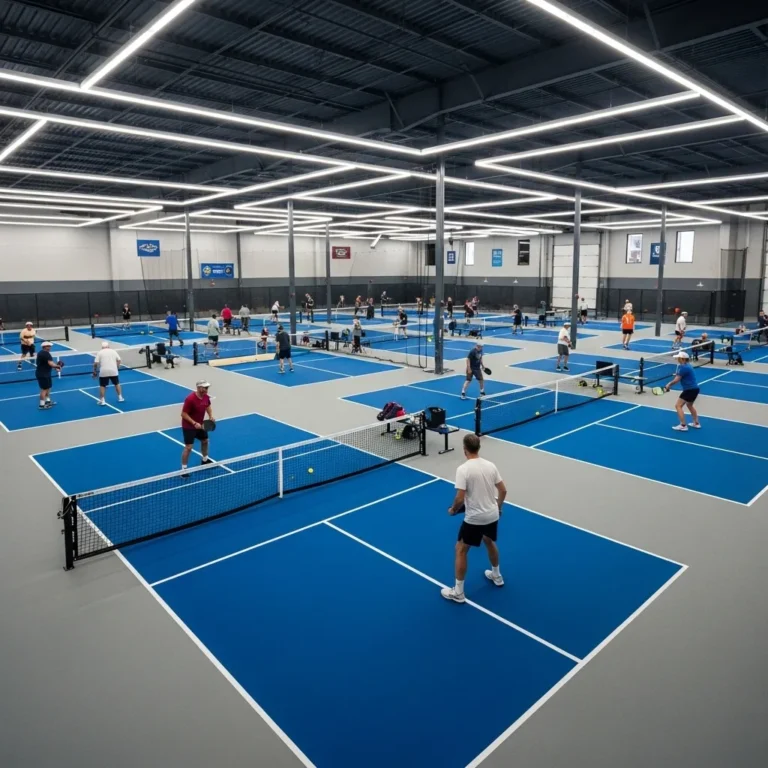
It’s impossible to talk about this scoring format without mentioning the venues that are popularizing it. We are seeing a massive surge in “eatertainment” pickleball complexes. Places like rally pickleball charlotte are redefining what it means to go to the courts. These aren’t just concrete slabs in a public park; they are full-service social hubs with craft cocktails, coffee bars, and dedicated event coordinators.
In these environments, rally scoring is often the default for social events. Why? Because it keeps reservations on time. If you book a court for an hour at a place like rally house pickleball club, you want to get in as many games as possible. Traditional scoring games can drag on for 45 minutes if the defense is good. Rally games have a predictable duration (usually 15-20 minutes), ensuring everyone gets a turn and the group rotates efficiently. It aligns perfectly with the social, fast-paced nature of the modern pickleball scene.
Recommended Reading

Top Pickleball Gifts 2025:From Stocking Stuffers to Pro Gear
Looking for unique pickleball gifts? We break down practical gear, funny apparel, and budget-friendly ideas to help you surprise the player in your life.
Final Thoughts
Change is scary. When you have spent years yelling “Side Out!” it feels almost sacrilegious to award a point when the server hits the net. But rally pickleball isn’t just a gimmick; it is a legitimate evolution of the sport that rewards consistency, aggression, and mental toughness. It eliminates the downtime and turns every single ball strike into a pivotal moment.
Whether you are a purist who loves the grind of traditional scoring or a newcomer looking for the adrenaline rush of the rally format, give it a try. Head to your local courts, maybe suggest a “Rally Tuesday” to your group, or check out a dedicated spot if you’re ever near rally pickleball charlotte. Just remember: when the score is 20-20, don’t forget to breathe. The next swing wins it all.
you may like it