Imagine this scenario: It’s match point. You see a high ball floating over the net, you step forward, smash a perfect winner, and throw your hands up in victory. But instead of cheering, your opponent points at your feet and yells, “Foot fault!” You stepped on the line. Point lost. Game over.
There is nothing more frustrating in this sport than losing a point because you didn’t fully understand the pickleball kitchen rules. The Non-Volley Zone (NVZ), affectionately known as “the kitchen,” is the most misunderstood area of the court. It is the source of the most arguments among beginners and the most strategic depth for pros.
Whether you are just learning how to play pickleball or looking to refine your tournament strategy, mastering these rules is non-negotiable. In this comprehensive guide, we will break down exactly what you can and cannot do in the kitchen, debunk common myths, and explain the tricky “momentum” rules that catch everyone off guard.
The Golden Rule: No Volleys in the Kitchen
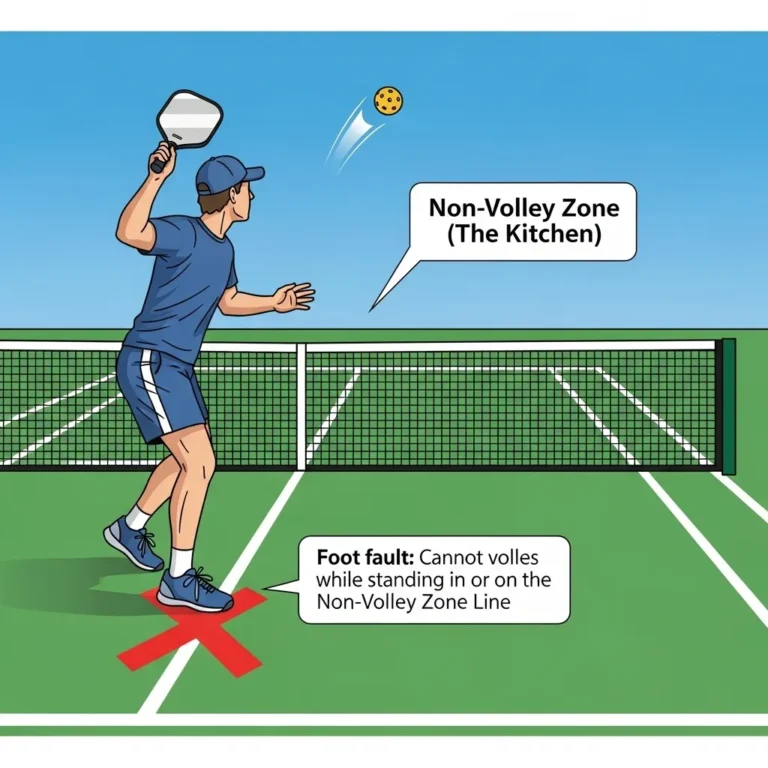
The fundamental kitchen rule in pickleball is simple in theory but complex in execution: You cannot volley the ball while standing in the Non-Volley Zone.
To clarify, a “volley” means hitting the ball out of the air before it bounces. If you are standing inside the 7-foot kitchen zone, or even if your toe is touching the kitchen line, you must let the ball bounce before you hit it. This rule exists to prevent players from standing right at the net and smashing every ball that comes their way. It forces players back, extending rallies and making the game more strategic rather than just a contest of power.
If you are looking to understand the exact layout of this zone, check out our guide on pickleball court dimensions.
Myth vs. Reality: When Can You Enter the Kitchen?
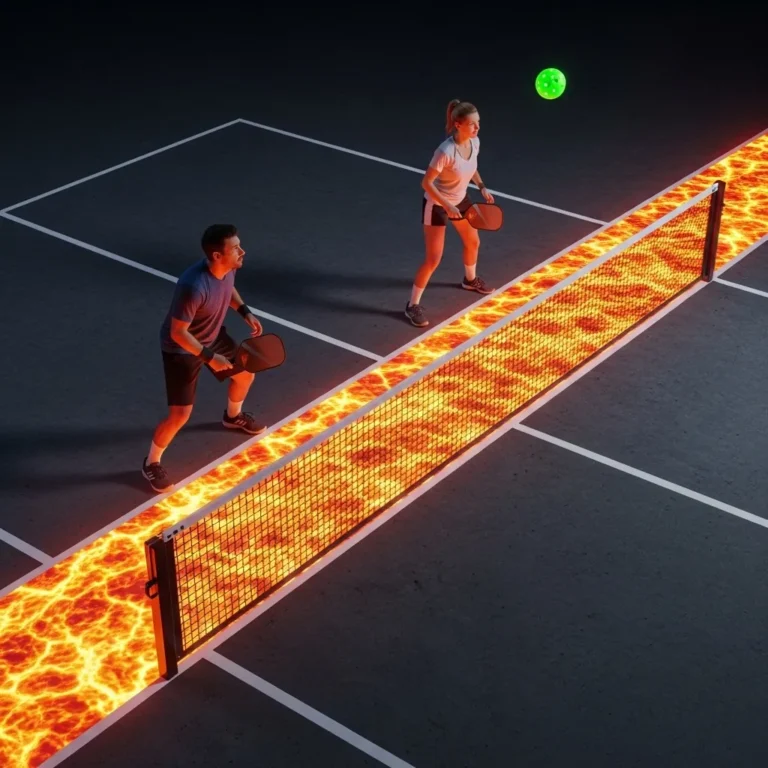
One of the biggest misconceptions among new players is that the kitchen is “lava”—a forbidden zone that you can never enter. This is completely false. The kitchen rules in pickleball only restrict volleys.
The Ground Stroke Exception
You can enter the kitchen at any time, as long as you do not volley the ball. In fact, if your opponent hits a short shot (a dink) that lands inside your kitchen, you must step into the kitchen to return it. Once the ball bounces, the Non-Volley Zone becomes just like any other part of the court.
Mastering the soft game is crucial here. If you want to improve your play at the net, read our guide on the pickleball dink.
Is the Line Part of the Kitchen?
Yes. The pickleball rules kitchen guidelines state that the kitchen line is part of the Non-Volley Zone. If you hit a volley while your toe, heel, or even the edge of your shoe is touching the line, it is a fault. It does not matter if 99% of your foot is outside the line; if you touch it, you are in the kitchen.
The “Momentum” Rule: Where Most Players Fail
This is where the kitchen rules pickleball players struggle with the most. It is not just about where you are standing when you hit the ball; it is about where your momentum takes you after you hit the ball.
According to the official rules, if you hit a volley while standing outside the kitchen, but your momentum causes you to stumble forward and step into the kitchen (or touch the line) after the shot, it is a fault. This applies even if:
- You hit a winner and the point is technically “over” before you land.
- You regain your balance for a second but eventually fall in.
- You drop your paddle or hat into the kitchen zone.
Speaking of equipment, ensuring you have a grip that prevents your paddle from flying out of your hand is essential. Check out our recommendations for best beginner pickleball paddles to ensure you have gear that stays in your hand, not on the kitchen floor.
For a deep dive into the specific wording, you can reference the official USA Pickleball Rulebook.
Re-Establishing Position: How to “Reset” Your Feet
What happens if you step into the kitchen to hit a dink, and the next ball comes at you fast? Can you volley it?
Not immediately. To legally hit a volley after being in the kitchen, you must “re-establish” your feet. This means both of your feet must touch the court surface outside the kitchen line before you make contact with the ball.
The “Levitation” Myth: You cannot jump backwards from inside the kitchen and hit a volley while you are in the air. Even if you are not touching the ground when you hit the ball, the rules consider you to be “in the kitchen” until you land outside. This is a common fault in pickleball doubles strategy where the action at the net is fast-paced.
Advanced Kitchen Mechanics: The Air Plane & The Erne
Once you understand the basics, you can start using the geometry of the court to your advantage.
The Air Space Rule
The kitchen is a two-dimensional zone—it only exists on the ground. The air space above the kitchen is fair game. You are allowed to reach your paddle over the kitchen line to hit a volley, provided your feet are safely behind the line and your momentum doesn’t carry you in. This allows you to cut off angles and put pressure on your opponents.
The Erne Shot
Named after Erne Perry, this is an advanced move where a player jumps over the corner of the kitchen (or runs around the side of the court) to smash a ball sitting near the net. It is legal because the player never touches the kitchen zone itself, landing out of bounds or on the sideline. It requires athleticism and precise knowledge of pickleball terms and court positioning.
Frequently Asked Questions (FAQ)
Q: Can I enter the kitchen in pickleball at any time?
A: Yes, you can enter the kitchen at any time, provided you do not hit a volley (hit the ball out of the air). You can stand there as long as you like, though strategically, it leaves you vulnerable to a smash at your feet.
Q: Do I have to wait for the ball to bounce before stepping into the kitchen?
A: No. You can step into the kitchen before the ball bounces if you anticipate a short shot (dink). You just cannot hit the ball until after it has bounced.
Q: Can I reach over the kitchen line to hit a volley?
A: Yes. The “kitchen” refers to the ground, not the air space above it. You can reach over the line to volley a ball, as long as your feet are behind the line and you do not step in afterward.
Q: If I hit a volley winner and then fall into the kitchen, is it a fault?
A: Yes. The pickleball kitchen rules regarding momentum state that if your momentum causes you to touch the NVZ (including the line) after a volley, it is a fault—even if the ball is already dead.
Q: Can my partner grab me to stop me from falling into the kitchen?
A: Yes! It is perfectly legal for your partner to grab your shirt or belt to prevent you from falling into the kitchen after a volley, as long as your partner is also standing outside the zone.
Q: Do both feet need to be outside the kitchen to hit a volley?
A: Yes. You cannot have one foot in and one foot out. Both feet must be established outside the Non-Volley Zone line before you initiate a volley.
Q: What happens if my hat or sunglasses fall into the kitchen during a volley?
A: It is a fault. Any object that is part of the player’s equipment (paddle, hat, glasses, keys) that falls into the kitchen during the act of volleying results in a lost point.
Conclusion
The kitchen is what makes pickleball unique. It neutralizes raw power and rewards patience, touch, and strategy. By understanding the nuances of the pickleball kitchen rules, you stop giving away free points and start commanding the net with confidence.
Remember: Respect the line, watch your momentum, and don’t be afraid to step in when the ball bounces. Now that you have mastered the NVZ, it is time to brush up on the rest of the game. Check out our complete guide on general pickleball rules to ensure your game is airtight from baseline to kitchen.