pickleball court dimensions
If you’ve walked past a local park recently and heard that distinct pop-pop-pop sound, you know exactly what’s happening. Pickleball has absolutely exploded in popularity, hasn’t it? It feels like overnight, everyone from your next-door neighbor to your grandmother—and even professional athletes—has picked up a paddle. It’s fast, it’s social, and honestly, it’s just plain fun.
But maybe you’re looking to take that obsession a step further. You’re thinking about painting lines on your driveway, converting an old tennis court, or perhaps you’re part of a committee planning a new community recreation center. Suddenly, the fun turns into a geometry problem. You need numbers. You need precision. You need to know exactly how much asphalt or concrete you’re dealing with.
Getting the pickleball court dimensions right is the difference between a game that feels professional and satisfying, and one where you’re constantly tripping over a fence or arguing about whether a ball was truly “out.” While the court looks deceptively simple—often compared to a smaller tennis court or a badminton setup—the measurements are specific, and they matter.
Let’s walk through everything you need to know about sizing up your court. We aren’t just going to throw a spec sheet at you; we’re going to look at why these numbers exist and how to make them work for your specific space. Whether you are grabbing a roll of tape for a weekend DIY project or hiring a contractor for a permanent installation, here is your ultimate guide.
Standard Official Dimensions ( The Basics)
When we talk about the playing area, we are talking about the rectangle where the magic happens. The beauty of pickleball lies in its compact nature. It doesn’t demand the sprawling acreage of a tennis court, which is a huge reason why it’s popping up in cul-de-sacs and backyards everywhere.
What are the official standard dimensions of a pickleball court?
dimensions of pickleball court: Let’s start with the golden numbers. According to USA Pickleball and the international governing bodies, a standard pickleball court measures 20 feet wide by 44 feet long.
To visualize this, imagine a rectangle that encompasses both the service courts and the non-volley zone (the Kitchen) on both sides of the net. That 20×44-foot footprint is the “in-bounds” area. If the ball lands on the line of this rectangle, it’s in. If it lands a millimeter outside, you’ve lost the point.
These dimensions remain constant regardless of the skill level. Whether you are watching the pros battle it out on championship Sunday or watching six-year-olds learn to hit the ball, the court size is identical. This standardization is great because it means the muscle memory you develop playing in your driveway translates perfectly to a tournament court.
Are pickleball court dimensions the same for both singles and doubles play?
If you come from a tennis background, you might be expecting those extra “doubles alleys” on the sides of the court. In tennis, the court gets wider when you add a second player.
In pickleball, however, that is not the case.
The court dimensions remain exactly the same—20 feet by 44 feet—whether you are playing singles (one-on-one) or doubles (two-on-two). There are no alleys to worry about. This is a fascinating aspect of the sport because it changes the strategy significantly.
In singles, covering that 20-foot width by yourself is a cardio workout; it’s a game of angles and endurance. In doubles, that same 20 feet feels much tighter. You and your partner have to move in sync, almost tethered together, to cover the gaps without getting in each other’s way. The fact that the court size doesn’t change simplifies construction significantly; you don’t need to paint two different sets of sidelines. One rectangle rules them all.
How do indoor pickleball court dimensions compare to outdoor courts?
Technically speaking, the playing lines are identical. An indoor court is 20×44 feet, just like an outdoor court. The ball doesn’t know if there is a roof over it or not.
However, the “feel” and the surrounding requirements can differ. When you are building or marking an indoor court—say, in a gymnasium or a converted warehouse—you have to consider vertical space. While the floor dimensions are the same, outdoor courts have the luxury of the sky. Indoors, you need to worry about the ceiling.
A good indoor court needs a clear height of at least 18 to 20 feet. Why? Because of the lob. If you are playing a competitive game and someone throws up a high defensive lob, you don’t want the point to end because the ball hit a basketball hoop or a light fixture.
Also, indoor courts often use different surface materials. While outdoor courts are usually concrete or asphalt with an acrylic coating, indoor courts might be wood (gym floors) or specialized rubberized sports mats. While this doesn’t change the 20×44 dimension, it changes the speed of the ball. But as far as your tape measure is concerned, the length and width remain the standard official size.
Internal Court Lines & Zones
Now that we have the perimeter defined, let’s zoom in. The internal lines of a pickleball court are what give the game its unique character. It isn’t just back-and-forth hitting; there are zones that dictate where you can stand and what you can do.
What are the exact dimensions of the Non-Volley Zone (The Kitchen)?
This is the most famous part of the court. If you know one thing about pickleball, you know about “The Kitchen.” Officially known as the Non-Volley Zone (NVZ), this area is the heartbeat of the game.
The Kitchen extends 7 feet from the net on both sides and runs the full 20-foot width of the court.
This 7-foot zone is a “no-fly zone” for volleys. You cannot step inside this line (or even touch the line) and hit the ball out of the air. You have to let it bounce first. This rule was invented to prevent players from smashing the ball right at the net, which would make the game nearly impossible to return and frankly, a bit dangerous.
So, when you are measuring your court, you measure 7 feet back from the net and draw a line parallel to the net. That line is the Non-Volley Zone Line. The remaining area on each side (from the Kitchen line to the baseline) is the service court, which measures 15 feet long. So, the math checks out: 7 feet (Kitchen) + 15 feet (Service Court) = 22 feet (one side). Multiply by two sides, and you get your 44-foot length.
What is the standard height of a pickleball net at the posts versus the center?
A sagging net can ruin a game, but a net that is too tight is just as bad. You want that perfect curve.
The official height of a pickleball net is 36 inches (3 feet) at the sidelines (the posts) and 34 inches at the center of the court.
This 2-inch drop creates a slight “smile” shape. It encourages players to hit toward the middle of the court where the net is lower, which keeps rallies going longer. If you are setting up a portable net, they usually come with a center strap or a rod to ensure that middle height sits perfectly at 34 inches. If you are building a permanent court, setting your posts at the right width (usually 22 feet apart, one foot outside each sideline) is crucial to maintaining this tension and height.
How wide are the lines on a pickleball court supposed to be?
When you are painting your court, you might be tempted to use whatever brush you have lying around. But for the sake of visibility and fairness, line width matters.
Standard pickleball lines should be 2 inches wide.
This width is substantial enough to be seen clearly during fast-paced play but not so wide that it distorts the court dimensions. The color should contrast sharply with the court surface. If you have a green or blue court, white lines are the standard. If you are taping lines on a light-colored driveway, you might use orange or blue tape.
An important detail for the perfectionists: measurements are taken to the outside of the lines. So, the 20-foot width includes the 2-inch sidelines. The lines are part of the court. If a ball hits that 2-inch white strip, it is considered “in.”
Total Space & Safety Zones (Crucial for Construction)
This is where many DIY court builders make a critical mistake. They measure out the 20×44 rectangle, pour the concrete, and then realize they have nowhere to run. The playing court is just the stage; you need the backstage area, too.
What is the recommended size for the full court enclosure (including out-of-bounds areas)?
If you want a court that feels playable and safe, you cannot stop at the boundary lines. You need “overrun” space.
The recommended total size for a standard court enclosure is 30 feet by 60 feet.
This is the standard usually cited for recreational play. It gives you 5 feet of space on the sides and 8 feet of space behind the baselines.
However, if you want a tournament-quality feel—or if you have players who are athletic and like to run down balls—the preferred dimension is 34 feet by 64 feet. This larger footprint allows for aggressive play. We’ve all seen those incredible “ATP” (Around the Post) shots where a player runs way off the court to curve the ball around the net post. You can’t do that if you hit a fence three feet later.
What is the minimum total square footage required to build a pickleball court?
Let’s do the math on the absolute minimums versus the playing area.
The playing area itself (20′ x 44′) is 880 square feet. That is the bare minimum of asphalt you need just to have a court.
But for the total footprint including safety zones (using the 30′ x 60′ recommendation), you are looking at 1,800 square feet.
If you are going for the pro-level 34′ x 64′ setup, you need 2,176 square feet.
Knowing this total square footage is vital when you are budgeting for materials. Surfacing systems, concrete pouring, and fencing are all calculated by the square foot. Knowing you need roughly 1,800 to 2,200 square feet helps you avoid sticker shock when the contractor gives you a quote.
How much space is needed for the safety run-off zones behind the baselines and sidelines?
Safety is paramount. Pickleball involves sudden stops, backward pedaling, and lateral lunges.
- Sidelines: You ideally want at least 5 feet of clearance on each side. This prevents players from running into fences, benches, or players on the adjacent court.
- Baselines: You need more room here because players often retreat deep to return hard serves or overhead smashes. A minimum of 8 feet is recommended, but 10 feet is luxurious and preferred for higher-level play.
Imagine running backward to return a deep lob, your eyes fixed on the ball. If there is a wall or a fence just 3 feet behind the line, you are going to instinctively hesitate (or crash). That hesitation changes the game. Adequate run-off zones allow players to commit fully to their shots without fear of injury.
Conversions & Comparisons (Tennis & DIY)
This is the most common scenario for new courts: “We have this old space; can we fit pickleball here?” Because pickleball is smaller than other racquet sports, it is incredibly versatile.
How many pickleball courts can fit on a standard tennis court?
This is the classic conversion. Tennis courts are everywhere, but many are underused. Since a standard tennis court is 60 feet wide by 120 feet long (including the run-off areas), you have a massive canvas to work with.
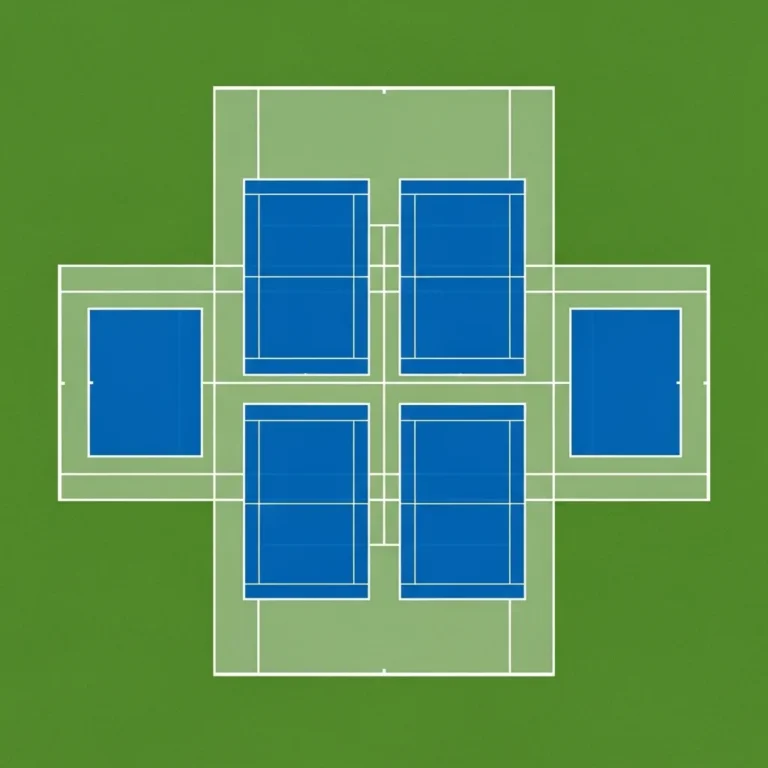
Generally, you can fit four pickleball courts on one standard tennis court.
This is usually done by placing the pickleball courts sideways (perpendicular) to the tennis net direction. You put two pickleball courts on one side of the tennis net, and two on the other. This creates a fantastic “hub” of activity. Instead of two people playing singles tennis, you can have 16 people playing doubles pickleball in the exact same footprint. That is a huge win for community engagement.
If you don’t want to permanently convert the court, you can just paint “shadow lines” (a different color than the tennis lines) so the court can be used for both sports.
What are the main size differences between a pickleball court, a tennis court, and a badminton court?
It helps to compare to understand the scale.
- Tennis Court: The playing area is 36′ x 78′ (for doubles). It’s massive. You really feel the difference in running. A pickleball court fits entirely inside just one half of a tennis court with room to spare.
- Badminton Court: This is the closest relative. A doubles badminton court is 20′ x 44’—exactly the same size as a pickleball court. This isn’t a coincidence; pickleball was invented using an old badminton court. The main difference is the net height (badminton is over 5 feet high) and the internal lines (badminton has different service zones). But the outer footprint is identical.
- Pickleball Court: 20′ x 44′. It sits in that “Goldilocks” zone—small enough to be accessible to all ages, but large enough to require skill and movement.
Can a pickleball court fit on a standard residential driveway?
This is the dream for many homeowners: stepping out the front door and playing a match before dinner.
The answer is: Yes, usually.
A standard two-car driveway is typically about 20 to 24 feet wide. This gives you the exact width for the court lines (20 feet). The length is often the challenge. You need 44 feet for the court plus some run-off.
If your driveway is flat and at least 26-28 feet wide and about 50-55 feet long, you can squeeze in a very playable court. You might have to compromise slightly on the safety zones—maybe you only have 3 feet on the side before you hit the grass—but for casual family fun, it absolutely works. Just grab some sidewalk chalk or temporary tape, measure out your 20×44 box, set up a portable net, and you are good to go.
Conclusion
Understanding pickleball court dimensions is the first step in respecting the game and enjoying it to its fullest. Whether you are an architect designing a city park, a club owner converting tennis courts, or just a dad with a bucket of chalk and a driveway, these numbers are your blueprint for fun.
The magic of 20 by 44 feet is that it creates a confined battlefield where strategy often beats power, and where three generations of a family can play together. So, grab that tape measure, double-check your safety zones, and get those lines down. The court is calling!