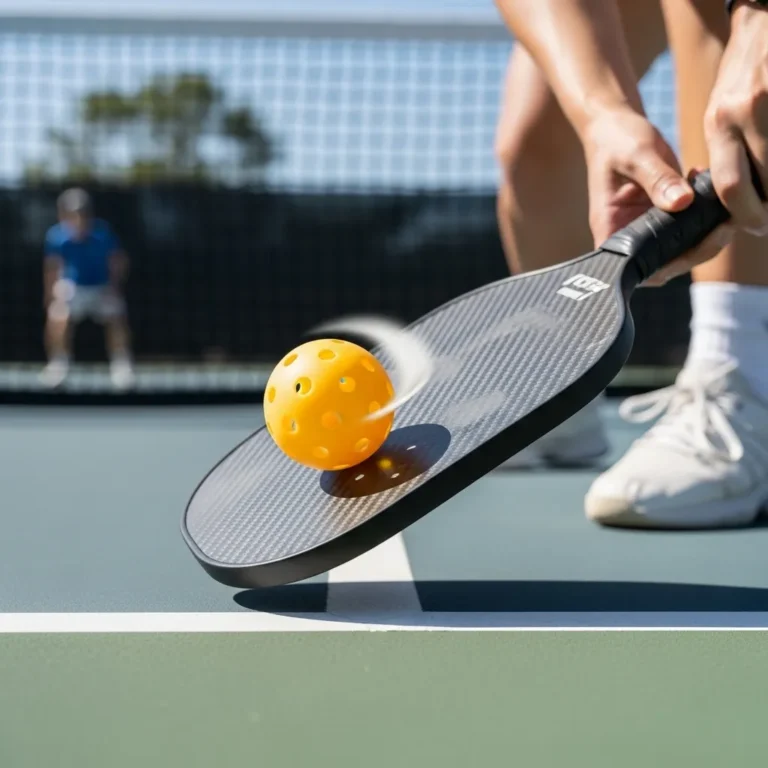
3rd shot pickleball
You’re standing at the baseline. The serve has gone over, and your opponent has just lofted a deep return back to your feet. This is it. This is the moment that separates the beginners from the intermediate players, and the intermediate players from the pros. It’s time to take your shot.
Welcome to the complex, frustrating, yet incredibly rewarding world of 3rd shot pickleball.
If you’ve spent any time on the courts, you’ve probably heard people obsessing over this specific stroke. It’s not just hype. Mastering this transition is the “secret sauce” that unlocks the rest of the game. But don’t worry—we aren’t going to bog you down with textbook definitions or robotic instructions. We’re going to break this down like we’re grabbing a drink after a match, talking through what works, what doesn’t, and how you can level up your game.
Let’s dive in.
The Fundamentals: Understanding the 3rd Shot
Before we start tweaking your grip or your footwork, we need to understand the soul of this shot. Why does everyone talk about it with such reverence?
What exactly is the “3rd shot” in pickleball and why is it considered the most important shot in the game?
To put it simply, the 3rd shot is the bridge between defense and offense. In pickleball, the serving team starts at a disadvantage. You are stuck back at the baseline while the returning team is already rushing up to the Non-Volley Zone (the kitchen) line, ready to smash anything high.
The sequence goes:
- Serve (You)
- Return (Opponent)
- 3rd Shot (You)
This third contact is your ticket to the party. If you mess this up—hitting it into the net or popping it too high—the point is practically over. But if you execute it well, you neutralize the serving team’s disadvantage, allowing you and your partner to move forward. It is the great equalizer. It turns a defensive position into a neutral one, setting the stage for the strategic “dinking” battles we all love.
What is the difference between a 3rd shot “drop” and a 3rd shot “drive”?
Think of these as your two primary weapons.
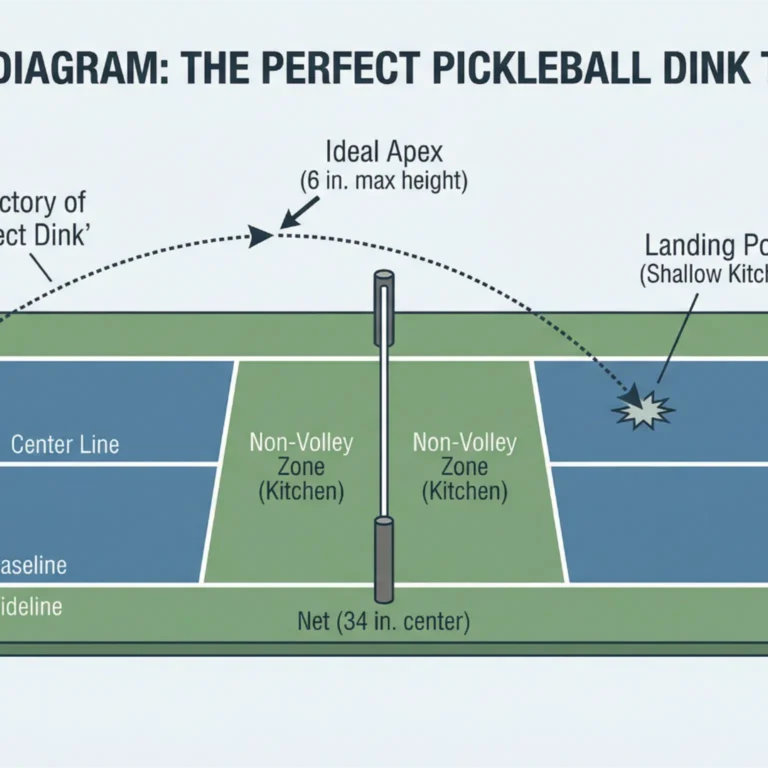
A 3rd shot drop is a soft, arcing shot that lands gently in the opponent’s kitchen. It’s the finesse move. The goal is to make the ball un-attackable. Because it lands in the kitchen, your opponent can’t smash it; they are forced to dink it back, which buys you time to run up to the net.
A 3rd shot drive, on the other hand, is a power move. It’s a hard, flat shot hit low over the net, similar to a tennis groundstroke. You aren’t trying to be gentle here; you’re trying to catch your opponent off guard or jam them so they pop up a weak volley.
Why is the primary goal of the 3rd shot to get to the non-volley zone (kitchen) line?
Pickleball is won at the net. It’s that simple. Statistically, the team that controls the kitchen line wins the vast majority of points. You cannot win consistently from the baseline because your angles are limited, and you have to run much further to retrieve balls.
The primary goal of the 3rd shot isn’t necessarily to hit a winner (though that’s nice if it happens). The goal is to hit a shot that allows you to travel those 15 feet from the baseline to the kitchen line safely. Once you get there, the playing field is level.
Strategic Decision Making: Drop vs. Drive
Now that we know what the shots are, let’s tackle the dilemma that keeps players up at night (and sparks endless debates on Reddit). Do you go soft, or do you bring the heat?
3rd Shot Drop vs. Drive: How do I decide which one to use during a match?
The honest answer? It depends on the vibe of the match and your opponent’s positioning.
However, a good rule of thumb is to treat the drop as your default. It has a higher margin for error in terms of setting up the point. If you drive the ball, it comes back fast, often before you’ve had a chance to take a step forward. If you drop the ball, it travels slowly, giving you precious seconds to move.
Use the drive to keep them honest, but use the drop to win the territory war.
When is the best time to drive the ball instead of dropping it?
There are specific moments when driving is clearly the better option. If your opponent hits a weak, short return that lands in the middle of the court, step in and rip it. They are likely out of position.
Also, look at your opponents. Are they moving backward? Are they slow to get to the kitchen line? If you see an opponent casually strolling to the net rather than sprinting, a hard drive right at their feet can catch them in “no man’s land” (the transition zone). If they aren’t set and balanced, a drive will often result in them popping the ball up or dumping it into the net.
How does the depth of the opponent’s return serve affect my 3rd shot choice?
This is a huge factor.
- Deep Return: If the ball lands near your baseline, you are far away from the net. A drop shot from here is difficult because it requires perfect touch over a long distance. However, a drive from deep is also risky because the ball has a long way to travel, giving opponents time to react. Many pros recommend a “hybrid” here—a rolling drop that isn’t too soft but isn’t a full blast.
- Short Return: If the return lands shallow, you have a green light. You are closer to the net, so driving becomes easier and more effective. You can generate pace and cut down the opponent’s reaction time.
Should I mix up my 3rd shots to keep opponents guessing, or stick to one style?
Predictability is the enemy of success in pickleball. If you drop the ball 100% of the time, your opponents will start leaning forward, ready to crush it out of the air. If you drive 100% of the time, they will just hold their ground and block your shots easily.
You want to keep them off balance. Maybe you drive two or three times to push them back, and then—just when they brace for power—you feather a soft drop into the kitchen. That hesitation in their reaction is exactly what you are looking for.
Technical Execution: How to Hit the Perfect Drop
Strategy is great, but it means nothing if you can’t physically execute the shot. Let’s look under the hood at the mechanics of the elusive drop shot.
What is the proper mechanics/technique for hitting a soft 3rd shot drop?
The biggest mistake people make is using their wrist. A consistent drop shot comes from the shoulder.
Imagine you are tossing a beanbag into a cornhole board. You wouldn’t flick your wrist; you would use a smooth, pendulum-like motion. It’s the same with a drop.
- Get low: Bend your knees, don’t just bend at the waist.
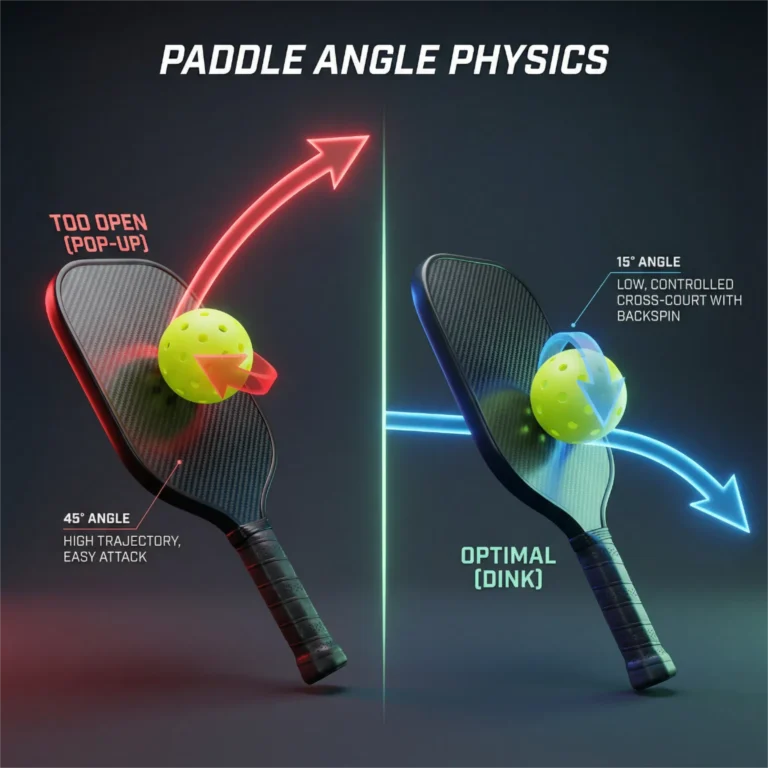
- Paddle face open: Slightly tilt your paddle face up.
- Push, don’t swing: It’s a pushing motion, lifting the ball from low to high.
- Follow through: Even though it’s a soft shot, you must follow through toward your target. If you stop your swing abruptly, the ball will dump into the net.
What is the ideal apex (height) and arc for a successful 3rd shot drop?
You aren’t trying to hit a laser beam; you’re trying to paint a rainbow. The ball needs to clear the net safely.
The apex (the highest point of the shot) should be on your side of the court. If the ball peaks after it crosses the net, it will bounce high on the opponent’s side, inviting a smash. You want the ball to peak just before the net, cross over, and then descend rapidly. A generous clearance of 1 to 2 feet over the net is actually safer and better than trying to skim the tape, provided you have the right spin.
How much spin (topspin vs. backspin) should I apply to a 3rd shot drop?
Topspin is your best friend here.
- Topspin: This causes the ball to “dip” quickly after crossing the net. It allows you to hit the ball with a bit more clearance (safety) while ensuring it still lands shallow in the kitchen.
- Backspin (Slice): While some players use a slice drop, it can be risky. Backspin tends to make the ball “float” or hang in the air a bit longer. If you float it too high, it’s an easy put-away for your opponent. However, a slice drop that lands successfully will skid and stay low, which is very hard to return. For most players, mastering the topspin roll is the more consistent path.
How should my grip pressure change when executing a 3rd shot compared to other shots?
Relax. Breathe.
On a scale of 1 to 10 (where 10 is strangling the paddle and 1 is dropping it), your grip pressure for a drop should be about a 3 or 4.
If you squeeze tight, the ball will bounce off the paddle face too hard (the “trampoline effect”). A loose grip absorbs some of that energy, allowing you to deaden the ball and place it softly. Think “soft hands.”
Target & Placement: Where to Aim
You’ve got the mechanics down. Now, where are we sending this yellow plastic ball? Precision is key.
Where is the safest spot to aim my 3rd shot to avoid being attacked?
The middle of the court is generally the “safe harbor.” The net is lowest in the middle (34 inches vs. 36 inches at the posts), giving you a slightly larger margin for error. Furthermore, hitting to the middle often causes confusion between your opponents. “Is it yours? Is it mine?” In that split second of hesitation, you’ve gained an advantage.
Should I aim for the opponent’s backhand or forehand on the 3rd shot?
For 80% of the population, the backhand is the weaker side, specifically when dealing with dinks or low balls. It is mechanically harder to generate power off a low backhand volley than a forehand roll.
Observe your opponents during warm-ups. If one player has a stiff backhand, target their feet. Make them uncomfortable.
Is it better to aim for the middle of the court or the sidelines on a 3rd shot?
Avoid the sidelines unless you are extremely confident. The risk-reward ratio just isn’t there. If you aim for the sideline, you risk hitting the ball out wide or, even worse, setting up a sharp angle for your opponent to hit a winner.
Sticking to the center-third of the court reduces your unforced errors and forces the opponents to move laterally to cover the middle, opening up gaps for later in the point.
Troubleshooting: Fixing Common Mistakes
We’ve all been there. You have the theory down, but on the court, things are falling apart. Let’s troubleshoot the most common pain points.
Why do I keep popping up my 3rd shot too high, and how can I keep it low?
This usually happens for two reasons:
- Deceleration: You get scared the ball will go long, so you slow down your swing right at contact. This causes a jerky motion that pops the ball up. Commit to the stroke! Smooth acceleration is better than a jerky stop.
- Flat paddle: You might be opening the paddle face too much, serving it up on a platter. Try closing the face slightly and focusing on that topspin “roll” motion to keep the trajectory lower.
How do I stop hitting my 3rd shot into the net?
If the net is eating your drops, you likely aren’t using your legs. Many players try to “arm” the ball over. The power and lift come from your knees. As you hit the ball, lift your body.
Also, aim higher! It sounds counterintuitive, but if you aim for a spot 1-2 feet above the net cord, gravity will do the work. Don’t aim for the tape; aim for the air above it.
What should I do if my 3rd shot is poor (too high) to survive the next shot?
This is the “Oh no” moment. You hit a high floater, and you see your opponent winding up to smash it.
Do not rush the net. If your shot is bad, stop moving forward. Split step immediately. Stay back in the transition zone or even the baseline. You need reaction time to defend the smash. This transitions you into the 5th shot reset. Your goal now is just to survive—block the smash softly into the kitchen to reset the point, then move up.
Drills & Equipment: How to Improve
You can read about swimming all day, but eventually, you have to get wet. Here is how to practice your 3rd shot pickleball skills.
What are the best solo drills to practice the 3rd shot drop?
You don’t need a partner to get better.
- The Wall Drill: Tape a line on a wall at net height (34 inches). Stand about 15-20 feet back (mimicking the baseline to kitchen distance). Hit soft, arcing shots that hit the wall just above the tape line. Focus on the feeling of the ball leaving the paddle.
- The Bucket Drill: Place a laundry basket or bucket in the kitchen zone on a court. Stand at the baseline with a bucket of balls. Try to drop them into the target. This gives you instant feedback on your depth and accuracy.
What are the most effective partner drills for mastering the transition zone?
Grab a friend and try the “7-11 Game.”
- One player stands at the net (the feeder).
- One player stands at the baseline (the worker).
- The worker serves (or feeds), the net player returns deep.
- The worker must hit a 3rd shot drop.
- Play out the point.
- Scoring: If the worker wins the point, they get 2 points. If the net player wins, they get 1 point. Play to 11.
- This forces the baseline player to focus on high-quality drops to neutralize the net player’s advantage.
If you’re looking for an excellent place to practice these drills and training sessions, try visiting 3rd Shot Pickleball Longmont – a leading indoor club in Colorado that offers specialized lessons, training machines, and an ideal environment for improving the 3rd shot drop and drive.
or 3rd Shot Pickleball Reno – a fantastic indoor facility in Reno that offers high-quality courts, lessons, and an ideal environment for practicing the drop and drive.
or 3rd Shot Pickleball Evansville – the only dedicated indoor club in the city, with high-quality courts and specialized lessons to help you master the 3rd shot drop.
Does paddle choice (power vs. control) significantly affect 3rd shot performance?
Absolutely. Equipment matters.
- Power Paddles (Thinner core, fiberglass): These make the ball pop off the face. They are great for drives but make drops harder because the ball jumps. You need softer hands to control these.
- Control Paddles (Thicker core 16mm+, Carbon Fiber/Raw Carbon): These absorb more energy. They feel “mushier” in a good way. They hold the ball on the face a fraction of a second longer, allowing for easier spin generation and softer drops.
If you struggle with popping the ball up, switching to a thicker core (16mm) paddle with a raw carbon face can make an instant difference in your soft game.
Mastering the 3rd shot takes time. It requires patience, touch, and a willingness to make mistakes while you learn. But once you unlock this skill, the entire court opens up. You stop playing defensively and start dictating the pace of the game. So grab your paddle, hit the courts, and start dropping them in!