The Difference Between Indoor and Outdoor Pickleballs
It’s a Saturday morning scenario that frustrates thousands of players: You step onto a new court, confident in your game, but suddenly your shots are sailing long, your dinks are popping up too high, and the ball feels like a rock—or conversely, a marshmallow—hitting your paddle.
The problem likely isn’t your swing mechanics; it’s the ball.
Many beginners assume a ball is just a ball. However, the difference between indoor and outdoor pickleballs is one of the most critical factors in the sport. It changes the physics of the game, the strategy you employ, and even the lifespan of your equipment. While they may look similar from a distance, the engineering behind the 26-hole indoor ball and the 40-hole outdoor ball creates two vastly different playing experiences.
In this guide, we will move beyond the basic visual differences and dive deep into the aerodynamics, durability issues, and strategic implications of your ball choice. Whether you are battling outdoor pickleball cold weather cracking or trying to stop your ball from skidding on a gym floor, this guide has the answers.
For a broader look at the best brands on the market, you can check out our comprehensive guide to pickleball balls, but for now, let’s dissect the physics behind why these balls behave so differently.
The “Feel” Factor: Physics & Playability
When players ask, “Why does my game feel different?” they are reacting to distinct aerodynamic and material properties. The difference isn’t just in the number of holes; it is about weight, hardness, and drag.
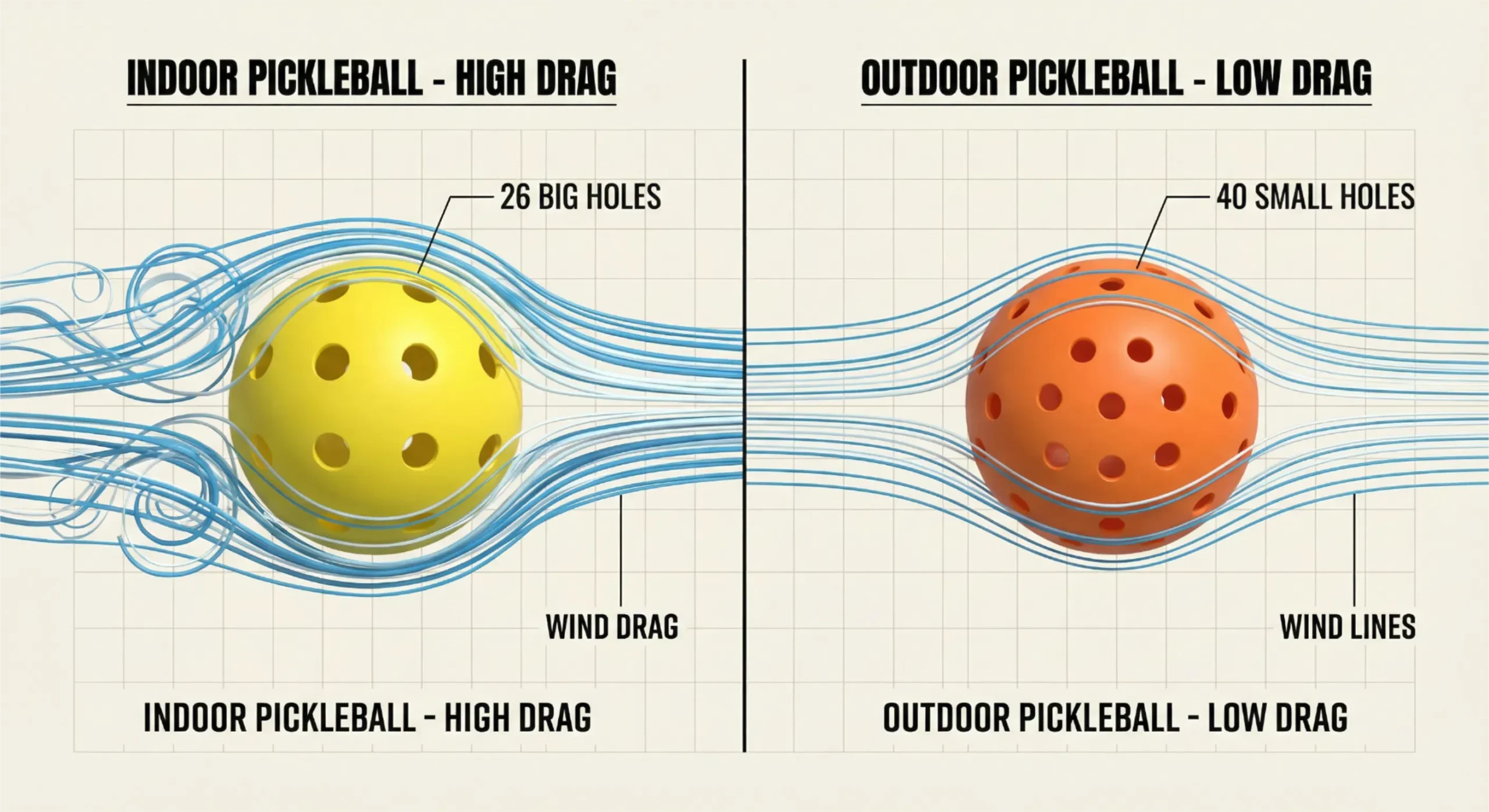
26 vs 40 Hole Pickleball: The Aerodynamics
The most obvious visual difference is the hole count:
- Outdoor Balls: 40 smaller holes.
- Indoor Balls: 26 larger holes.
Why the difference? The 26 vs 40 hole pickleball design is all about wind resistance. The smaller, more numerous holes on an outdoor ball allow it to cut through the wind more effectively, minimizing the impact of gusts on the ball’s trajectory. Conversely, indoor balls don’t need to fight the wind. Their larger holes create a different drag coefficient, which, combined with their lighter weight, makes them slightly slower and easier to control in a windless environment.
Answering Your Questions on “Feel”
“Why does my dink game feel completely different/mushy when switching from indoor to outdoor balls?”
This “mushy” sensation usually happens when an outdoor player moves indoors. Indoor balls are made of a softer plastic and are generally lighter. When you strike an indoor ball, it compresses more against the paddle face than a hard outdoor ball does. This absorbs some of the energy, resulting in less “pop.”
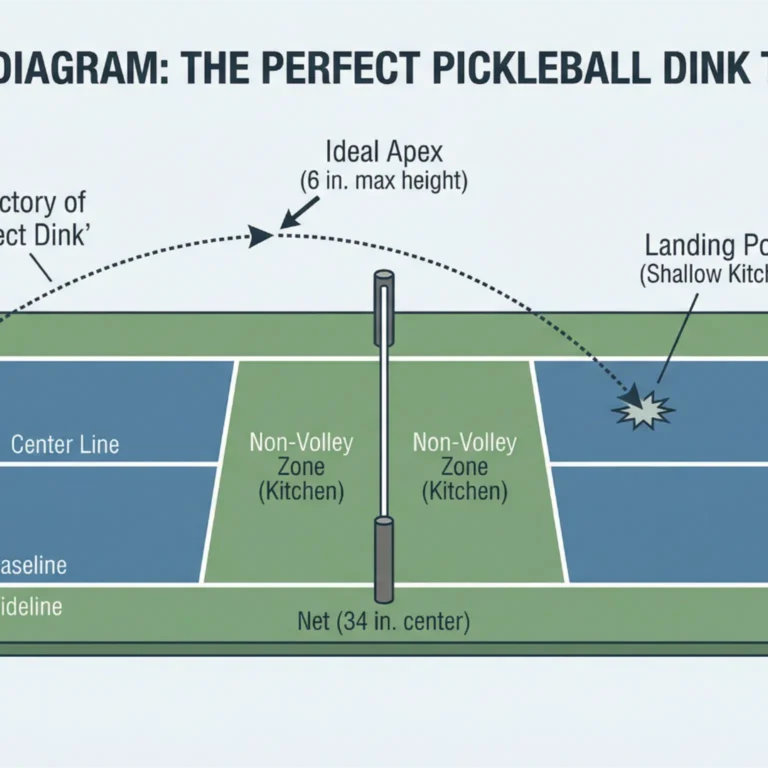
If you are trying to control your dink shots, you will find that indoor balls require a slightly firmer push to clear the net, whereas outdoor balls require softer hands to keep the ball from popping up.
“Do indoor balls actually skid more on wooden gym floors compared to outdoor surfaces?”
Yes. This comes down to friction. Indoor pickleball is often played on gym floors (finished maple wood or synthetic surfaces). The plastic of an indoor ball is smoother and softer, which creates less friction against the polished wood. This causes the ball to “skid” or slide low after the bounce rather than checking up. Outdoor courts are abrasive (like sandpaper); the ball “grabs” the grit, resulting in a higher, truer bounce.
“Is it true that outdoor balls engage more spin due to surface texture?”
Absolutely. Spin is generated by friction between the ball and the paddle, and the ball and the court. Outdoor balls are harder and often have a slightly textured surface (and get scuffed up quickly). This allows the paddle grit to “bite” into the ball more effectively. Indoor balls are slicker; generating topspin on an indoor ball often requires more exaggerated mechanics because the ball wants to slide off the paddle face.
Pro Tip: If you are transitioning from outdoor to indoor play, expect the ball to skip low and fast at your feet. You will need to get your paddle lower to the ground and shorten your backswing to handle the skid.
Durability Wars: Cracking vs. Mushiness
The most common complaint in pickleball forums is durability. However, indoor and outdoor balls fail in completely different ways due to their chemical composition.
Material Composition: Hard vs. Soft
Outdoor balls are typically made through a rotational molding process using harder, heavier plastics to withstand rough court surfaces and wind. Indoor balls are often injection-molded using softer, more pliable plastics.
Answering Your Questions on Durability
“Why do my outdoor pickleballs crack instantly in winter/cold weather (below 45°F)?”
This is the curse of outdoor pickleball cold weather cracking. The plastic used in high-performance outdoor balls (like the Dura Fast 40) is designed to be hard for speed. As the temperature drops, this plastic loses its elasticity and becomes brittle. When a frozen, brittle ball is struck by a hard paddle, the impact force exceeds the plastic’s ability to flex, causing it to crack or split down the seam.
“Is there a specific ‘cold weather’ outdoor ball that resists cracking better?”
Yes. While no ball is invincible, players should switch to slightly softer outdoor balls during winter months. Brands like CORE or the Franklin X-40 are slightly softer than the Dura Fast 40 and tend to survive longer in freezing temperatures, though they may play slightly slower.
“Why do indoor balls get ‘soft spots’ or warp instead of cracking?”
Because indoor balls are made of pliable plastic, they rarely crack. Instead, they suffer from fatigue. After repeated impacts, the plastic loses its structural memory. You might notice the ball wobbling in the air or bouncing erratically. If you squeeze an old indoor ball, you might find a “mushy” area—a soft spot where the plastic has broken down. Once an indoor ball goes out of round, it is time to retire it.
Pro Tip: To extend the life of your outdoor balls in winter, keep them in your jacket pocket or a warmed car until you play. Never leave your pickleball bag in the trunk overnight during freezing temperatures.
The “Cross-Over” Myth: Can You Mix Them?
A frequent question among newer players is whether they can just buy one tube of balls and use them everywhere. While you can physically do this, it is highly discouraged for competitive development.
Answering Your Questions on Mixing Balls
“Can I use outdoor balls indoors to practice for a tournament?”
Technically, yes, but proceed with caution. Many pros practice with outdoor balls indoors to simulate the speed of tournament play. However, outdoor balls are harder and can slide dangerously fast on wooden gym floors. Furthermore, some gym managers ban outdoor balls because the harder plastic can scuff or dent delicate wooden floors. Always check with the facility first.
“If I play outdoors with an indoor ball on a windy day, how much will the flight path deviate?”
Significantly. Indoor balls are lighter and have larger holes. If you use one outdoors, even a light breeze (5 mph) will catch those large holes and carry the ball dramatically. This is often called the “Wiffle Ball effect.” The ball will curve unpredictably, making it impossible to practice consistent shots or rely on standard court dimensions for placement strategy.
“Does using an outdoor ball indoors make the game significantly faster?”
Yes. An outdoor ball carries more energy and rebounds off the paddle face with more velocity. Combined with the low “skid” bounce on a gym floor, the game becomes incredibly fast-paced. It reduces the time you have to react, turning the game into a “banger” fest rather than a strategic dinking battle.
Player Comfort & Ergonomics (Safety/Health)
The difference between indoor and outdoor pickleballs extends to how your body feels after a two-hour session. The impact shock generated by the ball travels through the paddle and into your arm.
Vibration and Acoustics
“Do harder outdoor balls contribute more to vibration transfer than softer indoor balls?”
Yes. Physics dictates that when a hard object (outdoor ball) hits a rigid object (paddle), the shock wave is significant. This vibration travels up the wrist and into the elbow tendons. This repetitive shock is a leading contributor to pickleball elbow vibration issues. Indoor balls, being softer, absorb more of the impact upon collision, transmitting less shock to the arm.
“Which ball type is recommended for players with arm sensitivity?”
If you are recovering from common pickleball injuries or want to prevent arm strain, playing with a softer ball is safer. If you play outdoors, opt for a softer outdoor ball (like the Franklin X-40 or Onix Pure 2) rather than the harder tournament balls.
“Is there a significant decibel difference to avoid noise complaints?”
Yes. Outdoor balls create a high-pitched “POP” sound that can reach decibel levels annoying to neighbors (often exceeding 85 dB at close range). Indoor balls create a lower-frequency “thud” or “clunk” that doesn’t carry as far. This is why many residential communities near courts mandate specific “quiet” balls or paddles.
Official Specs: According to USA Pickleball Equipment Standards, balls must meet specific bounce and hardness criteria. However, within those approved ranges, the variance in hardness between an indoor Jugs ball and an outdoor Dura ball is distinct enough to affect player health.
Visibility & Aesthetics (Niche Tip)
You can’t hit what you can’t see. The color of your pickleball should be determined by the environment, not just your favorite color.
Answering Your Questions on Visibility
“Why are orange balls often recommended for indoor gym floors instead of the standard yellow?”
Indoor pickleball is often played on basketball courts which have light maple wood and confusing arrays of painted lines (white, black, red). A yellow ball often blends into the light wood tones of the floor. Orange (or sometimes hot pink) provides the highest contrast against the light wood and makes it easier for the eye to track the ball’s velocity.
“Which color provides the best contrast under LED indoor lighting vs. natural sunlight?”
- Outdoors (Sunlight/Asphalt): Neon Yellow or Green is the standard. It contrasts best against dark asphalt or blue/green court surfaces.
- Indoors (LED/Wood): Orange or Red. LED lighting can sometimes wash out yellow balls, making them look white. Darker, warmer colors like orange stand out sharply against the artificial glare and floor reflection.
Conclusion & Quick Reference Guide
The difference between indoor and outdoor pickleballs is not a marketing gimmick; it is a necessity dictated by physics. Using the wrong ball leads to frustrated strategy, broken equipment, and even potential injury.
Summary: Indoor vs. Outdoor Ball Comparison
| Feature | Indoor Pickleball | Outdoor Pickleball |
| Hole Count | 26 (Large Holes) | 40 (Small Holes) |
| Weight | Lighter (~0.8 oz) | Heavier (~0.9 oz) |
| Hardness | Softer Plastic | Harder Plastic |
| Best Surface | Wood, Tile, Gym Floors | Asphalt, Concrete, Tennis Courts |
| Failure Mode | Soft spots / Warping | Cracking / Splitting |
| Wind Resistance | Poor | Excellent |
Recommended Reading
Top Pickleball Gifts 2025:From Stocking Stuffers to Pro Gear
Looking for unique pickleball gifts? We break down practical gear, funny apparel, and budget-friendly ideas to help you surprise the player in your life.
Final Verdict
For the serious player, the best advice is to carry both types in your bag. You never know when weather-related playing conditions might force you indoors, or when a friend might invite you to a local park.
- Play Indoors? Use a Jugs or Onix Fuse Indoor ball (Orange) for better control and visibility.
- Play Outdoors? Use a Franklin X-40 or Dura Fast 40 (Yellow) for wind resistance and speed.
- Cold Weather? Swap your hard outdoor ball for a softer variant to prevent cracking.
Now that you know the science, it’s time to stock your bag. Check our list of the best pickleball balls to buy to find the top-rated brands for both indoor and outdoor play.
By matching your ball to your environment, you ensure that when you miss a shot, it’s actually your fault—not the equipment’s.
you may like it