how to pick a pickleball paddle
If you walk onto the court choosing equipment based on flashy graphics or a generic “4.8-star” rating on Amazon, you are already at a disadvantage. In pickleball, the paddle is the single piece of equipment you are legally allowed to customize to enhance your biomechanics.
Learning how to pick a pickleball paddle isn’t about brand loyalty; it is about physics. It requires understanding how weight distribution, core density, and surface friction dictate the ball’s trajectory. Before we dive into the engineering, let’s define three critical terms that will appear throughout this guide:
- Pop: The exit velocity of the ball immediately off the face. High pop means the ball travels fast with little effort.
- Dwell Time: How long the ball physically stays compressed against the paddle face. Longer dwell time usually equates to better control and spin manipulation.
- Sweet Spot: The area on the paddle face where vibration is minimal, and energy transfer is efficient.
While many players simply grab whatever the pros are using, analytical players look at the data. If you are ready to move beyond the marketing fluff and look at the current market leaders, this guide will break down exactly what you need to know.
II. Weight Dynamics: It’s Not Just About Ounces
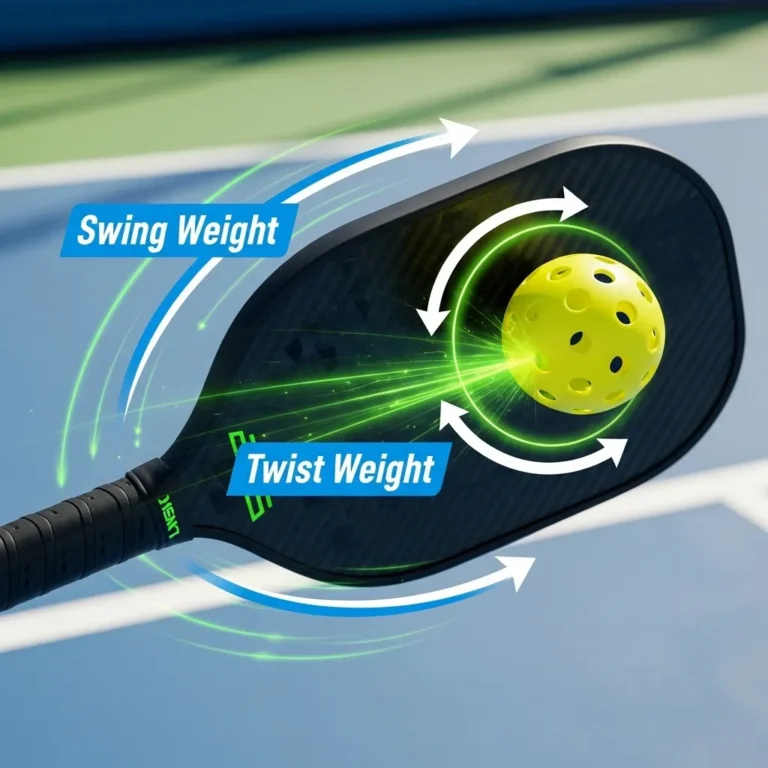
Most beginners obsess over the “Static Weight” (e.g., 7.8 oz vs. 8.2 oz). However, static weight is merely the total mass of the object. The metric that actually influences your hand speed and fatigue levels is Swing Weight.
Static Weight vs. Swing Weight
What is the difference, and which one affects hand speed?
Static weight is how heavy the paddle feels when you hold it still. Swing weight is how heavy the paddle feels when you swing it. A paddle with weight distributed toward the head (head-heavy) will have a high swing weight, generating more power but slowing down your hands during volley battles. Conversely, a handle-heavy paddle will feel lighter to swing, even if the total static weight is the same.
- Low Swing Weight: Ideal for “kitchen players” who rely on fast hands for blocks and speed-ups.
- High Swing Weight: Preferred by singles players or tennis converts who drive the ball from the baseline and need momentum.
The “Twist Weight” Factor
How does lead tape placement affect Torsional Stability?
Twist weight measures the paddle’s resistance to rotating in your hand when you hit the ball off-center. If you hit the ball near the edge, a paddle with low twist weight will wobble, causing a weak return.
You can artificially increase twist weight by adding lead tape to the sides (the 3 and 9 o’clock positions) of the paddle throat. This expands the sweet spot but will slightly increase the swing weight. However, be cautious; adding too much weight without testing can lead to physical stress. Prioritizing correct weight distribution is a key step in preventing pickleball injuries related to elbow strain.
III. Core Thickness: The Control vs. Power Scale
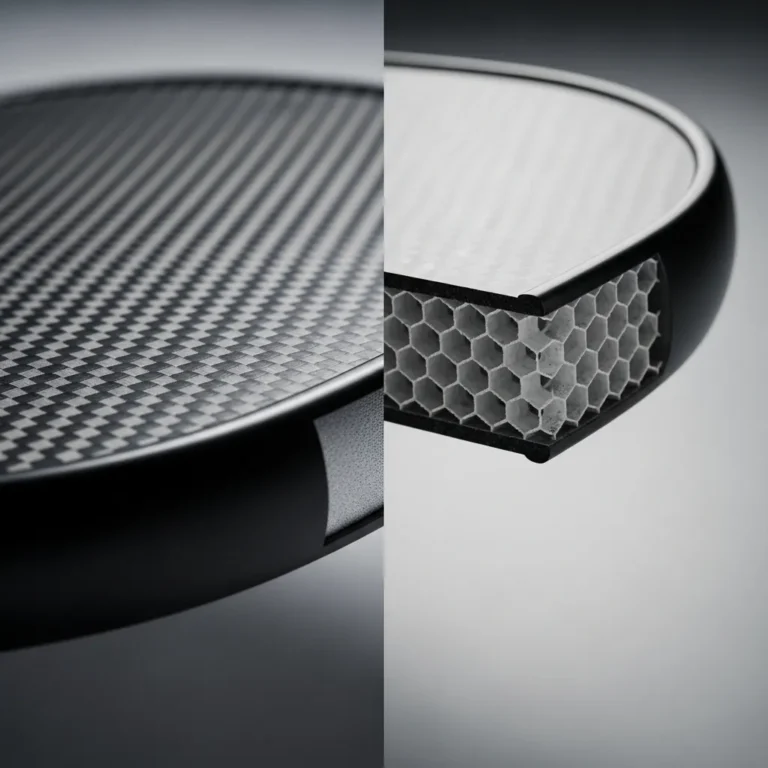
The core is the engine of the paddle. Today, the industry standard is Polypropylene Honeycomb, though some niche paddles use Nomex or Aluminum. The most critical variable here is thickness.
13mm/14mm vs. 16mm Cores
What is the practical difference?
When learning how to pick a pickleball paddle, you will generally face a binary choice:
- 16mm Cores (Control): Thicker cores absorb more energy. When the ball hits the paddle, the core compresses, dampening the impact. This is superior for “resets” (dropping a hard drive into the kitchen) and blocking.
- 13mm/14mm Cores (Power): Thinner cores are stiffer and return more energy to the ball. They offer immediate “pop” and feedback but are less forgiving on mishits.
Twist Weight and Core Stability
Thicker cores (16mm) naturally tend to have higher stability. Because there is more material density, the paddle resists twisting in the hand more effectively than a thin 13mm core. If you struggle with the paddle turning in your grip when you block hard drives, a 16mm pickleball paddle core thickness is usually the correct technical solution.
IV. Surface Materials: Generating Spin
Surface technology has evolved from simple paint to complex friction engineering. If you want to bend the ball with top-spin drives or cut-spin returns, the face material is paramount.
Raw Carbon Fiber vs. Fiberglass vs. Graphite
What is the difference?
- Raw Carbon Fiber (T700): Currently the gold standard. The material is woven, creating a natural, gritty texture that bites the ball. It provides high spin rates and is highly durable.
- Fiberglass (Composite): Offers the highest “pop” or trampoline effect. However, it is generally smoother than carbon fiber, meaning less spin potential.
- Graphite: An older technology. It is thin, hard, and offers good touch, but lacks the power of fiberglass or the spin of raw carbon.
The Problem with “Sprayed-On” Grit
Why does it wear out?
Cheap paddles use a smooth surface with a sand-like grit sprayed on top. This wears off after a few months of play, turning your paddle illegal or ineffective. High-end paddles, like brands like Joola or other pro-level carbon paddles, use “peel-ply” textures where the roughness is imprinted into the carbon fiber itself. This ensures the spin potential lasts for the life of the paddle.
V. Shape & Handle Mechanics (Ergonomics)
The physical dimensions of the paddle affect the location of the sweet spot and your ability to execute specific shots, particularly the two-handed backhand.
Elongated vs. Standard/Wide Body
- Elongated (16.5″ length): The face is longer and narrower. This provides more reach and leverage for power (higher swing weight), but the sweet spot is smaller and higher up the face.
- Standard/Wide Body: A squarer shape. This offers the largest possible sweet spot and high twist weight, making it ideal for defensive players who want maximum forgiveness.
Handle Length and Grip Sizing
What is the minimum length for a two-handed backhand?
Standard handles are often 5.0 inches, which is too short for most adults to fit two hands comfortably. If you use a two-handed backhand, look for a handle length of at least 5.3 to 5.5 inches.
Should I buy a grip size based on hand measurement?
A common pro tip regarding pickleball grip size is to buy a paddle with a smaller grip circumference than you think you need. You can always build a grip up using overgrips to achieve the perfect fit, but you cannot shave a handle down. Using an overgrip is also hygienic and improves tackiness, which is why checking out different pickleball grips is an essential part of paddle customization.
VI. Modern Manufacturing: Thermoformed vs. Cold Pressed
In 2024 and 2025, the market saw a shift toward “Gen 3” manufacturing. Understanding this build process is vital for durability.
Thermoformed (Gen 3) vs. Cold Pressed
What is a Thermoformed paddle?
Traditional paddles (Cold Pressed) are sandwich-layered: a sheet of carbon, a honeycomb core, and another sheet of carbon, glued together.
Thermoformed paddles, popularized by thermoformed pioneers like Six Zero, use a heat-molding process to fuse the materials into a “unibody” construction.
- Pros: The handle is molded as part of the paddle, virtually eliminating the risk of snapping at the neck. They also offer edge-to-edge sweet spots.
- Cons: They feel stiffer and “boardy” compared to the plush feel of cold-pressed paddles.
Core Crushing and Delamination
What is it?
Because thermoformed paddles are so stiff, the energy has nowhere to go but into the core. If the glue bonds fail or the honeycomb collapses, the paddle becomes a “trampoline,” launching the ball at illegal speeds. This is known as “core crushing” or delamination. You can identify it by a “crunchy” sound when pressing on the face or inconsistent, rocket-like shots.
VII. Conclusion: The Decision Matrix
To summarize, do not buy a paddle because it looks cool. Buy it because it fits your mechanics. Here is your quick checklist:
- The Beginner/Value Seeker: Look for a Wide Body shape, 16mm core, and preferably a carbon fiber face for durability.
- The Tennis Convert: Look for an Elongated shape, 13mm or 14mm core (for power), and a 5.5″ handle for two-handed backhands.
- The Touch/Control Player: Look for a 16mm Raw Carbon Fiber paddle with high twist weight to win hands battles at the kitchen.
For the most up-to-date regulations on what is legal for tournament play, always refer to the official equipment standards provided by USA Pickleball.
Once you have selected your weapon of choice, the next step is learning how to use it effectively. Check out our guide on pickleball strategy tips to improve your game and put that new technology to work.