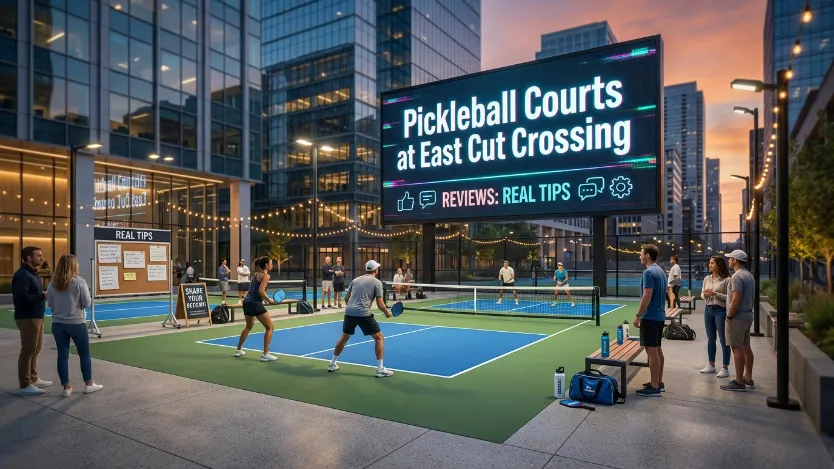
Imagine standing in a high-octane urban canyon, the glass facade of the Salesforce Tower gleaming above you, while the rhythmic “pop-pop” of plastic balls echoes against the surrounding skyscrapers. You aren’t in a traditional park; you are at the pickleball courts at east cut crossing, San Francisco’s most ambitious “meanwhile use” project. This former transit terminal has been surgically transformed into a premier social and athletic hub, but playing here is vastly different from your local suburban court.
For players scouring pickleball courts at east cut crossing reviews, the feedback often highlights the vibe but misses the physics. From the notorious “wind tunnel” effects to the structural “folds” in the concrete underlayment, this site presents a unique set of challenges. Whether you are a 4.5 DUPR beast or a tech professional picking up a paddle for the first time, this guide dissects the technical and social DNA of the Crossing to ensure you don’t just show up, but dominate. If you are new to the phenomenon, start by understanding what is pickleball to see why it has captured the heart of SOMA.
Pickleball Comparison: East Cut Crossing vs. Traditional SF Public Courts
| Technical Feature | East Cut Crossing | Louis Sutter / Presidio Wall |
|---|---|---|
| Surface Material | Raw Concrete (with minor folds) | Professional Acrylic Coating |
| Wind Dynamics | High (Urban Venturi Effect) | Moderate to Shielded |
| Net System | Permanent Heavy-Duty Steel | Rolling or Semi-Permanent |
| Lighting | Integrated LED Night Lighting | Varies (often daylight only) |
The Urban Transformation: Why East Cut is SF’s Hottest Pickleball Scene
The pickleball courts at east cut crossing represent more than just recreation; they are a cultural cornerstone of San Francisco’s post-pandemic recovery. Managed by East Cut Landing Partners, the site utilizes the former Temporary Transbay Terminal. This isn’t your average municipal court—it’s a private-public partnership that caters to a demographic of young professionals, tech innovators, and elite players who value proximity to the Financial District.
The energy here is unparalleled. On any given Tuesday evening, you’ll find the “Paddle Saddle” (the site’s specific rotation system) overflowing with players. The social scene is bolstered by nearby food trucks and The Greyhound Bar, making it a “destination” rather than just a court. For those coming from other cities, like those used to pickleball Boston, the verticality of the surrounding architecture provides a dizzying but exhilarating backdrop that redefines the “outdoor play” experience.
Engineering the “Urban Bounce”: Surface Folds and Drainage Slopes
The most critical “missing angle” in standard pickleball courts at east cut crossing reviews is the technical analysis of the playing surface. Unlike the perfectly leveled courts at Goldman Pickleball Courts, East Cut is built on transitional pavement.
The “Fold” Phenomenon
The concrete pavement underlayment at East Cut features minor “folds” or ridges. For a precision player, this is a game-changer. These folds can cause a ball to skid or take an erratic low bounce. Mastering the pickleball drop shot here requires an extra split-second of visual tracking to account for these surface irregularities. You cannot rely on a “true” bounce; you must play the ball with “soft hands” to neutralize the unpredictable friction of the raw concrete.
The Drainage Gradient
To prevent water pooling in San Francisco’s foggy climate, the courts have a slight drainage slope. This affects the pace of the ball when moving from the baseline to the kitchen. Pro players often adjust their pickleball serve to account for the uphill or downhill trajectory, ensuring the ball clears the net without sailing long. If you are struggling with the transition, check our guide on pickleball dink strategies to stay aggressive at the net.
Head-to-Head: pickleball courts at east cut crossing vs. The Challengers
How does East Cut stack up against the “Challengers”—the other major SF hubs? Let’s look at the competitive landscape through the eyes of a local regular.
East Cut Crossing vs. Louis Sutter: Louis Sutter is often considered the “Pro’s Choice” for high-level DUPR play, but it lacks the amenities of East Cut. While Sutter offers a truer bounce on its acrylic surface, the pickleball courts at east cut crossing offer a superior night-play experience. The LED lighting at East Cut is specifically positioned to minimize “dead zones,” which is a common complaint at more traditional parks.
East Cut Crossing vs. Presidio Wall: Presidio Wall is legendary for its community, but the wind conditions there are often “unplayable.” East Cut, while also windy, benefits from the “Salesforce Shield”—large buildings that occasionally break the wind’s direct path, creating swirly but manageable conditions. If you are a 4.0+ player, you will find the “Challenger Court” (usually the middle court at East Cut) to be just as competitive as any top-tier park in the city.
The SOMA Microclimate: Mastering the “Wind Tunnel”
The pickleball courts at east cut crossing are subject to the Venturi effect. As wind moves between the dense high-rises, it accelerates. This makes your choice of equipment vital. In these “wind tunnel” conditions, lightweight paddles are your enemy. You need mass and grit to stabilize your shots.
We recommend using carbon fiber pickleball paddles with a 16mm core, such as the JOOLA Ben Johns Perseus. The added stability helps prevent the wind from “taking” your ball during delicate kitchen rallies. Additionally, ensure you are using high-quality Franklin pickleball balls (the X-40 outdoor model), as their hole pattern is optimized for flight consistency in gusty urban environments.
Biomechanics: Why Your Footwear Matters More at East Cut
Raw concrete is a brutal master. Playing for three hours at the pickleball courts at east cut crossing without the right gear is a recipe for pickleball injuries. Concrete does not absorb shock like acrylic or wood; it reflects that energy back into your knees and lower back.
- Shock Absorption: You must wear specialized court shoes. We recommend the best shoes for pickleball that feature high-density EVA midsoles.
- Traction: Because the surface at East Cut can get “dusty” due to urban construction nearby, a gum-rubber outsole is essential to prevent sliding.
- Eye Protection: The glare from the surrounding glass towers can be blinding at 4:00 PM. Don’t forget to pack the best pickleball glasses with polarized lenses to maintain visibility of the ball against the skyline.
Mastering the System: Reservations vs. The Paddle Saddle
One of the “missing angles” often ignored by competitors is the logistical complexity of the pickleball courts at east cut crossing. Unlike a standard park, this is a managed facility with two distinct modes of entry:
- Free Open Play: Most days operate on a first-come, first-served basis. You place your paddle in the “Saddle” (the rack). When a game finishes, the next four players take the court. It’s an egalitarian system that fosters new friendships.
- Paid Reservations: From Monday to Thursday, you can reserve courts for approximately $125 per hour. This is the preferred method for Financial District corporate teams or those who want to avoid the 45-minute wait times during the 5 PM rush.
If you are planning a group outing, knowing items needed for pickleball (including extra balls and a pickleball paddle set for beginners) will make your session seamless. Also, remember that parking in SOMA is a nightmare—MUNI and bikes are your best friends here.
The Graphite vs. Carbon Fiber Edge in Urban Play
When playing in a high-glare, high-wind environment like East Cut, your gear shouldn’t just be “good”—it should be tactical. While graphite pickleball paddles are excellent for touch, many locals are upgrading to thermoformed tech. Models found in our best pickleball paddles for advanced players list provide the structural integrity needed to drive through the heavy air of the San Francisco bay.
Pickleball Courts at East Cut Crossing: Frequently Asked Questions
Are the pickleball courts at east cut crossing really free?
Yes, for most of the day, they are free and open to the public on a first-come, first-served basis. However, peak-time reservations (Mon-Thu) are paid and usually booked weeks in advance by corporate groups.
What is the “Challenger Court” at East Cut?
By local convention, the middle court (Court 2 or 3 depending on signage) is often designated as the “Challenge Court.” Winners stay for up to two games before rotating out, attracting the 4.0+ DUPR crowd.
Can I rent equipment at the Crossing?
Absolutely. You can check out paddles and balls from The Greyhound Bar. It’s perfect for coworkers who want a spontaneous match after a long day in the office.
Is the concrete surface slippery when foggy?
Yes. San Francisco’s evening “marine layer” can make the raw concrete quite slick. We suggest reading our guide on can you play pickleball on a wet court to understand the safety risks of moisture on non-acrylic surfaces.
What are the peak hours to avoid the crowd?
The “Tech Rush” occurs between 4:30 PM and 7:30 PM on weekdays. For a quiet game, aim for 10:00 AM on a Tuesday or late Saturday mornings.
Is there a dress code for the Crossing?
While there are no formal pickleball attire rules, most players wear athletic tech-wear. Layers are essential as the temperature can drop 10 degrees as soon as the sun goes behind the Salesforce Tower.
Beginner Pitfalls: What to Know Before You Go
The most common mistake beginners make at the pickleball courts at east cut crossing is underestimating the social etiquette. The “Paddle Saddle” is sacred. If you move someone else’s paddle to jump the line, you will hear about it.
Additionally, don’t forget the glare factor. The glass buildings don’t just create wind; they act as giant mirrors. If you aren’t wearing a hat or best pickleball glasses, you will lose the ball in the “skyline shimmer.” For a full breakdown of the rules to avoid “newbie” errors, visit our pickleball kitchen rules guide.
Conclusion: The Future of Urban Pickleball
The pickleball courts at east cut crossing are a testament to the sport’s power to reclaim urban space. Despite the minor surface folds and the challenging winds, the Crossing offers a “Big City” pickleball experience that you won’t find at Shaw Park or other traditional venues. It is fast, social, and quintessentially San Francisco.
Whether you are there to network, sweat, or test your new Selkirk pickleball paddles, the Crossing welcomes you. Just remember to watch the wind, respect the saddle, and always—always—stay ready for that erratic concrete bounce. See you in the kitchen!