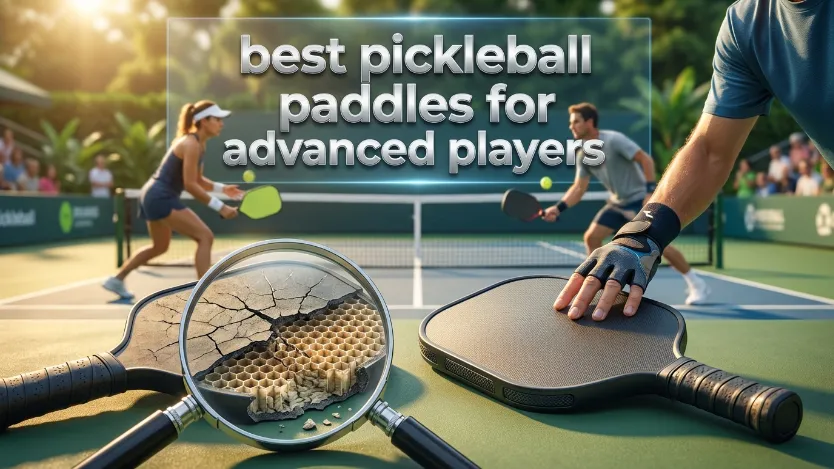
The era of the “honeycomb” is ending, and for high-level competitors, the 2026 gear cycle is a massive wake-up call. If you have spent the last season wondering why your favorite thermoformed paddle suddenly felt “mushy” or lost its bite after only two months, you are a victim of the core crush epidemic.
For those seeking the best pickleball paddles for advanced players, the conversation has shifted from brand loyalty to laboratory-grade metrics like Swing Weight (SW), Twist Weight (TW), and Coefficient of Restitution (PBCoR). In this guide, we bypass the marketing fluff to analyze the engineering revolution of 2026, helping you choose a weapon that maintains its elite performance from the first serve to the final tournament of the year.
The Gen 4 Revolution: Solving the “Core Crush” Epidemic
For years, the industry standard was the polypropylene honeycomb core. While effective for intermediate play, advanced players—especially those with DUPR ratings of 4.5 and above—found a fatal flaw: structural fatigue. Under the stress of 70+ MPH drives, these plastic cell walls eventually collapse, leading to unpredictable “hot spots” or “dead zones.”
- Gen 3 Construction: These are typically thermoformed pickleball paddles that use foam-injected edges to reinforce a honeycomb center. While powerful, they still rely on a hollow structure prone to internal disbonding over 6 to 12 months.
- Gen 4 Engineering: The 2026 “S-Tier” now features 100% full-foam cores made from Expanded Polypropylene (EPP) or Microcellular Polypropylene (MPP). These cores are solid, dense, and engineered to resist crushing indefinitely, providing a uniform feel across the entire face.
When selecting the best pickleball paddles for advanced players, understanding 14mm vs 16mm pickleball paddle thickness is crucial. While 16mm remains the gold standard for defensive stability and vibration dampening, the new Gen 4 foam cores allow 14mm models to retain surprisingly large sweet spots without the traditional “pingy” vibration of older thin paddles.
The Spin War: Beyond Initial RPM Ratings
Advanced players know that out-of-the-box spin is a deceptive stat. Most “top” paddles lose 15% to 20% of their RPM potential within the first 30 hours of play as the peel-ply carbon fiber wears down. In 2026, the focus has shifted to grit longevity.
If you are looking for the best pickleball paddle for spin, you must look for permanent friction technologies:
- HexGrit (11SIX24): A molded geometric pattern that resists the smoothing effect of ball impact.
- Diamond Tough (Six Zero): A high-hardness surface treatment that retains its texture through hundreds of hours of play.
- PermaGrit (Spartus): A ceramic-infused layer that provides a “sticky” friction feel rather than a sandpaper feel, ensuring consistent 2400+ RPM performance.
Deep Dive: Best Power Pickleball Paddle for Advanced Players
In the current meta, power is no longer just about exit velocity; it is about controlled aggression. The best power pickleball paddle for advanced players in 2026 must offer a high PBCoR (rebound efficiency) while maintaining a high enough Twist Weight to prevent the paddle from turning in your hand during heavy counters.
The standout for this category is the Selkirk Labs Project Boomstik. Utilizing a 16mm BoomCore and an EVA Power Ring, it creates a “trampoline effect” that was once thought impossible in a legal paddle. It is the ultimate choice for players who want to dominate the baseline. However, as noted in many 4.5+ community discussions, mastering how to play power pickleball requires a paddle that doesn’t just “pop” but allows for a deep dwell time to shape the ball with topspin.
Another elite contender is the Gearbox GX2 Power. Its patented SST 2.0 CarbonRibCore uses suspended carbon ribs to store energy, making it arguably the most stable power paddle on the market. For players who struggle with “pop-ups” at the kitchen but want explosive speed-ups, the GX2’s linear power delivery is unmatched.
Analysis: Best Pickleball Paddles for Advanced Players 2026
The market has bifurcated into two distinct philosophies for 2026: Full-Foam Consistency vs. Hybrid Feel. To truly identify the best pickleball paddles for advanced players 2026, we must look at models that have cleared the rigorous USA Pickleball equipment standards while pushing the legal limits of deflection.
One of the most praised models of the year is the JOOLA Ben Johns Perseus Pro IV. By integrating Tech Flex Power foam around the perimeter, JOOLA has expanded the sweet spot of the Perseus to nearly the entire face. It remains a tour favorite because it balances a 115+ Swing Weight (for plow-through) with a 7.0+ Twist Weight (for stability).
Advanced Technical Comparison Table
Pickleball Paddle Comparison 2026
Swing Weight · Twist Weight · Core Type
Precision Metrics: Why Static Weight is a Myth
If you are still choosing a paddle based on “8.0 ounces,” you are missing the forest for the trees. Two paddles can weigh exactly 8.0 ounces but feel entirely different. Advanced players must prioritize Swing Weight. A paddle with a 125 SW will provide massive power but will feel “sluggish” during hand battles at the kitchen. Conversely, a 105 SW paddle is a “lightning rod” for fast resets but may lack the “mass” to drive through the ball against a heavy hitter.
Twist Weight is the unsung hero of 2026. This metric measures how much the paddle resists rotating on off-center hits. Advanced players look for a TW of at least 6.5. Paddles like the Honolulu J2NF have achieved TW ratings of 7.4, effectively making the entire paddle a sweet spot.
Customization and Biomechanics: The “Pro” Setup
Most advanced players treat a stock paddle as a blank canvas. Lead tape is the standard tool for fine-tuning performance. Placing weight at the 3 and 9 o’clock positions increases the Twist Weight and stabilizes the head during volleys. Moving the tape to the 12 o’clock position increases the Swing Weight, raising the sweet spot for players who take large, tennis-style swings.
For former NCAA or high-UTR tennis players, handle length is non-negotiable. The 2026 trend is toward 5.5-inch to 6.0-inch handles. This provides the necessary leverage for the two-handed backhand, which has become a dominant shot in the pro circuit. Paddles like the Bread & Butter Loco and the CRBN TruFoam Genesis cater specifically to this biomechanic, offering elongated handles with tapered necks to reduce aerodynamic drag.
The Catch: Are Power Paddles Hurting Your Game?
While everyone wants the best power pickleball paddle for advanced players, there is a technical “plateau” where too much power becomes a liability. High-pop paddles can lead to unforced errors during resets and dinks. If you cannot consistently drop a 3rd shot from the baseline with a high-power paddle, you are “over-paddled.” The top 5% of players are moving toward “Plush Power”—paddles that have a soft initial touch but provide “pop” only when you accelerate through the ball.
2026 Equipment Deep Dive
Expert-level answers on foam technology, break-in myths, quiet paddles, and when to replace your gear.
01Is there really a difference between Gen 3 and Gen 4 foam?
Yes. Gen 3 uses foam as an enhancement to a honeycomb core. Gen 4 uses foam as the entire core. This eliminates the air pockets found in honeycombs, making Gen 4 paddles significantly more durable and consistent in their response over time.
02Does “stomping” a paddle really help with the break-in process?
This is a controversial community “hack.” While applying pressure can technically settle the internal adhesives in some “floating core” models (like the Luzz Inferno), it carries a high risk of internal disbonding. Most modern Gen 4 paddles are designed to play at peak performance from day one, making this practice unnecessary and potentially damaging to your warranty.
03Why are “Quiet Approved” paddles gaining traction among pros?
It isn’t just about noise. To achieve USA Pickleball Quiet Category status, manufacturers use denser, vibration-dampening foams. This results in a “muted” feel that many advanced players prefer for its incredible dwell time and connection to the ball. The Gearbox Pro Ultimate is a prime example of a quiet paddle that sacrifices zero power.
04How often should an advanced player replace their paddle?
For those playing 10+ hours a week, grit degradation is the primary clock. Even with Diamond Tough or HexGrit tech, most pros cycle their paddles every 4 to 6 months to ensure they have 100% of their spin potential for competitive matches.
Conclusion: The Future of Advanced Gear
Choosing the best pickleball paddles for advanced players in 2026 requires looking past the brand name and into the spec sheet. Whether you prioritize the explosive energy of a Selkirk Boomstik or the surgical precision of a Six Zero Coral, the key is matching the paddle’s Swing Weight and core technology to your specific biomechanics. As the game gets faster and the level of play rises in the United States, your equipment must be as resilient as your technique. Don’t just buy a paddle; invest in a piece of engineering that won’t “crush” when the game is on the line.