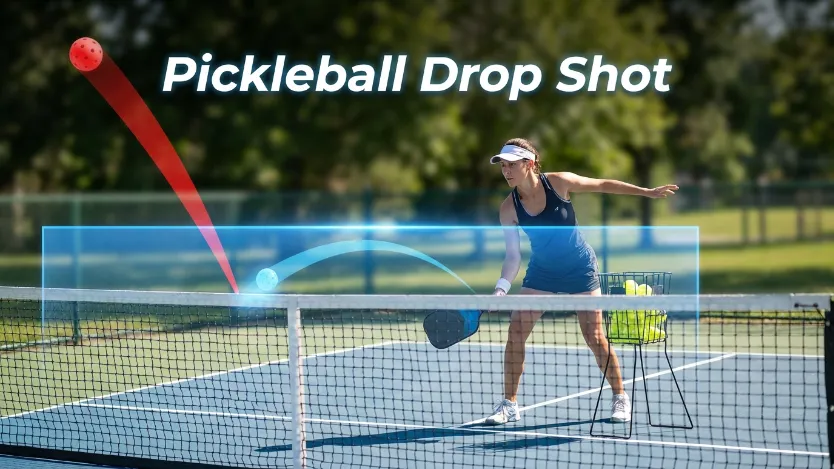
Step onto any competitive court in the United States, and you will quickly realize that the Pickleball Drop Shot is the ultimate gatekeeper of the game. While beginners rely on high-velocity drives to overwhelm opponents, advanced players know that the true battle for the kitchen is won with finesse, not just force. For the dedicated athlete aiming to break past the 3.5 skill plateau, the pickleball third shot drop is the most critical tool for neutralizing aggressive net players and securing a winning position.
However, simply “hitting the ball short” is no longer enough in the modern era of the sport. As equipment technology evolves and professional play becomes more aggressive, the nuances of the third shot drop pickleball have shifted. To master this transition, you must understand the biomechanics of “Zero Forward” swings, the thermodynamics of ball compression, and the strategic “Go Button” that determines when to charge the net. This guide explores the missing angles that standard tutorials overlook, providing a data-driven path to elite-level control.
The Strategic Dominance of the Pickleball Drop Shot in U.S. Competition
The dominance of the drop shot in pickleball within the American competitive scene isn’t just about playing “soft”; it is about tactical parity. In doubles play, the returning team starts with a massive positional advantage by already occupying the kitchen line. The pickleball third shot drop is the only high-percentage maneuver that forces those net-established opponents to “hit up” on the ball, effectively stripping away their ability to smash or drive for a winner.
For years, the drop shot pickleball was considered a mandatory “sacred” shot. However, the 2024-2025 pro circuit has seen a shift toward the “Third Shot Drive to Fifth Shot Drop” sequence. Data from the PPA Tour shows that pros are now driving nearly 51% of their thirds to setup a shorter, easier fifth-shot drop. Understanding this balance is vital. If you find yourself pinned at the baseline against heavy hitters, check our guide on the best pickleball paddles for advanced players to ensure your gear can handle the high-velocity resets required for this level of play.
Engineering the Perfect Arc: Biomechanics and “Zero Forward”
The performance of a successful pickleball third shot drop is rooted in the elimination of unnecessary variables. Unlike a drive, which requires a significant backswing to generate kinetic energy, a drop shot relies on a compact, pushing motion. To ensure you meet tournament-level standards, follow this strict engineering profile for your swing:
- The “Zero Forward” Concept: This technical fundamental dictates that there should be no “negative space” or backswing behind the body. By starting the paddle at “zero” (in front of the hips) and moving only into “positive space” (toward the net), you eliminate the timing errors that cause pop-ups.
- Shoulder-to-Ball Kinetic Chain: The wrist must remain stable and “quiet.” The motion should originate from the shoulder socket, similar to a cornhole toss, providing a consistent lever that translates to a predictable drop shot pickleball arc.
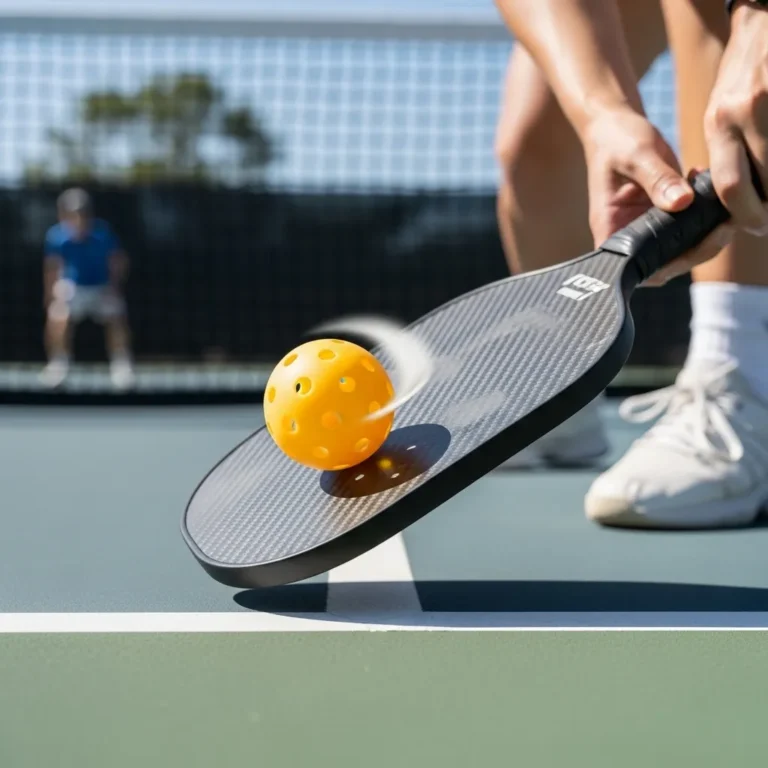
- Contact Point Timing: A common mistake is hitting the ball at its apex. For maximum control, advanced players wait for the ball to be “on the fall” (descending after the bounce) to scoop it with an open paddle face.
- Weight Distribution: Momentum must be going forward at impact. Falling backward during a third shot drop pickleball is a primary cause of hitting into the net.
When choosing equipment for this precision work, the 16mm core remains the gold standard. To understand why thickness matters for your “touch” game, read our breakdown of 14mm vs 16mm pickleball paddle technology.
Fluid Dynamics: Magnus Lift and Airflow Asymmetry
One of the “missing angles” in typical coaching is the physics of how a perforated plastic ball interacts with the air. A pickleball is essentially a ballistic object fighting constant drag. The 40 holes in an outdoor ball create air turbulence that differs significantly from the smooth surface of a tennis ball. This leads to two distinct aerodynamic behaviors:
1. The Magnus Effect and Downward Lift
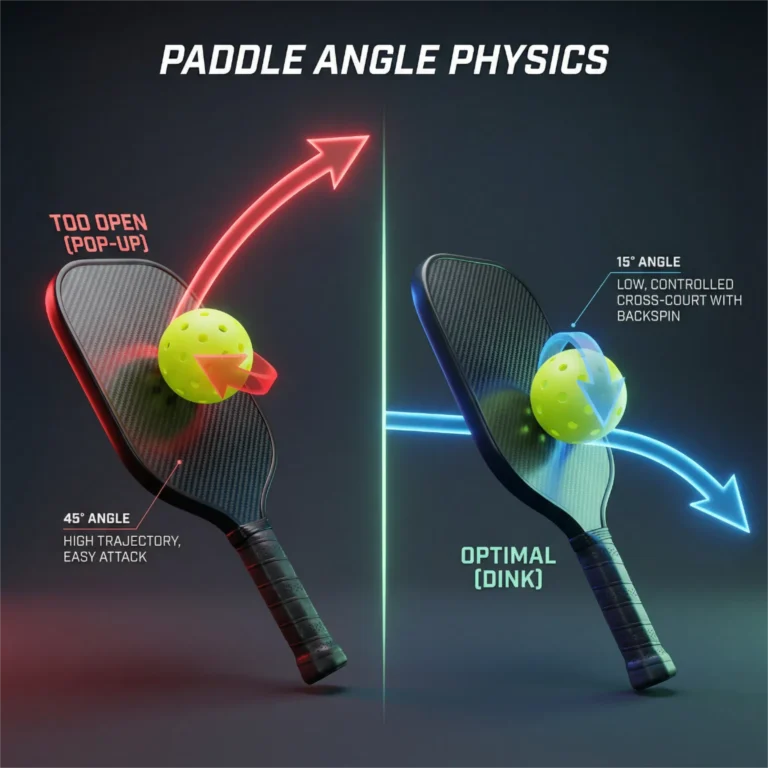
When you apply topspin to a pickleball third shot drop, you are utilizing the Magnus Effect. The advancing side of the ball (moving with the air) creates lower pressure, while the retreating side creates higher pressure. In pickleball, gravity actually reinforces topspin lift, compounding the downward force. This is why a “topspin drop” (often called a drip) dives more sharply over the net than a flat shot, allowing for a safer net clearance of 12-18 inches while still landing in the kitchen.
2. The “Hover” Threshold (Backspin)
Conversely, a slice drop shot (backspin) creates an upward lift that works against gravity. This can create a “hover” effect, making the ball appear to float or skid low upon landing. Pro players like Ben Johns often use a one-handed backhand slice drop with a 45-degree open paddle face to create a skidding bounce that is notoriously difficult for opponents to attack. To master these spin variations, practicing with dedicated pickleball drills is the only way to build the necessary tactile feel.
The “Invisible Decision”: The Traffic Light System
A critical gap in most drop shot pickleball guides is the lack of a decision-making matrix. Players often hit a great drop but stay at the baseline, or hit a terrible pop-up and rush the net. Advanced U.S. coaches use the “Traffic Light” system to solve this:
- Red Light (Stay Back): If your opponent’s paddle is high (above their shoulders), they are in an attacking position. Stay back, split step, and prepare for a 5th shot drop.
- Yellow Light (Proceed with Caution): If the opponent’s paddle is between waist and chest height, they can attack but with less power. Move to mid-court (the transition zone) and be ready for a reset.
- Green Light (The “Go Button”): If you see the button on the top of your opponent’s hat (meaning they have dropped their head to look at a low ball) or their paddle tip is below their knees, they MUST hit the ball upward. This is your signal to sprint to the kitchen.
Successful third shot drop pickleball play requires you to analyze your opponent’s body language more than your own ball. If you are struggling with the transition, consider using a pickleball machine to simulate these various return heights and practice your response timing.
Equipment Synergy: Choosing the Best Paddle for Control
The rise of “Gen 3” and “Gen 4” thermoformed paddles has introduced a “trampoline effect” that can make the Pickleball Drop Shot incredibly difficult to control for those without soft hands. For elite placement, you need a paddle designed for dwell time and vibration dampening. Here are the top contenders for 2025-2026:
- Selkirk LUXX Control Air: Utilizing the Infinigrit surface and a 20mm-equivalent feel from its ThickPolymer core, the Selkirk Luxx Control Air is arguably the best paddle on the market for players who prioritize the third shot drop.
- JOOLA Ben Johns Perseus 3S: While powerful, the Propulsion Core technology allows for a high degree of energy absorption on resets. It is the paddle of choice for the world’s #1 player to execute his signature 94% successful drop rate.
- Vatic Pro Prism Flash: For those on a budget, this non-thermoformed carbon fiber paddle offers a “plush” feel that makes hitting a consistent drop shot in pickleball feel effortless compared to stiff, power-oriented models.
For a complete list of gear that balances these needs, browse our ranking of the best pickleball paddles under 100 or explore the high-end best JOOLA pickleball paddles.
Internal Spacing: The 6-Foot Rule and Partner Coordination
Advanced players have learned that a pickleball third shot drop is a team effort. A frequent point-killer is “blind rushing”—where one partner charges the net while the other is still struggling with a deep return at the baseline. This creates a massive gap that opponents can exploit.
To fix this, implement the 6-Foot Rule: In doubles, partners should aim to stay within approximately 6 feet of each other laterally and stay on a similar horizontal plane during the advance. If your partner hits a “yellow” (mediocre) drop, do not leave them behind. Wait for the 5th shot reset, stabilize the point, and then move together as a “moving wall.” This strategy is officially recommended in the USA Pickleball Official Strategy Guide to maximize defensive coverage.
The “Drip” vs. The “Drop”: When to Use the Hybrid
A “missing angle” in modern play is the Third Shot Drip. Unlike the traditional arcing drop, the drip is a 60% power drive hit with extreme topspin. The goal is not to land it deep in the kitchen, but to have it cross the net flat and dive aggressively at the opponent’s feet as they are moving forward.
- Best for: Catching opponents who are “cheating” toward the net too early.
- The Mechanic: Use an Eastern Forehand Grip to close the paddle face slightly and “brush up” on the ball with a windshield-wiper motion.
- Brands for Spin: Paddles like the 6.0 Ruby or the best pickleball paddle for spin are essential for generating the RPMs required to make a “drip” dive before it goes long.
Pickleball Drop Shot-Frequently Asked Questions (FAQ)
How do I stop popping up my third shot drops when the ball is hit fast?
Popping up occurs because of “death-gripping” the paddle. When the ball is fast, your instinct is to tighten your hand, which turns the paddle into a springboard. Relax your grip pressure to a 3/10. Think of your paddle as a “pillow” that absorbs the pace rather than a “brick” that bounces it back.
Should I aim for the net tape or high above the net?
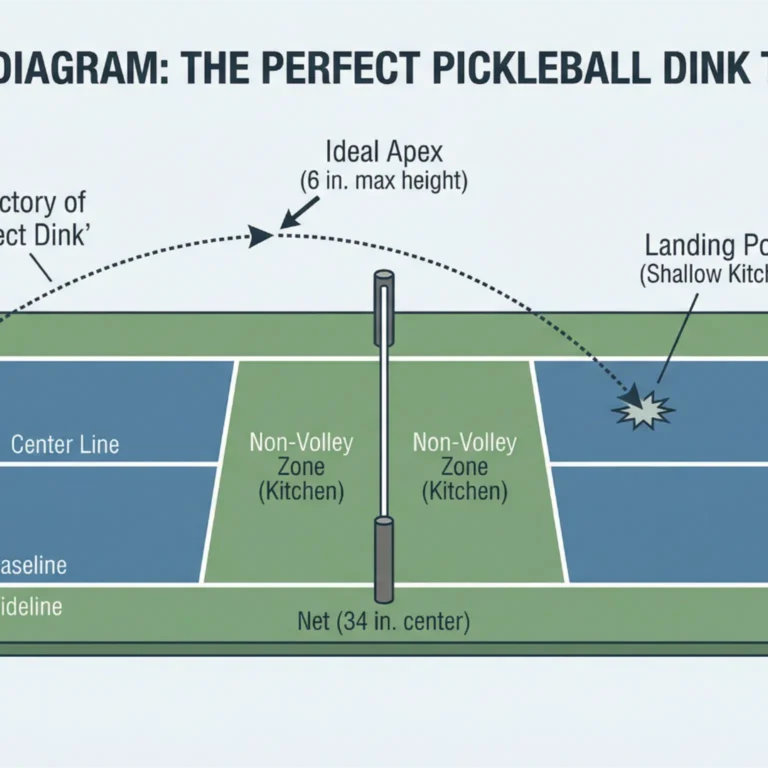
Flirting with the net tape is a high-risk strategy. Advanced players aim for an apex that is 1 to 2 feet above the net. It is always better to hit a slightly “high” drop that lands in the kitchen than to hit the net and end the point instantly. As you improve, you can lower the arc using topspin.
Why is it easier to hit a drop shot when it’s hot outside?
Thermodynamics plays a role. In temperatures above 75°F, the plastic of the ball becomes more ductile and soft. This increases the dwell time on your paddle, giving you more feel and control. In cold weather (below 50°F), the ball is “glassy” and fast, making the Pickleball Drop Shot significantly harder to touch-control.
Can I use a topspin drop with a Continental grip?
While possible, it is difficult. A Continental grip is neutral and best for flat drops or slice. For a heavy topspin drop shot pickleball, shifting to an Eastern grip allows you to close the paddle face naturally, ensuring the ball dives after the apex.
Conclusion: The Verdict on the Game’s Hardest Shot
The Pickleball Drop Shot remains the most difficult yet rewarding skill to master in the United States. While the pro game has introduced more power with the “third shot drive,” the ability to execute a soft, arcing pickleball third shot drop remains the only true way to neutralize a high-level opponent. By focusing on the biomechanical “Zero Forward” swing, understanding the aerodynamic Magnus Effect, and respecting the “Traffic Light” decision system, you can ensure your transition game is unshakeable.
Whether you are investing in a Selkirk Luxx Control Air or drilling the 7-Eleven drill on the weekends, remember that the goal of a drop is not a winner—it is the invitation to a fair fight at the kitchen line. Master the finesse, and the wins will follow.