
It’s the third game of the day. You are moving well, feeling confident, and ready to chase down a dink near the kitchen line. You plant your foot to stop and pivot—but instead of gripping the court, your foot slides inside your shoe, your ankle wobbles, and a sharp pain shoots up your shin. If this scenario sounds familiar, or if it’s your biggest fear on the court, you are not alone.
For many female players, the search for the perfect gear ends at the paddle. However, the most critical piece of equipment for safety and longevity isn’t in your hand—it’s on your feet. Choosing the right pair of women’s pickleball shoes is not just about fashion; it is a matter of biomechanics, safety, and game performance.
Unlike running, which is a linear, forward-motion activity, pickleball is a game of violent stops, starts, and lateral (side-to-side) cuts. If you are playing in standard trainers, you are risking injury. In this comprehensive guide, we will dive deep into the specific needs of female players, debunk the “running shoe” myth, and help you find the best women’s pickleball shoes for your specific foot shape and playing style.
Stop! Why You Should Never Wear Running Shoes for Pickleball
One of the most frequently asked questions by beginners is: “Can I just wear my Hoka or Brooks running shoes for pickleball?” The short answer is a definitive no.
Running shoes are engineered for one specific motion: moving forward. To achieve this, they utilize high-stack foam heels to absorb shock and flexible mesh uppers to allow airflow. While this feels like walking on clouds, it creates a dangerous instability on the pickleball court.
The Danger of Lateral Movement
Pickleball requires constant lateral agility. When you shuffle side-to-side in a running shoe, the soft mesh upper cannot contain your foot, causing it to slide over the midsole. Furthermore, the high platform of a running shoe raises your center of gravity. Combined with the lack of lateral support, this is a recipe for rolled ankles.
Wearing the wrong footwear is one of the leading causes of common pickleball injuries. Court shoes, by contrast, are designed with a lower profile and rigid sidewalls to lock your foot in place during aggressive lateral cuts.
The “Shrink and Pink” Problem: Understanding Women’s Specific Fit
For years, the athletic industry simply took men’s shoes, made them smaller, and colored them pink. However, female biomechanics are fundamentally different, and the modern market for women’s pickleball shoes is finally catching up.
The Q-Angle Factor
Women generally have wider hips than men, which creates a larger “Q-Angle” (the angle between the hip and the knee). This anatomical difference puts more stress on the knees and ACL during pivoting movements. Therefore, women often require shoes with enhanced torsional stability (resistance to twisting) to keep the knee aligned with the foot.
The Shape of the Female Foot
A true “Women’s Last” (the mold used to shape the shoe) differs from a unisex or men’s mold. Women typically have:
- Narrower Heels: Standard shoes often cause heel slippage for women.
- Wider Forefeet: Women need room in the toe box for metatarsal spread.
- Higher Arches: Requiring specific midfoot support.
Brands that understand this offer superior fit, reducing the friction that causes blisters and the instability that causes falls.
Top Brand Comparison: Asics, Nike, & The Specialized Contenders
Finding the best women’s pickleball shoes often comes down to brand loyalty and foot shape. However, not all court shoes are created equal. Let’s break down the heavy hitters.
Asics: The Queen of Stability
Asics has long been the gold standard for court sports, and they have successfully transitioned their tennis dominance into pickleball. If stability is your priority, Asics pickleball shoes are often the safest bet.
The Great Debate: Gel-Renma vs. Gel-Resolution
Many female players ask about the difference between these two popular models:
- Gel-Resolution (Tennis Line): These are built like tanks. They are heavier, stiffer, and offer maximum stability. If you have a history of ankle rolls, this is your shoe.
- Gel-Renma (Pickleball Specific): These are designed specifically for the movements of pickleball. They are lighter and more flexible than the Resolutions, allowing for quicker dink-battles at the kitchen line, but with slightly less ankle rigidity.
Nike: The Choice for Speed (and Narrow Feet)
If you prioritize speed and feeling “light on your feet,” Nike pickleball shoes women’s lines, specifically the Zoom Vapor series, are incredibly popular. Nike uses their “Zoom Air” technology to provide responsive cushioning that propels you into your next step.
Fit Warning: Nike notoriously runs narrow. If you have a wide foot or bunions, you may find Nikes constricting. However, for players with narrow heels who struggle with slippage in other brands, Nike offers a glove-like fit that is hard to beat.
The Comfort Kings: K-Swiss and Skechers
For players who prioritize comfort above all else, or who have wider feet, two brands stand out.
K-Swiss: Known for their “DragGuard” durability and generous fit. Many of their models are naturally wider in the toe box, making them a favorite for older players or those with foot sensitivities. You can read more about their specific technologies in our guide to K-Swiss pickleball shoes.
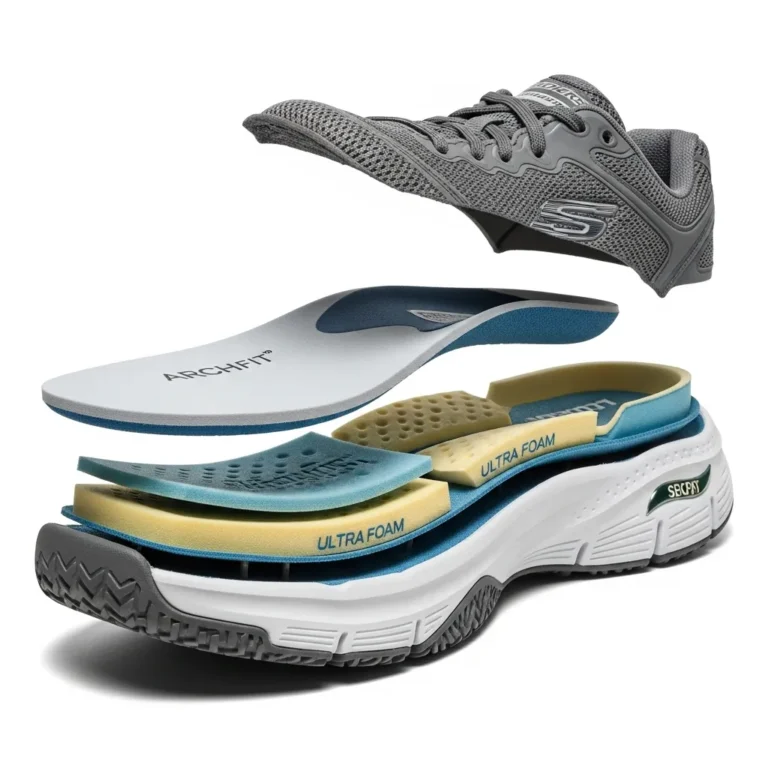
Skechers: The Viper Court series has taken the pickleball world by storm. They are incredibly lightweight and feature the “Arch Fit” insole, which is certified by podiatrists. If you suffer from flat feet or need immediate step-in comfort without a break-in period, Skechers pickleball shoes are a top-tier option.
Solving Pain Points: Knees, Heels, and Toes
Even with the best shoes, pain can occur if the fit isn’t right. Here are the most common questions women ask regarding foot pain and how to solve them.
The “Pickleball Toe” Phenomenon
Question: “Why do my big toes turn black and blue after a tournament?”
Answer: This is known as “Pickleball Toe” or “Tennis Toe.” It happens when your foot slides forward inside the shoe during a hard stop, jamming your toes against the front of the shoe.
The Fix: You likely need to size up. A general rule of thumb for women’s pickleball shoes is to have a full thumbnail’s width of space between your longest toe and the end of the shoe. This often means buying a shoe that is a half-size larger than your everyday street shoes. Additionally, using a “Runner’s Loop” lacing technique can lock your heel back, preventing the forward slide.
Plantar Fasciitis and Knee Pain
If you suffer from heel pain (Plantar Fasciitis) or sore knees, your instinct might be to find the softest, squishiest shoe possible. However, too much cushioning can be detrimental. Extremely soft foam creates instability, forcing your micro-muscles to work harder to balance, which fatigues the legs.
Instead, look for a shoe with a Rigid Heel Counter (the plastic cup around the heel). This locks the heel bone in place, supporting the arch and reducing strain on the plantar fascia. Pair this with proper pickleball socks that have extra padding in high-impact areas to reduce friction and blistering.
Indoor vs. Outdoor: Don’t Ruin Your Soles
A critical mistake many players make is wearing the wrong outsole for the court surface. Pickleball is played on two very different surfaces, and your shoes need to match.
The Gum Rubber Mistake
Question: “Can I wear my indoor gum-sole shoes on an outdoor court?”
Answer: You can, but you will regret it. “Gum rubber” (the brown, sticky soles often seen on volleyball or squash shoes) is designed for smooth, wooden, or composite indoor gym floors. If you take these to an outdoor court (which is essentially sandpaper-textured concrete), the asphalt will shred the soft rubber within a few weeks. Furthermore, gum rubber can become dangerously sticky on hot outdoor courts, leading to tripping.
Durability Expectations
Question: “How long should my shoes last?”
Answer: If you play outdoors 3 times a week, a standard pair of court shoes will typically last 4 to 6 months. The outsole tread is usually the first thing to go. However, pay attention to the midsole compression. Even if the tread looks fine, if the foam has collapsed, you will start feeling more shock in your knees and lower back. This is your sign to replace them.
For outdoor play, look for shoes labeled with “High Abrasion Rubber” (like Asics AHAR or Nike XDR). Some premium models even offer a 6-month outsole durability warranty, which is a great value for heavy users.
FAQ: Quick Answers for Female Players
1. Do beginners really need specific court shoes?
Yes. Even at a beginner level, the risk of falling is high because you are not yet used to the footwork. A pair of entry-level court shoes is cheaper than a visit to the ER for a sprained ankle.
2. Which women’s pickleball shoes have the widest toe box?
If you have bunions or a wide forefoot, K-Swiss and specialized brands like Tyrol or Fitville are generally the most accommodating. New Balance also offers many of their court shoes in Wide (D) and Extra Wide (2E) widths for women.
3. Do I need to break in my pickleball shoes?
It depends on the material. Shoes with heavy synthetic leather uppers (often more stable) may require 2-3 hours of play to soften up. Mesh-heavy shoes (like Skechers) usually feel good right out of the box but may offer less long-term support.
Conclusion: Invest in Your Foundation
The rise of pickleball has brought an incredible variety of footwear options to the market. Whether you need the locked-in stability of Asics women’s pickleball shoes, the speed of Nike pickleball shoes women’s models, or the comfort of a wide-fit K-Swiss, the perfect shoe is out there.
Remember, your feet are your foundation. By selecting a shoe that addresses your specific biomechanical needs—rather than just picking the cutest colorway—you are investing in your longevity on the court. Check your shoes today: if the tread is bald or the heel is soft, it’s time for an upgrade.
For more information on approved gear and safety standards, you can visit the USA Pickleball official website.