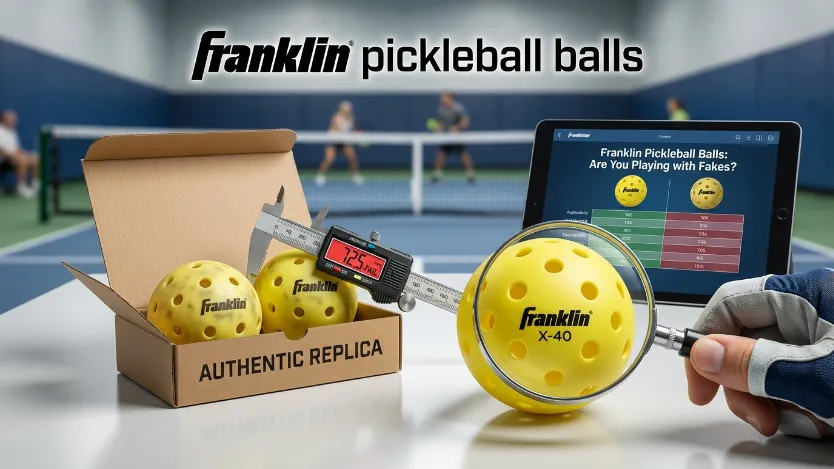
Walk onto any public court from the sun-drenched parks of Florida to the high-altitude hubs of Denver, and you will immediately recognize the distinct optic yellow glow of Franklin pickleball balls. While the sport has exploded with hundreds of new equipment brands, the Franklin X-40 remains the undisputed “Standard” of the American game.
It is the official ball of the US Open Pickleball Championships and the APP Tour, serving as the benchmark against which every other ball is measured. However, for the dedicated player, there is more to this ball than just its tournament pedigree. To truly master your game, you need to understand the material science, thermodynamic limits, and hidden degradation patterns that most franklin x-40 outdoor pickleball balls reviews simply overlook.
The Cultural Dominance of Franklin Pickleball Balls in the U.S.
The dominance of Franklin pickleball balls in the United States isn’t merely a result of clever marketing; it’s a result of consistency. In a sport where court surfaces vary and wind can ruin a match, players crave predictability. The franklin x-40 pickleball balls became the “Goldilocks” of the industry—not as blindingly fast as the Onix Dura Fast 40, yet significantly more performance-oriented than soft indoor varieties. This balanced profile has led to a state of “standardization” where showing up to open play with any other brand can often result in complaints from competitive regulars.
Engineering the “Perfect” Bounce: Materials and Specifications
The performance of the franklin x 40 outdoor pickleball balls is rooted in its manufacturing process. Unlike cheaper, two-piece balls that are glued together, Franklin utilizes rotational molding (roto-molding). This creates a single-piece, seamless construction that eliminates the weak points often found in fused alternatives. To ensure they meet USA Pickleball approved standards, Franklin adheres to a strict engineering profile:
- Weight: Precisely 26 grams (approximately 0.92 ounces), providing enough mass to cut through the wind without feeling like a “rock.”
- Diameter: 74mm, the industry standard for outdoor play.
- Hole Pattern: 40 machine-drilled holes. Drilling these holes after molding, rather than molding them into the shape, ensures a cleaner edge and a more stable flight path.
- Material: A proprietary blend of high-grade Polyethylene (PE) designed for a balance between stiffness and “give.”
When choosing equipment, it’s vital to distinguish between these and the franklin x-26, which is the indoor counterpart. For a deeper look at how these designs differ, check our guide on indoor vs outdoor pickleballs.
Thermodynamics: The 50°F and 80°F Thresholds
One of the “missing angles” in standard reviews is the ball’s extreme sensitivity to temperature. The molecular structure of Polyethylene relies on Van der Waals forces. These electrical attractions between polymer chains change drastically depending on the ambient air temperature, leading to two distinct performance failures known to seasoned pros.
1. The “Mushy” Effect (Above 80°F)
When temperatures climb in states like Arizona or Texas, the electrons within the PE chains become more active, increasing the distance between molecules. This makes the franklin x 40 outdoor pickleball balls significantly more ductile. Players describe the ball as feeling “spongy” or “mushy.” From a physics standpoint, the ball deforms too much upon impact, dissipating energy as heat rather than kinetic speed. This results in a slower game where “bangers” struggle to put the ball away.
2. The “Glass” Threshold (Below 50°F)
Conversely, as the mercury drops, the PE chains tighten and become brittle. Once you hit the 40°F to 45°F range, an X-40 essentially turns into glass. High-velocity impacts—such as overhead slams—will cause the ball to shatter or develop large cracks instantly. This is why many Northern U.S. clubs switch to the Selkirk Pro S1 or Onix Fuse during winter months, as those balls use a more flexible polymer blend that resists cold-weather cracking.
The “Invisible Failure”: 10% Stiffness Loss per Hour
A critical gap in the market’s understanding of Franklin pickleball balls is the rate of structural decay. Independent testing has shown that an X-40 loses roughly 10% of its compressive stiffness for every hour of aggressive 4.0+ level play. Because the ball is durable enough not to crack immediately, many players keep using it long after it has “died.”
By the third hour of play, the ball often develops soft spots. These are areas where the internal polymer lattice has broken down, but the exterior looks fine. This leads to erratic bounces and a loss of “pop” off the paddle face. To maintain a tournament-level experience, competitive players should rotate in a fresh ball every 10–12 games. If you’re looking for alternatives that might hold their shape longer, browse our list of the best outdoor pickleball balls.
The Amazon Problem: Spotting Fake Franklin X-40 Pickleball Balls
Due to the massive demand in the U.S. market, counterfeit franklin x-40 pickleball balls have become a rampant issue, especially with commingled inventory on platforms like Amazon. Fakes are often made using cheap injection molding, which results in a fused two-piece ball that plays nothing like the original.
The Authenticity Checklist:
- The Interior Seam Test: Look through one of the holes under a bright light. A genuine roto-molded Franklin will be smooth inside. If you see a raised seam line running around the internal “equator,” you have a fake.
- The Logo Wear: Franklin recently moved to a black printed logo. While this logo wears off quickly (sometimes in just 3 games due to court grit), a fake ball’s “X” stamp is often offset, crooked, or lacks the slightly depressed molding of the original.
- Bounce Height: Drop a suspected ball from 75 inches onto concrete. A genuine X-40 should rebound approximately 30–34 inches. Fakes often bounce significantly higher or lower due to inconsistent wall thickness.
Head-to-Head: Franklin X-40 vs. The New Challengers
While Franklin is the standard, 2025 and 2026 have seen the rise of “Franklin Killers” designed to fix the X-40’s flaws. Here is how they stack up:
- Lifetime Pro 48: The newest heavyweight. It features 48 holes and is significantly faster and more wind-resistant than the X-40. John Kew’s high-speed camera tests show the Pro 48 reshapes almost instantly upon impact, whereas the X-40 stays deformed longer, which can cause “funky” bounces on high-speed drives.
- Selkirk Pro S1: Known for its “never-crack” guarantee. It handles cold weather better than the Franklin but has a notorious tendency to go “out of round” (becoming egg-shaped) after several games of heavy spin.
- Onix Dura Fast 40: The choice for pure power. It is stiffer and faster but cracks much easier than the Franklin. In the U.S., the “Dura vs. Franklin” debate is the ultimate “Power vs. Finesse” argument.
- Joola HC-40: A high-quality imitation that aims to replicate the X-40 feel with slightly better cold-weather durability, though it hasn’t yet achieved the same level of tournament acceptance.
Beginner Gear: The Franklin Pickleball Paddle and Ball Set
Many U.S. players enter the sport by purchasing a franklin pickleball paddle and ball set from big-box retailers like Target or Walmart. While these sets almost always include the professional-grade X-40 balls, there is often a quality gap with the paddles.
Entry-level paddles in these bundles are typically made of wood or low-end fiberglass with spray-on grit. This grit wears off almost immediately, leaving you with a slick surface that cannot generate spin. While they are excellent for “backyard” play, ambitious players will quickly find their skill level “plateauing” because the equipment can’t handle the spin and reset shots required for 3.5+ play. If you are serious about improving, upgrading to a Franklin Signature pickleball paddle or a dedicated pickleball paddle set with carbon fiber faces is a necessary investment.
Internal Cracking: The “Aha!” Moment
Advanced players have learned to identify a failed ball before it actually splits. Most X-40s develop hairline cracks on the interior edges of the machine-drilled holes first. These micro-fractures weaken the structure, leading to a “dead” sound on impact. If you and your partner find yourselves questioning a bounce that seemed “off,” stop the rally and inspect the holes. Even if the ball isn’t in two pieces, an internal crack means the aerodynamics and bounce height are compromised.
Sustainability and the Veolia Recycling Program
A growing concern in the American pickleball community is the environmental impact of millions of cracked plastic balls heading to landfills. Franklin has begun participating in programs like P3 Cares and partnerships with Veolia. At major tournaments, you will now see dedicated recycling bins. Cracked balls are ground down and repurposed into engineered fuel for cement kilns or industrial materials. As a responsible player, check if your local club has a collection bin to help “greenify” the fastest-growing sport in America.
Expert Tips for Maintenance and Storage
To get the most out of your investment in Franklin pickleball balls, follow these U.S. pro storage tips:
- Avoid the Trunk: Never leave your balls in a hot car trunk. In summer, temperatures can reach 150°F, which can permanently warp the ball’s roundness even without play.
- The “Pocket Warm” Trick: In cold weather (40°F-50°F), keep your spare balls in your pockets close to your body heat. Rotating a “warm” ball into the game can prevent it from shattering on the first overhead slam.
- The Roll Test: Every few games, roll your ball across a flat kitchen floor. If it wobbles or doesn’t roll in a perfectly straight line, it has gone “out of round” and should be retired to the practice hopper.
Frequently Asked Questions (FAQ)
How many games do Franklin X-40 balls usually last?
For casual recreational play, a Franklin X-40 can last 20–30 games. However, for competitive 4.0+ players who hit with high velocity and spin, the ball typically loses its “true” bounce and stiffness after 10–12 games (approximately 3 hours of play) and should be replaced.
Why are Franklin pickleball balls more expensive than generic brands?
The price reflects the rotational molding process and official USAPA certification. Roto-molding ensures a one-piece, seamless construction which is significantly more durable and balanced than the two-piece injection-molded balls sold by generic “no-name” brands on Amazon.
What is the best temperature for playing with X-40s?
The ideal temperature range is between 60°F and 75°F. Below 50°F, the balls become brittle and crack easily. Above 85°F, they become soft and play significantly slower, often described as feeling “mushy.”
Are the different colors (Optic Yellow, Lava, Pink) different in performance?
Technically, the material is identical across all colors. However, some advanced players claim the Lava (Orange) balls feel slightly firmer. The primary difference is visibility; Optic Yellow is best for most outdoor courts, while Pink or Lava can offer better contrast against certain blue or red court surfaces.
Can I use outdoor Franklin X-40 balls for indoor play?
You can, but it is not recommended. Outdoor balls are heavier and harder, which leads to dangerously fast rallies and “skidding” on smooth wooden gym floors. For indoor gym surfaces, the 26-hole Franklin X-26 is the safer and more appropriate choice.
Conclusion: The Verdict on America’s Favorite Ball
The Franklin X-40 remains the backbone of the American pickleball scene for a reason. Its blend of durability, predictable flight, and massive availability makes it the safest bet for players of all levels. However, as the sport matures, so must our understanding of our gear. By recognizing the 10% hourly stiffness loss, avoiding the 50°F brittle zone, and knowing how to spot commingled fakes on Amazon, you can ensure that your equipment never holds back your performance on the court.
Whether you are buying a franklin pickleball paddle and ball set to get started or stocking up on 100-packs of franklin x-40 pickleball balls for tournament prep, remember that the ball is the only piece of equipment that touches every single point. Treat it with the scientific respect it deserves, and your game will thank you.