By 2026, the question in the United States is no longer “Who plays pickleball?” but rather, “What is in your bag?” As the sport transitions from a backyard pastime into a multi-billion-dollar professionalized industry, the list of items needed for pickleball has evolved from simple wooden paddles into a high-tech ecosystem of carbon fiber, aerospace-grade polymers, and smart sensors. Whether you are a “Dink Master” at a local pickleball dink session or an aspiring pro, understanding the technical nuances of your equipment is the difference between a winning streak and a trip to the physical therapist.
This guide goes beyond the superficial “buy a paddle and ball” advice found on most retail sites. We dive into the “missing angles”—the technical failures like core crushing and delamination, the science of out-of-round balls, and the legalities of noise-compliant gear that are dominating the US courts in 2026.
1. The Paddle Revolution: Choosing Your “Engine”
In 2026, the paddle is treated more like a precision instrument than a simple racket. While beginners often start with value-tier options, intermediate and advanced players are increasingly looking for thermoformed pickleball paddles which utilize heat and pressure to fuse the face and core into a single, seamless unibody structure.
The Material Science: T700 Carbon Fiber and Beyond
The standard for 2026 is Toray T700 Raw Carbon Fiber. Unlike painted surfaces that wear down in weeks, raw carbon fiber uses a microscopic texture to “bite” the ball. However, a major missing angle in most guides is the “Spin Decay” factor. Research shows that even premium carbon fiber surfaces can lose up to 50% of their friction after just 50 hours of competitive play. To maintain your edge, you must use a Pickleball Paddle Eraser to remove plastic fiber buildup from the ball, which acts as a “silent performance killer” by smoothing out the grit.
The Core Debate: 14mm vs. 16mm
One of the most frequent questions on US forums is the trade-off between power and control. It essentially boils down to the 14mm vs 16mm pickleball paddle comparison:
- 16mm (Thick Core): Preferred for control. The thicker honeycomb structure increases “dwell time,” allowing the ball to sink into the face for better placement and a larger Sweet Spot.
- 14mm (Thin Core): Designed for “bangers.” It offers less vibration dampening but provides higher Exit Velocity and faster hand speed at the kitchen line.
Before purchasing, always consult the USA Pickleball approved paddle list to ensure your gear is legal for tournament play, as Gen-3 and Gen-4 innovations often push the limits of the “trampoline effect” (PBCoR) limits.
2. Ball Consistency: Detecting the “Out-of-Round” Phantom
A ball is just a ball, right? Wrong. In the US market, 2026 has seen a divide between the Franklin X-40 (the standard for consistency) and the Dura Fast 40 (the choice for speed). When looking for the best outdoor pickleball balls, you are looking for a weight between 0.78 and 0.935 ounces with 40 precision-drilled holes to resist the wind.
The “Spin Test” for Roundness
A missing angle in current consumer advice is how to check for Out-of-Round balls. Over time, or due to extreme temperature shifts in states like Arizona or Florida, a plastic ball will become “egg-shaped” before it actually cracks.
The Hack: Hold the ball between your fingers and spin it into the air. If you see a visible “wobble” or “shimmer,” the ball is no longer a perfect sphere. An out-of-round ball will dive or sail unpredictably, ruining your high-stakes dink rallies.
3. Footwear: The “Lateral Support” Life-Saver
If you take one piece of advice from this 2026 guide, let it be this: Stop wearing running shoes on the court. Running shoes are engineered for forward motion and high heel-to-toe drops. In pickleball, you are moving side-to-side (lateral movement). The high stack height of a running shoe creates a leverage point that is the primary cause of rolled ankles and Achilles tendon ruptures.
You need the best shoes for pickleball, which feature:
- Rigid Lateral Walls: To hold your foot in place during sudden stops.
- Non-Marking Gum Rubber: Essential if you are playing at an indoor facility like Lubbock Indoor Pickleball.
- Reinforced Toe Guards: Essential for “toe-draggers” who serve with an aggressive forward lunge.
4. The Quiet Category: Navigating HOA and Sound Regulations
Pickleball noise has become a major legal issue across the United States. In response, the USA Pickleball Association launched the “Quiet Category” certification in late 2023, which has fully matured in 2026. For those playing in noise-sensitive residential areas, “Quiet Approved” gear is now a mandatory entry in the list of items needed for pickleball.
To be certified, a paddle must register:
- Decibel Level: Below 80 dB (Standard paddles are often 85+ dB).
- Hertz Level (Pitch): Below 600 Hz. This creates a low “thump” rather than the sharp, annoying “ping” that triggers noise complaints.
5. Customization Hacks: Lead Tape and Grip Science
Professional players rarely use a paddle “off the shelf.” They customize the Swing Weight and Twist Weight using lead or tungsten tape.
The Pro Strategy:
- Top Edge (12 o’clock): Increases power and “head heaviness” but slows down hand speed.
- Sides (3 and 9 o’clock): Increases Twist Weight, making the paddle more stable on off-center hits. This effectively expands your sweet spot.
- Handle (Counterbalancing): Adding weight under the grip can make a head-heavy paddle feel more maneuverable.
Additionally, don’t overlook the Pickleball Overgrip. In the humid summers of the Midwest or the South, a “tacky” overgrip is essential to prevent the paddle from flying out of your hand. Experts recommend replacing overgrips every 10-15 hours of play to maintain tactile feedback.
6. Maintenance: Detecting Delamination and Core Crushing
In 2026, the two biggest controversies in equipment are Delamination and Core Crushing. Most players assume their paddle is fine as long as the face isn’t cracked, but internal failures are more common.
The “Tap Test” and “Crunch Test”
- Delamination: This happens when the adhesive bonding the carbon face to the honeycomb core fails. It creates a “trampoline effect,” launching the ball with illegal and dangerous power. You can detect this by a loud, metallic “pop” sound that differs from the rest of the paddle.
- Core Crushing: This is the internal collapse of the polymer cells. Over time, the core becomes “mushy.” You can diagnose this with the Crunch Test: apply firm pressure to the sweet spot with your thumb. If you hear a faint crunching sound or feel the surface “give” inward, the core is dead and the paddle needs to be retired.
7. Protection and Apparel: The Overlooked Essentials
The 2026 player is a “protected” player. As ball exit speeds reach record highs, best pickleball glasses are no longer optional for competitive doubles.
The Missing Angle: Avoid polarized lenses. While great for fishing, polarization can distort depth perception when tracking a ball moving at 60 mph from 14 feet away. Opt for clear or high-contrast “tinted” non-polarized lenses.
Regarding apparel, look for “Smart Pockets.” Standard gym shorts place ball pockets in the front, which interferes with your hip rotation during a drive. 2026 pickleball-specific shorts place pockets behind the hip to keep the ball secure and out of the way of your swing path.
Pickleball Gear FAQ: Expert Insights for 2026
Q: Why shouldn’t I use my expensive running shoes for pickleball?
Running shoes are designed for linear (forward) motion and lack the lateral stability needed for the side-to-side shuffling in pickleball. Their high soles increase the risk of ankle rolls. Always opt for court-specific best shoes for pickleball.
Q: How do I know if my paddle core is “crushed”?
Perform the “Tap Test.” Lightly tap your paddle face with your knuckles. If you hear a dull, hollow thud instead of a crisp “thwack,” or if you feel a soft spot when pressing your thumb into the center, the internal honeycomb structure has likely failed.
Q: Is there really a difference between a $100 and $250 paddle?
In 2026, the gap is closing. However, $200+ paddles usually feature thermoformed pickleball paddles construction, which offers better durability, a larger sweet spot, and more consistent “pop” than cheaper, non-thermoformed versions.
Q: Where should I place lead tape for the best results?
For beginners, placing tape at the 3 and 9 o’clock positions is best as it stabilizes the paddle and reduces twisting. Advanced players wanting more power should place it at the 12 o’clock position (the tip).
Q: Are “Quiet” paddles less powerful?
Initially, yes. But 2026 technology, such as the **Diadem Hush** or **Quiet Play** series, uses specialized foam-injection and thick polymer cores to reduce sound without sacrificing the competitive “pop” required for high-level play.
Conclusion: The Final Gear Checklist
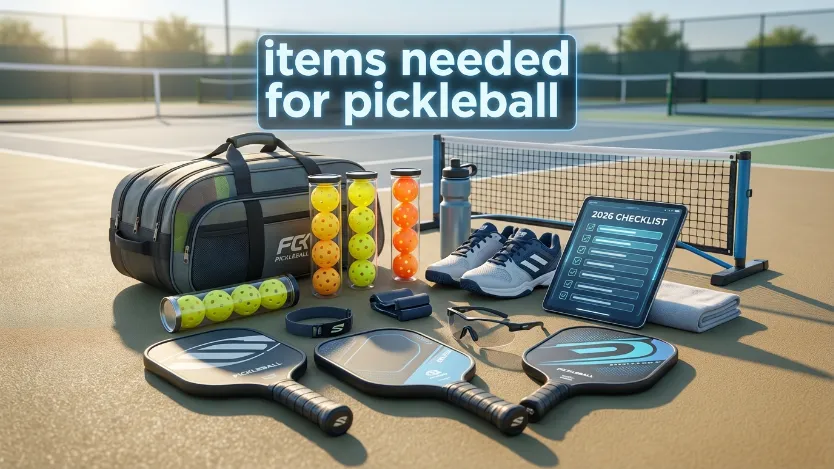
To summarize, a complete list of items needed for pickleball in 2026 includes more than just a paddle. To play safely and competitively in the US, ensure your pickleball bag contains the following:
- A thermoformed or USAPA-approved carbon fiber paddle.
- Court-specific shoes with lateral support.
- A mix of indoor and outdoor balls (and a spin-test routine).
- Non-polarized protective eyewear.
- Lead or Tungsten tape for balance adjustments.
- A Paddle Eraser to maintain surface grit.
By optimizing your gear ecosystem, you aren’t just buying equipment—you are buying confidence on the court. See you at the kitchen line!