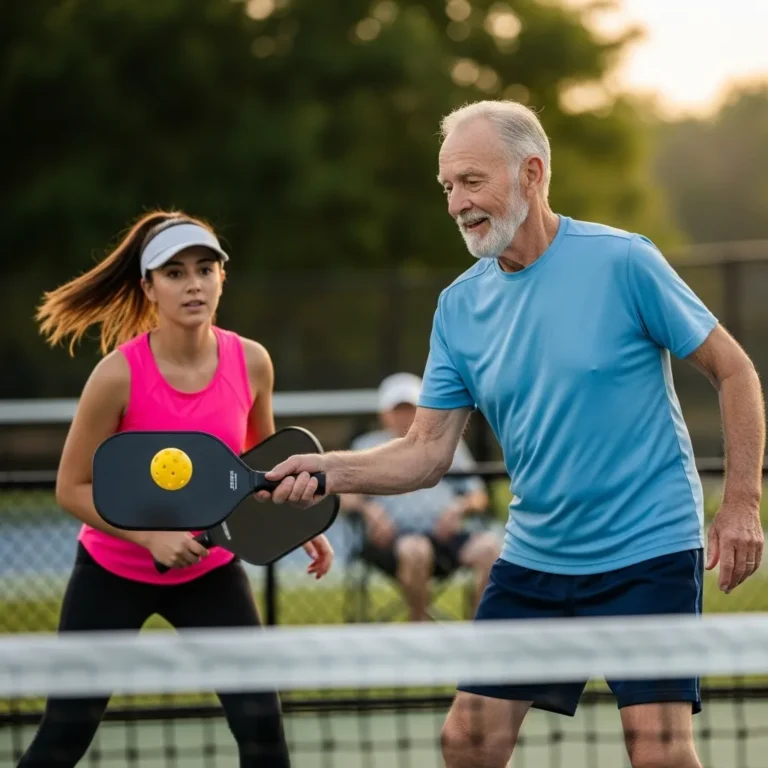
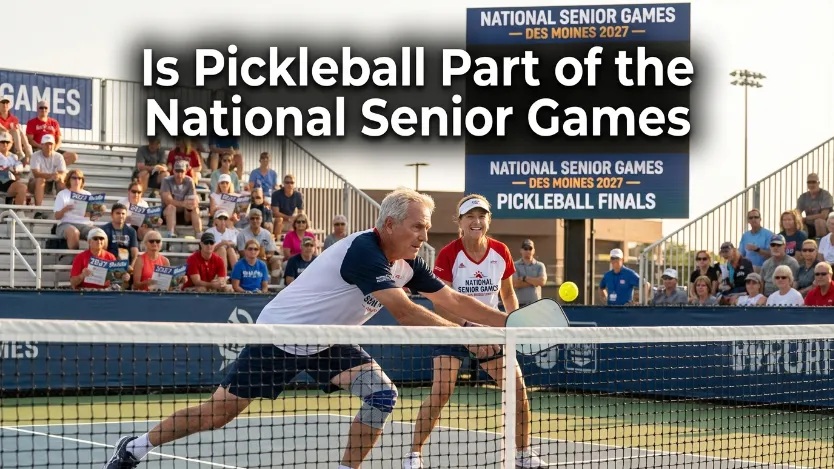
Walk onto any championship court during the biennial cycle of the National Senior Games, and you will immediately recognize that this is no longer just a “social hour” at the local park. While the sport began as a backyard hobby, it has evolved into a professional-grade institutional movement. For those asking, is pickleball part of the national senior games, the answer is a resounding yes, but with a level of regulatory rigor that often catches recreational players off guard.
The National Senior Games Association (NSGA) has transformed the sport into a masterpiece of competitive aging. However, many athletes fail to qualify because they overlook the “missing angles” of the rulebook—such as the 10% hourly ball stiffness decay or the strict “shirt-color” visibility mandates. To truly master your journey to the podium, you must understand the material science, thermodynamic limits, and the specific game pickleball standards that define elite senior play in the United States. Whether you are aiming for Des Moines in 2025 or Tulsa in 2027, the difference between a “Golden Ticket” and a spectator pass lies in the details of the pickleball games you play today.
The Biennial Competition Architecture: The 2026/2027 Cycle
The rhythm of senior play in the U.S. is dictated by a distinct two-year cycle that separates even-numbered “Qualification Years” from odd-numbered “National Games Years.” For the upcoming 2027 National Senior Games in Tulsa, athletes must secure their spots during the 2026 calendar year at sanctioned State Senior Games. Unlike many other disciplines where the top four finishers qualify, the explosive popularity of the game pickleball has necessitated a more restrictive “Top Three” rule.
In a sport where court surfaces vary and wind can ruin a match, players crave predictability. This is why understanding the pickleball skill levels is critical before entering a state qualifier. The NSGA utilizes a specific matrix: Division I (4.5+), Division II (4.0), Division III (3.5), and Division IV (3.0 and below). One “invisible” rule often missed is the Age-as-of requirement: your competitive age is determined by your age on December 31st of the National Games year, not the qualification year. This forward-looking calculation ensures that athletes compete in the correct five-year age bracket (e.g., 50-54, 55-59) for the duration of the championship.
Advanced Equipment Integrity: Starrett SR300 and Ultrasonic Diagnostics
The performance of pickleball games at the national level is rooted in equipment integrity. Unlike local “hit-and-giggle” tournaments, the NSGA implements random paddle testing using high-precision instruments. This is a significant knowledge gap for many athletes who believe a simple “USAP Approved” stamp is enough to clear inspection. If you are using best pickleball paddles for advanced players, you must ensure they have not degraded into “illegal” territory through wear or modification.
- Surface Roughness (Starrett SR300): Officials use this tool to measure the friction coefficient of the paddle face. The regulatory limit is an Rz of 30 microns. Excessive roughness allows for “unnatural” spin, which can lead to immediate match forfeiture.
- Core Integrity (Olympus BondMaster 600): This ultrasonic bond tester is used to detect “delamination” or “core crush.” If the internal honeycomb core has separated from the face—creating a trampoline effect—the paddle will fail the 50% bond failure threshold.
- Ball Compression (The 10% Rule): Independent testing shows that tournament balls like the Franklin X-40 lose roughly 10% of their compressive stiffness for every hour of aggressive 4.0+ play. At the National Games, balls are rotated frequently to ensure the bounce remains within the 30–34 inch rebound standard.
Before arriving at a qualifier, it is vital to consult the usa pickleball approved paddle list to verify that your specific model hasn’t been flagged for recent manufacturing non-compliance.
Thermodynamics of Play: The 50°F and 80°F Thresholds
One of the “missing angles” in standard guides is the extreme sensitivity of the ball to ambient temperature. Most senior athletes train in climate-controlled indoor hubs, but state qualifiers are often held in outdoor facilities where the molecular structure of the ball’s Polyethylene changes. These thermodynamic shifts create two distinct performance failures known to seasoned pros but rarely discussed in casual circles.
1. The “Mushy” Effect (Above 80°F)
When temperatures climb in states like Arizona or Florida, the ball deforms too much upon impact, dissipating energy as heat rather than kinetic speed. This results in a slower game where “bangers” struggle to put the ball away. In these conditions, mastering the “soft game” and strategic resets becomes the only viable path to victory.
2. The “Glass” Threshold (Below 50°F)
Conversely, as the mercury drops below 50°F, the polymer chains tighten and become brittle. High-velocity impacts can cause the ball to shatter or develop hairline micro-fractures on the edges of the machine-drilled holes. Pros often use the “Pocket Warm” trick, keeping spare balls in their pockets to maintain core temperature and prevent on-court breakage.
Regulatory Nuances: Partner Replacements and Out-of-State “Medal Hunters”
A frequent point of frustration on social forums like Reddit is the complexity of partner rules. If a qualified doubles partner is unable to compete due to a valid medical reason, they may be replaced after the registration deadline. However, the new partner must have already qualified in the sport of pickleball at a state games during that same cycle. This prevents teams from “upgrading” their roster with a high-level player who bypassed the qualification process.
Furthermore, the NSGA addresses the “Open State” phenomenon. While athletes are encouraged to play in their home state, many travel to neighboring regions to secure a spot. To protect local talent, the NSGA reserves four qualifying spots for in-state residents who may have been bumped from the podium by out-of-state competitors. For more tips on managing your tournament journey, see our guide on one more fun game pickleball strategies.
Bracketing and the “Higher Skill, Younger Age” Mandate
To ensure equitable competition, the NSGA enforces a strict dual-layered bracketing system. A common question is: “What happens if my partner is 70 and I am 55?” The rule is absolute: the team must compete in the age bracket of the younger player and the skill bracket of the higher-rated player. This prevents teams from gaining a physical advantage by dropping into older brackets.
- Division Placement: If your DUPR or UTPR rating changes significantly between the state qualifier and the national games, you will be moved to the division reflective of your rating at the time of the national competition.
- The Shirt Color Rule: A little-known but strictly enforced regulation states that an athlete’s shirt color cannot match the color of the game ball (typically neon/optic yellow). This ensures maximum visibility for the opponent and the referee.
- Scoring Integrity: Unlike recreational play, the score must be announced EXTRA LOUD before every serve, following the three-part format (Server Score, Receiver Score, Server Number).
For players still mastering the basics of tournament flow, understanding how many points do u need to win in pickleball and the win-by-two requirement is essential for mental stamina during long matches.
Pedagogy for the Senior Athlete: Strategic Drills
Preparing for the National Senior Games requires moving beyond “open play” and into structured drills that emphasize consistency over power. Senior-specific pedagogy focuses on the transition zone—the most dangerous area of the court.
- The Slinky Drill: Designed for transition zone mastery. One partner stays at the kitchen while the other moves from the kitchen to the baseline and back, hitting three consecutive shots at every step. This builds the “touch” needed for the third-shot drop.
- Dingles: A four-player game that starts with two simultaneous cross-court rallies. When one ball is faulted, the other ball becomes “live” for all four players. This trains the brain to switch instantly from a cooperative dink to an aggressive “speed-up” mindset.
- Fast Hands: Partners stand at the kitchen and volley back and forth, aiming for each other’s hips. This increases reaction speed and eye-hand coordination, making the ball seem “slower” during real pickleball games.
Mastering these drills is key to executing the pickleball kitchen rules under the pressure of a national referee.
Physiological Impact: The Wellness Mindset
The institutionalization of pickleball is, at its core, a public health initiative. Research from AARP and the International Journal of Exercise Science shows that senior athletes engaging in competitive play three times weekly show a 23% improvement in balance scores and a 28% increase in cognitive processing speed. The interval nature of the game mimics High-Intensity Interval Training (HIIT), which is proven to be effective for cardiovascular health in adults over 50. This “Wellness Mindset” is what allows octogenarian and nonagenarian players to remain competitive for decades.
Is Pickleball Part of the National Senior Games-Frequently Asked Questions (FAQ)
How do I qualify for the 2027 National Senior Games in Tulsa?
You must place 1st, 2nd, or 3rd in your age and skill division at a sanctioned State Senior Games during the 2026 qualification year. You must also be at least 50 years old by December 31, 2026.
Is my paddle legal for the National Senior Games?
It must be on the USA Pickleball Approved list and pass on-site testing for surface roughness (under 30 microns) and core integrity (no delamination detected by ultrasonic scanners).
What happens if my doubles partner gets injured after the deadline?
A partner may be replaced for valid medical reasons, but the substitute must have already medaled/qualified in pickleball at a state qualifier during the current cycle. Random replacements are not permitted.
Can I qualify in a state where I don’t live?
Yes, many states have “Open” games that allow out-of-state participants. However, some states reserve qualifying spots specifically for their own residents to ensure local representation.
Are there “Open” events that don’t require qualification?
Yes. For the 2027 Games, Non-Ambulatory Pickleball Singles is offered as an Open Event, meaning any eligible athlete age 50+ can register without medaling at a state qualifier.
Conclusion: The Verdict on Institutional Competition
The Franklin X-40 and professional-grade paddles like the Joola Perseus are the tools, but the National Senior Games is the ultimate stage. As the sport continues to grow, the gap between “recreational fun” and “institutional excellence” will only widen. By recognizing the 10% hourly stiffness decay of the ball, the Starrett SR300 surface limits, and the complexities of the partner replacement policy, you can ensure that your equipment and strategy are as elite as your aspirations.
For more official information and to stay updated on the 2027 cycle, visit the(https://nsga.com) (Target: _blank). Whether you’re chasing a medal or simply seeking the social joy of the “one more fun game” culture, the journey to the National Senior Games is the pinnacle of active aging in America. Treat the game with the scientific respect it deserves, and your performance will speak for itself on the court.