Imagine walking onto the court for your first major tournament, warming up with your favorite paddle, and suddenly being told by the referee that your equipment is illegal. It’s a nightmare scenario that became a reality for thousands of players during the recent “Gen 3” paddle controversy. With new technology pushing the limits of power and spin, the rules are stricter than ever.
Navigating the USA Pickleball Approved Paddle List is no longer just a technicality for pros; it is an absolute necessity for anyone playing in sanctioned events. Whether you are swinging a high-tech Joola Perseus or a classic Selkirk Vanguard, knowing the status of your gear is critical.
In this guide, we will break down exactly how to use the official database, the crucial difference between “compliant” and “approved,” and what modifications (like lead tape and grip changes) are actually legal.
Top Approved Brands & Models (2026 Snapshot)
To give you an idea of what a “Safe” buy looks like, here is a breakdown of major brands that consistently maintain their presence on the usa pickleball approved paddles registry. When looking for top pickleball paddles, sticking to these heritage brands is usually the safest bet against sudden bans.
| Brand | Popular Approved Series | Player Type |
|---|---|---|
| Joola | Perseus, Hyperion, Magnus | Power & Spin (Pro Level) |
| Selkirk | Luxx, Vanguard Control, Labs | Control & Balanced |
| CRBN | 1x, 2x, 3x Power Series | Spin Heavy (Carbon Fiber) |
| Six Zero | Double Black Diamond, Ruby | All-Court Performance |
| Franklin | FS Tour, Signature Series | Budget-Friendly Performance |
| Vatic Pro | Prism, Flash | High Value & Spin |
For a detailed comparison of two of the heavyweights on this list, check out our breakdown of the Joola Perseus vs Selkirk Luxx.
How to Check the USA Pickleball Approved Paddle List
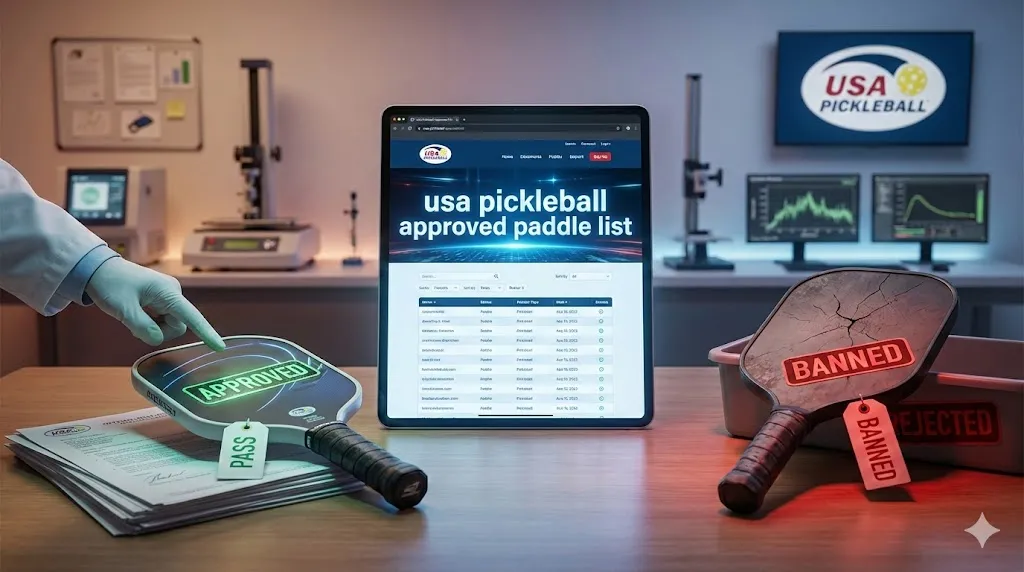
The only way to be 100% certain your equipment is legal is to verify it against the official database. Do not rely on the stamp on the paddle face alone, as older models can be “de-listed” or banned after production.
Step-by-Step Verification Process
- Step 1: Visit the official USA Pickleball equipment verification page.
- Step 2: Use the search bar to type in the manufacturer name (e.g., “CRBN” or “Franklin”).
- Step 3: Locate your specific model. Be precise—the “16mm” version might be approved while the “14mm” version is pending.
- Step 4: Check the status column. It must say “Pass”. If it says “Fail” or “Listed – Rescinded,” the paddle is illegal for sanctioned play.
Does “USAPA Approved” Mean the Same as “USA Pickleball Approved”?
Yes. You might notice many older paddles, or even some new ones, stamped with “USAPA Approved.” In 2020, the organization rebranded from the USAPA (USA Pickleball Association) to simply USA Pickleball. Both stamps are currently valid, provided the paddle model itself remains on the electronic approved list.
Is There an Official App to Scan Paddles?
Currently, there is no official mobile app that allows you to scan a QR code on a paddle to verify its status instantly. Players and referees must use the mobile-friendly version of the website mentioned above. Always bookmark the list before heading to a tournament.
“Approved” vs. “Compliant”: Don’t Be Fooled
One of the most common traps for new players is the wording used on Amazon or third-party marketplaces. There is a massive difference between usa approved pickleball paddles and those that claim to be “compliant.”
The “Compliant” Marketing Trap
If a paddle description says “Compliant with USA Pickleball standards” but does not display the official seal or appear on the list, it means the manufacturer claims it meets the specs (size, weight, deflection) but has not paid for testing. These paddles are illegal for tournament play. Always verify!
Are “Factory Clone” Paddles Legal?
You may see unbranded paddles on sites like Alibaba or Temu that claim to come from the “same factory” as major brands like CRBN pickleball paddles or the Joola Gen 3. Even if the mold is identical, without the specific branding and the testing certification, these “clones” are not on the USA Pickleball paddle approval registry and cannot be used in official matches.
Paddle Modifications: What You Can & Can’t Do
Once you buy an approved paddle, can you customize it? The answer is yes, but within strict limits. Improper modification is the fastest way to get disqualified.
Lead Tape Rules
Adding lead tape or tungsten tape is fully permitted to adjust the weight and balance of your paddle. However, strict placement rules apply:
- Allowed: You can place tape around the edge guard.
- Prohibited: You absolutely cannot place tape on the face of the paddle (the hitting surface).
Grip Replacements
You are free to change the grip size, add overgrips, or replace the handle wrap entirely. This is considered a “wear item” and does not affect the usa pickleball approved paddle list status. If you are unsure what to choose, read our guide on how to pick a pickleball paddle grip.
Stickers, Decals, and Pen Markings
Many players want to personalize their gear. Be careful here:
- Pen Markings: You can write your name on the paddle face, but it must not significantly affect the surface roughness.
- Decals: Stickers are generally allowed only on the edge guard or the handle. Placing a sticker on the hitting surface (the face) is usually a violation because it alters the friction and spin characteristics.
The “De-Listing” Controversy & Advanced Rules
The pickleball world was shaken recently when several high-profile paddles (specifically certain “Gen 3” models) were suddenly removed from the approved list after they had already been sold to the public.
Why Were Gen 3 Paddles Banned?
The controversy centered around the Deflection Test. USA Pickleball found that some paddles, while passing initially, would “break in” over time. As the core softened, the paddle acted more like a trampoline, propelling the ball at speeds that exceeded safety limits. This led to the removal of specific batches of paddles from brands like Joola and others.
USA Pickleball vs. UPA-A Certification
Due to these disputes, a rival certification body has emerged: the United Pickleball Association of America (UPA-A). Some pro tours (like the PPA) may allow UPA-A certified paddles even if they are not on the USA Pickleball list. However, for 99% of amateur tournaments and local leagues, the USA Pickleball Approved Paddle List remains the gold standard.
Checking the list is especially important if you are trying to improve your DUPR rating, as matches played with illegal equipment can be contested and voided.
Do You Actually Need an Approved Paddle?
If you are just playing for fun at a local park, do you need an approved paddle? Technically, no. Recreational play is self-regulated. However, if you plan to join a local club, many require approved equipment to ensure fair play and safety.
Furthermore, using a “hot” non-approved paddle might give you unrealistic power that hurts your development. We recommend training with approved gear like the Six Zero Pickleball Double Black Diamond or a Franklin pickleball paddle so your skills translate seamlessly to tournament play.
Frequently Asked Questions
Q: How do I know if my paddle is approved?
A: Do not rely on the printed text on the paddle face. You must search for the exact model name on the official USA Pickleball Equipment Verification website. If it appears with a “Pass” status, it is legal.
Q: Can I use a banned or de-listed paddle for recreational play?
A: Yes, there are no “pickleball police” for recreational games. However, be courteous to your opponents. Some banned paddles hit the ball dangerously hard, which can be a safety issue for players with slower reaction times.
Q: My paddle has a “USAPA Approved” stamp. Is it still legal?
A: Yes, the “USAPA” stamp is the legacy logo for USA Pickleball. As long as the paddle model has not been specifically banned or removed from the electronic list, the old logo is accepted.
Q: Can I paint my paddle face?
A: Generally, no. Applying paint to the paddle face changes the surface roughness and friction, which alters the spin capabilities. This counts as a prohibited modification and renders the paddle illegal.
Q: Does the approved list change often?
A: Yes, it is updated weekly. New paddles are added constantly, and occasionally, non-compliant paddles are removed. It is good practice to check the list at the start of every tournament season.
Conclusion
The landscape of pickleball technology is moving faster than ever. While this brings exciting power and spin to the game, it also brings confusion regarding the USA Pickleball Approved Paddle List. Whether you are a fan of the latest Joola tech or prefer the reliability of Selkirk, the rule of thumb remains the same: Trust the database, not the marketing.
Before you step onto the court for your next match, take thirty seconds to verify your gear. It saves you the embarrassment of a forfeiture and ensures the game remains fair for everyone.
Have you ever had a paddle challenged in a tournament? Let us know in the comments below!