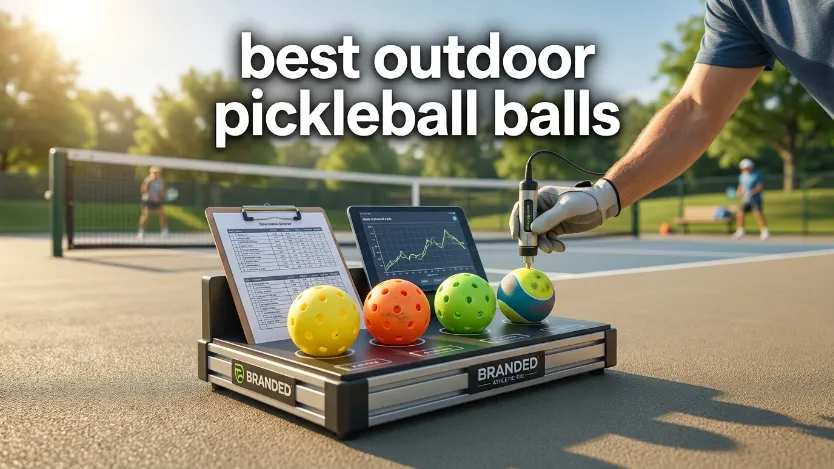
Imagine stepping onto a pristine acrylic court in the heart of Florida’s summer heat, only to find your shots feel like you’re hitting a wet marshmallow. Conversely, imagine a crisp morning in New England where your ball shatters into three pieces after a single overhead smash. This isn’t just bad luck—it’s physics. Finding the best outdoor pickleball balls is more than just picking a bright color; it is about understanding how polymer chains react to the American climate and how the 2026 rule changes are about to redefine your equipment bag.
As the sport explodes in popularity across the United States, the technical gap between professional-grade equipment and recreational “look-alikes” has never been wider. Whether you are looking for the best outdoor pickleball ball for high-speed tournament play or the best pickleball balls outdoor for enduring rough asphalt surfaces, this guide dives into the “missing angles” that competitors often ignore—from molecular heat sensitivity to spotting sophisticated Amazon counterfeits.
The Big Four: A Comparative Analysis of Top Brands
In the American market, four brands dominate the conversation. However, each caters to a specific pickleball skill level and environmental condition.
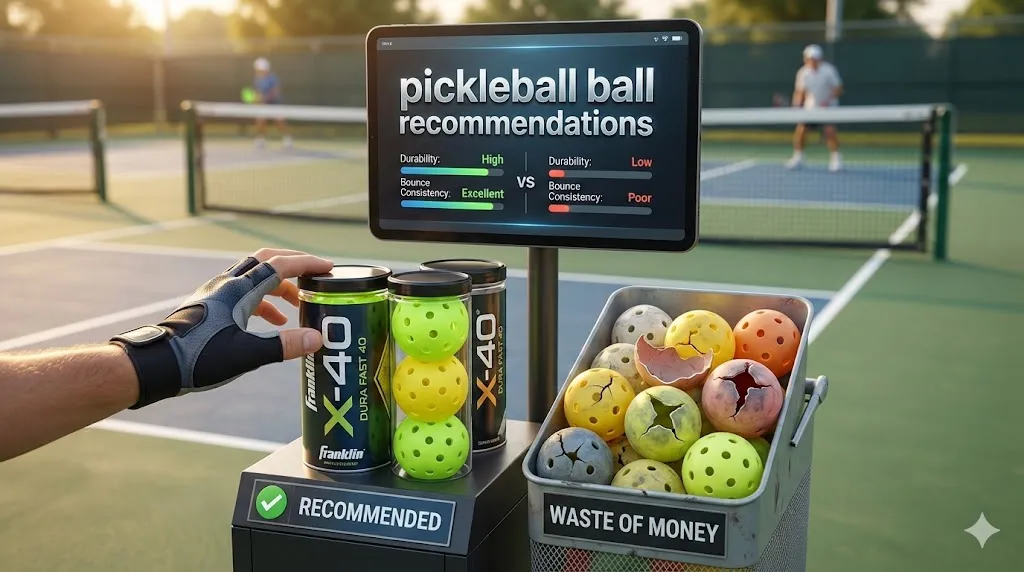
- Franklin X-40: The undisputed “Gold Standard” of recreational and club play. It is the official ball of the U.S. Open and is praised for its predictable bounce. However, it is notoriously sensitive to cold, often cracking when temperatures dip below 50°F.
- Onix Dura Fast 40: Known simply as “Duras,” these are the fastest balls in the sport. They are a favorite for 4.0+ players who want a “heavy” feel and maximum pace. The trade-off? They have the lowest durability in the industry, often going “out-of-round” or cracking within a few games.
- Life Time LT Pro 48: The new challenger and official ball of the PPA Tour. It features a unique 48-hole pattern and beveled edges designed to reduce stress points and prevent cracking.
- Selkirk Pro S1: Marketed as the most durable ball ever made, it comes with an industry-leading one-year “no-crack” warranty. It uses a proprietary rigid plastic that maintains its spherical integrity longer than the X-40.
Engineering the Perfect Flight: 40 Holes and Roto-Molding
Why do the best pickleball balls for outdoor play have 40 holes while indoor balls only have 26? It comes down to aerodynamic stability and wind resistance. The 40 smaller, precision-drilled holes allow air to flow through the ball more efficiently, preventing the “sail effect” that ruins shots in breezy conditions.
There are two primary manufacturing methods used for best pickleball outdoor balls:
- Roto-molding (Rotational Molding): This process creates a single, seamless shell. It is the gold standard for high-end balls like the Onix Dura Fast 40. Because there is no seam, the ball has a perfectly uniform thickness, leading to a “true flight” that pros demand.
- Injection Molding: This involves joining two halves together. While newer technologies (like those used in the Life Time LT Pro 48) have made these seams nearly invisible, lower-quality injection-molded balls often split at the seam during high-impact rallies.
The Molecular “Missing Angle”: Thermal Dynamics & Van der Waals Forces
One aspect often overlooked in standard reviews is the molecular behavior of the plastic. The polymers used in these balls are held together by Van der Waals forces—weak electrical attractions between atoms.
In the extreme heat of Arizona or Florida (>86°F), these forces weaken, allowing the plastic to become ductile or “mushy.” This absorbs energy, leading to a slower game. In the cold of a New York winter (<50°F), the atoms move closer together, the forces strengthen, and the ball becomes brittle. This is why a ball that plays beautifully in the spring will shatter like glass in December.
To measure this scientifically, engineers look at the Coefficient of Restitution (CoR), which can be expressed by the formula:
$$e = \sqrt{\frac{h_2}{h_1}}$$
Where $h_1$ is the drop height (78 inches) and $h_2$ is the bounce height (typically 30–34 inches). In colder temperatures, the CoR actually increases as the ball becomes stiffer, making the game significantly faster—right up until the moment the ball cracks.
Consumer Alert: Spotting Fake Franklin X-40s on Amazon
A growing problem in the United States market is the prevalence of counterfeit Franklin X-40 balls sold by third-party vendors. These “scams” often appear as high-discount 12-packs. Here is how to identify a fake:
- The Logo: Authentic Franklins manufactured after 2024 have the brand name printed in black ink. Older or fake versions may only have a molded “X”. If the “X” is shallow or off-center, it is likely a knockoff.
- The Seam: A genuine X-40 is roto-molded and seamless. If you see a prominent line encircling the middle of the ball, you have been sold a cheap injection-molded imitation.
- The Sound: Fakes often produce a high-pitched “clack” sound rather than the deep “pop” of high-impact polyethylene.
To ensure you are playing with regulation gear, always cross-reference the USA Pickleball Approved equipment list before purchasing in bulk.
The 2025-2026 Rule Updates: What Every Player Must Know
The USA Pickleball governing body has introduced several changes that impact how we use and carry balls on the court. According to the Official Equipment Standards (External Link), a new testing protocol called PBCoR (Paddle/Ball Coefficient of Restitution) has been implemented to standardize the “power” level of matches.
More importantly for players is the Visible Ball Rule set for 2026. Carrying a second ball in your pocket where it is clearly visible to your opponent is now considered a fault. The reasoning is that a second yellow object can distract the opponent’s vision during fast-paced exchanges. Tournament players should practice keeping their spare balls fully tucked away or off the court entirely.
Maintenance Hacks: Rotating and Pre-Chilling
If you want to extend the life of your best outdoor pickleball balls, follow these pro-level maintenance tips:
- The Pocket Rotation: In cold weather, keep a spare ball in your pocket. The body heat keeps the plastic flexible. Switch the balls every game to ensure neither becomes too brittle.
- Pre-Chilling: If you are moving from a heated home to a freezing outdoor court, “pre-chill” your balls in a garage or car for 20 minutes. This prevents the “thermal shock” of the first hard hit, which is a leading cause of immediate cracking.
- The Wobble Test: Before a match, spin the ball on the floor or in the air. If it “wobbles,” it is out-of-round. This usually happens to Selkirk Pro S1 or Vulcan balls after heavy use. While some players claim you can “heat mold” them back to shape, once a ball loses its spherical integrity, its flight path becomes unpredictable.
For players still confused about the differences between playing environments, it is helpful to review the best indoor pickleball balls to see how softer materials and 26-hole patterns change the game’s strategy.
Frequently Asked Questions (FAQ)
Q: Why does my ball feel “dead” after only two hours of play?
A: This is common with the Franklin X-40 in high heat. The plastic softens, and while it doesn’t crack, it loses its “pop.” Professional players often switch to Onix Dura Fast 40 in the summer because the harder plastic resists this mushiness.
Q: Can I use outdoor balls on an indoor court?
A: It depends on the surface. If you are playing in a dedicated facility with a “hard court” (acrylic or concrete), you should use an outdoor ball. If you are on a wooden gym floor, outdoor balls will skid and bounce too low. For those settings, see our guide on Pickleball Skill Levels to understand how ball speed affects different tiers of play.
Q: What is the most durable ball for cold weather?
A: Currently, the Selkirk Pro S1 and the PCKL Elite 40 are the top performers for temperatures below 45°F. They use a softer polymer blend that resists the brittleness that kills the Dura Fast 40.
Q: Is the color of the ball a regulated standard?
A: Most tournaments require Optic Yellow for visibility. While pink, orange, and even glow-in-the-dark balls exist, they are often harder to track against diverse backgrounds. In the 2026 season, high-visibility yellow remains the requirement for all sanctioned USA Pickleball events.
In conclusion, choosing the best outdoor pickleball balls is a balance between speed, durability, and climate. While the Franklin X-40 remains the comfort pick for millions, advanced players are increasingly moving toward the Life Time LT Pro 48 for its consistency or the Selkirk Pro S1 for its longevity. By understanding the science of the bounce and keeping an eye out for scams, you can ensure your equipment is as ready for the match as you are.