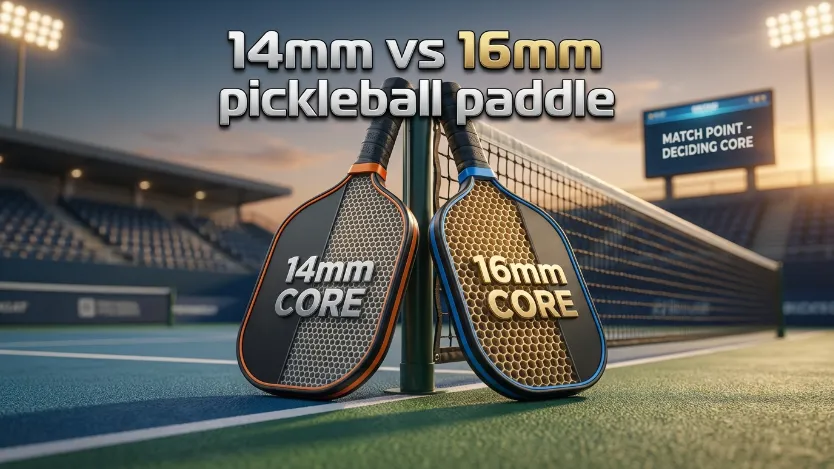
Picture this: you are at the kitchen line, tied 10-10 in a grueling third game. Your opponent fires a blistering speed-up aimed right at your chest. In that fraction of a second, your reaction time matters, but the engineering of the paddle in your hands matters just as much. As pickleball continues its explosive growth across the United States, the equipment landscape has transformed into an arms race of high-tech materials and microscopic adjustments. The most hotly debated spec among players today is undoubtedly the 14mm vs 16mm pickleball paddle dilemma.
At first glance, a mere two millimeters might seem like an insignificant detail—a marketing gimmick even. However, anyone who has spent enough time on the court knows that this tiny structural difference drastically alters the paddle’s physics, changing everything from how fast you can maneuver it to how the ball rebounds off the face. While big box retailers often simplify this by claiming “thinner means power and thicker means control,” the reality of a 16mm vs 14mm pickleball paddle comparison is far more complex, especially with the advent of modern paddle technology.
In this comprehensive guide, we are going beyond the superficial marketing jargon. We will dive deep into the biomechanics, hidden metrics like launch angles, acoustic signatures, and the pro-level customization secrets that most reviewers miss. Whether you are transitioning from tennis or looking to dominate your local open play, here is everything you actually need to know about choosing the right core thickness.
Basic Physics and Biomechanics of Paddle Thickness
To truly understand how a few millimeters change your game, we need to look at the underlying physics. It is not just about the static weight of the paddle; it is about how that mass is distributed and how it moves through the air.
Swing Weight and Aerodynamic Drag
Swing weight is a measurement of how heavy a paddle feels while it is in motion. Because a 16mm core is thicker, it inherently carries more mass spread across its profile, creating slightly more aerodynamic drag. Data shows that the average 16mm paddle has a swing weight of around 117, while a 14mm paddle averages around 113. This lower swing weight on the 14mm makes it noticeably faster through the air, granting you superior maneuverability and faster hands during rapid-fire volley exchanges.
Twist Weight and Sweet Spot Stability
Twist weight measures a paddle’s resistance to twisting when you hit the ball off-center. Thicker 16mm paddles excel here, boasting an average twist weight of 6.5 compared to 6.1 for thinner models. The extra width stabilizes the core, offering a substantially larger sweet spot. If you mishit a ball on a 16mm paddle, it will still travel over the net. Do the same on a 14mm paddle, and the paddle might twist in your hand, resulting in a dead ball.
The Pop vs. Power Paradox
One of the biggest information gaps in the pickleball community is the conflation of “pop” and “power.” When looking at pickleball paddles 14mm vs 16mm, understanding this distinction is crucial.
- Pop (The 14mm Advantage): Pop refers to the speed at which the ball rebounds off the paddle face during short, compact swings (like punch volleys or flicks at the kitchen). A 14mm paddle has a stiffer core that doesn’t compress much. The energy is immediately returned to the ball, making it incredibly “poppy” and deadly for quick counter-attacks.
- Power (The 16mm Advantage): Power refers to the top-end speed generated on full swings, like baseline drives and serves. Surprisingly to many, a 16mm paddle often generates more power. The thicker core provides more mass and “plow-through,” allowing the paddle to transfer a massive amount of kinetic energy into the ball without slowing down upon impact.
The Hidden Metric: Launch Angle Dynamics
If you have ever switched paddles and suddenly found yourself dumping drops into the net or popping balls up for easy smashes, you have experienced a change in launch angle. This is a highly nuanced topic that major review sites frequently ignore.
Thicker 16mm paddles offer longer dwell time (the time the ball stays on the face). This creates a “pocketing” effect, which naturally catches the ball and releases it with a higher, loopier trajectory. This high launch angle acts as a safety net for defensive resets and third-shot drops, helping the ball clear the net.
Conversely, 14mm paddles have a flat, piercing launch angle. The ball deflects instantly, staying low to the net. While this makes 14mm paddles phenomenal for aggressive drives and aiming at your opponent’s feet, it requires perfect technique to execute soft drops, as the paddle provides no upward assist.
Gen 3 & Gen 4 Evolution: Flipping the Script
If you are reading older guides, they might tell you that thin paddles are always for power. However, modern manufacturing has completely disrupted this rule. With the introduction of thermoformed pickleball paddles (Gen 3), edges are sealed with heat, pressure, and injected perimeter foam. This traps the core and turns the entire paddle face into a trampoline.
Today, a 16mm thermoformed paddle will hit significantly harder and faster than a 14mm Gen 1 or Gen 2 paddle. Gen 4 paddles have taken this a step further by using floating cores surrounded by EVA foam. In these modern iterations, a 16mm paddle gives you massive offensive power while still retaining the plush feel and large sweet spot, making standard 14mm paddles feel almost obsolete for some players unless they strictly desire a lighter swing weight.
Durability, Core Compression, and The Break-in Period
When investing in premium gear, longevity matters. When comparing a pickleball paddle 14mm vs 16mm, durability is a silent factor.
Because modern thermoforming generates immense internal pressure, the shorter honeycomb cells in a 14mm paddle are highly vulnerable to core compression or “core crushing.” Over time, hitting aggressive drives can permanently break down a 14mm core much faster than a 16mm core, leading to dead spots and an inconsistent bounce.
Additionally, modern carbon fiber paddles require a break-in period. A new 16mm paddle might feel stiff and board-like out of the box. It typically takes 5 to 10 hours of heavy play for the adhesives and core materials to relax, allowing the paddle to reach its optimal plushness and power potential.
Ergonomics, Acoustics, and Player Biomechanics
Choosing the right paddle thickness also impacts your physical health and your standing with the local Homeowners Association (HOA).
- Vibration and Tennis Elbow: The thicker polymer core of a 16mm paddle acts as a superior shock absorber. It dampens the high-frequency vibrations before they travel down the handle into your arm. If you suffer from joint pain, the 16mm is universally the better choice.
- Acoustic Signatures: Pickleball noise is a growing issue in the US. A 14mm paddle produces a high-pitched, sharp “ping” that carries over long distances. A 16mm paddle, due to its denser core, produces a lower, muted “thud” that is much less likely to result in noise complaints.
- Handle Circumference: A thicker core naturally necessitates a slightly thicker handle. If you rely on a two-handed backhand (2HBH) and have smaller hands, a 14mm paddle often provides a thinner grip that allows for greater wrist articulation and roll.
Sports Backgrounds and Transition Strategies
Your previous athletic background is an incredible indicator of which thickness will feel natural to you when checking out how to pick a pickleball paddle.
Former Tennis Players: If you come from a tennis background, you are used to taking long, aggressive swings and brushing up on the ball for heavy topspin. You will almost certainly prefer a 16mm elongated paddle. The thicker core mimics the “dwell time” of a stringbed, allowing you to grip the ball and shape your shots.
Table Tennis and Badminton Players: These players rely heavily on hyper-fast wrist flicks and immediate energy transfer rather than full-arm swings. For this demographic, a 14mm paddle feels like a natural extension of the hand, providing the instant pop and low swing weight needed for their style.
If you are an improving player looking to upgrade, assessing your background is vital. You can find excellent options in our guide to the best pickleball paddles for intermediate players.
Environmental Factors and Shot Physics
How do these paddles perform when the elements get tough? When playing outdoors in windy conditions across the United States, aerodynamics become crucial.
A 16mm paddle acts slightly more like a sail in a crosswind. Its higher swing weight means that if a gust of wind moves the ball at the last second, it is harder to make a micro-adjustment to your swing path. A 14mm paddle cuts through the wind easier and allows for split-second corrections.
However, when executing a block volley against a banger driving the ball at 60 MPH, the 16mm is king. The mass of the paddle absorbs the pace, dropping the ball harmlessly into the kitchen. Try the same block with a 14mm, and the ball is likely to pop up high into the air, setting up an easy put-away for your opponent. If your game relies heavily on resets, look for the best pickleball paddle for control.
The Pro Meta: Lead Tape Customization
Advanced tournament players have developed a “hybrid” strategy that breaks all the rules of the 14mm vs 16mm pickleball paddles debate: Perimeter Weighting.
Many pros will purchase a 14mm paddle because they want the aerodynamic profile, the thin handle, and the immediate “pop.” But to fix the paddle’s lack of stability and smaller sweet spot, they apply heavy lead or tungsten tape to the perimeter (usually at the 4 and 8 o’clock positions).
This customization dramatically increases the twist weight (stability) and plow-through (power), essentially giving them the forgiveness and baseline power of a 16mm paddle, while retaining the blazing fast hand speed of a 14mm. (Note: always ensure your modifications adhere to the rules; check the USA Pickleball approved equipment list for compliance details).
Frequently Asked Questions
Will switching to a 14mm paddle ruin my soft touch game?
It won’t ruin it, but it requires a mechanical adjustment. Because a 14mm paddle has less dwell time and more immediate pop, the ball springs off the face faster. To compensate during dinks and drops, you must consciously loosen your grip pressure (down to a 2 or 3 out of 10) to let your body absorb the pace rather than relying on the paddle’s core to do it.
Do 16mm Gen 3 paddles really have more power than 14mm ones?
Yes. This is a major point of confusion. Due to the “trampoline effect” created by thermoforming and perimeter foam injection in Gen 3 and Gen 4 paddles, the thicker 16mm core allows for more internal compression on hard swings. This results in higher maximum exit velocity (power) compared to the 14mm versions of the exact same paddle.
Which thickness is better for a two-handed backhand (2HBH)?
It depends on hand size, but generally, 14mm paddles are preferred for two-handed backhands because the overall handle circumference is slightly thinner. A thinner grip allows for better wrist flexibility and a smoother “roll” over the ball to generate topspin.
Do thicker cores always weigh more?
Not always. While 16mm cores naturally contain more material, the final static weight of a paddle depends heavily on the face material, handle construction, and edge guard. However, a 16mm paddle will almost always have a higher swing weight, meaning it will feel heavier in motion.
Conclusion & Strategic Recommendations
The debate between 14mm and 16mm is no longer a simple discussion of “power vs. control.” It is a highly technical choice that dictates your launch angle, hand speed, vibration absorption, and overall court strategy.
Who should play a 16mm paddle?
Beginners, intermediate players, and advanced control-strategists. The 16mm is the gold standard for a reason. The massive sweet spot forgives sloppy footwork, the higher launch angle makes drops easier, and the plush feel protects your elbow. If you want consistency and stability to build long rallies, stick to 16mm.
Who should play a 14mm paddle?
Highly aggressive net players, former badminton/table tennis players, and players with a DUPR rating of 4.0+. If your game revolves around fast-hand battles at the kitchen line, driving the ball hard and flat, and executing deceptive flicks, the 14mm will give you the offensive pop and maneuverability you need.
Ultimately, your paddle should complement your natural mechanics. Don’t be afraid to utilize demo programs to test both thicknesses. Find the paddle that compensates for your weaknesses while amplifying your strengths, and watch your game elevate to the next level.