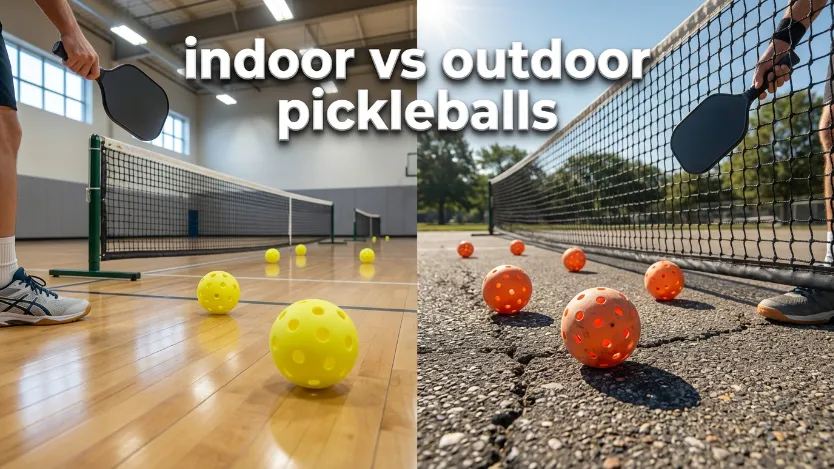
Imagine stepping onto a pristine court, paddle in hand, ready for a high-stakes match, only to find your perfectly aimed serve “skidding” across the floor or your precise dinks dying before they hit the net. For many players in the United States, the frustration of a “dead” game isn’t a lack of skill—it is a misunderstanding of the physics behind indoor vs outdoor pickleballs.
While the labels on the box seem straightforward, the reality of modern play involves a complex calculation of surface friction, wind resistance, and material durometer. This guide explores the engineering of the ball, debunking the myth that the “indoor” or “outdoor” label refers to the ceiling above you, and revealing why the surface beneath your feet is the only metric that matters.
The Physics of Performance: A Comprehensive Analysis of Indoor vs. Outdoor Pickleballs
In this technical deep dive, we examine why the distinction between pickleball balls indoor vs outdoor is a cornerstone of the sport’s evolution in the United States. The choice is no longer just about color; it is a refined selection process for the advanced player who understands that a ball’s flight path is governed by the USA Pickleball Equipment Standards. The indoor vs outdoor pickleball debate often centers on the “pop” and “speed,” but as we will uncover, the manufacturing process—whether rotational molding or injection molding—fundamentally alters how energy is transferred from your paddle to the court.
For those looking to dominate the kitchen line with a tactical mindset, selecting the best outdoor pickleball balls is only half the battle. You must also understand how atmospheric pressure in high-altitude regions like Colorado or the extreme humidity of Florida can turn a professional-grade ball into a “mushy” obstacle. Before you stock your bag for the 2026 season, it is vital to understand the intricate ball specifications that make a 40-hole ball behave so differently on a gritty acrylic surface compared to a polished hardwood gym floor.
Technical Breakdown: Structural and Material Specifications
The heart of the difference between these two variants lies in their aerodynamic and chemical composition. Unlike tennis balls, which rely on felt for drag, pickleballs utilize hole patterns and plastic density to navigate the air. Here are the key technical highlights based on USA Pickleball regulations:
- Hole Configuration (26 vs. 40): Outdoor balls typically feature 40 smaller holes محفورة آلياً to minimize wind interference, while indoor balls use 26 larger holes for slower, more controlled flight.
- Material Hardness (Durometer D): Outdoor balls are crafted from High-Density Polyethylene (HDPE), reaching a hardness of 40-50 on the Durometer D scale. Indoor balls utilize Low-Density Polyethylene (LDPE) or EVA blends for a softer, springier feel.
- Hole Diameter Variance: On average, indoor ball holes measure 0.43 inches, which is roughly 40% larger than the 0.282-inch holes found on outdoor models.
- Weight and Mass: While both must fall between 0.78 and 0.935 ounces, outdoor balls lean toward the heavier end (~0.925 oz) to maintain stability in breezy conditions.
- Manufacturing Method: Elite outdoor balls often use Rotational Molding for a seamless design, whereas many indoor balls are Injection Molded, resulting in a visible seam.
The price for premium balls like the Onix Dura Fast 40 or Franklin X-40 usually sits around $3.00 to $4.00 per ball when bought in bulk, making them a significant investment for clubs. For those playing in climate-controlled centers, exploring best indoor pickleball balls is essential to avoid the “skidding” effect that harder plastics cause on smooth wood.
The “Surface Rule”: Why the Ceiling is a Misnomer
One of the biggest “missing angles” in current literature is the Surface Rule. The terminology outdoor vs indoor pickleballs is a historical carryover from when the sport was played primarily on either hardwood basketball courts (indoor) or tennis courts (outdoor). Today, thousands of indoor pickleball facilities across the US utilize dedicated acrylic or concrete surfaces identical to outdoor courts.
If you are playing inside a building but on an acrylic hardcourt, you must use an outdoor ball. Using an indoor ball on this surface will result in a bounce that is too high and “floaty,” disrupting the pace of competitive play. Conversely, if you are playing on a wooden gym floor, an indoor ball is required because its softer plastic “grabs” the polished wood, preventing the ball from skidding. Understanding this distinction is a key pickleball dink strategy—your placement depends entirely on the predictable interaction between the ball and the surface material.
The Impact of Equipment Synergy: Paddles and Dwell Time
A common question among the US pickleball community is how ball choice interacts with paddle technology. The pickleball balls outdoor vs indoor choice directly affects dwell time—the fraction of a second the ball stays on the paddle face. Harder outdoor balls have less dwell time, creating a “poppy” feel that rewards fast hands but can be punishing for players with tennis elbow.
In contrast, the softer indoor ball compresses more on impact, increasing dwell time and allowing for superior spin and control. When selecting a paddle, the debate between a 14mm vs 16mm pickleball paddle often comes down to the ball you play with most. A 16mm paddle paired with a soft indoor ball offers ultimate control for a “soft” game, while a 14mm paddle with a Dura Fast 40 is a combination built for pure power and speed-ups.
The Missing Angles: What Other Guides Won’t Tell You
Most commercial reviews ignore the reality of environmental variables in the United States. Beyond the number of holes, there are three critical factors that advanced players must monitor to maintain peak performance.
1. The “1.2 kHz” Acoustic Reality
Pickleball noise has become a point of legal contention in many US residential areas. Engineering research shows that the “pop” of an outdoor ball hitting a carbon fiber paddle registers at a frequency of approximately 1.2 kHz. This is the exact frequency used for garbage truck backup beepers because it is the most annoying frequency to the human ear. Indoor balls, being made of softer EVA-based polymers, produce a lower-frequency sound that is significantly less disruptive, making them the socially responsible choice for noise-sensitive facilities.
2. The Regional Climate Playbook
The indoor vs outdoor pickleball dynamic shifts with the weather. In the Midwest or Northeast, playing with a Dura Fast 40 in temperatures below 50 degrees Fahrenheit is a recipe for disaster; the hard plastic becomes brittle like glass and cracks instantly. Players in these regions often swap to a “softer” outdoor ball like the Franklin X-40 or even an indoor ball for casual cold-weather play. In Arizona or Florida, the opposite occurs: heat makes balls “mushy,” slowing down the game and requiring a more rigid, seamless ball to maintain speed.
3. Visibility and the “Optic Yellow” Science
In the US, Optic Yellow is the standard for outdoor play because it provides the highest contrast against blue and green court surfaces. However, in gymnasiums with light-colored hardwood and bright LED lighting, yellow balls can “wash out.” This is why Lava Red or Neon Orange balls are popular for indoor settings—they provide a “Color Boost” that helps players track spin and Approaching pace sooner under artificial glare.
On-Court Performance: From Defense to Attack
During testing of the latest 2026 ball models, the standout feature was the stability of 40-hole rotational molded balls. When defending against a heavy drive, these balls resist “wobbling” in mid-air, allowing for a more accurate reset. On the other hand, the 26-hole indoor ball allows for a “finesse” game where the spin is much more effective. Because the indoor ball stays on the face longer, you can “brush” up on the ball to create a dipping topspin that is difficult for opponents to return on a smooth floor.
Frequently Asked Questions (US Audience)
Q: Why does my ball feel “lopsided” after only a few games?
A: This is known as going out of round. It typically happens to Dura balls in high heat or Franklin balls in extreme cold. To check, spin the ball on a flat surface; if it wobbles, the structural integrity is compromised.
Q: Can I use an indoor ball for outdoor tournament practice?
A: It is not advised. The aerodynamic profile is too different. If the tournament uses an X-40, practicing with an indoor ball will ruin your timing and touch.
Q: Is there a “Hybrid” ball that works for both?
A: While some brands market hybrid balls, they are usually a compromise. They are often too light for the wind and too hard for polished wood, leading to skidding and unpredictable bounces.
Q: Are there specific standards for ball bounce?
A: Yes. According to the USA Pickleball Equipment Standards, a ball must bounce 30-34 inches when dropped from a height of 78 inches onto a granite surface.
Final Verdict: Selecting the Right Ball for the 2026 Season
The indoor vs outdoor pickleball choice is a specialized decision that defines your tactical ceiling. It is not for the recreational player who grabs “whatever is in the bag.” It is for the strategic competitor—the player who recognizes that the HDPE of an outdoor ball is a weapon for speed, while the LDPE of an indoor ball is a tool for precision.
As the sport grows across the United States, manufacturers like Selkirk are offering warranties against cracking, and Vulcan is refining the “pop” of 40-hole patterns. If you are willing to navigate the surface requirements and protect your gear from the elements, your equipment will reward you with a professional-level experience. For the 2026 season, the gold standard remains simple: match your ball to your surface, not your roof, and always carry a mixed bag to account for the unpredictable American climate.