
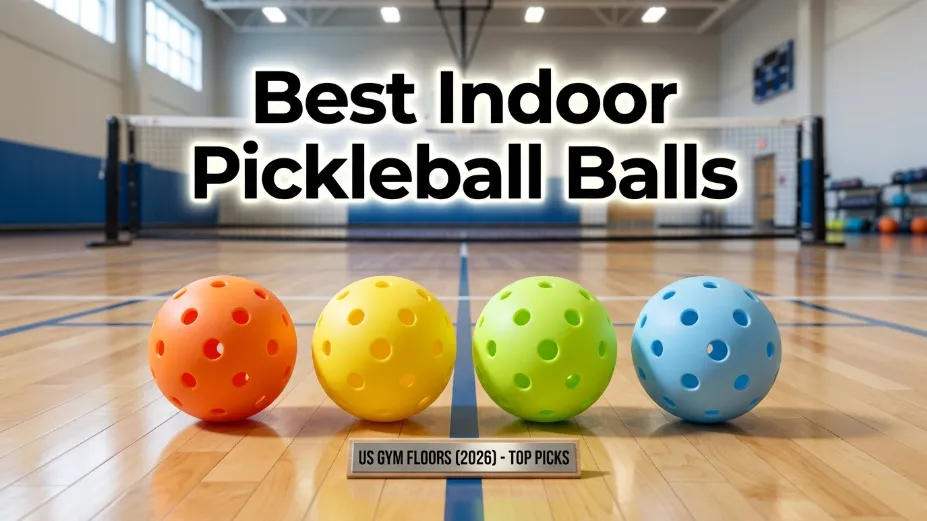
Gym floors are unforgiving, and using the wrong ball is a fast track to a frustrating session of “skidding” and inconsistent bounces. Whether you’re playing on polished hardwood or textured tile, the friction dynamics change the moment you step off the asphalt. Finding the best indoor pickleball balls isn’t just about picking a bright color; it’s about choosing a ball designed with the specific weight and hole patterns required to hold its flight in a windless environment. We’ve analyzed the top-rated gear and community favorites to ensure your next serve stays true to its mark.
| Ball Model | Hole Count | Structural Longevity | Visual Contrast | Gym Floor Grip | US Price Point |
|---|---|---|---|---|---|
| Onix Fuse Indoor | 26 Holes | High (Seamless) | Superior (Orange) | Excellent | Mid-Range |
| Franklin X-26 | 26 Holes | Moderate | Medium (Yellow) | Good | Budget-Friendly |
| Gamma Photon | 26 Holes | High | High (Two-Tone) | Aggressive | Mid-Range |
| Penn 26 | 26 Holes | Low (Goes Mushy) | Excellent (Lava) | Excellent | Mid-Range |
Short Answer: For the most consistent experience on hardwood gym floors, the Onix Fuse Indoor is currently the best indoor pickleball ball for US players due to its resistance to skidding and superior seam welding. If you find standard yellow balls hard to track against beige gym walls, the Penn 26 in Lava Red offers the best visibility, though it requires more frequent replacement as it softens over time.
Best Indoor Pickleball Balls: The Ultimate Guide for Gym Surface Play
When you transition from the gritty asphalt of an outdoor court to the polished hardwood of a local YMCA, the game fundamentally changes. The best indoor pickleball balls are engineered to solve a specific problem: the lack of friction. While an outdoor ball relies on a harder plastic to withstand rough surfaces, an indoor ball uses a softer polymer blend—typically Low-Density Polyethylene (LDPE)—to “bite” into the smooth floor rather than skidding across it like a hockey puck.
The technical difference between indoor and outdoor pickleballs centers on the holes. Indoor balls feature 26 larger, precision-drilled holes. Because there is no wind to contend with, these larger holes create “drag,” which stabilizes the flight and slows the ball down just enough to allow for the strategic “dink” rallies that define high-level indoor play.
The Realist’s Warning: Avoiding the “Mushy” Ball Syndrome
In the world of best indoor pickleball balls reddit discussions, players rarely complain about balls cracking. Instead, they talk about the “Bad Banana” effect. Unlike outdoor balls that fail by splitting, indoor balls fail by losing their structural integrity. Over 10 to 20 hours of play, the plastic softens until the ball feels “mushy” or sponge-like . A mushy ball kills the game—it won’t bounce true, and it absorbs the power of your overhead smashes, making it nearly impossible to put a point away .
Head-to-Head: Onix Fuse vs. Franklin X-26
If you walk into any indoor pickleball Chicago facility or local community center, you will likely see a battle between these two giants. Here is the reality of how they perform on the court:
- Onix Fuse Indoor: This is widely considered the “Gold Standard” for hardwood. It features exceptional seam welding that resists splitting better than almost any other ball on the market. However, the realism factor here is that brand-new Onix balls can be quite slick. Many pros use the “Sandpaper Hack”—lightly scuffing a new ball with 120-grit sandpaper—to give it immediate grip on a polished floor.
- Franklin X-26: The X-26 is the best indoor pickleball ball for clubs on a budget. It plays slightly faster and firmer than the Onix but is more prone to going out-of-round (warping) after a few heavy sessions. While it is USAPA approved, some players find the optic yellow version disappears against the light-colored wood of basketball courts.
Best Pickleball Balls for Indoor Visibility: Solving the Gym Wall Problem
One angle the big retailers often miss is the “background noise” of a gym. Most community centers have beige walls, yellow basketball lines, and orange padding on the hoops. A standard yellow best pickleball ball indoor can become invisible the moment it crosses these colors .
This is where the Penn 26 in Lava Red or the Gamma Photon in Orange shines. These high-contrast colors allow your eyes to track the ball’s rotation much faster, which is critical for returning heavy slice shots. The tradeoff? The Penn 26 is notoriously soft and will reach that “mushy” state faster than a firmer ball like the Gamma Photon.
The Missing Angle: Surface vs. Setting
There is a common misconception that if you are under a roof, you need an indoor ball. This is false. Your choice should be dictated by the surface, not the ceiling. If your indoor facility has dedicated acrylic courts (the gritty blue/green tennis-style surface), you should actually be using Franklin pickleball balls designed for the outdoors.Using a 26-hole indoor ball on a gritty surface will make the game painfully slow and wear the ball down in minutes.
Managing the 90dB “Pop”: Quiet Indoor Options
Indoor acoustics can amplify the sound of pickleball to nearly 90 decibels—equivalent to a vacuum cleaner running inside your head . For facilities with strict noise ordinances or shared spaces, players are turning to specialized low-noise balls. While not sanctioned for tournament play, foam-based balls like the Gamma Librarian reduce the “pop” by up to 70%, making them the best pickleball balls for indoor drilling sessions in residential buildings .
Maintenance Pro-Tips for Longevity
To get the most out of your gear, follow these community-tested rules:
- The 78-Inch Drop Test: If you suspect your ball is dead, drop it from 78 inches. A healthy indoor ball should rebound between 34 to 38 inches. Anything less means it’s time to retire it.
- Temperature Control: Never leave your balls in a hot car trunk in the summer. Heat accelerates the breakdown of the polymer, turning your expensive Onix Fuse into a “bad banana” overnight .
- Rotation: Don’t play with the same ball for four hours straight. Rotate a 3-pack throughout the session to allow the plastic to “recover” its shape between games .
For more detailed breakdowns on equipment, check out our guide on the difference between indoor and outdoor pickleballs or explore our comprehensive list of all pickleball balls currently on the market.
Before purchasing, always ensure your choice is on the USA Pickleball Approved Ball List if you plan on playing in sanctioned tournaments.
Frequently Asked Questions
Q: Why do my indoor balls keep skidding on the floor?
A: This usually happens because the floor is dusty or you are using a brand-new, glossy ball. Try the “Sandpaper Hack” (120-grit) to scuff the surface, and ensure the court is damp-mopped before play.
Q: Can I use outdoor balls for indoor gym play?
A: You can, but it’s not recommended. Outdoor balls are made of harder plastic and will “skip” low across hardwood, making rallies shorter and less predictable.
Q: How long does a high-quality indoor ball actually last?
A: On average, expect 10 to 20 hours of competitive play before the ball loses its bounce. Recreational players may get up to 40 hours before noticing a difference.
Q: Which color is actually best for indoor gyms?
A: While yellow is standard, Orange and Lava Red are superior for visibility against typical gymnasium wood floors and beige-colored walls.

For newest news you have to pay a quick visit world wide web and on the web I found this web site as a most excellent web page for hottest updates.