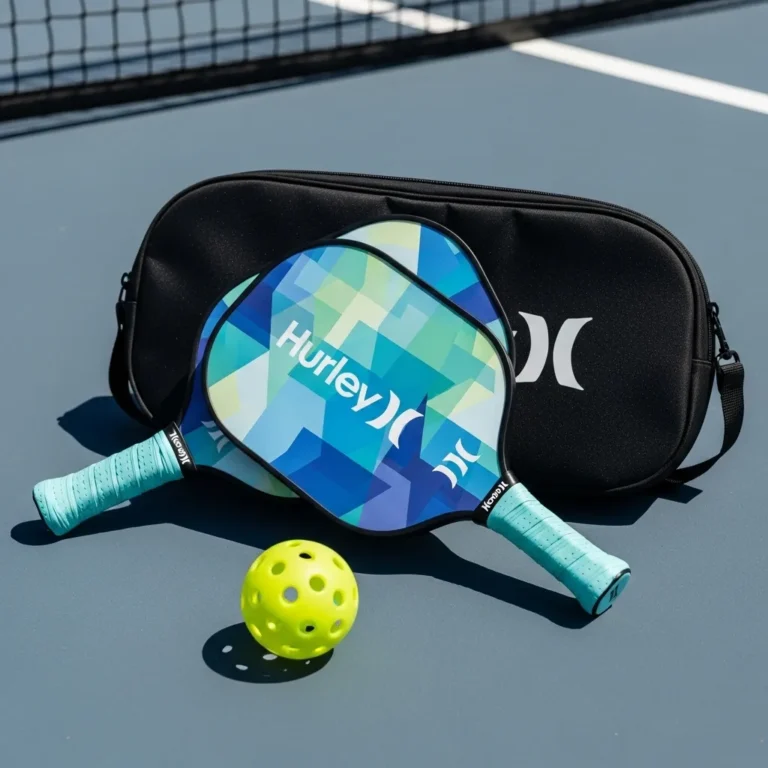
Hurley Pickleball Set
So, you’ve caught the bug. You know the one I’m talking about—the sudden urge to stand on a small court, paddle in hand, and dink a plastic ball back and forth until the sun goes down. Pickleball has absolutely exploded in popularity, and naturally, everyone wants in on the action.
You might be strolling through a department store, or maybe you’re scrolling online late at night, and you see it: the hurley pickleball set. It looks cool. It’s got that surf-inspired aesthetic we all know from the boardshorts and t-shirts. It’s affordable. But before you tap “buy” or toss it in your cart, you probably paused. You’re wondering if a surf brand can actually make decent sports equipment, or if you’re just paying for a cool logo.
It’s a valid question. Buying gear for a new hobby is always a bit of a dance. You don’t want to spend a fortune on a pro-level paddle before you even know the rules, but you also don’t want to buy something that falls apart after one weekend at the park.
I’ve spent a lot of time looking at entry-level gear, and I want to walk you through exactly what you’re getting with this setup. Think of this as a deep dive, a chat between friends figuring out if this gear is the right fit for your Saturday afternoon barbecue or if you should keep looking. We’re going to cover everything from how it hits to how it holds up, including a candid hurley pickleball set review based on what users are actually experiencing on the court.
Let’s strip away the marketing fluff and look at what’s really under the hood.
Performance & “Dead Spots”: The Real Feel
When we talk about pickleball paddles, the “feel” is everything. It’s that sensation that travels up your arm when the ball meets the face of the paddle. With high-end gear, it feels crisp and poppy. But with budget-friendly options, things can get a little complicated. If you are eyeing a pickleball set hurley makes, you need to manage your expectations regarding the physics of the materials used.
Why does my Hurley paddle sound “dead” or hollow when I hit the ball?
This is easily the number one question people ask after their first game. You swing, you make contact, and instead of a satisfying pop, you get a dull thud. It can feel a bit underwhelming, almost like hitting the ball with a wet plank.
Here is the reality of the situation: This isn’t usually a manufacturing error; it is a materials reality. Unlike premium paddles that utilize a sophisticated polypropylene honeycomb core (think of a beehive structure that absorbs and rebounds energy efficiently), many budget-friendly options, including those often found in the hurley 7 piece pickleball set sold at off-price retailers, rely on different construction methods.
These paddles often use MDF (Medium Density Fiberboard) or a basic plywood core. Wood and compressed fibers are dense. When the ball hits them, the material naturally absorbs a significant chunk of that kinetic energy rather than transferring it back into the ball. That absorption results in that “dead” sensation and the hollow sound. It’s the difference between bouncing a ball on concrete versus bouncing it on a carpet. It’s not broken; it’s just basic physics at play.
Is the “dead spot” a defect or just how the paddle is made?
This is where it helps to be a bit of a detective. Because of the wood/MDF construction we just talked about, the entire face of the paddle is going to feel somewhat unresponsive if you compare it to a friend’s $100 carbon fiber paddle. That general lack of “pop” is a feature, not a bug. It is simply the nature of the beast when you buy wood-core equipment.
However, there is a nuance here. If the paddle generally feels okay, but there is one specific corner or a spot near the edge that sounds completely different—perhaps like a rattle or a distinct buzz—then you might actually have a defect. In these cases, the internal layers may have delaminated, meaning the glue holding the layers together has failed. If you press on the face and it feels spongy in one isolated spot, that’s a defect. If it just feels solid and heavy everywhere, that’s just the paddle being a paddle.
Recommended Reading
Top Pickleball Gifts 2025:From Stocking Stuffers to Pro Gear
Looking for unique pickleball gifts? We break down practical gear, funny apparel, and budget-friendly ideas to help you surprise the player in your life.
Can I generate spin with the Hurley paddle surface?
If you have been watching the pros play on YouTube, you have seen them slice the ball so it dances sideways when it lands, or hit top-spin shots that dive aggressively at the baseline. Naturally, you want to do that too.
With a Hurley paddle, your ability to spin the ball is going to be capped. Spin comes from friction. High-performance paddles have faces made of raw carbon fiber or have a grit-spray texture applied to them, acting like sandpaper to grab the ball and rotate it.
The Hurley paddles typically feature a smooth or very lightly textured paint or coating. It’s slicker. When you try to brush up on the ball for top-spin, the ball is more likely to slide off the face rather than grab. You can certainly hit basic cuts and defensive slices—playstyle matters more than gear at the beginner level—but you aren’t going to get that aggressive, dipping top-spin needed for advanced competitive play. For casual driveway games, though? It’s totally fine.
Specs & Suitability
Before you buy, it is important to know if this thing is actually going to fit your hand and your playstyle. A lot of people see a “deal” and grab it without thinking about the ergonomics, which can lead to a sore wrist later.
Is the grip size suitable for kids or small hands?
When manufacturers make these all-in-one box sets, they have to design for the average human. They can’t offer Small, Medium, and Large grip options like they do with expensive individual paddles.
As a result, the grips on these generic sets are usually a “standard” size, roughly 4.25 inches in circumference. This is the “Goldilocks” size for the average adult male or female. However, this one-size-fits-most approach has drawbacks.
If you are buying this for a young child (under 10) or an adult with very small hands, the grip might feel thick and unwieldy. A grip that is too large makes it harder to snap your wrist and control the paddle face, which can make learning the game more frustrating. Conversely, if you have massive hands, it might feel like holding a pencil.
Here is the kicker: because the handle underneath that foam grip is often solid wood (part of the paddle’s core), you can’t really sand it down to make it smaller. You can make a small grip bigger with tape, but you can’t make a big grip smaller.
How heavy is the paddle? It feels heavier than my friend’s.
Weight is a silent killer in pickleball. You might pick up the paddle and think, “This is light!” But swing it 500 times in an hour, and your forearm will tell you the truth.
Hurley paddles typically weigh in the range of 8.0 to 9.5 ounces. In the pickleball world, that is considered on the heavier side. For context, “mid-weight” pro paddles usually sit in the 7.8 to 8.2 oz range.
That extra ounce or two comes from the density of the wood or MDF core. While heavy paddles can actually help you drive the ball with more power (mass x acceleration = force), they require more muscle to control at the “kitchen line” (the non-volley zone) where reactions need to be lightning fast.
If you are a beginner with undeveloped forearm strength, or if you are prone to wrist or elbow soreness, this extra weight can lead to fatigue much faster than using a honeycomb core paddle. It’s something to keep in mind if you plan on playing for hours at a time.
Check out our guide to pickleball kitchen rules: What You Can and Can’t Do
Durability & DIY Fixes
Let’s be real: budget gear is budget for a reason. Things might come loose or peel. But the good news is that most issues with the hurley pickleball set amazon sells are easily fixable with a little DIY spirit. You don’t need to throw the paddle away just because it looks a little ragged.
My handle grip tape started peeling off after one game—how do I fix it?
I have seen this happen a dozen times. You are in the middle of a heated match, your hands are sweaty, and suddenly the black tape wrapped around the handle starts sliding down or unraveling. It’s annoying, but it is a known issue with the factory adhesive on these mass-produced sets.
Don’t panic, and definitely don’t buy a new paddle yet. The secret weapon here is “Overgrip.”
Go to any sporting goods store or look online and buy a roll of tennis or pickleball overgrip. A 3-pack usually costs about $5. You simply wrap this thin, tacky tape over the existing messed-up handle. Not only does this fix the peeling problem, but overgrip is also generally much higher quality than the factory grip. It absorbs sweat better and feels softer in the hand. Honestly, even if your grip isn’t peeling, I recommend doing this immediately. It’s the cheapest upgrade you can make to feel like a pro.
The edge guard is coming loose at the top—is the paddle ruined?
The edge guard is that plastic bumper running around the rim of the paddle. Its job is to protect the layers from splitting when you inevitably scrape the paddle on the ground trying to hit a low ball.
On budget paddles, the glue holding this guard on can sometimes be brittle. If you scrape it hard, it might pop loose, creating a gap that rattles or catches on things.
Is the paddle ruined? Not necessarily. You can perform surgery.
- Clean the gap carefully with a little rubbing alcohol to remove dirt and old glue dust.
- Apply a small amount of E6000 craft glue or a strong super glue (cyanoacrylate) inside the loose guard.
- Clamp it tight. If you don’t have clamps, wrap the head of the paddle firmly with electrical tape or painter’s tape to hold the guard against the face.
- Let it dry overnight.
It might not look pretty, but it will hold, and you can get months more play out of it.
Will this paddle survive getting wet or being left in the car?
This is the one area where you have to be careful. The answer is a hard No.
Because many Hurley paddles utilize a wood or composite wood (MDF) core, they are highly sensitive to their environment. Wood is a living material—it breathes. If you leave these paddles in a hot car during the summer, the extreme heat can cause the internal glue to soften, leading to the face bubbling or shifting.
Moisture is even worse. If you leave them out in the rain or store them in a damp garage, the wood core can absorb that moisture. This causes warping (twisting) or swelling. Once a wood paddle swells, the “sweet spot” is gone forever, and the layers will likely separate. Treat it like a musical instrument—keep it dry and at room temperature.
Value & Comparisons
You work hard for your money, and you want to know if this set is a smart buy. When you see the Hurley logo, you’re paying for a vibe, but how does it stack up against the titans of the industry?
Hurley vs. Franklin (or Amazon Basics)—which cheap set is better?
This is the ultimate showdown in the budget aisle. Franklin Sports is a massive name in pickleball. They make everything from $10 paddles to $200 pro gear. Hurley is a lifestyle brand that licenses its name to manufacturers to create cool-looking recreational gear.
If we are looking strictly at gameplay mechanics, Franklin (specifically their X-1000 or Activator lines) is often preferred by pickleball communities. Why? Because Franklin is a sports equipment manufacturer first. Their designs, even the cheap ones, often benefit from the R&D they put into their higher-end stuff. They tend to have better weight distribution and consistent durability.
However, the Hurley set wins on style. Let’s be honest, Franklin paddles often look like… sports equipment. The Hurley paddles usually feature cool graphics, beachy aesthetics, and a cohesive look. If you care about how the paddle looks in your beach bag, Hurley wins. If you care about how it plays, Franklin usually edges it out for the same price.
Check out our guide to Franklin Pickleball Paddle Guide: Signature vs. FS Tour
I found this set at Marshalls/TJ Maxx for $30—is it a steal?
If you frequent stores like Marshalls, Ross, or TJ Maxx, you have likely seen the hurley 7 piece pickleball set stacked on a shelf. The price tag usually screams “bargain.”
Is it a steal? It is a fair price, but I wouldn’t call it a “steal” in terms of performance. You aren’t getting a $100 paddle for $30. You are getting a $30 paddle for $30.
You are paying for the brand logo and the extreme convenience of a “court-in-a-box.” You get two or four paddles, balls, and a carrying bag all at once. If you are just playing casually in the driveway with family, or you need a set to leave at your vacation rental for guests to abuse, it is a great value.
But, if you plan to play at a local community center with others who play regularly, you will likely outgrow this set within a month. You’ll try someone else’s paddle, realize how much lighter and poppier it is, and end up buying a new one anyway.
Why is this set not “USA Pickleball Approved” for tournaments?
You might notice that serious paddles have a little “USA Pickleball Approved” seal printed on the face. The Hurley sets usually do not.
To get that certification, a manufacturer has to send their paddles to a lab and pay a significant fee for testing. They check for surface roughness (to limit spin), deflection (power), and size. Budget sets like Hurley often skip this expensive testing to keep the retail price low.
Does this matter? For 99% of people buying this set, no. You cannot use them in an official, sanctioned tournament, but they are perfectly fine for recreational play. However, be aware that some strict local clubs or community centers have rules stating “Approved Paddles Only” to prevent noise complaints or unfair advantages. It’s rare in casual play, but it happens.
Noise & Etiquette
Pickleball has a noise problem. It’s a click-clack sport, and in quiet neighborhoods, that sound can drive people crazy.
Is the Hurley paddle louder than others? My neighbors are complaining.
I hate to be the bearer of bad news, but yes, these paddles are generally louder.
Remember that wood/MDF core we talked about? It produces a high-pitched “crack” or “clack” sound upon impact. In contrast, higher-end paddles with honeycomb polymer cores produce a lower-pitched, deeper “pop.”
High-frequency sounds travel differently and tend to be perceived as more annoying to the human ear. If you are playing on a backyard court and your neighbors are close by, the constant crack-crack-crack of a wooden or MDF paddle is going to be more aggravating to them than a quieter, polymer-core option. If you want to keep the peace in the neighborhood, this is something to consider.
The Final Verdict
So, where does that leave us?
The Hurley pickleball set is the perfect “gateway drug” into the sport. It is accessible, it looks good, and it gets you out on the court without requiring a loan. It is fantastic for families, beach trips, and casual weekends where the score doesn’t really matter.
But it is not performance gear. It has dead spots, it’s a bit heavy, and it lacks the spin and touch of “real” pickleball equipment. If you are just looking to sweat and laugh with friends, grab it. But if you have a competitive itch and think you might get hooked on this sport, you might want to skip the surf brand and look for a dedicated pickleball manufacturer.
Whatever you choose, the most important thing is that you’re playing. See you on the court!
You May Also Like