grant park pickleball courts
The Ultimate Insider’s Guide to the Grant Park Pickleball Courts
If you’ve ever walked along the Chicago lakefront on a crisp morning or a balmy summer evening, you’ve probably heard it before you saw it. That distinct, rhythmic pop-pop-pop sound echoing off the skyscrapers. It’s the heartbeat of the city’s fastest-growing obsession, and nowhere does it beat louder than at the grant park pickleball courts.
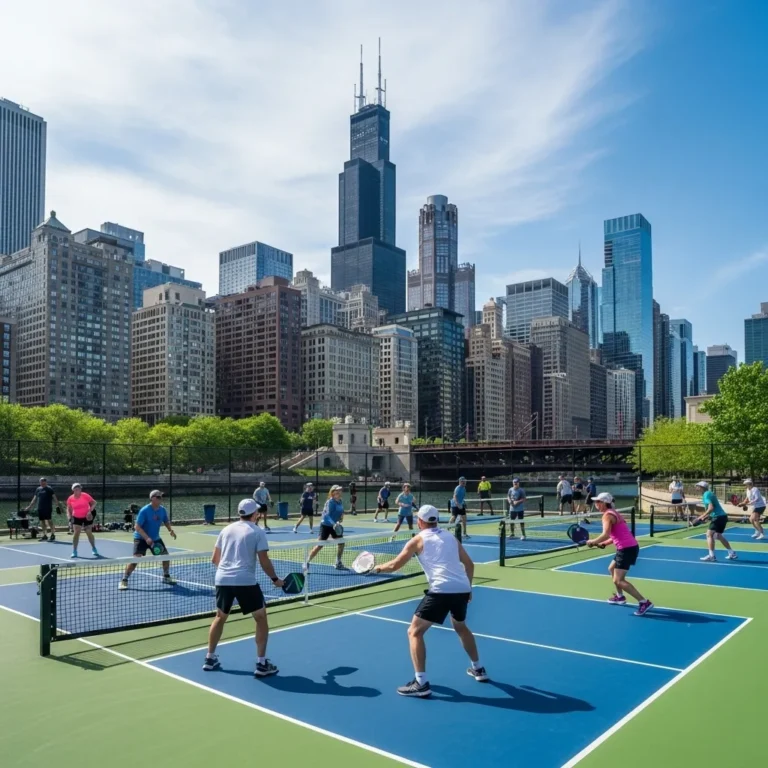
I still remember my first time heading down there. I had my paddle in my backpack, a water bottle that was probably too small, and a mild case of anxiety about whether I’d actually get to play or just awkwardly stand by the fence watching people who looked like semi-pros. But the moment I stepped onto the concrete, with the Willis Tower looming in the background and the breeze coming off Lake Michigan, I got it. It’s not just about the game here; it’s about the experience.
Whether you’re a local from the South Loop looking for a post-work rally or a visitor wanting to cross “playing pickleball under a skyline” off your bucket list, this guide is for you. I’m going to walk you through everything—no fluff, just the honest truth about what it’s like to play at the grant park pickleball courts chicago. We’ll cover the unwritten rules, the parking nightmares (and how to solve them), and exactly how to handle that legendary Chicago wind.
Grab your paddle, and let’s dive in.
Access, Costs, and Reservations (The Basics)
Before you even lace up your court shoes, you need to know the logistics. Nothing ruins a day faster than showing up ready to play only to find out you needed a permit or cash you don’t have. Let’s break down the barriers to entry.
Is there an admission fee, or are the courts truly free?
Here is the best news you’ll hear all day: playing at the grant park pickleball courts is completely free.
I know, in a city where a cup of coffee can cost seven dollars, it feels suspicious. You might be scrolling through grant park pickleball courts reviews wondering if there’s a hidden “club fee” or a gatekeeper asking for a membership card. There isn’t. These courts are part of the Chicago Park District, which means they are public land. They belong to you, me, and that guy over there practicing his dinks.
However, “free” comes with a different kind of cost: patience. Because there’s no financial barrier, the barrier becomes popularity. You don’t pay with your wallet; you pay with your time waiting in the queue (more on that in a minute). But strictly speaking, you can walk on without spending a dime.
Can I reserve a court in advance, or is it strictly first-come, first-served?
If you are a planner who loves a Google Calendar invite, take a deep breath. For the general public, the pickleball courts grant park hosts are strictly first-come, first-served.
There is no app to book a 6:00 PM slot. You cannot call ahead to save a spot. This is the great equalizer of public play. It doesn’t matter if you’re a CEO or a student; if the courts are full, you’re putting your paddle in the rack and waiting your turn.
This system creates a unique dynamic. It forces interaction. You can’t just stay in your bubble; you have to talk to people to find out whose turn is next. It can be chaotic on a beautiful Saturday morning, but it’s also fair. That said, if you have a very tight schedule and only have exactly 45 minutes to play, Grant Park might be a gamble during peak hours.
Do I need a permit for organized groups or coaching sessions?
This is where things get a little technical. If you are just three friends showing up to hit the ball, you do not need a permit. You just fall into the rotation.
However, if you are a coach charging money for lessons, or if you’re trying to organize a formal tournament or a massive meetup where you want to lock down three courts for two hours, you are entering “permit territory.” The Chicago Park District requires permits for organized athletic activities that monopolize space.
Here’s the reality on the ground: The locals are protective of their court time. If a coach shows up and tries to commandeer a court for private lessons while twenty people are waiting to play, it’s not going to go over well. If you’re running a clinic, go through the official channels and get the permit. If you don’t, you’ll likely be politely (or not so politely) asked to join the rotation like everyone else.
Is there a strict time limit per game when people are waiting?
Yes, and this is the golden rule of the grant park pickleball courts. When the courts are full—and they almost always are during good weather—the standard etiquette is “four on, four off.”
Usually, games are played to 11 points (win by 2). Once the winning point is scored, all four players vacate the court, and the next four players from the paddle rack step in. There isn’t a strict stopwatch running, but if you’re casually rallying for 45 minutes while a line of people stares at you through the fence, you are breaking the social contract.
Occasionally, if the queue is insanely long, people might agree to play to 9 points just to keep the line moving. The vibe is generally “let everyone play.” It’s a community effort to minimize waiting time.
Recommended Reading
Top Pickleball Gifts 2025:From Stocking Stuffers to Pro Gear
Looking for unique pickleball gifts? We break down practical gear, funny apparel, and budget-friendly ideas to help you surprise the player in your life.
Court Conditions & Equipment
You know you can play, but should you? The quality of the facility can make or break your game. Let’s talk about the physical reality of the courts, because this is where the grant park pickleball courts chicago differ from your driveway or a high-end club.
Do I need to bring my own portable net, or are permanent nets provided?
Leave the portable net in your trunk. The courts at Grant Park (specifically the dedicated ones at the South Loop location) are equipped with permanent, heavy-duty nets.
This is a huge relief. There are few things sadder than showing up to a “pickleball court” only to find it’s just painted lines on flat concrete with nothing in the middle. Here, the nets are solid. They don’t sag in the middle (usually), and they can take a beating from a ball driven hard into the tape.
That being said, because they are public amenities, they see thousands of hours of play. Occasionally, a center strap might be broken or the crank might be stuck. It’s rare, but it happens. But for 99% of your visits, the equipment is ready and waiting for you.
check out our guide to : Portable Pickleball Net: What to Know Before You Buy
Are the courts dedicated solely to pickleball, or are they shared tennis surfaces with confusing lines?
This is one of the biggest selling points for the area. While many parks slap some light blue lines on a tennis court and call it a day, Grant Park has dedicated pickleball courts.
This means the nets are the right height, the court dimensions are permanent, and—crucially—you aren’t visually distracted by a web of tennis lines running through your kitchen (the non-volley zone). The “ghost line” confusion is minimal here.
Playing on a dedicated surface changes the feeling of the game. It feels legitimate. It feels like the city respects the sport. You aren’t a second-class citizen to the tennis players next door; you have your own turf.
How severely does the wind affect play at this specific location?
Okay, we need to have a serious talk about the wind. They don’t call it the Windy City for nothing, and Grant Park is wide open, right next to Lake Michigan.
The wind here is a legitimate opponent. It’s practically the fifth player on the court. On some days, it’s a gentle breeze that feels nice. On other days, it’s a swirling vortex that will take your perfect third-shot drop and toss it three courts over.
If you read honest grant park pickleball courts reviews, you’ll see this mentioned constantly. The wind comes off the lake and cuts across the courts. It requires a strategic shift. You have to play lower. Lobs are dangerous—if you lob into the wind, the ball might come back and hit you in the face. If you lob with the wind, that ball is landing in the next zip code.
My advice? Bring a slightly heavier outdoor ball if you have one (like a Dura Fast 40 or Franklin X-40, which are standard, but fresh ones fly truer). And bring a windbreaker. Even in summer, that lake breeze can get chilly once you stop moving.
Is the court surface prone to cracking or dead spots?
Generally speaking, the surface quality is above average for a public park. The courts are acrylic on asphalt/concrete. They provide a good bounce—consistent and predictable.
However, Chicago winters are brutal. The freeze-thaw cycle wreaks havoc on pavement. Every spring, you might notice a few new hairline cracks appearing. The Park District is usually decent about sealing them, but by late summer, wear and tear shows.
You won’t typically find massive “dead spots” where the ball hits and just doesn’t bounce, but you should always do a quick scan of your specific court before you start keeping score. Watch out for debris, too. Leaves and dust can accumulate in the corners, making for a slippery baseline.
Are the courts individually fenced to prevent ball interference from neighboring games?
The courts are grouped, usually in blocks. While there is fencing around the perimeter of the court block, there isn’t always floor-to-ceiling fencing between every single court.
This means “Ball on court!” is a phrase you will hear and say often. If a play gets wild on the court next to you, their ball is coming into your space. It’s just part of the density of the facility.
High-level players sometimes find this frustrating, but for recreational play, it’s manageable. The key is just to be vocal and stop play immediately for safety if a stray ball rolls behind a player. Don’t try to be a hero and play through it; rolling an ankle on a stray ball is the most common injury out there.
Solo Play & Community Atmosphere
Pickleball is unique because it’s arguably 50% sport and 50% social hour. But if you’re an introvert or just new to the area, walking into a crowded park can be intimidating. Here is how to navigate the social scene at the pickleball courts grant park.
Is there an established “paddle stacking” or rotation system for open play?
Yes, and knowing how to use it is your ticket to playing. Because the courts are so busy, the locals use a “paddle rack” system (or sometimes just lining up paddles on the ground or a bench near the gate).
Here is how it works: When you arrive, you look for the designated waiting area. You will see a lineup of paddles. You put your paddle at the back of the line. As a game finishes, the people playing come off, and the owners of the next four paddles in line go on.
It’s a beautiful, self-regulating system. It prevents arguments about who was next. It also means you don’t have to awkwardly ask, “Can I play?” Your paddle does the talking for you. If you are confused, just ask someone holding a paddle, “Is this the stack for open play?” They will point you in the right direction.
Can I show up solo and realistically find a game, or is it “bring your own partner” only?
You can absolutely show up solo. in fact, I highly recommend it.
Grant Park is a melting pot. You’ll find retirees, college students, tech workers on lunch breaks, and tourists. Because of the paddle rotation system, you will naturally be paired up with others.
When your paddle gets to the front of the line, you grab it and look for the owners of the other three paddles. “Who’s with me?” you’ll ask. And just like that, you have a partner and two opponents. It is one of the easiest ways to make friends in Chicago. The vibe is usually very welcoming. I’ve seen 4.0 players happily partner with total beginners just to keep the game moving.
What are the peak “crowded” hours I should avoid if I want continuous play?
If you hate waiting, you need to time this right.
The Danger Zones:
- Weekdays 5:00 PM – 8:00 PM: The after-work crowd. This is the busiest time. The courts are packed, the music is playing, and the paddle rack is full. You might wait 20 minutes between games.
- Saturday/Sunday Mornings (8:00 AM – 12:00 PM): The weekend warriors are out in force.
The Sweet Spots:
- Weekdays 10:00 AM – 3:00 PM: If you have a flexible job or a day off, this is nirvana. You can often play continuously with almost no wait.
- Early Mornings (Before 7:00 AM): If you are a morning person, the sunrise crowd is smaller and very dedicated. Plus, watching the sun come up over the lake while dinking is a spiritual experience.
Is the local scene beginner-friendly, or is it dominated by 4.0+ competitive players?
It is a mix, but generally leans towards “friendly competitive.”
Because it’s a public park in a dense city, you get everyone. You will see people who can barely hold the paddle, and you will see people who look like they could go pro.
Usually, the courts naturally segregate a little bit. The “killers” tends to stick to one end or specific courts if they can, while the more casual players gravitate together. If you are a total beginner, don’t be afraid. Just let people know: “Hey, I’m new, still learning the scoring.” 99% of players will help you out. The only time it gets tense is if a beginner unknowingly wanders onto a court where four high-level players are battling it out. Just read the room, watch a few points, and slot yourself in where the skill level looks comparable to yours.
Logistics & Amenities
We’ve covered the game; now let’s cover the survival guide. Grant Park is massive, and if you don’t know where you’re going, you can end up walking a mile just to find a restroom.
Is the lighting sufficient for high-visibility night play?
Chicago generally does a good job lighting its parks, and the grant park pickleball courts are playable at night. The lights usually stay on until 11:00 PM (typical Park District hours).
However, “playable” and “perfect” are different things. The lights are high overhead, and while they illuminate the court well enough to see the ball, there can be shadows. The contrast isn’t as sharp as daylight. If you have poor night vision, tracking a fast yellow ball against a dark gray court under artificial light can be tricky. But for most players, the night sessions are a highlight. The city lights surrounding you create an electric atmosphere that you can’t get anywhere else.
Where is the closest bathroom and water station relative to the courts?
This is the most critical logistical tip in this entire article: Go before you go.
Grant Park is huge. Depending on exactly which courts you are at (usually the South Fields), the nearest bathroom might be a significant walk away—sometimes 5 to 10 minutes depending on which facilities are unlocked.
There are usually field houses or portable toilets nearby, but cleanliness varies wildly. In the summer, the field houses are generally open. In the shoulder seasons (early spring/late fall), they might be locked, leaving you scrambling.
As for water, there are fountains, but I never rely on them. They might be turned off, or the pressure might be a sad trickle. Bring a large water bottle. Bring two. You are exercising on concrete in the sun; dehydration hits faster than you think.
What is the specific parking situation—is it paid street parking or a dedicated lot?
Parking in downtown Chicago is a sport in itself, and it’s usually a contact sport.
There is no free “pickleball parking lot.” You are in the heart of the city. Your options are:
- Street Parking (Meters): There is metered parking along Columbus Drive and some of the side streets. It is expensive (
4−4-4−7 per hour depending on the zone), and you have to be lucky to grab a spot. Use the ParkChicago app so you can feed the meter from the court. - Millennium Lakeside Garage: This is the massive underground garage. It’s convenient, safe, and close, but it’s pricey unless you book in advance using an app like SpotHero or iParkit. Pro tip: Always check SpotHero before you leave the house. You can often get a spot for half the drive-up rate.
- Public Transit: Honestly? If you can, take the train or a bus. The Red Line stops nearby, and you can walk over. It saves you the stress of circling for a spot while your warm-up time ticks away.
Is the area safe for walking back to the car after dark?
Grant Park is generally very safe, especially around the athletic fields where there are lights and people. The South Loop is a bustling neighborhood.
That said, it is still a major urban center. Use common sense. If you play until 10:00 PM, try to walk back to your car or the train station with a buddy. The park gets quiet late at night once the crowds disperse. Stick to the lit paths (which are plentiful) and avoid cutting through dark, wooded patches of the park alone.
The pickleball community looks out for its own. It’s common for groups to walk out together. If you parked far away, ask someone, “Hey, are you heading toward Columbus Drive?” You’ll likely find a walking companion.
grant park pickleball courts photos
The Final Verdict
So, are the grant park pickleball courts worth the trip?
Absolutely. There are fancier clubs in the suburbs with heated floors and juice bars. There are quiet neighborhood parks with zero wait times. But none of them have the soul of Grant Park.
There is something special about playing a drop shot while the traffic of Lake Shore Drive hums in the distance and the skyscrapers light up the night. It’s gritty, it’s windy, and it’s crowded, but it’s also vibrant, diverse, and incredibly fun.
Just remember: Bring layers for the wind, bring patience for the queue, and bring your best attitude. You’re not just playing a game; you’re joining a community in the front yard of Chicago. See you on the courts!
you may like it