pickleball paddle covers
Whether you are swinging one of the high-performance Engage pickleball paddles known for their power and touch, or another top-tier brand, you’ve likely realized something important: good paddles aren’t cheap. They are an investment in your game and, frankly, your happiness on the court.
But here is the thing we often forget in the excitement of buying new gear: how do we treat it when the game is over? We toss it in the backseat, jam it into a backpack next to a leaky water bottle, or leave it baking in the sun. It’s a little heartbreaking when you think about it. This brings us to a small but mighty accessory that often gets overlooked—the humble paddle cover.
In this guide, we are going to walk through everything you need to know about protecting your paddle. We aren’t just talking about keeping it clean; we’re talking about preserving that gritty texture that helps you hit that wicked spin shot. We’ll look at the best pickleball paddle covers, explore the fun world of custom pickleball paddle covers, and answer the questions you might feel silly asking aloud at the courts.
Necessity & Benefits
Let’s be real for a second. When you are standing at the checkout counter (or the online cart), and you’ve just dropped a decent amount of money on a paddle, adding an accessory can feel like overkill. It’s the same hesitation we feel when the cashier asks if we want the extended warranty. But when it comes to paddle covers, the logic is a bit different.
Do I really need a cover for my pickleball paddle?
This is the most common question I hear from new players. The short answer? No, you don’t need one to play the game. The ball will still bounce off the face without it. However, the long answer is a bit more nuanced.
Think of your paddle like your smartphone. You wouldn’t walk around with a brand-new iPhone without a case, right? Not because the phone won’t work without it, but because life happens. You drop things. You bump into tables.
If you are playing with a basic wooden paddle or an entry-level composite that cost twenty bucks, a cover might cost more than the paddle itself. in that case, skip it. But, if you have upgraded to a carbon fiber or graphite surface—like those found on premium Engage pickleball paddles—you are dealing with specialized technology. These materials are incredibly strong when hitting a ball, but they can be surprisingly fragile when they hit something sharp or abrasive in your bag.
Preserving the lifespan of your gear is the main goal here. A cover is essentially a cheap insurance policy for an expensive asset. It says that you care about your game enough to take care of your tools.
What exactly does a cover protect against?
“It’s just a paddle, it’s meant to take a beating,” you might say. And you’re right—on the court. But off the court is where the damage usually happens.
First, let’s talk about “Bag Chaos.” If you are like most of us, your gym bag is a black hole. It has your keys, maybe a spare carabiner, a water bottle, loose change, and maybe even a fence hook. When you slide your naked paddle into that mix, every step you take causes friction. Metal keys scratching against a polymer honeycomb core is a sound no one wants to hear.
Then there are the zippers. The number one enemy of a paddle face is actually the zipper of the bag you carry it in. Sliding a paddle in and out of a tight backpack compartment often leads to scratches right across the sweet spot.
Beyond physical scratches, there are the elements. UV rays are sneaky. While pickleball is often an outdoor game, prolonged exposure to direct sunlight when you aren’t playing can degrade the materials over time, causing graphics to fade and, in extreme cases, the core materials to weaken. A cover acts as a sunblock for your gear.
Moisture is another culprit. I’m not talking about rain delay downpours, but rather the humidity and condensation. A cover provides a barrier against unexpected spills in your bag or the damp air if you leave your gear in the garage.
Does a cover help the paddle surface (grit) last longer?
This is the secret sauce for advanced players. You know that rough texture on the face of your paddle? The “grit”? That is what allows you to cut the ball, adding backspin or topspin that sends your opponent scrambling.
That texture is finite. It wears down over time just from hitting the ball. However, it wears down significantly faster if it’s rubbing against other surfaces.
Imagine taking a piece of sandpaper and rubbing it against a smooth rock. Eventually, the sandpaper becomes smooth. If your paddle face is constantly rubbing against the polyester lining of your bag, or worse, against another paddle’s face, you are essentially sanding away your advantage.
By using a cover—especially one with a soft interior lining—you are suspending the paddle in a safe environment. You are preventing “dead spots” and ensuring that the texture stays rough for the game, not wasted on the inside of your backpack. For anyone trying to improve their spin game, this is the single biggest reason to use a cover.
Sizing & Compatibility
So, you’re convinced. You want to protect your investment. Now comes the tricky part: finding one that fits. Pickleball has evolved, and paddles aren’t just rectangles anymore. They come in all sorts of shapes and sizes.
Are pickleball paddle covers “one size fits all”?
In the early days of the sport, yes, pretty much everything was standard. But today? Not so much.
Most generic covers you find online are designed for the “standard” paddle shape—roughly 8 inches wide and 15-16 inches long. If you have a classic paddle shape, almost any cover will do the job.
However, the industry has shifted. We now have wide-body paddles (optimized for a larger sweet spot) and elongated paddles (designed for reach and power). A cover designed for a standard paddle might feel like trying to put a size 6 shoe on a size 10 foot if you have a wide-body paddle. It might zip up, but it will be under tension, which puts stress on the zipper and the paddle edge guard.
Conversely, if you put a standard paddle in a cover designed for a wide-body, it’s going to swim around in there. While that’s better than being too tight, it takes up unnecessary space in your bag.
Will a standard cover fit an elongated or thick-core paddle (16mm+)?
This is a very current issue. A few years ago, most paddle cores were about 10mm to 13mm thick. Now, with the popularity of control-oriented paddles, we are seeing 16mm and even 20mm cores.
If you are swinging one of these “thick core” paddles, a standard neoprene cover usually works fine because neoprene is stretchy—it’s the same material used for wetsuits. It gives a little. However, standard synthetic leather or canvas covers with rigid piping might not close.
The elongated paddles are a different beast. These paddles trade width for length, often extending the handle or the face. If you have an elongated paddle, specifically look for covers labeled “elongated” or “universal fit.” Many Selkirk pickleball paddle covers, for example, are designed with a slightly more generous cut to accommodate their various paddle shapes.
When shopping, don’t just look at the width and height; look at the thickness allowance. If you have a particularly long handle (for those two-handed backhands), make sure the cover opening is wide enough to allow the handle to slide through comfortably without snagging the grip tape.
What is the difference between a “head cover” and a “full sleeve”?
You will generally encounter two styles of protection.
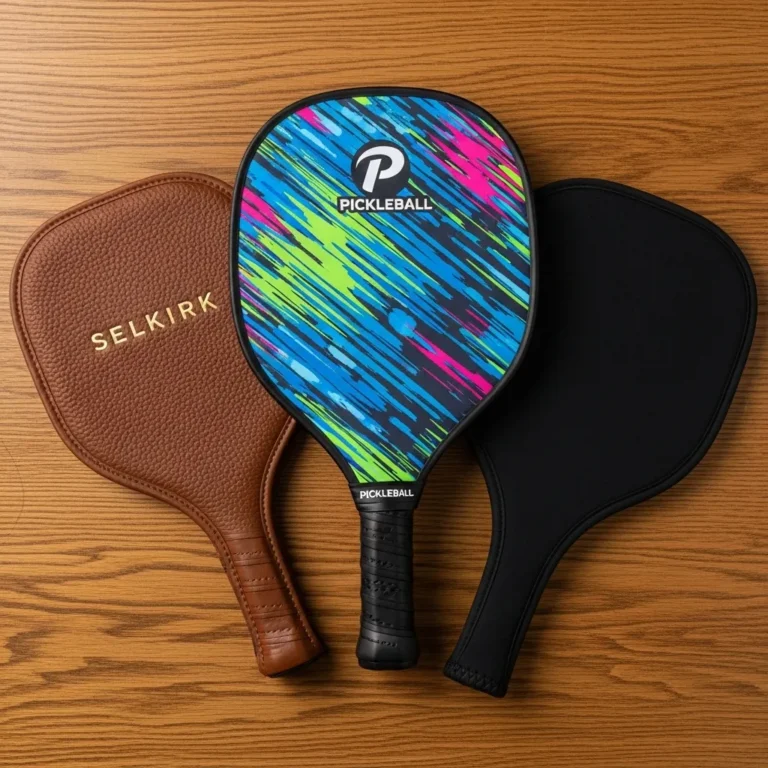
The Head Cover is the most common. It looks like a mitten for your paddle. It slides over the face of the paddle and usually zips or snaps shut at the neck, leaving the handle exposed. These are great because they are compact. Since the handle is usually rubber or leather grip tape, it doesn’t really need protection from scratches. The head cover protects the vital part—the playing surface—while keeping the overall package small.
The Full Sleeve (or full case) covers the entire paddle, handle and all. These look a bit like mini racquetball bags. Why would you want this? Well, if you have a white grip tape that you want to keep pristine, or if you toss your paddle into a particularly dirty environment (like the trunk of a car with muddy hiking boots), a full sleeve offers total isolation.
However, for 90% of players, the head cover is the way to go. It’s faster to get on and off, and it allows the grip to “breathe” after a sweaty match, preventing that gross, soggy handle feeling the next time you play.
Materials & Features (The “What”)
Not all covers are created equal. You can find them for five dollars, and you can find them for fifty. What’s the difference? It usually comes down to the materials used and the little extra features that make life easier.
What is the best material for a pickleball paddle cover?
If you browse for best pickleball paddle covers, you will see three main contenders: Neoprene, Canvas, and Synthetic Leather (PU Leather).
Neoprene is the gold standard for functionality. As mentioned earlier, it’s the wetsuit material. It is soft, squishy, and stretchy. This means it provides excellent cushioning. If you drop your paddle on the asphalt parking lot, a neoprene cover will bounce; a thin fabric cover will just transfer that impact to the paddle edge. It’s also gentle on the paddle face, ensuring no abrasion occurs.
Synthetic Leather is the choice for style. These look sleek, professional, and often come in vibrant designs. They are great for water resistance—rain slides right off. However, they can be stiff. If you go this route, ensure the interior is lined with fleece or a soft microfiber to protect the paddle face, as the back of raw PU leather can be scratchy.
Canvas or Nylon is durable and rugged, often used for custom pickleball paddle covers because it prints well. It offers decent protection against scratches but usually lacks the impact absorption of neoprene unless it has foam padding sewn in between the layers.
Do neoprene covers offer better protection than standard fabric ones?
In my experience, yes. Neoprene wins on two fronts: Impact resistance and insulation.
We have already talked about impact—the cushioning is superior. But let’s talk about insulation. Neoprene is an insulator. While it won’t keep your paddle at precisely 70 degrees, it does buffer against extreme temperature swings better than thin fabric.
If you leave your paddle in the car on a hot day (please don’t do this, but if you do), a neoprene cover helps slow down the heat transfer to the paddle core. Extreme heat can delaminate paddles—causing the face to separate from the honeycomb core. While no cover can save a paddle from a baking oven of a car forever, neoprene buys you a little more time than a thin nylon sleeve.
Furthermore, neoprene is naturally water-resistant. It doesn’t soak up water like cotton or canvas. If a water bottle leaks in your bag, the neoprene cover will repel the liquid long enough for you to rescue your gear.
Are there paddle covers with extra storage or pockets?
This is where things get fun. The basic job is protection, but why not add some utility?
Some of the most popular covers now feature a “kangaroo pouch” or a zippered pocket on the outside. This is a game-changer for the minimalist player. If you don’t want to carry a massive gym bag, you can slide your car keys, a debit card, and maybe a fence hook into the pocket of your paddle cover, grab your water bottle, and walk onto the court.
I’ve seen covers with mesh pockets designed to hold a single pickleball. This is great if you are practicing solo and just need one ball to wall-drill with.
Another feature to look for is a fence hook or a carabiner loop. Pickleball courts are notorious for having limited bench space. Being able to clip your paddle cover (with the paddle inside) to the chain-link fence keeps it off the dirty ground and out of the way.
If you are looking for personalized pickleball paddle covers, looking for one with these extra pockets makes for a fantastic gift. You can tuck a gift card or a note inside the pocket for a nice surprise.
Care & Maintenance (The “How”)
You bought the paddle. You bought the cover to protect the paddle. Now… how do you protect the cover? It sounds like a never-ending cycle, but taking care of your gear is actually quite simple.
How do I clean my pickleball paddle cover?
After a few months of use, your cover is going to get dirty. It’s living in a gym bag, getting touched by sweaty hands, and maybe getting dropped on the court.
For neoprene covers, hand washing is usually best. Use a mild detergent (like baby shampoo or a gentle dish soap) and warm water. Soak it, gently scrub any stained areas with a soft cloth, and rinse thoroughly.
Can you machine wash them? Often, yes, but be careful. If you throw it in the washing machine, use a cold, delicate cycle and place the cover inside a mesh laundry bag to prevent the zipper from snagging on your other clothes. Never put a neoprene cover in the dryer. High heat degrades the rubber in the neoprene, causing it to crack or lose its stretch. Air dry it flat or hang it up in the shade.
For Synthetic Leather covers, simply wipe them down with a damp cloth. Do not submerge them in water, as it can ruin the interior lining or cause the layers to separate.
For custom pickleball paddle covers with printed photos or names, be extra gentle. Harsh scrubbing can peel vinyl decals or fade sublimated prints. Treat them like your favorite graphic tee.
Can I put a wet paddle inside the cover?
This is a big no-no, yet I see it happen all the time.
You just finished a grueling match. It’s humid, maybe it started drizzling, or maybe you just wiped your paddle down with a damp towel to clean off the ball dust. Do not zip it up immediately!
If you seal a wet paddle inside a neoprene or waterproof cover, you are creating a terrarium. Moisture gets trapped. This can lead to a few nasty problems:
- Mold and Mildew: The fabric lining of the cover can start to smell like old gym socks. Once that mildew smell gets into the fabric, it is very hard to get out.
- Edge Guard Rot: The tape or glue holding your edge guard on can degrade if kept in a constantly damp environment.
- Grit Issues: While the paddle face is durable, trapping moisture against it for days isn’t ideal for the longevity of the surface texture.
The best practice? Wipe your paddle dry with a towel before putting it away. If the handle is soaked with sweat, leave the zipper open a few inches to allow for airflow until you get home. When you get home, take the paddle out and let both the paddle and the cover air out completely.
The Personal Touch: Customization and Style
We have covered the technical stuff, but let’s not forget the fun part. Pickleball is a social game. It’s vibrant, loud, and full of personality. Your gear should reflect that.
We are seeing a massive boom in personalized pickleball paddle covers. It used to be that you just had a black cover with a white logo. Now? The sky is the limit.
You can find makers on Etsy or specialized sports printing sites who will put your face, your dog’s face, or your team name on a cover. If you are part of a local league, getting matching covers for your doubles partner is a great way to build team camaraderie (and intimidate the opposition just a little bit with your coordination).
Even the big brands are getting into it. If you look at Selkirk pickleball paddle covers, they are releasing limited edition colors and patterns that match their paddle designs. It’s becoming a fashion statement.
Why does this matter? Because of the “Look Good, Play Good” effect. There is a psychological boost when you love your gear. Pulling a high-end Engage paddle out of a custom cover that has your nickname on it just feels cool. It puts you in a positive mindset before the first serve.
Furthermore, from a practical standpoint, customization helps you identify your gear. When there are fifty paddles lined up on the rack waiting for a court, having a unique cover ensures you don’t accidentally walk off with someone else’s equipment—or them with yours.
Final Thoughts: It’s the Little Things
At the end of the day, pickleball is about having fun. It’s about community, exercise, and the joy of competition. But part of enjoying any hobby is taking pride in the tools you use.
Whether you are a casual weekend warrior or a tournament grinder, taking that extra step to protect your paddle matters. It ensures that when you step up to the kitchen line, your equipment is performing exactly as it should. The grit is there to grab the ball. The edge guard is intact. The core is solid.
A paddle cover is a small investment—usually the price of lunch—but it pays dividends in the longevity of your gear. So, if you have treated yourself to one of those nice Engage pickleball paddles, or any other high-quality brand, do yourself a favor. Wrap it up. Keep it safe.
And hey, if you can find one that matches your shoes or has a picture of your golden retriever on it, that’s just a bonus. See you on the courts!
you may like it