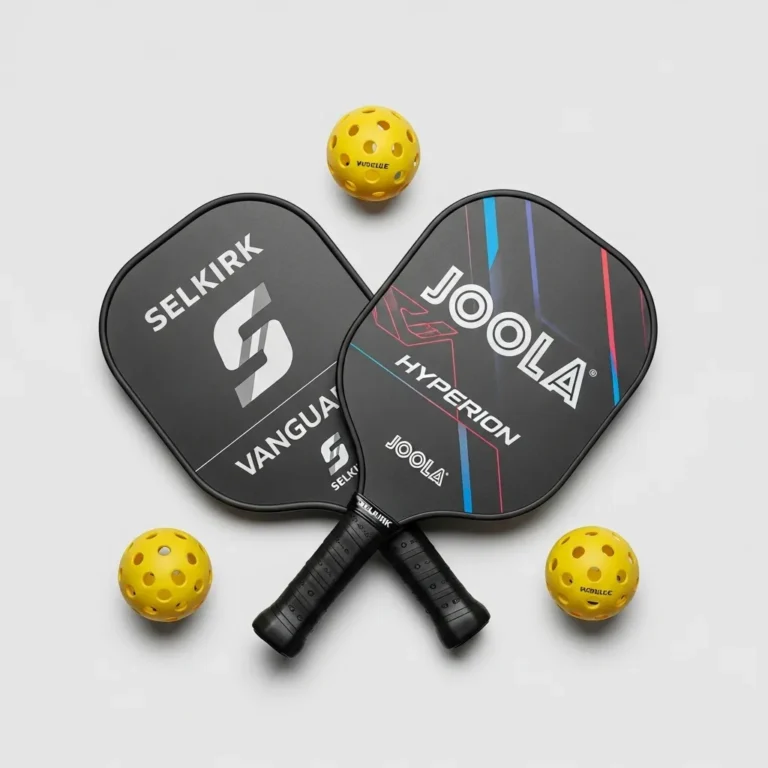
ben johns pickleball paddle
There is a familiar rhythm to Saturday morning at the local courts. You hear the thwack-thwack-thwack of plastic on carbon, the squeak of court shoes, and the inevitable debate happening on the sidelines about gear. If you hang around the gear bag bench long enough, one name always dominates the conversation: Ben Johns.
It makes sense. When you watch the “GOAT” (Greatest of All Time) play, he moves with an efficiency that makes the game look impossibly easy. Naturally, we all want a piece of that magic. We start wondering if the secret sauce isn’t just in his drilling regimen, but in the ben johns pickleball paddle he holds in his hand.
Navigating the world of paddles lately feels a bit like buying a car. There are generations, trims, core thicknesses, and technical jargon that can make your head spin faster than a topspin lob. If you’ve been scrolling through forums or staring at online listings trying to figure out if you need a joola ben johns hyperion pickleball paddle or the newer Perseus, you are definitely not alone.
Let’s sit down and unpack everything you need to know about Ben’s setup in 2025. We’ll cut through the marketing noise and look at what this gear actually does for your game, how it holds up, and whether it’s the right fit for your playstyle.
you may like it
Top Pickleball Gifts 2025:From Stocking Stuffers to Pro Gear
Looking for unique pickleball gifts? We break down practical gear, funny apparel, and budget-friendly ideas to help you surprise the player in your life.
1. Which specific paddle does Ben Johns currently use in 2025?
If you tuned into the PPA Tour recently, you’ve likely seen Ben wielding a grey and black paddle that looks sleek and mean. There is often confusion because JOOLA releases updates fairly quickly, but here is the definitive answer for 2025.
Answer: Ben Johns primarily uses the JOOLA Ben Johns Perseus 3S 16mm.
It’s been quite an evolution to get here. If you’ve been following his career, you remember when he was using the joola ben johns hyperion cfs 16 pickleball paddle, and then briefly the Gen 3 Perseus. However, the landscape shifted. The “3S” model is the updated, officially sanctioned version that you see widely used on the pro tour today.
Why the switch to the 3S? It largely comes down to reliability and compliance. The 3S offers that sweet spot of high performance without running afoul of tournament testing. It’s the paddle you buy when you want to play exactly what the pros are playing.
However, keep in mind that Ben doesn’t play with a paddle straight out of the plastic wrapper. He’s a tinkerer. He typically customizes his personal paddle with lead tape (we’ll get into the “why” and “where” of that later) and always uses an overgrip. So, while the chassis is the joola ben johns perseus pickleball paddle, the engine is tuned specifically for his hands.
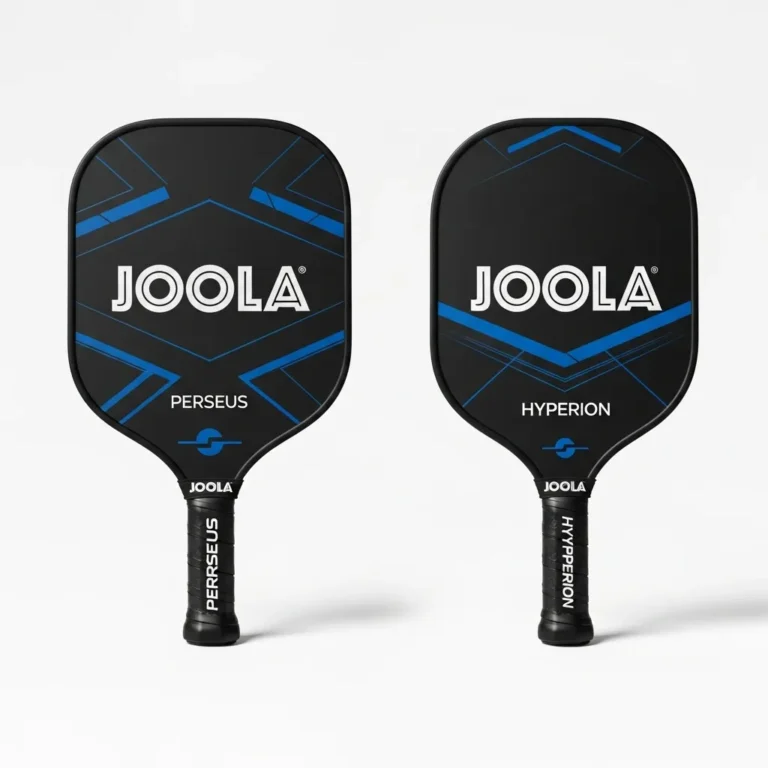
2. What is the main difference between the JOOLA Perseus and the JOOLA Hyperion?
This is probably the most common question players ask. You look at them, and aside from the shape of the head, they both scream “high performance.” But the difference in how they play is like the difference between a muscle car and a sports coupe.
Answer: The primary difference is the shape and swing feel.
The Perseus (The Powerhouse):
The Perseus features a “unibody” thermoformed construction. If you aren’t an engineer, think of this as the paddle being baked as one continuous piece rather than pieces glued together. This makes it more durable and, crucially, slightly stiffer. In pickleball terms, stiffness usually translates to added power.
The shape matters, too. The Perseus has a squarer, elongated top. This creates a sweet spot that feels a bit higher up the face, which is great for leverage when you are snapping your wrist on a drive. It’s a favorite for players who want that aggressive edge.
The Hyperion (The Smooth Operator):
On the other hand, the joola ben johns hyperion pickleball paddle is famous for its “Aero-Curve” rounded top. It just looks faster, doesn’t it? That curvature isn’t just aesthetic; it provides a lower swing weight. A lower swing weight means the paddle feels lighter in your hand when you are swinging it, even if the static weight is the same.
Because of this, the Hyperion offers a softer feel. It is generally preferred for control and hand speed at the net. If you are the type of player who prides themselves on lightning-fast hands during a volley exchange, the Hyperion shape often feels more natural.
3. Should I choose the 14mm or 16mm core thickness?
So, you’ve picked your shape. Now you have to pick your thickness. This single number—14mm vs. 16mm—changes the personality of the paddle more than almost anything else.
Answer:
16mm (Control – The Ben Johns Choice):
This is the version Ben Johns plays with. Whether he is using the joola ben johns perseus pro iv pickleball paddle variants or the standard 3S, he sticks to 16mm. Why? Because the game is won and lost at the kitchen line. A 16mm core is thicker, which means it absorbs more energy from the ball.
Think of it like catching an egg with a pillow versus a wooden board. The 16mm offers a softer feel, better “reset” capability (taking a hard shot and dropping it softly into the kitchen), and significantly more control for dinking. It is also more forgiving on off-center hits, which helps when you’re under pressure.
14mm (Power – The Firecracker):
The 14mm core is thinner and stiffer. When the ball hits a 14mm paddle, it rebounds almost instantly. This results in more “pop” and power on drives and serves. The trade-off? You have less “dwell time” (the time the ball sits on the face), which means you have to be much more precise with your soft game. If you have “stone hands,” a 14mm paddle might make your dinks pop up too high.
Part 2: Performance & Playability
Let’s move away from the spec sheet and talk about what it actually feels like to be on the court with these paddles. This is where the rubber meets the road—or rather, where the carbon meets the ball.
4. How does the “Charged Carbon Surface” affect spin generation?
We all want to hit those dipping drives that look like they’re going out before magically dropping on the baseline. That’s top spin.
Answer: The Carbon Friction Surface (CFS) technology creates a gritty, textured finish that literally “bites” the ball.
Imagine running your hand over extremely fine sandpaper; that’s the vibe. This texture allows for significant dwell time. Because the ball “sticks” to the face for a fraction of a second longer, you can brush up the back of the ball more effectively. This enables players to generate high RPMs (spin rates) on drives, rolls, and serves.
If you are a spin enthusiast—someone who loves to cut the ball on returns or hit heavy topspin passing shots—this surface is widely considered top-tier. It makes the ball dance.
5. Is the Ben Johns Perseus considered a “power” or “control” paddle?
In the old days of pickleball, you had to choose. You either bought a heavy, hard paddle for power, or a soft, light one for control. Technology has blurred those lines.
Answer: It is an all-court paddle leaning towards power.
The thermoformed construction gives the Perseus more “pop” than traditional control paddles (like the original Hyperion). When you really step into a drive, the ball explodes off the face. However, because Ben prefers the 16mm core, it retains enough softness for the soft game (dinks/drops).
It’s a hybrid. It gives you the weapon you need to finish the point, but it doesn’t betray you when you’re trying to survive a dink rally.
6. Does the paddle have a small sweet spot?
There is nothing worse than hitting a ball slightly off-center and feeling that jarring vibration known as a “dead ball.”
Answer: The Perseus has a fairly average-to-large sweet spot due to its thermoformed unibody design, which expands the responsive area to the edges.
This is a massive upgrade from the past. The older Hyperion models were sometimes criticized for having a “dead” feeling near the very top edge. If you hit the ball near the rim, it would just die. This has been largely improved in the newer “3S” and “C2” iterations. The foam injection around the perimeter of the newer models helps stabilize the paddle, so even if you aren’t hitting the bullseye every time, the ball still goes over the net.
Part 3: Durability & Construction
We have to have an honest conversation here. Pickleball paddles are expensive. If you are dropping over $200 on a ben johns pickleball paddle, you want to know it’s going to last longer than a carton of milk.
7. What is the “Loose Guard” or “Rattle” issue mentioned in reviews?
If you dive into Reddit threads or YouTube comments, you might see people complaining about a maraca-like sound coming from their paddle.
Answer: In some earlier generations (specifically Gen 2 and Gen 3), players reported a rattling sound. This was usually caused by loose glue or a small piece of core material breaking off inside the honeycomb cells.
The good news? JOOLA has addressed this in the newer “3S” manufacturing process to improve quality control. While no manufacturer is perfect, the “death rattle” is becoming much less common in the 2025 batches compared to the previous years.
8. Has the “snapping handle” issue from the original Hyperion been fixed?
This was the biggest drama in pickleball a few years ago. You’d see photos of the joola ben johns hyperion cfs 16 pickleball paddle snapped clean off at the neck.
Answer: Yes, this has been fixed.
The original Hyperion CFS sometimes suffered from weakness at the neck (where the handle meets the face) because the handle was essentially glued onto the face. The newer Perseus and Hyperion C2/3S models use a unibody design. This means the carbon fiber runs continuously from the face down through the handle. It makes them significantly stronger and has virtually eliminated this breakage risk. You can play hard without fear of your paddle turning into a projectile.
9. Is the Ben Johns paddle approved for USAP tournament play?
This is critical if you plan on playing in sanctioned tournaments.
Answer: Yes, the Perseus 3S and Hyperion C2 are USAP Approved.
There was a brief controversy with the “Gen 3” models being removed from the approved list in 2024 due to them being “too hot” (too powerful). It was a messy time for gear heads. However, the dust has settled. Players should ensure they are buying the “3S” or versions specifically labeled “USAP Approved” for tournament use. If you show up with a banned Gen 3, the referee will not let you play.
Part 4: Technical Specs & Customization
Now, let’s get into the weeds. If you want to replicate Ben Johns’ setup exactly, simply buying the paddle isn’t enough. You have to customize it. Ben treats his paddle like a Formula 1 car—the stock setup is just the beginning.
10. How does Ben Johns customize his paddle?
You might notice that Ben’s paddle looks slightly different on TV. That’s usually the white tape around the edge.
Answer: Ben Johns is known to add lead tape to the sides and throat of his paddle.
Why? He wants to increase the “twist weight.” Twist weight is a measure of how much the paddle resists twisting in your hand when you hit the ball off-center. By adding weight to the sides (specifically the 3 and 9 o’clock positions) and the throat, the paddle becomes more stable. It effectively enlarges the sweet spot even further.
He also uses a white JOOLA Overgrip. This isn’t just for looks. It increases the handle thickness slightly, which can help prevent “tennis elbow,” and improves sweat absorption in those high-pressure, sweaty matches.
11. What is the grip size and handle length?
The ergonomics of the handle dictate how the paddle connects to your body.
Answer:
- Handle Length: 5.5 inches (Elongated). This is crucial for the modern game. Ben hits a two-handed backhand (as do most top pros now). The 5.5-inch handle gives you enough room to fit two hands comfortably on the grip without feeling cramped.
- Grip Circumference: Standard 4.25 inches. This is a fairly standard tennis size.
- Weight: It averages around 8.0 oz straight out of the box, but can vary slightly. Remember, once Ben adds his lead tape and overgrip, his actual playing weight is likely closer to 8.4 or 8.5 oz.
12. What is the “Propulsion Core” technology?
You will see this term plastered on the packaging of the newer models, including the joola ben johns perseus pro iv pickleball paddle discussions or the 3S marketing.
Answer: Found in the newer models, this core allows the paddle face to compress slightly upon impact (like a trampoline) to generate power on hard swings, while remaining rigid on soft touches for control.
It attempts to bridge the gap between power and touch. In the past, a paddle was either a trampoline (great for power, bad for control) or a brick (great for control, bad for power). The Propulsion Core is designed to be smart—it reacts differently depending on how hard you swing.
Final Thoughts: Is It Right For You?
Choosing a paddle is personal. Just because Ben Johns wins triple crowns with the Perseus doesn’t guarantee it will fix your third-shot drop. However, there is a reason these paddles are so popular. The combination of the friction surface for spin, the 16mm core for control, and the thermoformed body for power creates a piece of equipment that truly lets you do it all.
If you are a beginner, the 16mm joola ben johns hyperion pickleball paddle might be the friendlier starting point due to its balance and speed. But if you are an intermediate to advanced player looking to add some serious pop to your game while keeping your soft game honest, the ben johns pickleball paddle (specifically the Perseus 3S) is hard to beat in 2025.
If you’re a beginner and don’t want to spend $200, check out our review of the [JOOLA Ben Johns Blue Lightning Pickleball] starter set.
See you on the courts!
you may like it