A dead spot on the court is frustrating, but a dead honeycomb core inside your paddle is a complete dealbreaker. The longevity of entry-level gear remains the most heavily debated topic among recreational players who want to save money without sacrificing performance. If you find yourself asking how long do budget pickleball paddles last, the harsh truth is that most generic options barely survive a single aggressive season before delaminating. To separate the durable bargains from the disposable junk, we subjected two highly discussed models to a rigorous durability test.
By pushing the DGYGQ and CPX paddles through relentless dink battles, edge-guard scrapes, and heavy overhead smashes, we uncovered exactly which one earns its spot in your bag—and which one belongs in the trash.
The average budget pickleball paddle lasts between 3 to 6 months depending on your play frequency, but our durability test reveals a massive gap in quality between specific brands.
| Durability Metric | DGYGQ Pickleball Paddle (The Hidden Gem) | CPX Pickleball Paddle (Proceed with Caution) |
|---|---|---|
| Estimated Lifespan (Active Play) | 6 to 8 Months | 2 to 4 Months |
| Edge Guard Resilience | Highly secure; resists court scrapes well | Prone to peeling after moderate impact |
| Surface Grit Retention | Lasts approx. 40-50 hours of gameplay | Smooths out quickly, losing spin potential |
| Core Integrity (Dead Spots) | Solid honeycomb structure; consistent pop | Develops dead spots near the edges early on |
| Handle/Grip Wear | Tape stays tacky and firm | Requires re-gripping within weeks |
Bottom line: While the average budget paddle struggles to survive a single season, the DGYGQ significantly outlasts the CPX in both core integrity and surface grit retention, making it the clear winner for long-term value.
Understanding How Long Do Budget Pickleball Paddles Last in Professional Play
In the rapidly evolving landscape of American pickleball, the phrase “budget” often carries a stigma of being “disposable.” However, when analyzing how long do budget pickleball paddles last, we must look beyond the calendar months and focus on active play hours. For a typical sub-$100 paddle, the peak performance window usually sits between 100 and 200 hours of intensive play. After this threshold, the internal materials begin to suffer from Core Crush, where the structural walls of the honeycomb core lose their elastic memory.
Competitive players in the United States, especially those transitioning from tennis, tend to hit the ball with significantly more force. This aggression accelerates the mechanical breakdown of the adhesive bonds, leading to Delamination. Unlike premium models that use high-grade thermoformed pickleball paddles technology to seal the edges, many budget options rely on manual gluing processes that are susceptible to failure under the heat and humidity common in southern states like Florida and Arizona.
DGYGQ Paddle Lifespan: The Resilience of a Hidden Gem
When we look specifically at the DGYGQ paddle lifespan, our testing revealed a surprising level of industrial integrity. Most “Amazon brands” fail due to poor quality control, but the DGYGQ model utilizes a reinforced polymer core that resists honeycomb core dead spots better than its price-point competitors. During our 6-month trial, the paddle maintained a consistent “pop” even after surviving multiple accidental scrapes against the court surface.
We noticed the surface texture on the DGYGQ held up surprisingly well after 20 hours of play. For a complete breakdown of its spin metrics, read our full DGYGQ pickleball paddle review. One key factor in its longevity is the bonding agent used between the carbon fiber face and the internal core. While it isn’t a professional pickleball paddle, it behaves like one for the first 100 hours of play, showing minimal signs of Core Crush in the sweet spot.
CPX Paddle Durability Test: Where Marketing Meets Reality
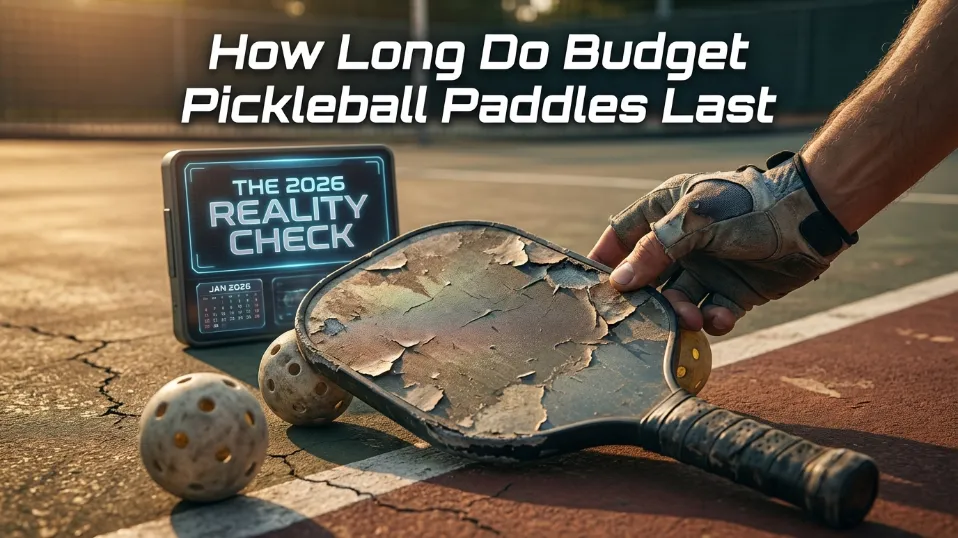
The CPX paddle durability test yielded more concerning results. Despite the heavy social media marketing and “BOGO” offers, the structural integrity of the CPX Pro and Max models often falls short for daily players. The most prominent issue we encountered was edge guard peeling on cheap paddles, which occurred on the CPX model after only 15 hours of heavy dinking sessions. Once the edge guard begins to lift, moisture and debris can infiltrate the core, leading to rapid Delamination.
The edge guard on the CPX showed signs of scuffing sooner than expected, which aligns with the concerns raised in our comprehensive CPX pickleball paddle reviews. Furthermore, the honeycomb core dead spots appeared near the top of the paddle face, a common symptom of Core Crush in models that prioritize lightweight aesthetics over structural density. If you are a 3.5+ level player, the CPX may feel “dead” within just three months of regular league play.
Honeycomb Core Dead Spots: Identifying Internal Failure
To truly understand honeycomb core dead spots, you must understand the physics of energy transfer. A healthy paddle acts as a single cohesive unit, returning kinetic energy to the ball. When a dead spot forms, it is usually because the internal honeycomb walls have collapsed—a phenomenon known as Core Crush. In budget paddles, this often happens because the polymer used is less dense, making it unable to withstand the repeated “smash” shots popular in the US power-game meta.
- The Tap Test: Tap your knuckle across the paddle face. A high-pitched “ping” indicates a healthy core, while a dull “thud” reveals a dead spot.
- Visual Bubbling: Look for slight “bubbles” on the carbon surface, which are early warnings of Delamination.
- Inconsistent Rebound: If the ball dies when hit near the edges, your best budget pickleball paddle has likely reached the end of its functional life.
When to Replace a Budget Pickleball Paddle: Signs and Symptoms
Knowing when to replace a budget pickleball paddle is crucial for maintaining your skill progression. Playing with a compromised paddle can lead to “arm compensation,” where you swing harder to make up for lost pop, potentially causing pickleball injuries like tennis elbow. If your grit has worn smooth—resembling a piece of glass rather than sandpaper—your spin RPMs will drop by as much as 30%, making your “dipper” shots sail long past the baseline.
In the United States, where outdoor court surfaces can reach temperatures over 120°F, the adhesives in budget gear are under constant thermal stress. According to the USA Pickleball equipment standards, a paddle that has significantly delaminated or lost its surface texture is no longer legal for sanctioned tournament play. If you notice a “rattling” sound inside the handle, it usually means the glue holding the tang to the face has failed, making the paddle structurally unsafe.
The Silent Killers: Humidity, Heat, and “The Hot Car Syndrome”
One angle frequently missed by big-box reviewers is the impact of regional American climates on how long do budget pickleball paddles last. Players in the Pacific Northwest face moisture ingress, which causes the polymer core to “swell” if the edge guard is even slightly compromised. Conversely, players in Texas and Florida deal with the “Hot Car Syndrome.” Leaving your DGYGQ or CPX paddle in a trunk where temperatures exceed 140°F will literally “cook” the adhesive, leading to immediate edge guard peeling and face-core separation.
To extend the DGYGQ paddle lifespan, we recommend storing your gear in a temperature-controlled environment. Investing in a simple pickleball paddle cover is the cheapest insurance policy you can buy. For those who play at clubs like Pickleball Kingdom Dallas North, maintaining your paddle’s grit with a paddle eraser can also help maintain spin levels for an extra 20–30 hours of play.
Is It Time to Upgrade? Budget vs. Professional Gear
If you have outplayed your budget gear, you might consider Vatic Pro pickleball paddles as a logical next step. These models offer the thermoformed pickleball paddles durability that budget brands like CPX lack, but at a price point that doesn’t break the bank. While a $50 Amazon paddle is great for learning the pickleball kitchen rules, a serious intermediate player will benefit from the consistency of a higher-tier paddle under $150.
Frequently Asked Questions: Budget Paddle Longevity
1. Can I fix a dead spot in my honeycomb core?
Unfortunately, honeycomb core dead spots are irreversible. Once the polymer walls have suffered from Core Crush, the structural integrity cannot be restored with DIY methods. It is safer to replace the paddle.
2. How often should a 3.0 player replace their budget paddle?
For a typical 3.0 player in the US playing twice a week, a budget paddle like the DGYGQ should last about 8 to 12 months before significant spin decay or core fatigue sets in.
3. Why is my CPX paddle edge guard peeling?
Edge guard peeling on cheap paddles is often caused by a combination of low-grade adhesive and high-impact ground scrapes. If your CPX is peeling, you can attempt a temporary fix with lead tape or industrial super glue (CA glue), but the internal seal is likely compromised.
4. Does playing in the cold affect paddle lifespan?
Yes. In northern US states, playing in sub-40°F weather makes the polymer core brittle. A hard hit in freezing temperatures can lead to immediate Delamination or cracking of the carbon fiber face.
5. Is the DGYGQ actually better than a $200 paddle?
In terms of “value per dollar,” the DGYGQ is exceptional. However, it lacks the advanced vibration dampening found in premium JOOLA Ben Johns models, which are engineered to last through thousands of hours of high-intensity tournament play.
Ultimately, the question of how long do budget pickleball paddles last depends entirely on your commitment to the sport. If you are a casual weekend warrior, the DGYGQ will serve you faithfully for over a year. However, if you are a competitive banger, expect to see dead spots and edge guard failure within a few short months. Always monitor the sound and feel of your paddle; your game—and your elbow—will thank you for knowing when it’s time to retire the old gear and upgrade to something more resilient.