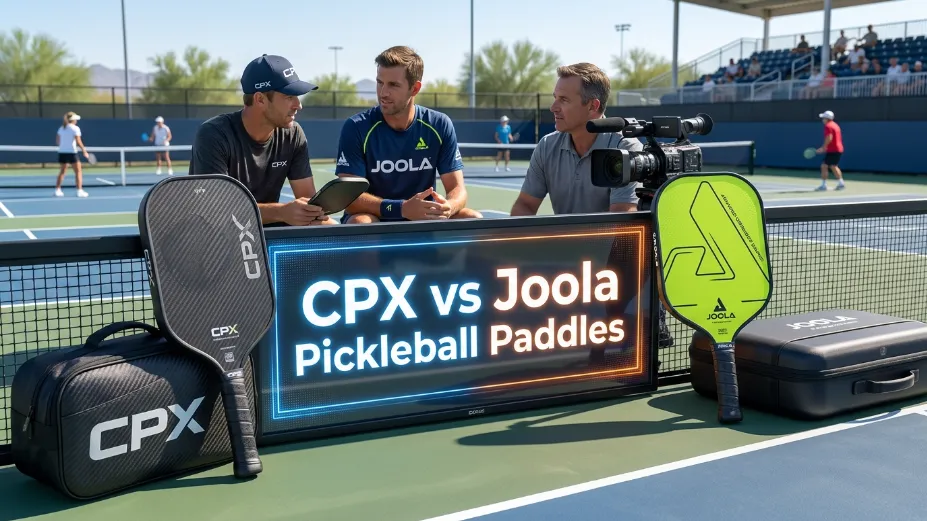
Walk onto any local pickleball court, and you will likely see a sea of Joola paddles dominating the net. But lately, a quieter, highly-engineered challenger has been disrupting tournament brackets and recreational play alike. The debate over CPX vs Joola pickleball paddles isn’t just about brand loyalty—it is a clash between established premium engineering and aggressive new-school design. Before you drop hundreds of dollars on your next gear upgrade, you need to understand exactly what each paddle sacrifices to give you an edge on the court.
| Feature | CPX Paddles | Joola Paddles |
|---|---|---|
| Best For | Control & Value | Maximum Spin & Power |
| Surface Material | T700 Raw Carbon Fiber | Carbon Friction Surface (CFS) |
| Sweet Spot | Generous & Forgiving | Highly Responsive |
| Price Tier | Mid-Range | Premium / High-End |
| Winner | Best Budget-Friendly Pro Paddle | Best Overall Pro Performance |
Ultimately, choose Joola if you want aggressive, tournament-level spin and power, but go with CPX if you need superior control and a forgiving sweet spot without paying a premium price.
The Technical Evolution: CPX vs Joola Pickleball Paddles in the Modern Era
Pickleball in the United States has undergone a seismic shift. We have moved past the era of wooden rackets and basic honeycombs into a world dominated by aerospace-grade materials and thermoforming. When comparing CPX vs Joola pickleball paddles, we are looking at two different philosophies of this evolution. Joola, the German-born titan, leverages its heritage in table tennis to create high-RPM machines. CPX, a Chicago-designed disruptor, focuses on the “Direct-to-Consumer” (DTC) model, offering elite specs that usually cost $250+ for nearly half that price.
Players today are obsessed with “Gen 2” and “Gen 3” technology. Joola’s latest Pro V and Pro IV series represent the pinnacle of established tech, while CPX aims to provide a Joola vs CPX paddle comparison that highlights value without compromising on the unibody construction that advanced players demand.
Engineering Showdown: KineticFrame vs. Unibody Construction
The internal architecture of these paddles determines how they “feel” during a 60-mph fire fight at the kitchen. Joola has introduced the KineticFrame, inspired by the “kick-point” engineering found in high-end hockey sticks. This allows the paddle to flex and recover instantly, creating a “connected” feel that many pros crave. On the other hand, the CPX paddle performance review data suggests their strength lies in a rock-solid Thermoformed Unibody. By molding the face and handle as a single piece, CPX eliminates the weak points that often lead to handle snapping—a common complaint in older, non-thermoformed models.
Surface Science: Carbon Fiber vs Carbon Friction Surface (CFS)
If you are looking for the best pickleball paddle for control and spin, the surface material is your most critical factor. This is where the carbon fiber vs carbon friction surface debate gets technical. Joola uses a proprietary Carbon-Flex5 weave, which they call their Carbon Friction Surface (CFS). This isn’t just raw carbon; it’s a treated surface designed to maximize “dwell time,” allowing the ball to sink into the face for a fraction of a second longer to generate massive RPMs.
CPX takes a different route, utilizing Raw T700 Carbon Fiber sourced from Toray in Japan. T700 is the gold standard for “grit” longevity. While Joola’s CFS is legendary for its out-of-the-box spin, some long-term users have noted that the “grit” can wear down after 3-4 months of heavy play. In contrast, CPX paddles use a sandblasted matte finish on their T700 carbon that tends to hold its texture longer, even if it doesn’t reach the extreme peak RPMs of a brand-new Joola.
- Joola CFS: Higher peak spin, softer feel, but potential for faster grit degradation.
- CPX T700: Consistent grit, firmer “pop,” and extreme durability against surface smoothing.
Performance Mechanics: Power, Pop, and the 14mm vs 16mm Dilemma
When choosing your weapon, you must decide between a 14mm vs 16mm pickleball paddle. Joola’s Perseus Pro IV and the CPX Max both offer 14mm versions that are “poppy” and aggressive. The 14mm core is a “power” player’s dream—it returns energy to the ball quickly, making it ideal for overhead slams and drives. However, the 16mm Joola remains the favorite for doubles players who need to “reset” hard drives into the kitchen.
For a deep dive into the core technologies and longevity of this brand, check out our comprehensive CPX Pickleball Paddle reviews. One thing we discovered in testing the CPX Max is that it carries a surprisingly high swing weight. While marketed at 7.8 oz, many independent tests show the actual weight closer to 8.4 or 8.5 oz. This added mass at the head provides “plow-through” power that rivals the Joola Ben Johns Perseus Pro IV, but it might feel “clunky” for players with slower hand speeds.
Durability Realities: Core Crushing and Delamination
The “elephant in the room” for any high-end paddle is delamination and core crushing. The thermoforming process uses heat and pressure to bond layers, but if the quality control isn’t perfect, the honeycomb core can collapse. Joola faced significant scrutiny with their earlier Gen 3 models regarding core durability. The Pro IV and Pro V series have implemented tighter QC to fix this, adding Hyperfoam Edge Walls to stabilize the perimeter.
CPX counters this with a Lifetime Durability Guarantee on their Max series. This is a massive “US-market” advantage. While Joola offers a standard 6-month warranty, CPX’s lifetime promise targets the “hidden fear” of every player: spending $200 on a paddle that becomes a “dead board” in six months. Their thermoformed pickleball paddles are built with foam-injected walls that not only expand the sweet spot but act as a structural “roll cage” for the honeycomb core.
Missing Information: What the Big Review Sites Don’t Tell You
Most reviews gloss over the “marketing vs. reality” gap. For example, CPX leans heavily on being “Designed in Chicago.” While the brand is US-based, the manufacturing—like 99% of the industry including Joola—takes place in high-tech facilities in China. The “designed in” label is more about the spec-tuning and quality oversight than the actual factory floor.
Additionally, the Aero Throat hole seen on the CPX Max and similar designs like Selkirk’s Power Air is often touted as a “drag reducer.” In reality, for most recreational players, the aerodynamic benefit is negligible. Its real value is shifting the balance point higher up the paddle, which increases the twist weight—making the paddle more stable on off-center hits. If you struggle with the paddle “turning” in your hand when you hit the edge, this design is a functional win, even if the “speed” claims are overblown.
The Search for a Joola Ben Johns Alternative
Let’s talk economics. Is the Joola name worth the $280 price tag? For pros like Ben Johns, who get fresh paddles every few weeks, the answer is yes. But for the weekend warrior, the Joola Ben Johns alternative market is booming. CPX offers a “BOGO” (Buy One Get One) strategy or deep discounts that bring their pro-level gear down to $100-$130. When you look at the USA Pickleball approved paddle list, you’ll find both brands fully certified for tournament play.
If you aren’t ready to commit to CPX, other high-value alternatives like the 11SIX24 Vapor Power or the Honolulu J6CR provide that same “Gen 3” feel with better transparency on manufacturing specs. However, CPX remains the most aggressive on price, essentially offering “95% of Joola’s performance at 50% of the cost.”
Final Buying Advice: Which Side of the Net Are You On?
The choice between CPX vs Joola ultimately comes down to your “Relationship with the Ball.”
- Choose Joola if you are an elite competitor who demands the highest possible Spin Rate (RPM) and the “prestigious” feel of a paddle tuned by the World #1. You are paying for R&D and a thinner, faster-moving frame.
- Choose CPX if you are a “value-performance” seeker who wants a durable, head-heavy power-hitter with a Lifetime Warranty. It is the best Joola Ben Johns alternative for someone who wants to dominate the baseline without breaking the bank.
Before you make your final choice, always check if your local club has a demo program. No amount of data can replace the feel of a Perseus Pro IV in your own hand during a high-stakes tiebreaker.
Frequently Asked Questions
Is CPX Pickleball a legitimate brand?
Yes. CPX (formerly Carbon Pickle) is a US-based company with a wide range of USA Pickleball-approved paddles. They are known for their high-quality DTC (Direct to Consumer) business model and strong customer service in Chicago.
Why is Joola so much more expensive than CPX?
Joola invests heavily in professional endorsements (Ben Johns, Anna Bright), global distribution, and custom-engineered technologies like KineticFrame. You are paying for a premium brand experience and pro-level refinements.
Which paddle is better for tennis elbow?
The 16mm versions of either brand are better for joint health. Specifically, the CPX Pro 19mm offers the most vibration dampening due to its extreme core thickness, making it a top choice for players with “pickleball elbow.”
Does the CPX Max really weigh 8.5 ounces?
While marketed at a lighter target weight (7.8 oz), many production units of the CPX Max test between 8.3 oz and 8.5 oz. This makes it a “Power” paddle with significant head-weight.
For more equipment guides, visit the official USA Pickleball approved paddle list to verify your gear’s tournament eligibility.