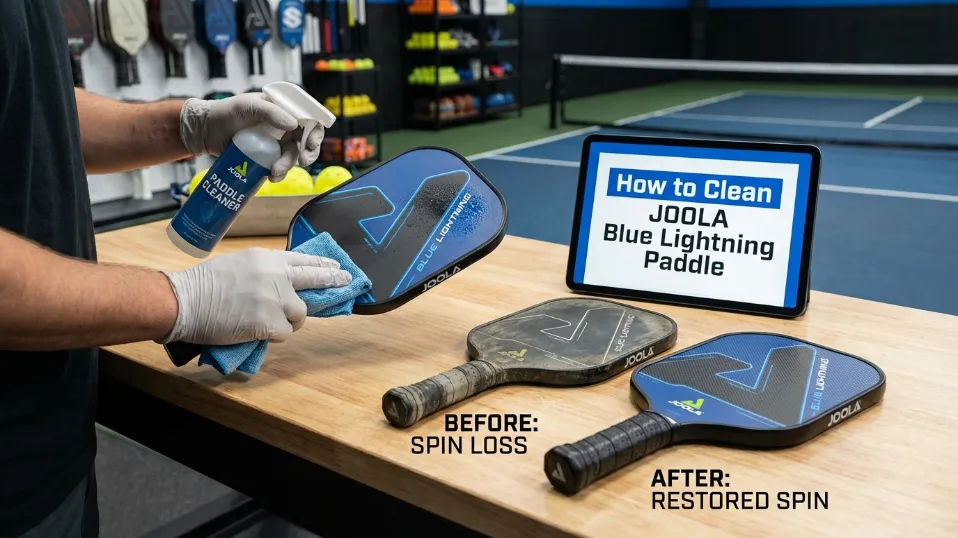
Is your spin starting to slip? If you’ve noticed your shots losing their bite, the culprit isn’t your technique—it’s the buildup on your gear. Learning how to clean JOOLA Blue Lightning paddle surfaces is the secret to restoring that ‘out-of-the-box’ grit and keeping your Ben Johns-inspired game at its peak. Here’s how to revive your paddle in minutes without damaging the fiberglass face.
The JOOLA Ben Johns Blue Lightning is a masterpiece of entry-level engineering, but its maintenance is often misunderstood. Unlike the raw carbon fiber surfaces used by pros on the PPA Tour, this paddle features a high-performance fiberglass face. If you apply the wrong cleaning methods, you risk stripping the graphic grit and ruining the 10mm response core. In this guide, we will dive deep into joola pickleball paddle care to ensure your equipment lasts through hundreds of matches at your local free pickleball courts.
Understanding the Fiberglass Anatomy of the Blue Lightning
To provide proper joola pickleball paddle care, you must understand what is under the hood. The Blue Lightning utilizes a Fiberglass Surface layered over a polymer honeycomb core. Fiberglass is naturally smoother and more elastic than carbon fiber, which provides that signature “pop” on drives.
- Core Thickness: At 10mm, this is a “thinner” paddle designed for power.
- Surface Texture: The grit is applied through a multi-layer printing process, not a raw weave.
- Edge-Shield: A specialized plastic guard designed to absorb ground impact.
Because the texture is a “printed” finish, it is significantly more sensitive to chemical solvents and abrasive tools than a carbon fiber pickleball paddle. This is the first gap most players miss: treating fiberglass like carbon fiber is the fastest way to lose your spin potential.
The Daily Protocol: Clean Fiberglass Pickleball Paddle Surfaces Safely
Daily maintenance is the backbone of performance. After a session at the Pickleball Kingdom Tigard or any outdoor facility, your paddle face is coated in “ball fuzz”—microscopic plastic fibers from the ball—and court dust.
Step 1: The Dry Wipe
Before introducing moisture, use a dry microfiber cloth to lift loose debris. This prevents you from “scrubbing” dust particles into the fiberglass resin, which can act like sandpaper and dull the finish.
Step 2: The Damp Method
Dampen a clean section of your microfiber cloth with lukewarm water. Note: “Damp” means the cloth shouldn’t drip. Gently wipe the face in circular motions. This is the gold standard for how to clean fiberglass pickleball paddle faces without degrading the materials.
Step 3: Immediate Drying
Never let your JOOLA air dry. Residual moisture can find its way into the seams of the edge guard. Use a separate dry microfiber towel to buff the surface until it is bone-dry. This restores the tactile friction required for a deadly pickleball drop shot.
The Critical Warning: The Pickleball Paddle Eraser Controversy
If you search for cleaning tips, you will undoubtedly see the pickleball paddle eraser recommended everywhere. Here is the “missing angle” that other sites won’t tell you: Do not use a standard carbon eraser on the JOOLA Blue Lightning.
A pickleball paddle eraser is designed for Raw Carbon Fiber. It works by reaching into the deep pores of the carbon weave to pull out plastic. On a fiberglass face like the Blue Lightning, the eraser’s density is too aggressive. Using it can actually “sand down” the printed grit, leaving you with a smooth, illegal surface that cannot grip the ball.
Pro-Tip: If you see a pro using an eraser on their best JOOLA pickleball paddle, they are likely using the Perseus or Scorpeus models, which are raw carbon. For your Blue Lightning, stick to the microfiber and water method to preserve the integrity of your fiberglass pickleball paddles.
Deep Cleaning: Removing Stubborn Stains and Ball Marks
Sometimes, water isn’t enough. If you have yellow dye transfer from outdoor balls or skin oils from frequent handling, you need a slightly more advanced approach to joola pickleball paddle care.
- Mild Detergent: Add one drop of pH-neutral dish soap (like Dawn) to a cup of water. Use this solution sparingly on a cloth for stubborn scuffs.
- White Vinegar Solution: For players in high-mineral water areas (like Arizona or Florida), a 50/50 mix of water and white vinegar can remove “cloudiness” caused by hard water deposits.
- Avoid These: Never use acetone, bleach, or high-percentage isopropyl alcohol. These chemicals can dissolve the epoxy resins that hold the fiberglass layers together, leading to delamination.
If you are looking for a paddle with a more durable cleaning profile for the future, you might compare the JOOLA Blue Lightning vs JOOLA Essentials to see which fits your maintenance style better.
Protect JOOLA Paddle Edge Guard: Preservation and Longevity
The edge guard is the most vulnerable part of the Blue Lightning. Since it’s a 10mm paddle, any direct hit to the asphalt can crack the “Edge-Shield” protection. To protect joola paddle edge guard components, you must be proactive.
The best solution is applying JOOLA Clear Edge Guard Tape. This 30mm or 28mm tape wraps around the perimeter, acting as a “sacrificial layer.” When you scrape the ground for a low dink, the tape takes the damage, not the plastic guard.
Why use clear tape?
- It preserves the “Blue Lightning” aesthetics.
- It prevents the edge guard from “clicking” or loosening over time.
- It adds a negligible amount of weight, which can actually help with stability—a common upgrade for best pickleball paddles for intermediate players.
Handle and Grip Maintenance: Hygiene for the Sure-Grip Ridge
The JOOLA Blue Lightning features a unique Sure-Grip Ridge. This handle is perforated to allow sweat to escape, but those same holes can trap bacteria and dead skin cells.
To maintain your grip:
- Wipe the handle with a damp cloth (using unscented, alcohol-free baby wipes) after every match.
- If the “tackiness” is gone, don’t just clean it—replace the overgrip. Using a fresh overgrip is the most cost-effective way to ensure your paddle doesn’t fly out of your hand during a Pickleball Smash It session.
- Check the 14mm vs 16mm pickleball paddle weight distribution if you decide to add multiple overgrips, as this can shift the balance toward the handle.
Environmental Hazards: US Climate Impact on JOOLA Gear
Whether you play in the humid heat of Houston or the dry desert of Scottsdale, the environment is a silent “paddle killer.”
Extreme Heat: Never leave your paddle in a car trunk. Temperatures in a closed vehicle can exceed 140°F, which softens the internal adhesives and can cause your fiberglass face to bubble or delaminate.
Humidity and Sweat: If you play at the Pickleball Katy center in Texas, humidity is your enemy. Always air out your paddle bag at home. Storing a damp paddle in a sealed bag creates a greenhouse effect that can degrade the core’s “pop” over time.
How to Clean JOOLA Blue Lightning Paddle-Frequently Asked Questions
Can I use a Magic Eraser on my JOOLA Blue Lightning?
While some players use a “Magic Eraser” (melamine foam), it is an abrasive material. It is safer than a pickleball paddle eraser but should only be used dry and with very light pressure for extreme stains. Excessive use will wear down the fiberglass finish.
How often should I clean my fiberglass paddle?
You should perform a dry wipe after every match and a damp deep clean once a week if you play 3 or more times per week. This prevents the “buildup” that leads to spin loss.
Why does my paddle sound hollow after cleaning?
If the sound changes, you may have gotten water inside the core. This is why you must protect joola paddle edge guard seams and never submerge the paddle. A hollow sound usually indicates internal damage or delamination.
Will cleaning my paddle restore the spin?
Yes. By removing the compressed plastic fibers and dirt from the surface, you allow the original texture to make better contact with the ball, significantly improving your best pickleball paddle for spin performance.
Conclusion: The Path to 5.0 Maintenance
Maintaining your equipment is just as important as mastering your pickleball serve tips. By following these professional joola pickleball paddle care steps—specifically avoiding the pickleball paddle eraser on fiberglass and using protective tape—you ensure your Blue Lightning remains a high-performance tool for years.
Ready to upgrade your gear? Check out our reviews on the best Selkirk pickleball paddle or browse our list of top pickleball paddle brands to find your next favorite weapon on the court.