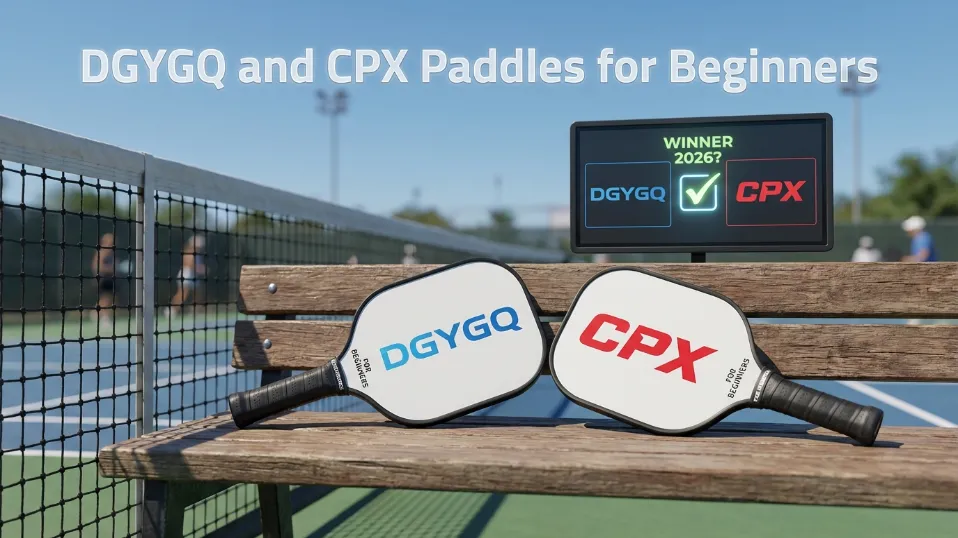
Stepping onto the pickleball court for the first time is intimidating enough without wrestling with gear that actively fights against your learning curve. Most newcomers gravitate towards affordable options, quickly narrowing their carts down to a few recognizable budget brands. This naturally begs the critical question: are DGYGQ and CPX paddles for beginners truly a smart choice, or will they secretly hold back your progress? Rather than just reciting technical spec sheets, we need to evaluate how these specific models handle the erratic swings, off-center hits, and power-control struggles that define your first few months of play. Let’s find out which paddle actually forgives your mistakes and helps you build a solid foundation.
| Beginner Criteria | DGYGQ PKB-EL01 | CPX Pro (19mm) | CPX Max (14mm) |
|---|---|---|---|
| Forgiveness (Sweet Spot) | 8/10 | 9.5/10 | 7.5/10 |
| Control & Precision | 7/10 | 10/10 | 7/10 |
| Vibration Dampening | 8/10 | 10/10 | 7/10 |
| Ease of Use (Weight) | 9/10 | 8/10 | 8/10 |
| Spin Development | 9/10 | 7/10 | 9/10 |
Are DGYGQ and CPX Paddles for Beginners the Best Entry-Level Investment?
The transition from a total novice to a consistent player depends heavily on finding forgiving pickleball paddles on a budget. In the current 2026 market, players are no longer satisfied with generic wooden sets. Brands like DGYGQ and CPX have disrupted the space by offering “pro-level” materials like Raw T700 Carbon Fiber at a fraction of the cost of mainstream giants. But for a beginner, the tech jargon often masks the most important factor: how the paddle feels when you are scrambling to return a fast serve.
When performing an entry-level pickleball paddles comparison, we must look at the structural stability of the frame. DGYGQ utilizes a 13mm core optimized for “pop,” while CPX offers a range including the massive 19mm Pro series. For the newcomer, this choice isn’t just about speed; it is about protecting your arm from the repetitive vibrations that lead to “Pickleball Elbow.” While it offers great control for novices, you can explore the exact material specs in our full DGYGQ pickleball paddle review.
The Structural Engineering: Why Material Matters for New Hands
Most beginners don’t realize that the “face” of the paddle is what dictates how long you can keep a rally going. The use of Toray T700 Carbon Fiber in these budget models is a game-changer. Unlike cheaper fiberglass surfaces that lose their “grit” after a few weeks, carbon fiber provides a naturally textured surface. This is vital for the best pickleball paddle for learning because it allows you to experiment with topspin and slices without having to swing with excessive force.
- Core Physics: The honeycomb polypropylene core acts as a shock absorber. In physics terms, a thicker core ($16mm$ to $19mm$) increases the “dwell time”—the millisecond the ball stays on the face—giving you more maneuverability and time to aim your shot.
- Thermoforming: Both DGYGQ and CPX utilize thermoformed unibody construction. This means the paddle is molded as one solid piece, preventing the handle from snapping during an aggressive overhead smash.
- Edge Guards: A sturdy edge guard is a beginner’s best friend. Since you will likely “scrape” the court while learning low dinks, these paddles are designed to take a beating without delaminating.
is DGYGQ a good starter paddle for aggressive learners?
The short answer is yes, specifically for those with a background in tennis. The DGYGQ PKB-EL01 is widely considered one of the best budget pickleball paddle options because of its balance. Weighing in at approximately 7.76 oz, it is exceptionally lightweight, which helps reduce arm fatigue during long training sessions.
One “hidden” advantage of the DGYGQ for beginners is its extended 5.9-inch handle. If you are struggling to reach wide shots or prefer using a two-handed backhand, this extra length provides the necessary leverage. However, the 13mm core is thinner than average, meaning the ball will “pop” off the face faster. While this helps with power, it requires a steady hand to control during delicate shots at the “kitchen” line. If you are a novice who naturally hits the ball too long, you might want to compare this to a 16mm option like those found in our 14mm vs 16mm pickleball paddle guide.
CPX paddle beginner review: Navigating the Air, Pro, and Max Series
CPX takes a different approach by offering a tiered ecosystem. Their CPX paddle beginner review feedback often highlights the “BOGO” (Buy One Get One) deals, which make them a staple for families starting out.
- CPX Pro (The Control King): Featuring a rare 19mm core, this is arguably the most forgiving paddle for a beginner. The sheer thickness creates a massive sweet spot, meaning even if you miss the center of the paddle, the ball will still likely clear the net.
- CPX Air: A 16mm standard model that focuses on maneuverability and fast “hand speed” at the net. It’s a solid entry-level pickleball paddles comparison point for those who want a “classic” feel.
- CPX Max: At 14mm, this is for the beginner who wants to end points quickly with power. Be warned: users have noted that the Max can feel “head-heavy”.
Some beginners find the grip texture slightly different. To see if it’s a dealbreaker, read the complete CPX pickleball paddle reviews before buying. If you’re looking for even more savings, you might also check out our list of the best pickleball paddles under 100.
Information Gaps: What Big Reviewers Won’t Tell You
When searching for the best pickleball paddle for learning, most sites focus on the positives. However, there are “missing angles” regarding these budget performance brands that every buyer should know:
1. USAPA Approval Verification: While DGYGQ and CPX claim USA Pickleball official standards (USAPA) approval, beginners should always verify the specific model on the official USA Pickleball database. Some “clones” sold on major marketplaces look identical but lack the testing certification required for sanctioned tournament play.
2. The “Tested Weight” Discrepancy: Manufacturers often market a “target weight” (e.g., 7.8 oz), but independent tests on the CPX Max have shown weights as high as 8.47 oz. For a beginner with wrist issues, that half-ounce difference can be the difference between a fun afternoon and a week of icing your arm.
3. Grit Longevity: The T700 Raw Carbon Fiber is excellent for spin, but it is not immortal. For a daily player, expect the “grit” to start smoothing out after 6 to 9 months of play. This is why many beginners opt for the CPX “Lifetime Warranty” add-on for $39.97, which allows for free replacements for almost any reason.
Frequently Asked Questions (FAQ)
Is the DGYGQ paddle too heavy for new players?
No. At 7.7 to 8.2 ounces, the DGYGQ is categorized as a mid-weight paddle. It provides enough mass to block fast shots without feeling like a “sledgehammer” in your hand. In fact, its lightweight nature is one of its highest-rated features for reducing shoulder strain.
Does the CPX offer a large sweet spot?
Yes, particularly the CPX Pro 19mm model. Because it uses a thick honeycomb core and foam-injected walls, the energy is distributed across a larger area of the paddle face. This makes it incredibly forgiving for beginners who haven’t yet mastered consistent ball-to-center contact.
Can I use these paddles in local tournaments?
Both DGYGQ and CPX models are generally USAPA Approved. However, always check for the “USA Pickleball Approved” seal on the face of the paddle before entering a sanctioned event to ensure you are compliant with USA Pickleball official standards.
How often should I replace my beginner paddle?
For most recreational players, these paddles will last 12 to 18 months. You should consider an upgrade if you notice a “dead” sound when hitting the ball (core breakdown) or if the surface feels completely smooth to the touch.
Conclusion: Finding Your “Forever” Starter Paddle
Choosing between DGYGQ and CPX depends on your “Player Identity.” If you are a Banger (someone who loves power and fast drives), the DGYGQ PKB-EL01 or CPX Max will suit your aggressive style. If you are a Dinker (someone who prioritizes control over power and safety), the CPX Pro with its 19mm core is a “reset machine” that will forgive almost any technical error.
Ultimately, the best pickleball paddle for learning is the one that stays in your hand rather than in your bag. Both brands offer a professional gateway that makes the sport more accessible. Don’t forget to protect your investment with a pickleball paddle cover, and if you’re still undecided, our guide on the best beginner pickleball paddles offers even more alternatives to kickstart your journey.