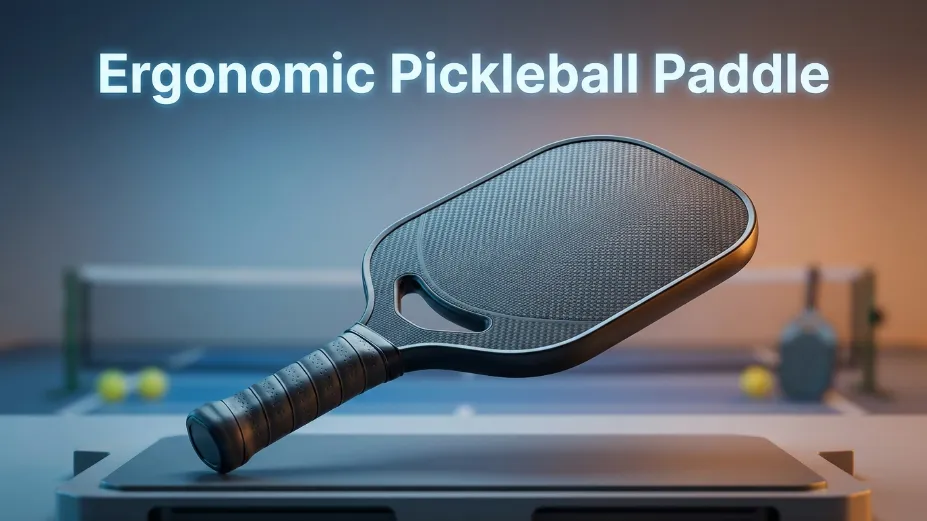
For over five decades, tennis and racquetball players transitioning to court sports have walked out gripping a straight, symmetrical cylinder inherited from table tennis, entirely ignoring the physiological limitations of the human forearm. Standard handles force continuous, micro-traumatic wrist deviation during rapid-fire exchanges, turning competitive play into a fast track for chronic tendonitis. Breaking this obsolete design cycle is not just about aesthetic novelty; it requires an ergonomic pickleball paddle engineered to place the physical bend in the tool itself, rather than forcing the wrist joints to bear the impact of every high-velocity ball.
Ergonomic pickleball paddles comparison 2026: grip design type, USAP tournament legality, primary ergonomic benefit, and core material and weight
Ergonomic Pickleball Paddles 2026
Verified Specs & Tournament Legality · June 2026
For active tournament competitors seeking a high-performance, legal, and stable weapon, the XCELER8 Xcaliber Ergo is the best premium option on the market. If you are primarily recovering from joint pain and require extreme vibration dampening with defensive finesse, the PBZ Viper Strike Kevlar is an exceptional choice. If you prefer a traditional paddle face but want subtle wrist protection, the ProXR Blackout Advantage offers a clean transition without altering your primary biomechanical strokes.
Biomechanics of the Pistol Grip: Bending the Tool vs. Bending the Joint
To truly understand what is pickleball and its intense physical demands, one must look closely at the mechanical interface between the human hand and the paddle grip. Standard straight-handle paddles require the wrist to actively compensate during fast-paced exchanges. When players scramble to execute dinks or block high-velocity drives, they must constantly bend their wrists sideways in a movement known as radial or ulnar deviation. This continuous deviation compresses the median nerve within the carpal tunnel and overworks the forearm tendons, directly contributing to painful, repetitive-motion pickleball injuries.
The biomechanical philosophy of an ergonomic paddle pickleball design completely reverses this strain. By building a physical bend or angle directly into the handle, the gear does the geometric alignment work instead of your body. This allows the hand and wrist to remain in a natural, neutral resting position. Biomechanical testing demonstrates that a neutral grip reduces peak muscle load in the extensor carpi radialis muscles. Instead of absorbing high-frequency impact vibrations in the delicate bones and tendons of the wrist, these forces are transferred directly to the larger, stronger muscle groups of the forearm, bicep, and shoulder, which are far better equipped to handle them.
For players without a background in tennis or squash, learning how to hold a pickleball paddle can feel awkward and unintuitive. Traditional handles do not offer natural reference points, leading many beginners to choke up too high or rest their index finger flat against the paddle face. This habit cuts down on their reach and exposes their hand to painful ball impacts. Ergonomic, pistol-grip handles solve this by guiding the fingers naturally into a comfortable grip. The hand sits deeper in the open-loop handle, aligning the forearm bones directly with the paddle’s center of mass. This physical alignment provides immediate tactile feedback, making face angle control and shot placement much more intuitive from day one.
The Silent Technical Challenge: The “Death Grip” and Twist Weight Dilemma
While the health and comfort benefits of an ergonomic handle are clear, players must also understand a subtle technical challenge: the physics of off-center hits. When the ball strikes a paddle face outside the sweet spot, it generates a rotational force that tries to twist the handle in your hand. This rotation is governed by the physics of torque, which can be expressed through a simple formula:
Where:
- t is the rotational torque trying to twist the paddle.
- F is the force of the ball’s impact.
- d is the distance from the impact point to the centerline axis of the handle.
On traditional paddles with a straight handle, the hand sits directly beneath the sweet spot, keeping the torque axis balanced. However, with an angled pickleball ergonomic paddle, the physical bend increases the distance (d) on off-center hits. If the paddle has a low twist weight, it can twist easily, behaving like a loose hinge. This forces players into a “death grip”—squeezing the handle too tightly to keep it stable.
This “death grip” is a major cause of tennis elbow. Squeezing tightly keeps the forearm muscles under constant tension, preventing them from absorbing shock. This is why older, non-thermoformed ergonomic paddles sometimes made joint pain worse. To prevent this, modern ergonomic designs focus on raising the twist weight using foam-injected perimeter walls and edgeless, thermoformed structures, which stabilize the paddle on off-center hits.
USA Pickleball (USAP) Rules and Legal Compliance
Because ergonomic shapes look unconventional, players often ask: is an ergonomic pickleball paddle legal for tournament play? The answer is yes, provided the paddle complies with the physical specifications set by USA Pickleball. Under Section 2.E of the official rulebook, paddles must be constructed of rigid, non-compressible materials with no moving parts that could increase power. The total combined length and width of the paddle, including the edge guard and butt cap, cannot exceed 24 inches, and the individual length cannot exceed 17 inches.
An angled or curved handle is legal as long as the entire structure remains rigid and flat. For tournament play, players must ensure their gear is certified. For example, the XCELER8 Xcaliber Ergo was officially added to the USA Pickleball approved paddle list on January 14, 2025, confirming its compliance with tournament guidelines. Always check the official USA Pickleball Equipment Standards database before using a unique paddle in sanctioned events.
Additionally, USA Pickleball rules clarify what constitutes a legal hit. Under Rule 7.C, any contact where the ball strikes the hand below the wrist while holding the paddle is considered legal, and play continues. This rule applies to both single and two-handed holds, meaning players using ergonomic grips can safely use a double-handed backhand without worrying about accidental finger ticks stopping the rally.
Court Dynamics: How Grip Geometry Changes Shot Execution
Switching from a standard handle to an ergonomic grip changes how you execute shots. At the Non-Volley Zone (NVZ), players using an ergonomic paddle enjoy a natural defensive advantage. In the ready position, the pre-angled face naturally points forward, acting like a shield. This simplifies hand battles, allowing players to block and reset hard drives back into the kitchen with minimal wrist movement, in line with pickleball kitchen rules.
On overhead slams, the pistol grip shines. Because the wrist remains straight, you can transfer power cleanly from your forearm and shoulder into the ball, mimicking a volleyball spike. This alignment provides excellent leverage on high volleys, allowing for clean, powerful put-aways.
However, the locked-wrist design has a trade-off: it limits your ability to snap or flick your wrist. Traditional wrist-driven topspin and backspin chops become difficult. To generate spin on an ergonomic paddle, players must use their forearm and shoulder as a pendulum, brushing up on the ball rather than flicking the wrist. This movement requires a textured paddle surface to generate the necessary friction. Additionally, when serving, players must keep their swing in an upward arc, striking the ball below the navel to remain compliant with official rules.
Brand Evolution: A Tale of Failure and Success
The development of ergonomic paddles has been shaped by manufacturing successes and failures. The bird ergonomic pickleball paddle (specifically the Falcon Elite Ergo, priced at $250) was a notable attempt at ergonomic design, but fell short in execution. It paired a multi-layer carbon fiber face with a stiff 14mm core and a thick PVC edge guard. This setup created dead zones, a small sweet spot, and did not transfer energy well, making drives feel jarring rather than powerful.
In contrast, the Xcaliber Ergo by XCELER8 solved these issues by using modern manufacturing techniques. It features a 16mm core, an edgeless design, and a thermoformed unibody made of Toray T700 raw carbon fiber. This unibody construction integrates the grip, neck, and face into a single piece, expanding the sweet spot and eliminating dead spots around the perimeter. This design successfully delivers the joint relief of an ergonomic paddle without sacrificing power or control.
Another key player is PBZ Paddles, which holds the original US patents for ergonomic pickleball handles. Drawing on design ideas from racquetball and tennis in the 1980s, PBZ offers specialized core materials, including aluminum honeycomb cores with fiberglass faces and Kevlar cores with carbon fiber faces. These materials absorb vibrations and offer great control, making them a popular choice for recreational players looking for comfortable, pain-free play.
Head-to-Head: The Battle for Ergonomic Superiority
To help you choose, let us look at how the top ergonomic designs compare. When evaluating an ergonomic paddle pickleball setup, the shape of the handle and face construction determine how the paddle behaves on the court. Below, we compare the three leading models across performance, touch, and stability metrics.
- XCELER8 Xcaliber Ergo vs. ProXR Blackout Advantage: The Xcaliber Ergo features an open-loop pistol grip that angles the paddle face, completely changing your hand position. This design maximizes reach (16.39 inches) and net coverage, but requires a 2-to-14-day adjustment period to reprogram muscle memory. The ProXR Blackout Advantage, on the other hand, uses a subtle 23-degree handle offset on a standard rectangular paddle. This provides gentle wrist relief while keeping your traditional swing mechanics, making it much easier to transition to.
- XCELER8 Xcaliber Ergo vs. PBZ Viper Strike Kevlar: The Xcaliber Ergo uses a 16mm thermoformed unibody with a raw Toray T700 carbon face, offering a balanced mix of power and control. The PBZ Viper Strike Kevlar features a hybrid Kevlar-carbon face on a 14mm propulsion EVA-polypropylene core, prioritizing touch and shock absorption. The PBZ’s Kevlar weave dampens vibrations better, but the Xcaliber’s unibody design is more durable and delivers harder drives.
- XCELER8 Xcaliber Ergo vs. Six Zero Ruby (The Material Comparison): While not an ergonomic-handle paddle, the ruby pickleball paddle by six zero pickleball is the gold standard for Kevlar performance. The Ruby utilizes a 100% Kevlar face, which is very crisp but can pop up dinks if you do not have a soft touch. The Xcaliber Ergo uses raw Toray T700 carbon fiber to provide a larger sweet spot and more predictable ball control, making it easier for players transitioning to ergonomic equipment to manage. This raw carbon fiber construction can be explored further in our guide to carbon fiber pickleball paddle technology, and stands out among the top pickleball paddles on the court today.
- PBZ Viper Strike Kevlar vs. Vatic Pro Prism Flash 16mm (The Budget Control Duel): For players on a budget, the Vatic Pro Prism Flash is often called the best budget pickleball paddle for its soft feel. However, its straight handle still requires active wrist movement. The PBZ Viper Strike Kevlar offers a comfortable curved grip that reduces joint strain, making it a better option for players dealing with wrist issues. This comparison highlights the ongoing kevlar vs carbon pickleball paddle debate. Hybrid weaves and raw carbon fiber faces offer unique advantages that traditional fiberglass cannot match, especially when combined with an ergonomic handle.
Player Transition and Weight Optimization Blueprint
Switching from a standard paddle to an ergonomic model requires a physical transition. Muscle memory is highly sensitive to the angle of the paddle face relative to your arm. Expect an adjustment period of 2 to 14 days. During your first few sessions, avoid competitive matches and focus on soft wall drills and cooperative dinking. This helps you get used to the new angle and find the sweet spot consistently.
To prevent the paddle from twisting on off-center hits, you can customize its weight. Applying lead or tungsten tape to the outer edges at the 3 o’clock and 9 o’clock positions is a simple way to increase the paddle’s twist weight and Moment of Inertia (MOI). This added weight stabilizes the paddle on mishits, allowing you to maintain a relaxed grip and reducing arm fatigue during play.
Finally, make sure your grip size is correct. A grip that is too small leads to over-squeezing, while a grip that is too large limits wrist mobility. You can adjust the grip circumference using aftermarket overgrips to find a comfortable, secure fit. This customization ensures you get the full ergonomic benefits of your paddle, protecting your joints and keeping your game comfortable.
Summary of Viability and Final Verdict
An ergonomic pickleball paddle is a practical piece of equipment backed by biomechanics, not a marketing gimmick. By shifting the angle of the paddle relative to the handle, these designs reduce wrist strain and help prevent injuries, making them an excellent choice for players dealing with joint pain.
To get the most out of an ergonomic design, look for models with modern thermoformed unibody construction, such as the XCELER8 Xcaliber. Adding lead tape to the perimeter can also help stabilize the paddle on off-center hits. With the right setup and a brief adjustment period, an ergonomic paddle can make your games more comfortable, protecting your joints and helping you play pain-free for years to come.
Frequently Asked Questions (FAQ)
Q: Is the Xcaliber Ergo USA Pickleball legal for tournament play?
A: Yes. The XCELER8 Xcaliber Ergo is certified by USA Pickleball for all sanctioned play, including tournament and recreational games. It was officially added to the USA Pickleball approved paddle database on January 14, 2025.
Q: Can an ergonomic paddle really cure my tennis elbow?
A: While no paddle is a medical cure-all, ergonomic designs help by keeping your wrist in a neutral position. This reduces the strain on your forearm tendons. However, to prevent pain, you must also avoid a tight “death grip” on off-center hits. Using a paddle with a stable, high twist weight or adding lead tape can help you maintain a relaxed grip.
Q: Why is the Bird Falcon Elite Ergo paddle no longer available?
A: The Bird Falcon Elite Ergo struggled commercially due to its $250 price tag and several design flaws. Its stiff 14mm core and heavy PVC edge guard created dead zones and a small sweet spot, which did not justify the high cost. Bird’s parent company, Grip6, has since stopped manufacturing pickleball paddles.
Q: How do I generate spin if my wrist movement is restricted?
A: Because an ergonomic handle limits wrist flicking, you must generate spin using a full forearm and shoulder pendulum motion. Brushing up on the ball utilizing a highly textured face, such as Toray T700 raw carbon fiber, allows you to generate consistent spin without relying on wrist movement.