ruby pickleball paddle
The Game Changer in Red: A Deep Dive into the Six Zero Ruby
If you have spent any time on the pickleball courts lately, you’ve probably noticed a splash of crimson catching the sunlight. It’s distinct, it’s vibrant, and it’s usually in the hands of someone who just hit a drive that dipped uncomfortably fast at your feet. That, my friends, is the ruby pickleball paddle.
For the longest time, the pickleball world was a sea of black and grey. Raw carbon fiber became the gold standard, and every paddle started looking—and feeling—roughly the same. Then came Six Zero, an Australian company that decided to shake things up, not just aesthetically, but materially. They introduced the world to the first 100% Aramid (Kevlar) fiber face, and the game hasn’t really been the same since.
But is it just hype? Is that beautiful red face just a marketing gimmick, or does it actually change the way the ball behaves? I’ve spent considerable time with the six zero ruby pickleball paddle, analyzing everything from its spin rates to its “plush” feel, to help you figure out if this is the upgrade your gear bag needs. Let’s break it down, friend to friend, and look past the marketing buzzwords to see what this paddle is really made of.
to read the deep technical analysis and 2026 updates, 6.0 ruby pickleball paddle
The Fundamentals: What Makes the Ruby Special?
When you first hold the Ruby, it feels substantial. It feels premium. But the questions swirling around it are usually about what’s going on under the hood—or rather, right on top of the surface.
What makes the Six Zero Ruby different from other paddles on the market? (Focus on the 100% Kevlar/Aramid face vs. Carbon Fiber).
The elephant in the room—or the red gem in the room—is the face material. Most top-tier paddles you see today use T700 Raw Carbon Fiber. It’s a great material; it’s stiff, durable, and provides good spin. However, the 6.0 ruby pickleball paddle swaps that out for 100% Aramid fiber, which you might know better by the brand name Kevlar.
Think of it this way: Carbon fiber is like a stiff board. It’s rigid. Kevlar, on the other hand, is what they make bulletproof vests out of. It’s incredibly strong, but it has a high impact resistance and, crucially, a different elasticity. It’s a fabric that absorbs energy differently. Six Zero didn’t just paint a carbon paddle red; they utilized a cross-weave of this Aramid material. This innovation is what sets the Ruby apart from the sea of black carbon clones. It’s a fundamental shift in material science applied to a plastic ball.
How does the Kevlar face affect the feel and performance of the ball?
This is where things get interesting. Because Aramid fibers are naturally tougher and have different dampening properties than carbon, the ruby 6.0 pickleball paddle grabs the ball differently. When the ball hits a stiff carbon face, it rebounds quickly. When it hits the Kevlar face of the Ruby, there is a sensation of “dwell time.”
Imagine catching a baseball with a stiff leather glove versus a soft, broken-in mitt. The Ruby is that broken-in mitt. The ball seems to sit on the face of the paddle for a fraction of a millisecond longer. This dwell time allows the texture of the paddle to bite into the ball more effectively, which is the secret sauce behind its performance. It creates a connection to the ball that feels less “pingy” and more “grabby.”
Is the Ruby considered a power paddle, a control paddle, or an all-court paddle?
If we had to put a label on it, the Ruby sits firmly in the “All-Court” category, but it leans heavily towards control and spin. However, don’t let that fool you into thinking it’s weak. Because Kevlar returns energy efficiently, there is a surprising amount of pop when you really swing out.
It’s not a sledgehammer like some of the power-focused EVA foam paddles or thin 12mm carbon rockets. It’s more of a surgeon’s scalpel that can turn into a hammer when you need it. It offers the soft hands required for dinking battles at the kitchen line but retains enough put-away power to finish a point when your opponent leaves a ball high.
What are the core specs of the Ruby (weight, thickness, dimensions)?
Let’s look at the vitals. The Ruby generally comes in a standard 16mm thickness, which is the industry standard for control and stability. The shape is an elongated hybrid, featuring a curved aerodynamic top that Six Zero is famous for.
- Average Weight: It tends to run slightly heavier than its carbon siblings, usually averaging between 8.2 to 8.4 ounces. Kevlar is a denser material than carbon, adding a bit of natural heft.
- Dimensions: It usually measures around 16.3 inches in length and 7.5 to 7.7 inches in width.
- Handle: It sports a 5.3 to 5.5-inch handle, making it accommodating for those of us who like a two-handed backhand.
Performance & Playability
Specs are great on paper, but pickleball is played on concrete. Here is how the ruby 6 pickleball paddle actually translates to gameplay.
How much spin can the Ruby generate compared to raw carbon fiber paddles? (Addressing the high RPM claims).
If spin were currency, the Ruby would be a billionaire. This is arguably the paddle’s standout feature. Because of that Aramid fiber surface and the high dwell time we discussed earlier, the friction generated is immense.
In independent testing and general community consensus, the Ruby consistently clocks in at the very top of the RPM (revolutions per minute) charts—often exceeding 2,000 RPMs for advanced players. Compared to raw carbon fiber, which is already good, the Ruby feels like it has claws. If you love hitting topspin drives that dip at the baseline or slicing returns that skid low, this paddle enhances those shots almost immediately. You don’t have to change your stroke; the paddle just does more of the work for you.
Does the Ruby have a “soft” or “plush” feel, or is it crisp?
“Plush” is the word you will hear repeated in almost every review, and for good reason. It is the defining characteristic of the six zero ruby pickleball paddle.
Carbon fiber often feels “crisp”—a sharp, immediate feedback. The Ruby feels muted and soft. When you block a hard drive from an opponent, the paddle absorbs the shock rather than reflecting it straight back into your arm. It feels luxurious, almost like there is a dampener built into the entire face. If you hate the jarring vibration of hitting a hard plastic ball, this feel is going to be a revelation for you.
How big is the sweet spot on the Ruby, and is it forgiving on off-center hits?
Six Zero utilizes a process called “edge foam injection,” where foam is injected around the perimeter of the paddle, inside the edge guard. This expands the sweet spot practically from edge to edge.
While no paddle is perfect on the very frame, the Ruby is incredibly forgiving. If you mishit a dink slightly off-center, the ball doesn’t just die on the paddle face; it usually still makes it over the net. The stability (twist weight) is high, meaning the paddle doesn’t twist in your hand if you hit the ball near the edge. For intermediate players, this forgiveness is a massive confidence booster.
How does the “pop” level compare on resets and dinks vs. hard drives? (Addressing the variable pop characteristic).
This is one of the most unique aspects of the Ruby. It seems to possess a “variable pop.” When you are playing soft—dinking, resetting, dropping—the paddle feels dead and controlled, ensuring you don’t pop the ball up for a smash.
However, when you tighten your grip and swing hard for a drive or overhead, the Kevlar fibers engage and provide a significant boost of power. It’s almost intuitive. It gives you power when you ask for it, and control when you need it. This linear progression is rare; usually, a paddle is either always hot (poppy) or always soft. The Ruby manages to straddle the line beautifully.
Does the Ruby require a “break-in” period to reach peak performance?
Yes, and this is important to note. Out of the plastic wrapper, the Ruby feels great, but the Kevlar fibers tend to “open up” after a few sessions. Many players report that the spin and the plush feel actually improve after about 5 to 10 hours of play. As the fibers settle and the resin creates microscopic grooves, the grab on the ball enhances. So, if you buy one, give it a week of play before you make your final judgment.
Critical Comparisons (The “Vs.” Section)
You probably have a few tabs open on your browser right now comparing the 6.0 ruby pickleball paddle to others. Let’s save you some clicking.
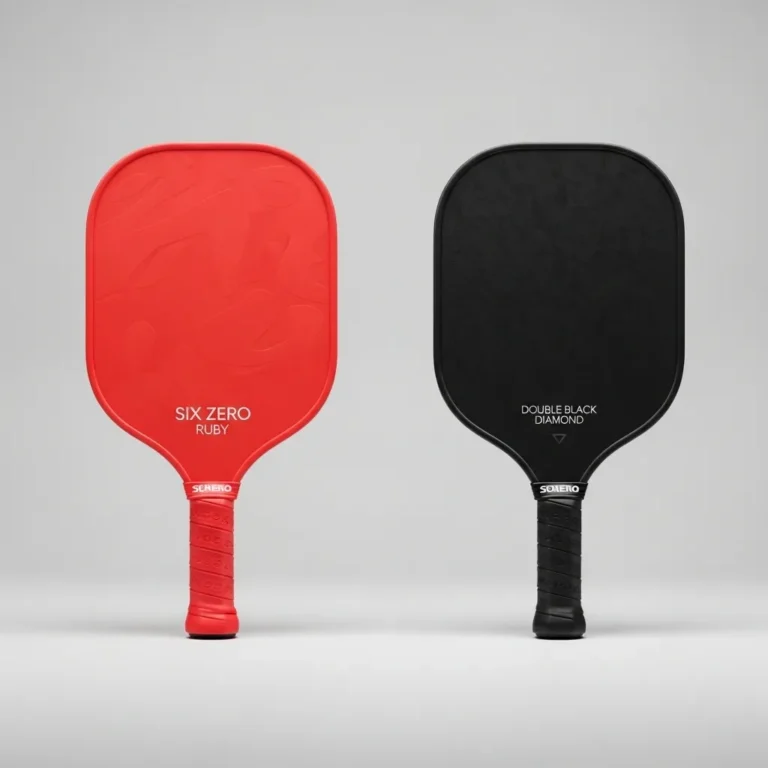
Six Zero Ruby vs. Double Black Diamond (DBD): Which one should I choose? (The #1 most asked comparison).
This is the big one. The Double Black Diamond (DBD) is Six Zero’s flagship carbon paddle and a legend in its own right.
- The DBD is crisper, slightly lighter, and has a bit more “pop” right out of the hand. It feels faster at the net.
- The Ruby is softer, plusher, creates more spin, and feels slightly heavier/more stable.
Choose the DBD if: You want faster hands at the net and a crisper, more traditional carbon feel.
Choose the Ruby if: You want maximum spin, a softer feel on dinks, and don’t mind a tiny bit of extra weight.
How does the Ruby compare to the Six Zero Black Diamond (Power version)?
The Black Diamond (not the Double Black Diamond) is a pure power paddle with a fiberglass composite face.
- The Black Diamond is a rocket launcher. It has massive pop but much less control.
- The Ruby is a control paddle with access to power.
Unless you are a banger who refuses to dink, the Ruby is likely the more versatile choice for the modern game.
Ruby 14mm vs. 16mm: Which thickness is right for my playstyle?
Generally, the Ruby is most popular in 16mm because that thickness complements the plush, control-oriented nature of the Kevlar.
- 16mm: Better blocking, softer feel, bigger sweet spot. (Recommended for 90% of players).
- 14mm: Moves faster through the air and hits harder, but you lose some of that signature plushness and stability. If you have slow hands, the 14mm might help, but you sacrifice the “magic” of the Ruby’s feel.
How does the Ruby stack up against other Kevlar paddles (e.g., Pickleball Apes)?
Since the Ruby launched, other brands (like Pickleball Apes or Spartus) have released Kevlar paddles. The specific “Kevlar” trend is growing.
The difference often lies in the manufacturing quality and the resin used. Six Zero uses a high-temperature curing process (thermoforming) that creates a very unibody feel. While other Kevlar paddles are good, the ruby 6.0 pickleball paddle is widely considered the “original” regarding this specific weave and feel. It tends to feel more refined and balanced than some of the cheaper knock-offs that are just pasting Kevlar over a standard core without adjusting the internal weighting.
Durability & Quality
When you pay a premium price, you want the paddle to last. The red face looks amazing, but does it hold up?
Does the grit/texture on the Kevlar face wear off quickly?
One of the distinct advantages of the ruby 6 pickleball paddle is that the texture comes from the fabric weave itself (peel ply texture), not just a spray-on grit. While all paddles lose some spin over time, the Ruby retains its grit remarkably well. The Aramid fibers are incredibly abrasion-resistant. You won’t see the “smoothing out” happen as quickly as you might on a raw carbon fiber paddle.
Is the Kevlar surface more durable than raw carbon fiber over time?
In terms of impact durability, yes. Kevlar is designed to stop bullets and prevent cuts. It is less brittle than carbon fiber. You are far less likely to see the face crack or delaminate from normal play. However, because it is a fabric, there can be cosmetic fraying at the very edges if you scrape the ground constantly, but the edge guard does a good job of protecting it.
Does the red face material show dirt or scuffs more easily than black paddles?
Let’s be honest: Yes. This is the trade-off for having a cool red paddle. Pickleballs leave plastic residue (dust), and courts are dirty. After a long session, you will see ball marks and scuffs on the red face much more clearly than on a black paddle. Some players wear these “battle scars” with pride; others find it annoying.
How do I properly clean the Ruby without damaging the fibers? (Specific queries about using rubber erasers vs. damp cloths).
This is a crucial point. With raw carbon paddles, everyone uses those rubber abrasive erasers.
Proceed with caution on the Ruby. While you can use a rubber eraser, don’t scrub as hard as you would on carbon. Kevlar is a fabric; if you scrub too violently, you can pull at the fibers and create fuzz.
- Best method: Use a damp microfiber cloth to wipe away dust and sweat first.
- For ball residue: Use a rubber eraser gently, moving in the direction of the grain if visible, or in light circles. Don’t dig in.
Technical Specs & Customization
For the gear nerds among us (and I include myself in that group), let’s talk about the nitty-gritty physics of the paddle.
Is the Ruby significantly heavier than standard paddles? (Addressing the slightly higher static weight).
The static weight of the ruby pickleball paddle is usually about 0.2 to 0.4 ounces heavier than the Double Black Diamond. While that sounds negligible, sensitive players feel it.
However, it’s not “heavy” in a clunky way. It feels “solid.” The weight distribution is balanced, so it doesn’t feel like a hammer dragging your wrist down. It just feels like there is mass behind the ball, which helps with blocking hard drives.
What is the swing weight and twist weight of the Ruby?
- Swing Weight: Usually falls in the 116-119 range. This is moderate-high. It means it takes a little more effort to get moving than a lightweight speed paddle, but once it’s moving, it plows through the ball.
- Twist Weight: This is the resistance to twisting on off-center hits. The Ruby scores very high here (often around 6.8 – 7.0+). This is why the sweet spot feels so big. The paddle stabilizes your hand, rather than your hand needing to stabilize the paddle.
Can I customize the weight with lead tape, or is it already too heavy?
Because the Ruby comes in slightly heavier, I recommend playing with it stock for at least two weeks before adding lead.
Most players find they don’t need lead tape because the stability is already excellent. However, if you are a power junkie, adding a tiny bit of lead tape at the 12 o’clock position can turn this thing into a monster—but be warned, it will slow your hands down at the net.
Does the handle shape or length differ from other Six Zero models?
The handle is consistent with other Six Zero elongated models. It’s roughly 5.3 inches long (usable length feels like 5.5 due to the tapered neck). The circumference is a standard 4.125 to 4.25 inches. It’s an octagon shape, but the bevels aren’t too sharp, making it comfortable for changing grips between forehand and backhand.
Suitability & Value
We’ve covered the tech, the feel, and the durability. Now comes the final decision. Is the six zero ruby pickleball paddle right for you?
Is the Six Zero Ruby suitable for players with tennis elbow? (Regarding vibration control/plushness).
Disclaimer: I am not a doctor, and this is not medical advice. If you have pain, see a professional.
That said, from an equipment perspective, the Ruby is often cited by players as being very friendly to the arm. The Kevlar face and the foam-injected walls are excellent at dampening vibration. The “shock” of the ball impact is absorbed by the Aramid fibers rather than traveling up the shaft into your tendon. If you find stiff carbon paddles aggravate your elbow, the plush, muted feel of the Ruby is a safer bet for comfort.
Is this paddle beginner-friendly, or is it strictly for advanced players?
While the Ruby is priced and marketed as a premium performance paddle, it is surprisingly beginner-friendly. Why? Control and Stability.
Beginners struggle with pop-ups and mishits. The Ruby’s large sweet spot and high twist weight help correct those errors. You don’t need to be a 5.0 pro to appreciate the paddle. However, a total beginner might not fully utilize the high-spin capabilities immediately. It’s a paddle you can grow into, rather than one you will grow out of in three months.
Is the Ruby worth the price premium over the Double Black Diamond?
The Ruby typically costs about $20 more than the Double Black Diamond. Is it worth it?
If you want the absolute latest technology, the coolest looking paddle on the court, and that specific “plush” feel, then yes, absolutely. The durability of the Kevlar also suggests it might have a longer lifespan for peak performance.
However, if you are on a strict budget, the Double Black Diamond is still an incredible paddle. You aren’t “losing” by picking the DBD, but you are gaining a unique experience by choosing the Ruby.
Final Thoughts
The ruby pickleball paddle is more than just a pretty red face. It represents a shift in pickleball technology towards materials that offer better feel and dwell time without sacrificing power. It solves the problem of stiff, vibrating paddles and offers a spin potential that is borderline unfair.
Whether you call it the 6.0 ruby pickleball paddle, the ruby 6.0 pickleball paddle, or just “that red paddle everyone is talking about,” one thing is clear: Six Zero has created a classic. It feels human. It feels forgiving. And most importantly, it makes playing the game we love just a little bit more fun. See you on the courts!