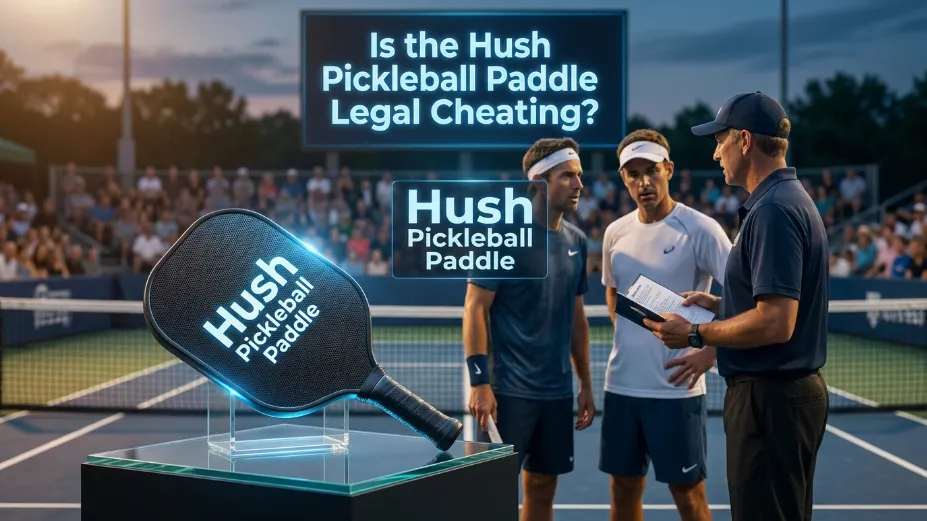
The sharp, rhythmic clack of a pickleball impact is the proud heartbeat of the court to players, but to nearby homeowners, it is a psychological slow-drip torture that has sparked zoning wars across the United States. While homeowners associations deploy decibel meters and threaten court closures, players have been forced to choose between social exile and playing with dead, sponge-like paddles that turn drives into soft dinks. That compromise is officially dead with the arrival of the hush pickleball paddle—a silent, heavily cushioned monster that dampens acoustic frequencies by 40% while quietly packing a trampoline-like rebound so aggressive it has been banned from sanctioned tournaments.
This is not just a noise-suppression tool; it is a covert performance upgrade that wraps a legal silencer around an absolute rocket launcher.
Quiet pickleball paddles comparison: price, USAP approval status, face material, core thickness, and key performance focus
Quiet Pickleball Paddles
USAP Approval · Face · Core · Performance Focus · Price
For players seeking to eliminate local noise complaints without sacrificing offensive firepower, purchasing the diadem hush pickleball paddle from the official Diadem Sports website is the undisputed king of stealthy power. However, if your local club strictly enforces USA Pickleball tournament rules during open play, you should opt for the fully approved OWL pickleball paddle or the Whisper Silencer instead to maintain legal play.
The Engineering Behind the Silence: eTPU Foam and Two-Piece Molding
The core materials science of the hush paddle pickleball relies on a complete departure from traditional stiff, sound-reflecting faces like raw carbon fiber or fiberglass. Traditional paddles act like hard soundboards, reflecting the impact of the ball as a sharp, high-pitched decibel spike. To mitigate this, Diadem engineered the face using Expanded Thermoplastic Polyurethane (eTPU). This material features an elastic, closed-cell micro-structure that mimics the shock-absorption properties found in high-performance running shoe midsoles. When a pickleball compresses against the eTPU face, the material deforms locally, trapping acoustic waves and converting kinetic vibrational energy into heat, yielding a low-frequency thump instead of a high-frequency crack.
Supporting this soft outer face is an industry-first, dual-piece molding structure. While typical thermoformed unibody paddles bond the face sheets directly to the core edges, the Hush utilizes an inner carbon fiber structural ring that connects to the outer frame, mimicking the architectural design of modern tennis racquets. This structural framework allows Diadem to suspend an incredibly soft face material within a rigid, highly stable chassis.
Additionally, the integration of Anti-Damp Kraibon—a specialized visco-elastic rubber compound—along the perimeter further minimizes residual frame oscillations. This dampening framework works in harmony with the Core Mold System 3D, distributing impact forces evenly across the face to create a highly cushioned feel while protecting the internal polymer core from collapsing under high-velocity strikes.
Comparing Core Thickness: The Hush 18mm vs. 14mm Performance
A critical consideration for players navigating the quiet paddle market is the physical core thickness. Unlike the slim profiles of competitive models, the hush 18 pickleball paddle features an exceptionally thick 18 mm polypropylene honeycomb core. In paddle design, core thickness dictates the balance between energy return (power) and shock absorption (control).
Typically, an 18 mm core is incredibly soft and slow, acting as a defensive block. However, the Hush defies conventional mechanics; its thick polypropylene core serves as an acoustic barrier to absorb internal sound waves, while the high elasticity of the eTPU outer face provides a rapid rebound. The result is a unique “plush catapult” sensation where the ball sinks deep into the paddle face before launching with explosive velocity.
For players who prefer a faster, more maneuverable paddle at the kitchen line, Diadem also offers a 14 mm variant. To understand how these dimensions influence playability, it is helpful to contrast them with standard industry dynamics. When comparing a 14mm vs 16mm pickleball paddle, a thinner core typically provides a crisper feel and faster hand speed, but sacrifices the vibration dampening and sweet spot stability of a thicker build.
The 14 mm Hush is lighter and easier to swing during fast hand battles, but it does not offer the same absolute noise suppression or ultra-plush feedback as the 18 mm flagship model. If your primary goal is maximum decibel reduction and joint protection, the 18 mm core remains the superior technical choice.
The Regulatory Dilemma: Quiet Approved vs. USAP Tournament Legal
One of the most common points of confusion surrounding the diadem hush pickleball paddle is its legal status. On the throat of the paddle, you will find a prominent “USAP Quiet Approved” stamp. This certification, established by USA Pickleball, is an acoustic designation awarded to gear that demonstrates a minimum 40% reduction in high-frequency court noise during laboratory decibel testing. It is designed to assist players who reside in communities governed by strict homeowner associations (HOAs) or municipal noise ordinances. However, this acoustic seal of approval is entirely separate from standard competitive regulations.
The reality is that the Hush is not approved for sanctioned tournament play. To understand why, one must look at the physical limitations enforced by the governing body. USA Pickleball maintains strict rules regarding a paddle’s surface roughness, coefficient of restitution (the trampoline effect), and core deflection. Because Diadem built the Hush with an elastic eTPU face and a tennis-style suspended core, the paddle generates deflection rates and ball-bounce metrics that far exceed the legal limit. It acts as an unregulated spring, giving players an “illegal” mechanical advantage. For competitive players, always consult the official USA Pickleball approved paddle list to ensure your gear is certified for official league play.
Diadem Hush Pickleball Paddle Reviews: Lab Measurements and On-Court Realities
When diving into independent laboratory data and diadem hush pickleball paddle reviews, the performance metrics of this paddle are staggering. In standardized paddle lab testing, the Hush registers an exit velocity of 41.96 to 45.90 MPH (putting it in the 99th percentile for raw power) and an astonishing spin rate approaching 2,800 RPM in certain independent databases. In comparison, most tournament-legal, raw carbon fiber models cap out around 2,000 to 2,200 RPM. This hyper-spin capability is a direct result of the high friction and elastic deformation of the eTPU material.
When you cut under the ball, the rubbery surface grips the plastic ball, holding it on the face (increasing dwell time) and allowing the player to paint the corners with sharp, sweeping side-spin and heavy topspin.
On the court, this translates to a highly polarizing playing experience. Bangers and transition-zone players find that executing deep baseline drives and high-velocity overhead slams requires very little physical effort. However, this extreme responsiveness comes at a cost: control. Because the face is so elastic, the ball bounces off with unpredictable pop during delicate touch shots. At the kitchen line, executing soft third-shot drops and keeping dinks low requires precise, highly calibrated hand movements. If your mechanics are slightly off, the trampoline effect can easily launch a soft ball high into the air, presenting opponents with an easy put-away opportunity.
Head-to-Head: Diadem Hush vs. OWL PXE vs. Whisper Silencer
To help you navigate the specialized market of sound-suppressed equipment, let us look at a direct head-to-head comparison of the leading options available in 2026. While all three models are designed to reduce noise, they target entirely different player profiles and playing conditions.
- Diadem Hush vs. OWL PXE: The OWL PXE utilizes a unique, felt-like fabric face called Acoustene Graphene. This surface provides a buttery-soft touch, excellent kitchen dink control, and is fully USAP tournament legal. However, the OWL PXE is severely lacking in raw power and drive speed. In contrast, the Diadem Hush trades tournament legality for pure, unadulterated speed and heavy spin, making it a better option for aggressive players who do not participate in official tournaments.
- Diadem Hush vs. Whisper Silencer: The Whisper Silencer (~$199.95) strikes a highly balanced middle ground. It features a thermoformed polymer core that reduces noise while maintaining a highly consistent, larger sweet spot. However, if you are looking for maximum raw power and the absolute highest spin ceiling, the Hush’s eTPU face easily outperforms the Whisper’s more conservative construction.
This comparison highlights the ongoing trade-offs in quiet paddle design. If your priority is tournament-legal kitchen control, choose the OWL. If you are an aggressive player seeking maximum power and heavy spin for recreational play, the Hush is the undisputed champion.
Therapeutic Benefits: Unrivaled Shock Absorption for Arm Health
Beyond its acoustic qualities, the structural build of the Hush makes it an exceptional medical and therapeutic tool for players suffering from arm fatigue and joint stress. The primary cause of lateral epicondylitis (commonly known as tennis elbow) or medial epicondylitis (golfer’s elbow) on the court is the transmission of high-frequency shock waves. When a hard plastic ball impacts a stiff carbon fiber face, those vibrations travel directly up the composite shaft and into the tendons of the forearm.
The combination of the 18 mm core, visco-elastic Kraibon rubber edges, and the soft eTPU face acts as an integrated shock-absorption system. It dampens structural vibrations before they can reach your grip. If you are rehabbing a joint injury or looking for other arm-friendly options, exploring the best CPX paddles for players with tennis elbow can provide excellent guidance on highly cushioned designs. However, players must be aware of a critical mechanical catch: because the Hush generates so much effortless power, you will naturally shorten your swing. While this protects your joints in the short term, it can make it difficult to develop clean, full-stroke mechanics when you eventually transition back to standard, legal paddles.
The Missing Angles: Social Friction, Safety, and Quality Control
While mainstream commercial reviews focus entirely on specification sheets, a deep dive into the player community reveals several overlooked issues that buyers must consider before purchasing a Hush paddle.
The first major issue is auditory timing disruption. Experienced players rely heavily on the sound of the ball hitting their opponent’s paddle to estimate ball speed and spin. The silent nature of the eTPU face deprives opponents of this auditory cue, throwing off their timing and reaction windows. In recreational open play, this silence can create intense social friction, with competitive players (4.0+ level) often expressing frustration or outright refusing to play against what they perceive as an “illegal” or “cheating” paddle.
The second concern is safety and body bagging. Because the Hush launches the ball at exceptional speeds with minimal physical player movement, opponents standing at the kitchen line are highly vulnerable to being hit in the face or chest (“body bagged”) before they can react. Many players in the community strongly advise wearing protective eye gear when playing against a Hush user. Finally, there are notable quality control and customer service challenges. Some users have reported receiving paddles with uneven eTPU foam faces or minor surface defects. Because Diadem utilizes an automated AI phone representative that redirects product issues to email, resolving warranty claims can be a slow, frustrating process.
Understanding Diadem’s Broader Paddle Lineup
To understand where the Hush fits, it is helpful to look at the brand’s broader design philosophy. Diadem is a highly respected name in the racquet sports industry, known for producing premium Diadem pickleball paddles that emphasize smart engineering and advanced materials. Their product line includes elite power models like the Edge 18K Power Pro and control-oriented models like the Warrior BluCore. While their standard carbon fiber and Kevlar hybrid paddles are fully USAP approved for competitive tournaments, the Hush represents their boundary-pushing research division, showcasing what is possible when design constraints are removed to solve the sport’s noise crisis.
If you are looking for a paddle that provides tournament-legal spin and power, explore the best pickleball paddle for spin categories to find approved models that fit your competitive goals. But if your target is purely recreational play, home-court peace, and unrivaled comfort, the Diadem Hush remains a spectacular engineering achievement that is truly in a class of its own.
Frequently Asked Questions (FAQ)
Q: Is the Diadem Hush approved for USA Pickleball tournament play?
A: No. While it is certified as “Quiet Approved” for decibel reduction in noise-sensitive communities, it is not approved for general use or sanctioned tournament play because its elastic eTPU face and high deflection levels exceed USAP limits.
Q: How long does the spin and surface grit last on the eTPU face?
A: The rubbery, high-traction texture of the eTPU face provides exceptional spin out of the box. However, like all specialized composite faces, intense play over 50 to 80 hours will cause gradual smoothing of the surface, lowering the maximum spin potential over time.
Q: Is the 18 mm core better than the 14 mm core option?
A: It depends on your needs. The 18 mm core offers the absolute maximum noise reduction and vibration dampening, making it the best choice for HOA compliance and elbow relief. The 14 mm core is lighter and faster in hand battles, but provides less shock absorption and slightly higher pitch sound.
Q: Does playing with a silent paddle really give an on-court advantage?
A: Yes. Many players report that the absence of a loud sound cue makes it highly difficult for opponents to judge the speed and spin of the ball, resulting in delayed reaction times and timing errors.