At the kitchen line, matches are no longer decided by strength alone, but by tiny tactical adjustments where every reset, block, and counter can change the outcome of the rally. Modern American pickleball has moved far beyond casual driveway play, evolving into a fast, technical sport where your equipment becomes your most reliable weapon. For players who value control, touch, and consistency over pure power, the debate around the Kevlar vs Carbon pickleball paddle marks a major shift in how serious competitors choose their gear.
Today, selecting a paddle is not just about weight or grip size — it is about the behavior of the surface material itself. Whether you are neutralizing pace at the net or driving through difficult conditions, understanding the Best pickleball paddle material can redefine your performance ceiling and give you the tactical edge every advanced player is searching for.
In this comprehensive technical breakdown, we dive into why the Kevlar vs Carbon pickleball paddle choice has become the defining conversation in clubs from Florida to Washington.
This is not merely a cosmetic trend; it is a refined engineering evolution designed for the advanced player who values a massive sweet spot but refuses to sacrifice the “pop” required to end a point.
While many players have long treated a Carbon fiber pickleball paddle as the ultimate standard, the emergence of aramid fibers (Kevlar) has introduced a “plush” feedback that bridges the gap between comfort and aggressive tactical play.
For those looking to dominate the court with a strategic mindset, finding the Best pickleball paddle material is arguably the most important investment you will make in 2026.
It rewards the player who can transition from a deep defensive reset to a clinical overhead smash in a split second.
But before you invest your hard-earned dollars, it is vital to understand the intricate specifications that make a Kevlar pickleball paddle behave so differently in the humid air of the South compared to the dry, fast courts of the desert Southwest.
Technical Breakdown: Molecular Mechanics and Specifications
The heart of the Kevlar vs Carbon pickleball paddle debate lies in the complex material composition of the face.
Unlike entry-level gear, professional-grade models utilize a multi-layered approach to ensure every shot type—from the third-shot drop to the baseline drive—is optimized.
Here are the key technical highlights of these advanced materials:
- Toray T700 Carbon Fiber: The industry benchmark, providing a rigid, crystalline structure that offers high durability and explosive exit velocity .
- DuPont™ Kevlar® (Para-Aramid): A synthetic fiber with high fracture toughness and a lower modulus of elasticity than carbon, resulting in superior energy absorption and a “dampened” feel .
- X-EVA & Polymer Honeycomb Cores: Modern iterations, such as those found in a 6.0 Ruby, use thick cores (usually 16mm) to maximize the “pocketing” effect.
- Peel-Ply Texture: A manufacturing process where a removable fabric layer leaves a permanent grit on the resin, essential for generating elite levels of spin.
- Thermoformed Unibody Construction: A process that bonds the face and edges into a single piece, dramatically increasing the Pickleball paddle power vs control balance by stabilizing the perimeter.
The price for these premium materials typically ranges from $160.00 to $250.00 in the US market.
For more technical details on testing, you can visit the official USA Pickleball Equipment Standards Manual.
The Typology of Feel: Why Stiffness Matters
While most aggressive paddles opt for a standard 16.5-inch elongated shape to maximize leverage, the Kevlar vs Carbon pickleball paddle choice fundamentally alters the identity of the paddle.
Carbon fiber is synonymous with stiffness. Its graphitic structure transfers energy efficiently from your swing to the ball, resulting in impressive shot speed .
When you wield a Carbon fiber pickleball paddle, you can expect a “crisp” response that tells your brain exactly where you made contact on the face .
However, the Kevlar pickleball paddle introduces a more flexible, “soft-touch” profile.
Because aramid fibers have roughly half the stiffness of carbon fiber in composite form, they provide an exceptionally wide sweet spot .
This makes them some of the most forgiving tools in the best pickleball paddles for advanced players category.
This unique combination allows you to have the stability needed to block heavy drives at the net, while the material flex provides the “dwell time” required to shape the ball with spin.
Battle of the Materials: Power vs. Control Dynamics
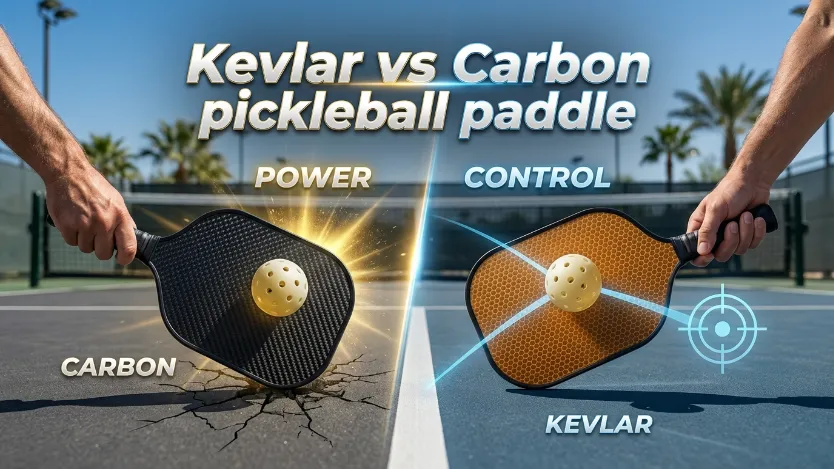
A common question in the US community is the Pickleball paddle power vs control trade-off.
While both materials are elite, they serve different playstyles.
A pure carbon paddle is an attacker’s weapon—stiff, demanding, and powerful.
It requires “millimetric” precision to unlock its potential, as the ball exits the face quickly.
In contrast, the Kevlar-faced Honolulu J2K or the 6.0 Ruby is about “controllable power.”
If you find yourself playing a tactical game focused on resets and dinking, Kevlar is the superior choice.
The material absorbs the energy of an incoming “banger,” allowing you to drop the ball softly into the kitchen.
To further refine your strategy, understanding the difference in core thickness is crucial, as seen in our guide on 14mm vs 16mm pickleball paddle performance.
The Missing Angles: What Traditional Reviews Overlook
Most commercial reviews ignore the reality of playing in the diverse climates of the United States.
High-performance composite tools react to their environment.
Here are the “missing angles” you need to consider before making your final decision:
1. The UV Sensitivity Factor
Kevlar is an organic aramid fiber, which makes it inherently sensitive to ultraviolet (UV) light.
In sun-drenched states like Arizona or Florida, prolonged exposure to direct sunlight can cause the fibers to degrade and lose tensile strength over time .
While manufacturers use UV-resistant resins, players should avoid leaving their Kevlar paddles in hot cars or under direct sun during breaks to preserve the Best pickleball paddle material integrity.
2. The Acoustic Tactical Advantage
One of the most overlooked aspects of the Kevlar vs Carbon pickleball paddle debate is the sound profile.
Kevlar acts as a “structural dampener,” shifting the dominant frequency of the strike down by a full octave—from a sharp “pop” to a low “thud” .
This provides a tactical advantage; by muffling the sound, you deprive your opponent of the auditory cues they use to judge the ball’s exit velocity and depth .
3. Epoxy Bonding and “Wetting Out”
Molecular bonding issues are real.
Aramid fibers do not absorb epoxy resin as readily or bond as tightly as carbon fibers do.
This is why “Gen 1” Kevlar paddles sometimes suffered from delamination or “dead spots.”
Modern high-end brands have solved this through vacuum-pressure curing, but it is the reason why cheaper, off-brand Kevlar paddles often fail to last more than a few months .
On-Court Performance: From Defense to Attack
During testing, the standout feature of the Kevlar vs Carbon pickleball paddle comparison was the stability.
When defending deep in the transition zone, a Kevlar face feels like a shield.
You can absorb the highest-velocity drives with zero “twist” in the handle .
This stability allows for highly accurate lobs and resets, which are the primary weapons for any counter-striker.
At the net, the raw carbon surface of a Carbon fiber pickleball paddle “bites” the ball beautifully for speed-ups.
For players who love to play with heavy slice, carbon offers a “crispier” sensation that many pros prefer .
While it doesn’t have the “velvet” feel of Kevlar, the high stiffness ensures that when you do get a chance to smash, you can generate the maximum Pickleball paddle power vs control ratio to end the rally instantly.
Frequently Asked Questions (US Audience)
Q: What is the “Tufting” issue I hear about with Kevlar paddles?
A: “Tufting” occurs when the Kevlar fibers begin to fray or pull up through the resin. This was common in early batches of certain paddles when players used standard rubber erasers to clean them. We recommend using a damp microfiber cloth for Kevlar surfaces instead.
Q: Does Kevlar really last longer than Carbon Fiber?
A: In terms of impact resistance and fracture toughness, yes. Kevlar is less brittle and less prone to internal core cracking. However, the surface “grit” on both materials is typically a resin-based peel-ply, which will wear down at similar rates depending on use.
Q: Is a Kevlar paddle better for Tennis Elbow?
A: Yes. Because Kevlar is a superior vibration dampener, it filters out the high-frequency vibrations that typically irritate the tendons in the elbow and wrist .
Q: Can I use a carbon eraser on my Kevlar paddle?
A: It is generally advised to be very gentle or avoid them on pure Kevlar. Some manufacturers recommend a damp cloth because the eraser can “grab” onto micro-fibers if the resin layer has thinned, leading to surface damage .
Final Verdict: Should You Switch to Kevlar?
The choice between a Kevlar vs Carbon pickleball paddle is a specialized decision.
It is not for the beginner who just wants the cheapest option, nor is it for the player who only wants to hit the ball as hard as possible every time.
It is for the strategic competitor—the player who enjoys the “grind” and wins by being more consistent and precise than their opponent.
With its premium durability, advanced vibration damping, and a unique balance that offers a “safety net” for off-center hits, Kevlar is quickly proving it is not just a marketing gimmick.
If you are willing to navigate the slight learning curve and protect the face from the harsh US elements, a Kevlar-faced paddle will undoubtedly elevate your tactical game to a professional level.
For the 2026 season, the hybrid blend of Kevlar and Carbon remains the gold standard for controllable power on the court.