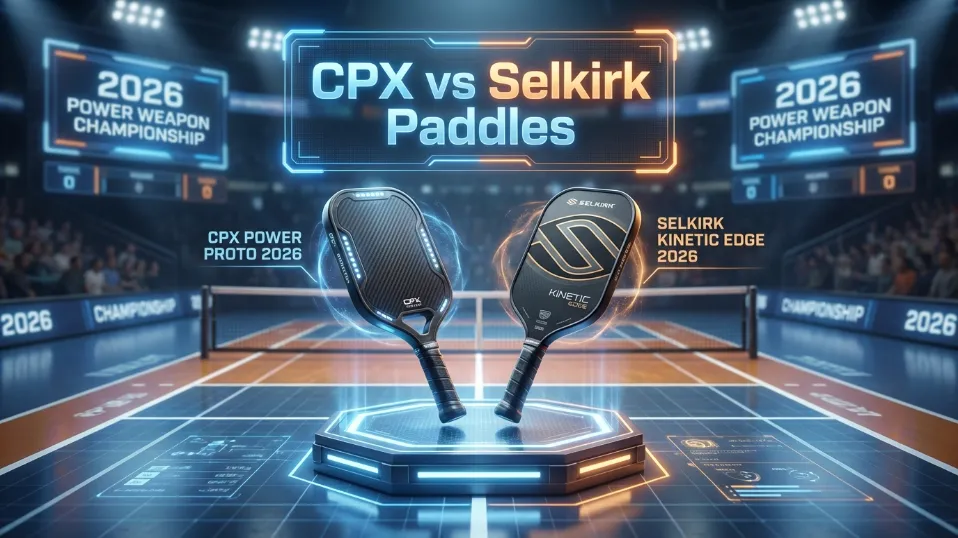
The pickleball court does not care about the logo on your paddle, but your scorecard certainly does. When players find themselves caught in the CPX vs Selkirk paddles debate, they are usually forced to choose between raw, explosive pop and surgical, predictable precision. Both brands command serious respect on the court, but they engineer their cores and carbon fiber surfaces for entirely different styles of play.
Instead of relying on marketing hype, let’s break down the exact specs, the on-court feel, and the durability of both brands so you can grab the weapon that actually matches your game.
| Feature | CPX Paddles | Selkirk Paddles |
|---|---|---|
| Primary Strength | Aggressive power and pop | Unmatched control and huge sweet spot |
| Surface Material | Toray Carbon Fiber (typically) | FiberFlex / Raw Carbon (varies by line) |
| Price Point | Mid-range to Premium | Premium (Investment tier) |
| Warranty | Standard manufacturer warranty | Limited Lifetime Warranty (industry best) |
| Best For | Bangers and power players | Strategic droppers and control players |
The Short Answer: Go with a Selkirk paddle if your game relies on precision, soft dinks at the kitchen line, and you want the peace of mind that comes with an industry-leading lifetime warranty. On the flip side, grab a CPX paddle if you have an aggressive, fast-paced playstyle and need maximum power and spin generation without paying the absolute highest premium on the market.
CPX vs Selkirk Paddles: The Battle of Heritage and Disruption
When analyzing the American pickleball market, Selkirk Sport stands as the institutional giant. Based in Idaho, they have positioned themselves as the premium standard, much like “Nike” did in the tennis world. They control the professional landscape through heavy sponsorships of athletes like Tyson McGuffin and Jack Sock, and they maintain an experimental division, Selkirk Labs, to pilot futuristic technology like InfiniGrit and BoomCore. When you buy a top-tier Selkirk paddle, you are paying for American engineering and an unmatched reputation for customer service.
On the opposite side is CPX (widely known as Carbon Pickle Pro), a brand that has leveraged social media and Direct-to-Consumer (D2C) pricing to disrupt the $200+ price ceiling. While CPX markets itself as “Designed in Chicago,” eagle-eyed players on Reddit have pointed out that their registered address sits above a local nail salon, leading to discussions about their use of “catalog” parts from Chinese manufacturers.
However, for the average US league player, the performance of their Toray T700 carbon fiber and Kevlar blends at a sub-$100 sale price presents a compelling value. Our in-depth CPX pickleball paddle review covers how these materials perform under stress, but the question remains: Can a value-driven brand truly compete with the R&D of a $200 million legacy brand?
Selkirk vs CPX Comparison: Technical Engineering and Surface Tech
The fundamental difference in a Selkirk vs CPX comparison is how they approach surface friction and ball bite. Selkirk has spent millions developing InfiniGrit, a proprietary surface technology designed to last three times longer than traditional grit coatings . Many elite power paddles suffer from “smoothing” within 30 days of heavy play, but independent testing shows Selkirk’s newest Labs projects retain their RPM potential significantly longer .
CPX has countered this by using raw materials rather than coatings. The CPX Ultra features a hybrid surface of raw DuPont Kevlar and carbon fiber . Kevlar is famously used in ballistic vests for its energy absorption, and in a Kevlar vs carbon pickleball paddle matchup, the Kevlar adds a “plush” feel that minimizes the shock transmitted to the arm. This is a critical factor for players in the United States dealing with overuse injuries like tennis elbow .
Surface Texture and Grit Longevity
- Selkirk InfiniGrit: Designed for “micro-bite” and consistent spin throughout the life of the paddle. It avoids the “spray-on” grit issues that plagued older models.
- CPX Raw Carbon/Kevlar: Relies on the natural weave of the fabric. While very gritty out of the box, some 5.0-level players on Reddit report visual smoothing after 3 months of intense use .
The Performance Metric: Best Pickleball Paddle for Spin and Power
If you are hunting for the best pickleball paddle for spin and power, the Selkirk Labs Project Boomstik is the current technological apex in the United States. Its 100% foam core (BoomCore) eliminates the hollow feel of traditional honeycombs, resulting in a recorded Exit Velocity of 43.30 MPH—the highest in its class . This allows for effortless “put-away” power on overheads and aggressive power drives .
However, power is useless without spin to keep the ball in the lines. The Boomstik generates up to 2000 RPMs, which is elite for the current USAP standards. CPX paddles, specifically the CPX MAX and Ultra, offer what players call “accessible power.” They don’t hit quite as hard as the Boomstik, but their 16mm thermoformed construction provides a more uniform sweet spot. While the Boomstik can feel “too poppy” for beginners trying to master dink battles, the CPX Pro with its massive 19mm core offers superior dwell time, rivaling control-focused weapons like the Selkirk Luxx Control Air .
Durability and the “Core Crushing” Controversy
One of the biggest “missing angles” in marketing is the discussion of core crushing and delamination. In many community forums, Selkirk’s Vanguard Power Air was criticized for developing “dead spots” due to internal honeycomb collapse under high-intensity play. Selkirk has largely fixed this in 2026 by shifting to full-foam core builds in the Labs series, which are virtually indestructible .
CPX paddles utilize foam-injected walls and a unibody thermoformed build to prevent the edges from breaking down. While the structural integrity of CPX is high, “savvy” players note that the surface grit might wear down faster than Selkirk’s new InfiniGrit . For the cost of one Selkirk Labs paddle ($333), you could theoretically buy three CPX paddles over the course of a year, ensuring you always have a fresh, gritty surface .
Selkirk Amped vs CPX: Choosing for the Intermediate Player
The Selkirk Amped vs CPX debate is a frequent entry point for players moving beyond a beginner set. The Selkirk Amped Invikta is a classic fiberglass-faced paddle known for its large sweet spot and “plush” feel . It is exceptionally forgiving for 3.0 to 3.5 players who struggle with mishits.
However, when choosing between CPX and Selkirk at this level, CPX offers more modern tech for less money. The CPX MAX series utilizes Gen 3.5 thermoforming, whereas the Amped is a Gen 2 cold-pressed design . This means CPX will provide more stability and spin potential. If your priority is brand prestige and a safe “all-court” feel, stick with the Amped. If you want a more competitive “pro-level” feel with a higher performance ceiling for under $150, the CPX line is the tactical choice.
Top CPX Paddle Alternatives for 2026
If you find that neither brand perfectly matches your style, the United States market is currently flooded with high-performance alternative brands:
- Vatic Pro Prism Flash: Widely cited on Reddit as the absolute best value under $100. It uses Toray T700 carbon fiber and offers a very similar (if not better) feel to the CPX Pro .
- Honolulu J2NF: A next-gen foam-core hybrid that competes directly with the Selkirk Labs series in terms of sweet spot size but costs significantly less .
- JOOLA Perseus Pro IV: The heavy-hitter institutional rival to Selkirk. It offers a more balanced feel for all-court players who want professional-grade power .
- Bread & Butter Loco: A favorite for those moving from intermediate to advanced, offering a unique blend of “pop” and reset control .
Customer Service: The Risk-Free Trial Advantage
In the United States, your investment is only as good as the service behind it. Selkirk offers a Limited Lifetime Warranty that is the gold standard for manufacturer defects like handle snaps . However, Selkirk is strict; they don’t cover “normal wear” like grit loss .
CPX has disrupted the market with their 90-Day Risk-Free Trial. This allows American players to buy a paddle, play with it for three months, and return it for a full refund if it doesn’t fit their game—no questions asked . Furthermore, Trustpilot reviews suggest that CPX customer service often replaces paddles within 48 hours without even requiring the defective one to be shipped back . For players who are “paddle breakers” or frequent players, this lower-barrier entry is a massive strategic advantage.
Common Questions from the US Pickleball Community
Frequently Asked Questions
1. Why don’t I see any PPA professionals playing with CPX paddles?
It is largely a matter of sponsorship budgets. Selkirk pays hundreds of thousands of dollars to high-level athletes to be the “face” of the brand. CPX reinvests that money into digital marketing and lowering the direct price for the consumer. Both pass USA Pickleball Compliance Data for tournament play.
2. Are CPX paddles just Selkirk clones?
While the aerodynamic throat hole on some CPX models looks like the Selkirk Power Air, they play very differently. CPX focuses on 16mm and 19mm thicknesses for dwell time and arm-safety, while the Selkirk Power Air is a thin, stiff 13mm machine designed for raw energy return .
3. How long will the “grit” last on each paddle?
Testing by reviewers like John Kew suggests that Selkirk’s InfiniGrit is one of the top performers for retention . CPX paddles have a very high initial friction coefficient, but as with most raw carbon paddles, you can expect a 15-20% drop in spin performance after 3-4 months of heavy play .
4. Which brand is better for “Tennis Elbow”?
CPX generally wins here because of their commitment to thicker cores (up to 19mm) and Kevlar blends, which naturally dampen vibrations better than the stiffer, thinner power paddles in Selkirk’s main production lines .
Final Verdict: Grabbing Your Weapon
The winner of the CPX vs Selkirk paddles debate depends on what you value as a player.
Choose Selkirk if: You want the prestige of an American-engineered legacy brand, you value the most advanced spin-retention technology (InfiniGrit), and you want the peace of mind that comes with a Limited Lifetime Warranty from a massive Idaho-based company. It is a long-term investment in your game.
Choose CPX if: You are a “savvy” consumer who prioritizes material science (Kevlar/T700) and value over brand heritage. With the 90-day risk-free trial and high-performance thermoformed builds at a significantly lower price point, CPX is the smarter tactical play for the modern American club player.