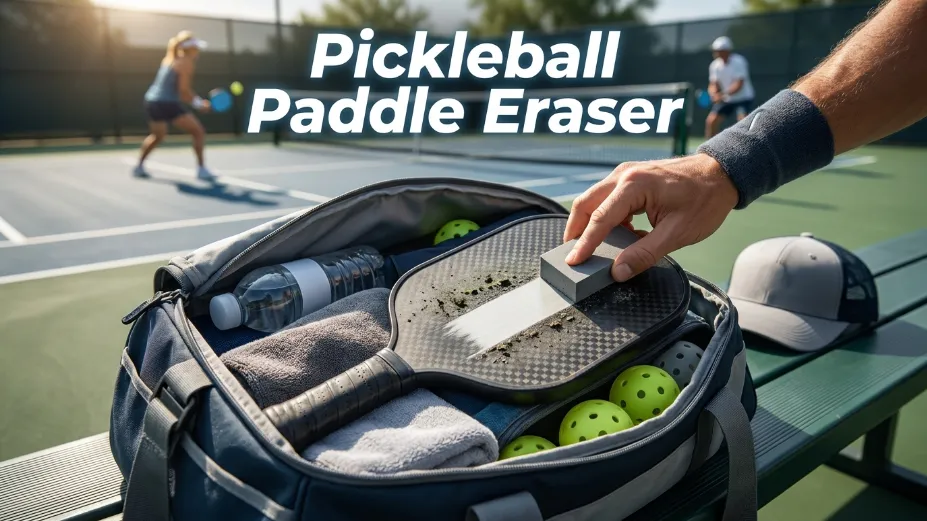
That $250 raw carbon fiber paddle in your bag is losing its teeth with every spin serve you hit. It’s not your technique; it’s the microscopic plastic residue from the ball melting into the texture, turning your premium paddle into a slick piece of wood. Before you shell out hundreds for a replacement to get your wicked spin back, there is a $12 tool elite players keep in their bags. Utilizing a targeted pickleball paddle eraser isn’t just about aesthetics—it’s a performance reset that instantly restores grit without degrading the face.
Pickleball Paddle Erasers — Comparison
Material · Price · Best For · Durability Rating
For US tournament players looking to maintain maximum ball bite, the ultimate option depends on your paddle’s face material and your budget. If you want a specialized, compact block designed specifically for raw carbon fiber, the premium crbn pickleball paddle eraser remains the benchmark. However, players looking for the absolute best value can purchase a generic industrial sanding belt cleaner, which offers identical chemical composition at a fraction of the cost.
The Science of Spin: A Deep Dive into Pickleball Paddle Erasers and Surface Maintenance
To understand why you need the best pickleball paddle eraser, you must first understand the mechanical physics of ball-to-paddle contact. Modern high-spin play relies on a paddle’s ability to grab the plastic skin of the ball during milliseconds of impact.
- The Anatomy of Raw Carbon Fiber (RCF): High-end manufacturers utilize unidirectional carbon prepregs cured under intense heat. During this thermal curing phase, a textured, sacrificial fabric sheet known as “peel-ply” is applied to the surface. When peeled away, it leaves behind a microscopic, cross-hatched grid of microscopic grooves and sharp resin peaks in the carbon fiber pickleball paddle face.
- The Physics of Spin (RPM): These micro-grooves act like microscopic teeth. When a ball strikes the paddle, the friction coefficient determines the “dwell time”—how long the ball stays compressed against the face. Higher friction prevents ball slippage, allowing the paddle to transfer rotational velocity (up to 2,200+ RPM) to the ball.
- The Friction Barrier: When these microscopic valleys are filled with debris, the surface becomes flat. Without the valleys to bite into, the ball slides across the paddle face, causing a dramatic drop in spin and control.
Maintaining this micro-texture is the single most important factor in keeping your paddle performing like new. Failing to clean this grit regularly is like driving a sports car on bald tires; no matter how good your stroke technique is, the mechanical connection to the ball is compromised.
What is Clogging Your Paddle? (Debunking the “Ball Dust” Myth)
Many players believe the gray residue accumulating on their paddle is harmless “dust.” In reality, this buildup is a highly adhesive mixture of melted polymers and abrasive court materials that binds directly to the paddle’s resin surface.
Microscopic Ball Shearing
When you strike a plastic ball at speeds exceeding 40 MPH, the impact creates extreme localized heat and friction. This shear force literally slices micro-fibers off the pickleball balls. This microscopic plastic residue is instantly melted by the kinetic energy and pressed deep into the carbon weave. Over time, this creates a smooth, plasticized glaze over the sweet spot, rendering your paddle completely slick.
The Court Dirt Problem
Pickleball court surfaces are coated with silica sand to provide traction. As balls bounce, they act as high-efficiency vectors, picking up this microscopic silica dust, environmental grime, and sweat. When the ball collides with your paddle, these hard silica particles are hammered into the carbon grooves, locking the plastic residue into place. This is why playing with dirty balls on outdoor courts accelerates the loss of spin potential far quicker than playing with clean best indoor pickleball balls.
Without deep mechanical extraction, this packed matrix of plastic and silica cannot be wiped away by a simple cloth. This is where a dedicated pickleball paddle cleaner eraser becomes a vital tool in your equipment bag.
The Empirical Truth: Do Erasers Actually Restore Spin (RPM)?
There is a common misconception that paddle erasers are merely cosmetic tools designed to make a dirty paddle look pretty. However, empirical testing from leading independent labs reveals a major performance benefit.
Controlled launch monitor testing on heavily clogged paddles shows that a thorough cleaning with a dry rubber block can restore up to 100 RPM of lost spin potential. While a 100 RPM difference is highly valuable for tournament competitors, the human perception threshold for spin changes on court is generally around 300 RPM. This means the average recreational player may not immediately feel the extra rotational bite during a casual dink rally.
However, the real value of using a dry rubber block is long-term preservation. When silica sand and court dirt remain trapped inside the micro-grooves, every subsequent ball impact acts as an abrasive grinding force. This trapped grit literally grinds down the delicate peaks of the protective epoxy resin. By using a specialized cleaning block, you remove these grinding agents, preventing permanent structural wear and keeping your paddle legal under USA Pickleball guidelines.
Material Compatibility: Where Erasers Work and Where They Destroy
While a premium cleaning block is an incredible tool, using it on the wrong paddle face can permanently ruin your gear. Understanding your paddle’s surface engineering is critical before applying any abrasive force.
- Raw Carbon Fiber (RCF): Standard solid-cured raw carbon faces (such as the crbn pickleball paddle or Joola CFS) are highly resilient. The texture is baked into the structural epoxy resin, making it completely safe for dry rubber cleaning. The rubber will lift the debris out of the valleys without harming the carbon fibers.
- The Kevlar/Aramid Hazard: Newer hybrid paddles utilize woven Kevlar or aramid fibers (such as the ruby pickleball paddle). Kevlar has incredible tensile strength but poor resistance to friction. Dragging a dry rubber eraser across exposed Kevlar fibers can pull up the weave, causing irreversible fraying or “tufting.” Always follow specific manufacturer care guidelines, such as those issued for the six zero pickleball Ruby, which warn against using erasers.
- Spray-On Abrasive Grit: Many budget and intermediate paddles use a spray-on grit coating (such as Joola’s CAS or older fiberglass textures). A high-friction dry rubber eraser will easily strip this non-structural grit right off the face, leaving you with a completely smooth, ruined paddle. For these models, a light wipe with a damp cloth is the only safe option.
Before purchasing any pickleball paddle erasers, verify whether your paddle face relies on structural peel-ply raw carbon texture or an applied, sprayed-on abrasive paint. If you are unsure of your paddle’s composition, checking our detailed comparisons of the best pickleball paddle for spin can help clarify its material makeup.
The Commercial Hype: Branded Erasers vs. Sanding Belt Cleaners
One of the best-kept secrets among advanced players is the massive retail markup on branded pickleball cleaning accessories. A standard branded paddle eraser typically retails between $12 and $15 for a small block measuring roughly 2″ x 2″ x 1″.
Physically, chemically, and mechanically, these branded erasers are 100% identical to the natural crepe rubber blocks used in woodworking to clean sanding belts. Woodworking shops use these blocks to remove packed sawdust from sandpaper without destroying the abrasive silicon carbide crystals. You can purchase a massive 8.5″ industrial sanding belt cleaner online for under $5. This industrial block can easily be sliced with a utility knife into six separate, travel-sized paddle cleaners, saving you a massive amount of money over time.
Furthermore, players must completely avoid using Melamine foam (commonly known as “Magic Erasers”). While Melamine foam is highly effective at removing stains from household surfaces, it acts as an ultra-fine, 3000 to 4000-grit sandpaper. Using it on your paddle will micro-shave the delicate epoxy resin peaks with every single wipe, permanently flattening the face and destroying its spin capabilities within weeks.
Health, Physics, and Storage Precautions
Because most premium cleaning blocks are constructed from natural crepe rubber, they carry specific physical limitations and health warnings that are rarely discussed in product descriptions.
Latex Allergy Warning
Natural rubber is harvested from the sap of the Hevea brasiliensis tree and contains active, water-soluble latex proteins. When you rub a crepe rubber block vigorously against a textured carbon paddle, the friction causes the rubber to crumble into a fine, airborne dust. On windy outdoor courts, this dust can easily be inhaled or make contact with your skin. For players with severe latex sensitivities, this can trigger contact dermatitis, localized hives, or acute respiratory irritation. If you have a known latex allergy, always choose synthetic, latex-free cleaning blocks (such as the Selkirk Carbon Cleaning Block).
Thermal Instability
Natural rubber has low thermal stability. If exposed to temperatures exceeding 110 degrees Fahrenheit—which is easily reached inside a locked car trunk or a black gear bag on a hot summer afternoon—the polymer chains begin to break down. The rubber will soften, becoming highly viscous and sticky. If you attempt to clean your paddle with a heat-degraded eraser, it will smear a sticky, gooey residue into the carbon micro-grooves, permanently ruining the paddle’s texture and attracting twice as much dirt during your next match.
The Professional Paddle Care Protocol (SOP)
To maximize the lifespan of your raw carbon fiber paddle, implement this professional maintenance routine to keep your surface clean and tournament-legal.
- Daily Post-Match Wipe: Immediately after finishing play, wipe down both faces of your paddle with a dry, clean microfiber cloth. This lifts loose court dust and superficial ball debris before they can react with sweat, humidity, and heat to form a hardened glaze.
- Deep Eraser Cleaning (Every 5 to 10 Hours of Play):
- Ensure the paddle face is 100% dry. Trying to use an eraser on a damp paddle will cause the rubber to slick over and lose its grabbing force.
- Hold the paddle firmly and sweep the eraser vertically, following the direction of the carbon weave, using moderate, even pressure.
- Work in small, overlapping sections across the entire face.
- Vigorously brush away all rubber crumbs using a dry microfiber cloth or a soft-bristled brush to prevent the rubber particles from settling back into the micro-grooves.
- Removing Sunscreen and Oils: If your paddle face becomes contaminated with oily sunscreen, sweat, or skin oils, the eraser will not work. Instead, place a single drop of mild, non-moisturizing dish soap onto a lightly damp microfiber cloth. Gently wipe the contaminated zone, taking extreme care to keep water away from the edge guard seams to prevent internal core delamination. Wipe dry immediately with a clean towel.
Frequently Asked Questions (FAQ)
Are pickleball paddle erasers safe to use on all types of paddles?
No. They are highly safe for raw carbon fiber (RCF) surfaces. However, they should never be used on paddles with sprayed-on grit, painted finishes, or woven Kevlar/aramid faces, as the extreme friction can strip away the grit coatings or cause the Kevlar fibers to fray.
Can I use a household Magic Eraser to clean my carbon fiber paddle?
Absolutely not. Magic Erasers are made of melamine foam, which is highly abrasive (equivalent to 3000-grit sandpaper). Using a Magic Eraser will permanently sand down the microscopic resin texture of your paddle, destroying its spin potential.
How often should I clean my paddle with an eraser?
For the average player, a deep cleaning every 5 to 10 hours of active court play is ideal. If you play on dusty outdoor courts with scuffed balls, you may want to use the eraser after every match to prevent the plastic residue from baking into the surface texture.