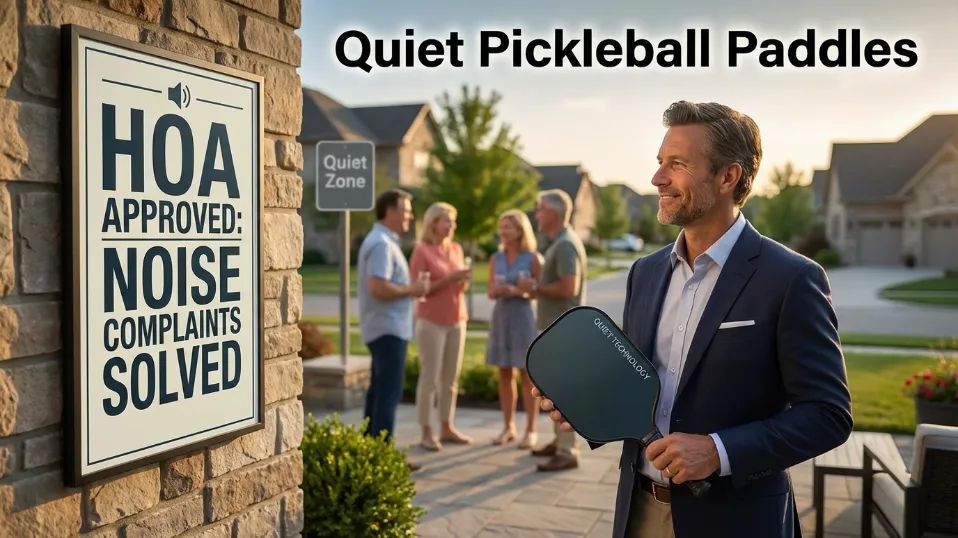
The distinct ‘pop’ of a pickleball is music to a player’s ears, but it’s fast becoming the dreaded soundtrack to neighborhood disputes. As courts continue to take over local parks and HOA communities across the country, strict noise ordinances are forcing players into a frustrating corner: adapt your gear or pack up your net. You don’t have to sacrifice power or spin to keep the peace. Upgrading to one of the best quiet pickleball paddles is the smartest way to dampen the decibels and stay on the court. Let’s break down the gear that keeps the neighbors happy without compromising your killer dinks.
Quiet Pickleball Paddles — Comparison
Core Material · Noise Level · Best For
The best quiet pickleball paddles are those certified under the USA Pickleball “Quiet Category,” which ensures a 50% reduction in acoustic output compared to standard gear. For most players, the Whisper Silencer offers the best balance of muted sound and explosive power. However, tactical players seeking elite spin should choose the OWL PXE, while those needing maximum power in noise-sensitive zones will find the Diadem Hush to be a “silent missile” on the court.
The Ultimate Guide to Quiet Pickleball Paddles: Science of Silence
In the United States, the pickleball noise issue has escalated from a simple annoyance to a major regulatory challenge for HOAs from Florida to California. Traditional paddles create a sharp “pop” that hits frequencies between 1,000 Hz and 2,000 Hz—the exact range where human hearing is most sensitive. Modern quiet pickleball paddles solve this by shifting that frequency down to a low-pitched “thump” (under 600 Hz), which doesn’t travel as far and is less irritating to the human ear.
When searching for a quiet pickleball paddle, you aren’t just looking for a “soft” feel; you are looking for acoustic engineering. This involves high-modulus materials that absorb vibrations before they leave the face. Brands like OWL Sport and Whisper Paddles have pioneered this space, but advanced tech from Gearbox and Diadem has proven that quiet play doesn’t have to mean weak play.
Best Quiet Pickleball Paddles: Top Brands and Stealth Models
The market for pickleball quiet paddles has moved far beyond wooden or foam-filled prototypes. Here is a deep dive into the industry leaders:
1. OWL Sport: The “Acoustene” Revolution
The OWL pickleball paddle was the first to receive the official “Quiet Approved” stamp from USA Pickleball. Its secret lies in the Acoustene™ face—a specialized fabric sheath made of yarn with a fiberglass core. This rug-like texture eliminates the hollow “echo chamber” effect found in standard graphite pickleball paddles. It offers insane 2,000+ RPM spin but is often criticized for its head-heavy weight (8.8 oz stock).
2. Whisper Silencer: The Performance All-Rounder
If you want a paddle that feels like a professional pickleball paddle but sounds like a whisper, the Whisper Silencer is the gold standard. It uses a 2nd-gen laminate carbon face and an advanced polymer core. Unlike the OWL, it provides a “catapult” power effect, making it ideal for aggressive players in noise-restricted neighborhoods.
3. Diadem Hush: The Power Master
The Diadem Hush is colloquially known as the “rocket launcher.” It is tested to be 40% quieter than standard models but hits harder than almost any other paddle. This is achieved through a proprietary quiet core that prioritizes PBCOR (Coefficient of Restitution)—meaning it returns energy to the ball with extreme efficiency while muffling the sound signature.
The Technical “Why”: Core Thickness and Aerospace Materials
Why is one quiet pickleball paddle better than another? It comes down to material science that most competitors overlook:
- Core Thickness: Thicker is quieter. A 16mm vs 16mm core comparison shows that thicker cores absorb more kinetic energy. Some newer models even push to 19mm for maximum vibration dampening.
- Toray T1100 Carbon Fiber: While T700 is the standard, elite quiet paddles use **T1100 intermediate modulus carbon fiber**. It is 30% stronger and allows the paddle to “Supersonic-tune” the face for better energy return without the loud “clack” of cheaper materials.
- Tupelo SolidCore: Used by Quiet Play, this non-honeycomb military-grade material is 25x stiffer than standard foam, eliminating the hollow “ping” entirely.
Quiet Pickleball Paddles and Balls: A Complete Acoustic Strategy
Using a quiet pickleball paddle is only half the equation. If you hit a hard, 40-hole outdoor plastic ball, you will still generate significant noise. For the ultimate stealth setup, you need quiet pickleball paddles and balls working in tandem.
Brands like Onix Fuse and Monarch offer “Lower Acoustic Profile” balls that sit at roughly 81-83 dBA. However, for total peace, specialized foam pickleball balls like the Gamma Librarian or DigiPro are game-changers. These balls use advanced polymers that reduce the “pop” by up to 10x while maintaining a realistic bounce for residential play.
The Missing Angles: What Your Opponents (And Neighbors) Aren’t Telling You
While marketing focuses on decibels, the real-world experience of using best quiet pickleball paddles has several “hidden” factors:
1. The Loss of Auditory Feedback
Humans process sound faster than sight. In a fast-paced rally at the kitchen line, you rely on the “pop” to judge how hard the ball is coming at you. When you play against a quiet pickleball paddle, your reaction time may be delayed by several milliseconds because the “trigger” sound is missing. This often leads to opponents feeling “body bagged” by shots they didn’t hear coming.
2. The “Silent Killer”: Crushed Cores and Safety
A dangerous phenomenon in modern tech is thermoformed paddles experiencing “crushed cores” or delamination. When the internal honeycomb breaks, the face becomes a trampoline. The paddle becomes eerily quiet, but the ball launches 50% faster than legal limits. This is a major safety risk in the United States, as it outpaces human reflexes and can lead to retinal injuries or broken teeth.
3. The Customization Headache (Lead Tape Issues)
Tactical players love adding lead tape to increase stability. However, on paddles like the OWL PXE, the Acoustene fabric surface makes it nearly impossible for standard adhesive to stick. If you buy a quiet pickleball paddle with a textured fabric face, you may be stuck with the stock weight distribution.
Frequently Asked Questions
Expert Insights on Quiet Gear
Are quiet pickleball paddles allowed in tournaments?
It depends on the certification. Most quiet pickleball paddles like the Whisper Silencer and Quiet Play models are USA Pickleball approved for tournament play. However, some “recreational only” models like the original OWL CX are strictly for non-sanctioned games.
Do quiet paddles wear out faster?
Paddles with fabric or felt-like surfaces (like Acoustene) tend to trap dirt and moisture more than Kevlar or Carbon fiber. While the core is durable, the surface texture may require more frequent cleaning to maintain spin.
Why is my paddle making a “crinkling” sound?
If your quiet pickleball paddle starts sounding like a bag of chips when you press it, you likely have a “crushed core.” This is common in budget pickleball paddles or older thermoformed models and should be replaced immediately for safety.
What is the best weight for a quiet paddle?
Most pickleball quiet paddles are mid-weight (7.8 to 8.2 oz). However, the added dampening materials often result in a higher swing weight. If you suffer from tennis elbow, look for a model with a lower swing weight (under 115) to avoid arm fatigue.
Final Thoughts: Staying in the “Green Zone”
As pickleball continues its explosive growth across the United States, the move toward quiet pickleball paddles is no longer optional for many players. By selecting a paddle from the USAP Quiet Category or the Arizona Sun City Grand Green Zone list, you ensure that you can play 24/7 without being “that neighbor.” Whether you choose the Whisper Silencer for its balance or the Diadem Hush for its power, the future of the game is undeniably hushed.