The physics of a winning dink often boils down to a few fractions of an ounce. While most players obsess over flashy neon graphics, the seasoned pros know that pickleball paddle weight is the silent engine behind every overhead smash and delicate drop shot. It is the difference between a lightning-fast reaction at the kitchen line and a sluggish swing that lands the ball straight into the net.
Pickleball Paddle Weight Specifications and Customization Guide for US Players
| Weight Category | Weight Range (oz) | Player Profile | Customization (Tape Placement) | Performance Impact |
|---|---|---|---|---|
| Lightweight | Under 7.5 oz | Control/Touch Players | Under-grip or Throat | Max maneuverability; faster resets. |
| Midweight | 7.5 – 8.2 oz | All-Court/Intermediate | 3 & 9 o’clock (Sides) | Balanced power/control; expanded sweet spot. |
| Heavyweight | 8.2+ oz | Power Hitters/Singles | 12 o’clock (Top edge) | Extreme plow-through; deep baseline drives. |
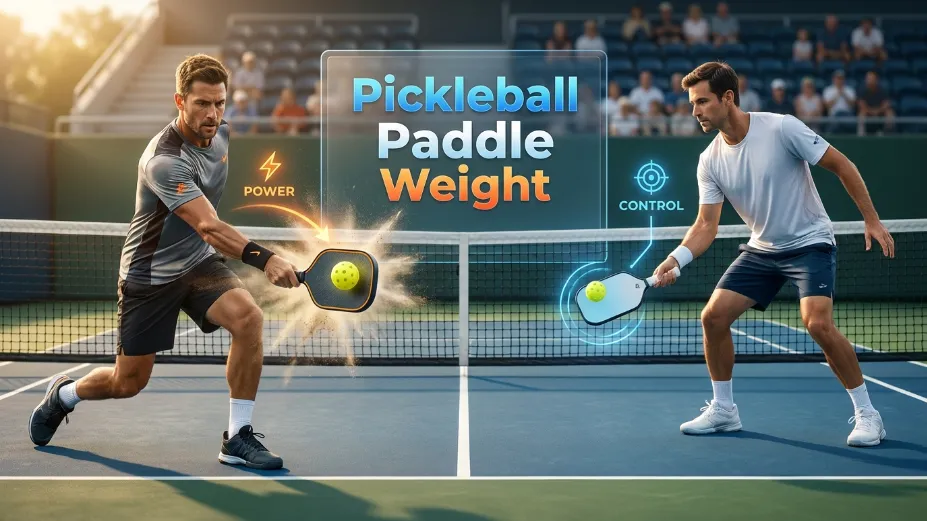
To answer the primary question: pickleball paddle weight dictates the balance between hand speed and power. A heavier paddle (8.2+ oz) provides stability and effortless depth but slows down net reactions, whereas a lighter paddle (under 7.5 oz) prioritizes quick wrist flicks and defensive resets at the expense of raw driving force. Customizing weight with lead or tungsten tape allows players to fine-tune the sweet spot and rotational stability (twist weight) to match their unique playing style.
The Science Behind Pickleball Paddle Weight: Why Every Ounce Counts
In the American competitive scene, players are moving beyond “off-the-shelf” specs. The total mass of your gear—known as static weight—is only half the story. To truly master the court, you must understand how that weight is distributed. For instance, a paddle weighing 8.0 ounces can feel like a “sledgehammer” if the mass is at the tip, or a “scalpel” if the mass is concentrated in the handle.
This technical nuance is what separates a 3.5-rated player from a 5.0 pro. When you increase the weight, you increase the Momentum ($p = m \cdot v$). In practical terms, this means the ball carries more energy on 3rd shot pickleball drops, making them harder for your opponent to attack. However, the trade-off is rotational inertia; a heavier head is harder to move during those lightning-fast “firefights” at the kitchen line.
Experts often discuss Swing Weight versus Twist Weight. Swing weight measures how heavy the paddle feels during a full arc, while twist weight measures how much the paddle resists turning in your hand when you hit the ball off-center. High twist weight is the “secret sauce” for consistency, as it effectively expands the usable sweet spot toward the edges.
The Rise of the Light weight pickleball paddle
While power is tempting, many players are shifting toward a light weight pickleball paddle to gain an edge in speed-ups and defensive blocks. These paddles, typically weighing between 7.0 and 7.4 ounces, offer unparalleled maneuverability for doubles specialists who spend most of their time at the non-volley zone. If you feel your hands are too slow to counter a hard drive, switching to a lighter setup might be the solution. You can explore a curated selection of the best lightweight pickleball paddles to see which technology suits your hand speed goals.
Mastering Pickleball Paddle Weight Placement for Elite Performance
Strategic pickleball paddle weight placement is the ultimate “hack” for personalizing your gear. By using the “Clock System,” you can transform a defensive paddle into an offensive weapon without buying a new one. The placement of mass changes the Center of Pressure and Center of Percussion (COP) on the paddle face.
- 12 o’clock (Top): This maximizes the lever arm. Placing weight here significantly increases your “plow-through” on serves. It is ideal for singles players like Ben Johns who need to dictate pace from the baseline.
- 3 & 9 o’clock (Sides): This is the most popular configuration. It increases twist weight, making the paddle much more “forgiving.” If you find your paddle twisting during a pickleball dink, adding mass here stabilizes the face.
- 4 & 8 o’clock (Bottom Corners): This adds mass without significantly increasing swing weight. It provides a “solid” feel and improves the sweet spot near the throat, which is crucial for pickleball rules doubles where resets are frequent.
A “missing angle” often ignored by competitors is Flick Weight. This refers to the effort required to snap the paddle using only the wrist. If you add too much weight at the 12 o’clock position, your flick weight skyrockets, making your overhead put-aways powerful but your wrist-based deceptive shots much slower.
How to Use Pickleball Paddle Weight Tape Safely and Effectively
When selecting pickleball paddle weight tape, you generally have two choices: Lead and Tungsten. While lead tape is the traditional, cost-effective option, it requires safety measures. Because lead is a heavy metal, it is essential to cover it with electrical tape to prevent direct skin contact. Many USAP-sanctioned tournaments require this for safety reasons.
Tungsten tape is the modern, non-toxic alternative. It is approximately 50% denser than lead, meaning you can add more weight in a smaller physical footprint. This is vital for edgeless paddles where surface area is limited. Regardless of the material, always start by adding weight in 2-gram increments. Testing your setup during pickleball drills is the only way to ensure you haven’t over-weighted your arm, which could lead to fatigue.
Advanced Strategy: Polarized vs. Non-Polarized Setups
One area where most online guides fail is the distinction between polarized and non-polarized weighting. This is a concept borrowed from high-end tennis customization but is now revolutionizing pickleball.
A polarized setup involves placing weight at the extreme ends of the paddle: the very top (12 o’clock) and the very bottom (the butt cap or handle). This maximizes the “swing-through” power while keeping the balance point relatively neutral. It is perfect for players who want a “heavy” hit but don’t want the paddle to feel sluggish. In contrast, a non-polarized setup places all the weight at the 3 and 9 o’clock positions. This creates the largest possible sweet spot but offers less “whip” on full swings.
Head-to-Head: Elongated vs. Widebody Weight Dynamics
The shape of your paddle dictates how it reacts to added pickleball paddle weights. Understanding this interaction is key to avoiding “equipment mismatch.”
- Elongated Paddles (e.g., 16.5″ x 7.5″): Naturally have a higher swing weight. Adding weight to the top of an elongated paddle can quickly make it unmanageable for anyone without elite forearm strength. Most pros recommend weighting the throat area of elongated models to boost stability without killing hand speed.
- Widebody Paddles (e.g., 16″ x 8″): These have a naturally high twist weight but lower swing weight. They are the perfect canvas for pickleball paddle weight tape at the 10 and 2 o’clock positions, which gives them the reach and power of an elongated paddle while retaining their massive sweet spot.
If you are trying to decide between these shapes, checking a comparison like the Selkirk Vanguard vs Joola Hyperion can help you understand how base weights differ before you even add tape.
Biomechanics: Preventing “Pickleball Elbow” Through Proper Weighting
A common myth in the United States is that “lighter is always better” for injuries. This is dangerous misinformation. A paddle that is too light vibrates excessively upon impact with a hard ball. These vibrations travel directly into the tendons of the elbow, often causing or exacerbating pickleball injuries like lateral epicondylitis (tennis elbow).
By adding pickleball paddle weights to the sides (3 and 9 o’clock), you increase the paddle’s “mass-at-impact.” This allows the paddle to absorb the shock rather than your arm. However, the caveat is over-weighting. If you cannot comfortably hold your paddle at arm’s length for 30 seconds without trembling, your setup is too heavy and will strain your shoulder. Finding the “Goldilocks” weight is a balance of physics and personal physiology.
USAP Compliance: Rule 2.E.5 and Your Modifications
Is your custom setup legal? According to USA Pickleball Equipment Standards, weighted tape is a permitted modification, but there are strict boundaries. Under Rule 2.E.5, decals and tape cannot extend more than 1.0 inch above the top of the grip. Additionally, tape must not extend more than 0.5 inches into the hitting surface of the paddle face. This is to ensure that the texture of the tape does not impart illegal spin on the ball.
Using a personalized pickleball paddle that exceeds these limits can result in a forfeit during sanctioned tournament play. Always use a ruler to verify your placement before heading to a competitive event like those at the Atlanta Pickleball Center.
Frequently Asked Questions (FAQ)
Is 8.5 oz too heavy for a pickleball paddle?
For most intermediate players, 8.5 oz is considered the upper limit of “midweight.” It provides excellent stability and power but may cause arm fatigue during 3-hour sessions if you lack forearm conditioning.
Does lead tape actually increase the sweet spot?
Technically, it increases the “effective” sweet spot. By increasing twist weight, the paddle loses less energy on off-center hits, making those shots feel as solid as if they hit the dead center.
Where should I put weight for a two-handed backhand?
Players like Anna Bright often add weight to the throat and lower sides. This provides stability for the second hand’s guiding force without making the head too heavy to “flick” on the backhand side.
Can I put weight under the grip?
Yes. Adding weight under the grip (or using a pickleball grip with built-in weights) lowers the balance point. This makes the paddle feel lighter and faster at the net, even though the total scale weight has increased.
How often should I replace my weight tape?
Weight tape is durable, but the adhesive can weaken over time or with heat. If you notice the tape “rattling” or peeling, replace it immediately, as loose tape can absorb energy and deaden your shots.
Final Thoughts: The 10-Hour Customization Rule
The journey to the perfect pickleball paddle weight is a marathon, not a sprint. Expert coaches recommend the “10-Hour Rule”: play with your paddle in its stock form for at least 10 hours before adding a single gram of tape. This allows you to identify genuine performance gaps—like a lack of power or a small sweet spot—rather than blaming a “bad day” on your equipment.
Once you begin customizing, change only one variable at a time. Record your paddle’s new weight using a digital scale and take notes on how it affects your pickleball serve tips and net play. With patience and the right pickleball paddle weight placement, you can turn a standard piece of equipment into a professional tool tailored specifically to your American playing style.