Every player wants faster hands. It’s the holy grail of the modern game. You watch the pros exchanging lightning-fast volleys at the kitchen line, and the logic seems simple: to move faster, you need less weight. But is lighter always better? Or is it a trap that’s robbing you of power and stability?
The market is flooded with light pickleball paddles promising to transform your reaction time. However, dropping ounces off your equipment often introduces complex trade-offs that most manufacturers don’t advertise. From “twist weight” instability to the surprising mechanics of “swing weight,” the reality of playing with a featherweight paddle is far more nuanced than simply looking at a number on a scale.
Whether you are a finesse player looking for precision or a tinkerer planning to customize your gear, understanding the mechanics of a light weight pickleball paddle is crucial. In this deep dive, we move beyond the marketing fluff to explore the physics, the hidden downsides, and the strategic advantages of going light.
The Speed Advantage: Hand Battles at the Net
Let’s start with the primary reason players switch to light pickleball paddles: agility. In Pickleball, the game is increasingly won or lost at the Non-Volley Zone (the Kitchen). When you are standing 14 feet away from your opponent, and the ball is traveling at 40+ mph, your reaction time is measured in milliseconds.
A paddle that weighs 7.3 ounces or less significantly reduces the inertia required to initiate movement. This is basic physics. A lighter object requires less force to accelerate. For players who struggle with “heavy hands” or feel late on their blocks, a light pickleball paddle can provide an immediate, tangible boost in hand speed.
This is particularly effective during:
- Fast Hands Battles: Rapid-fire volleys where you don’t have time to backswing.
- The pickleball dink: Soft, controlled shots where touch matters more than power.
- Overhead Put-Aways: Snapping the wrist quickly to punish a high ball.
However, speed is only one part of the equation. While your hands might be faster, the stability of the paddle upon contact is a completely different story.
The Hidden Trap: Static Weight vs. Swing Weight
One of the most common complaints players have after buying a light weight pickleball paddle is, “Why does this feel sluggish?”
This confusion stems from the difference between Static Weight and Swing Weight. This concept is critical if you want to learn how to pick a pickleball paddle that actually fits your game.
Static Weight
This is the number printed on the box (e.g., 7.2 oz). It is the total mass of the paddle when placed on a scale. While this number is useful for shipping, it tells you very little about how the paddle performs in motion.
Swing Weight
Swing weight measures how heavy the paddle feels when you swing it through the air. It depends entirely on how the weight is distributed.
- Head-Heavy: If the weight is concentrated at the top (furthest from your hand), the paddle will have a high swing weight. A 7.2 oz paddle that is head-heavy can actually feel harder to swing than a balanced 8.0 oz paddle.
- Head-Light: If the weight is concentrated near the handle, the paddle will feel whippy and fast.
Many cheaper light weight pickleball paddles suffer from poor weight distribution. Manufacturers remove material from the handle or throat to cut weight, leaving the head relatively heavy. The result? A paddle that is “light” on paper but feels clunky and slow during play.
Stability & Power: The “Twist Weight” Trade-Off
When you strike a pickleball perfectly in the center of the face (the sweet spot), almost any paddle feels good. The true test of a paddle is what happens when you miss.
Light pickleball paddles naturally suffer from low Twist Weight. Twist weight refers to the paddle’s resistance to rotating in your hand when you hit the ball off-center (near the edges). Because light paddles lack mass on the perimeter (the 3 o’clock and 9 o’clock positions), they are less stable.
If you block a hard drive with a light paddle and miss the sweet spot, the paddle is likely to twist. This absorbs the energy of the ball, leading to:
- Weak Returns: The ball dies on the paddle and lands in the net.
- Unforced Errors: The face angle changes due to the twist, sending the ball wide or high.
- Arm Fatigue: Your forearm muscles have to work overtime to stabilize the paddle against the force of the ball.
This brings us to power generation. Physics dictates that Force = Mass x Acceleration. If you reduce the mass (the paddle weight), you must increase the acceleration (your swing speed) to achieve the same power. With light pickleball paddles, there is very little “plow through.” The paddle doesn’t do the work for you; you have to generate nearly 100% of the power yourself.
Customization: The “Blank Canvas” Strategy
If light paddles lack stability and power, why do so many pros use them? The answer lies in customization. Many advanced players view a light pickleball paddle not as a finished product, but as a “blank canvas.”
By starting with a lightweight base (e.g., 7.3 oz), you can strategically add lead or tungsten tape to create a paddle that is perfectly tailored to your needs. This is something you cannot do if you buy a heavy paddle (8.5 oz) straight from the factory, as you cannot easily remove weight.
Strategic Weight Placement:
- Throat (5 & 7 o’clock): Adding weight here increases static weight without significantly increasing swing weight. This makes the paddle feel solid without slowing down your hands.
- Corners (3 & 9 o’clock): This is the cure for the stability issue. Adding weight to the edges increases the Twist Weight, expanding the sweet spot and preventing the paddle from wobbling on off-center hits.
- Top (12 o’clock): Only for those seeking maximum power. This makes the paddle head-heavy and acts like a hammer.
If you are looking at the top pickleball paddles on the market, many are sold in “lightweight” models specifically to allow for this customization.
Equipment Mechanics & Comfort: The Vibration Debate
There is a persistent myth that lighter paddles are better for injuries like tennis elbow because there is “less weight to move.” However, biomechanics experts and equipment junkies often argue the opposite.
A heavier object absorbs more shock. Think of it like a car crash: a heavy truck absorbs impact better than a light compact car. When a pickleball strikes a very light paddle, the paddle lacks the mass to absorb that energy. Instead, the shock wave travels through the paddle, down the handle, and directly into your wrist and elbow.
Furthermore, because light weight pickleball paddles are less stable, players subconsciously squeeze the handle tighter to prevent it from twisting in their hands. This “death grip” is a leading cause of forearm strain. To mitigate this, ensuring you have the correct pickleball grips and consciously relaxing your hand is essential.
If you have a history of arm pain, you might want to look into paddles specifically designed for dampening, or check our guide on preventing pickleball injuries before committing to a sub-7.0 oz paddle.
Aesthetics & Visibility: The “Light Blue” Factor
Beyond the physics of weight, the visual design of modern paddles is evolving. A trending search among players is for a light blue pickleball paddle. While this seems purely aesthetic, paddle color can actually impact gameplay and maintenance.
Visibility and “The Distraction Rule”
Most pickleballs are yellow (like the Franklin X-40 or Dura Fast 40). According to official pickleball rules, a player generally cannot wear clothing or use equipment that matches the color of the ball to the point of distraction. While a bright yellow paddle face might be banned in some tournaments, a light blue pickleball paddle provides excellent contrast against the yellow ball, making it easier for both you and your opponent to track the spin.
Maintenance of Light Colors
If you choose a paddle with a light-colored face (white, light blue, pink), be aware of the “ball dust” factor. Pickleballs leave a plastic residue on the gritty surface of carbon fiber pickleball paddle faces.
On a black paddle, this looks like white dust. On a light blue paddle, it can look like dark scuff marks. Warning: Be very careful when cleaning printed graphics. While raw carbon fiber erasers work wonders on black raw carbon surfaces, using an abrasive eraser on a painted or printed light blue pickleball paddle can sometimes strip away the grit or the design itself. Always check the manufacturer’s cleaning instructions.
Conclusion: Who Should Actually Buy Light?
Ultimately, the decision to use a light pickleball paddle comes down to your playstyle and your willingness to customize.
You should buy a light paddle if:
- You are a “touch” player who prioritizes dinks, drops, and hand speed at the net.
- You have a table tennis background and use a lot of wrist action.
- You want to customize your gear with lead tape to find your perfect balance.
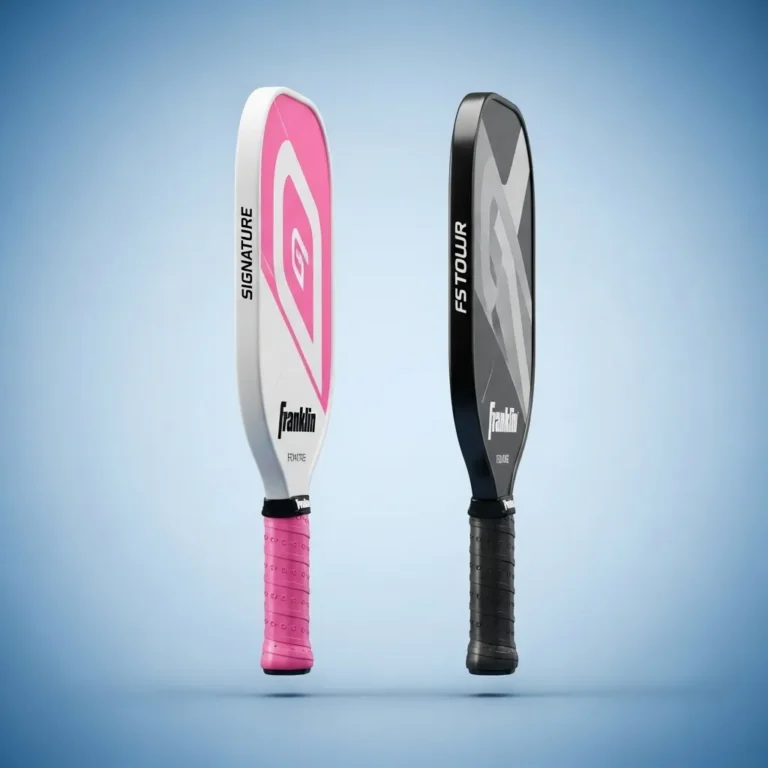
- You prefer brands like Head pickleball paddles that offer excellent lightweight maneuverability.
You should avoid a light paddle if:
- You struggle to generate power on your own.
- You face heavy hitters and need a stable paddle to block hard drives.
- You have tennis elbow (unless you plan to add weight to dampen vibration).
Before you buy, ignore the static weight on the sticker. Pick up the paddle, swing it, and ask yourself: Does this help my hands fly, or will it twist when the pressure is on?
Frequently Asked Questions
What is considered a “light” weight for a pickleball paddle?
Generally, any paddle weighing under 7.3 ounces is considered a light pickleball paddle. Mid-weight typically ranges from 7.3 to 8.2 ounces, and anything above 8.3 ounces is considered heavy.
Are light pickleball paddles better for beginners?
Not necessarily. While they are easier to swing, they offer less stability and a smaller sweet spot. A mid-weight paddle (around 7.8 oz) is often better for beginners as it provides a balance of control and stability.
Can I make a light paddle heavier?
Yes, absolutely. This is the main advantage of buying light. You can add lead or tungsten tape to the edges or throat to increase the weight and stability to your exact preference.
Is a light blue pickleball paddle allowed in tournaments?
Yes, light blue is generally allowed. The USA Pickleball Equipment Standards focus on ensuring the paddle surface isn’t reflective and doesn’t match the color of the ball (yellow/neon) to cause a distraction. Light blue offers good contrast.
Do light paddles vibrate more?
Physics suggests yes. Because they have less mass to absorb the energy of the ball impact, more shock is often transferred to the handle and the player’s arm compared to a heavier, denser paddle.