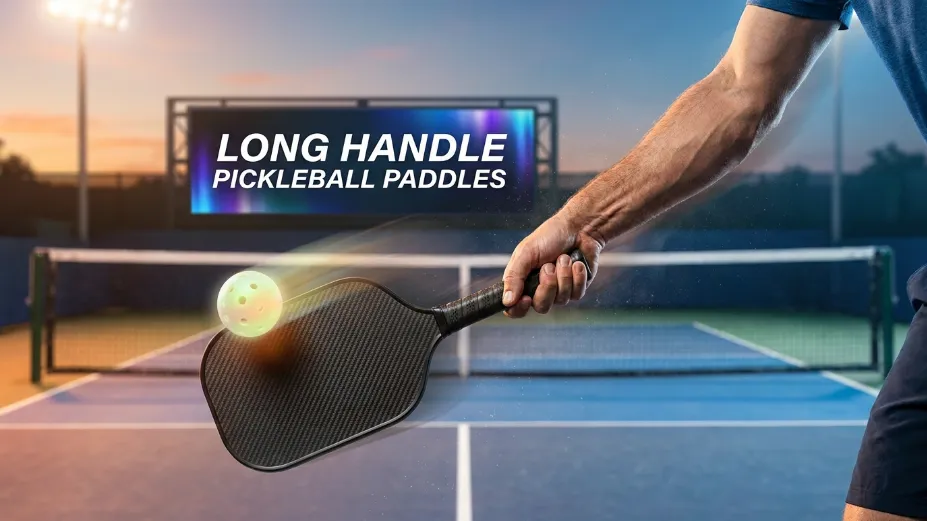
The two-handed backhand used to be an anomaly on the courts; today, it’s the lethal weapon defining modern tournament play across the US. Executing that baseline drive requires more than just flawless technique—it demands real estate. If your grip feels crowded and your reach falls a fraction of an inch short, upgrading to long handle pickleball paddles isn’t a mere luxury; it’s a strategic necessity for court dominance. We’ve rigorously analyzed the market’s top elongated setups, stripping away the marketing noise to reveal exactly which paddles deliver uncompromising leverage, superior court coverage, and that elusive extra power generation.
Elongated Pickleball Paddles — Comparison
Handle · Face · Core · Weight · MSRP
For competitive tournament players seeking the optimal blend of hand space and speed-up potential, selecting the correct layout from the leading long handle pickleball paddles segment is critical. If your priority is comfortable two-handed backhand execution paired with raw, explosive pop, the crbn 1 trufoam barrage elongated long handle pickleball paddle represents the absolute gold standard of engineering. Players seeking a more balanced, control-oriented hybrid will find a better match in the Six Zero Double Black Diamond, while pure baseline power bangers will naturally gravitate toward the edgeless design of the Selkirk Vanguard Power Air.
To implement these physical modifications successfully on the court, understanding the fundamentals of how to play pickleball with extended lever arms is crucial. Players transitioning from traditional tennis grips will find these extended-reach layouts highly intuitive, though they demand precise timing to maximize the enhanced paddle tip acceleration without hitting off-center.
1. Biomechanical Modeling and the Lever-Arm Physics of Extended Grips
The core performance of long handled pickleball paddles is rooted in simple, unyielding rotational physics. In biomechanical terms, the paddle functions as an extension of the human forearm, forming a third-class lever. When the pivot point (the player’s wrist or palm grip) is situated further away from the center of mass of the paddle face, the mechanical lever arm is lengthened. This physical change alters the entire rotational velocity equation:
v = r · ω
Where v represents the linear velocity of the paddle tip, r is the radius of the lever arm (measured from the wrist pivot to the paddle tip), and ω is the rotational angular velocity of the player’s swing. By increasing the handle length, the radius r is effectively expanded, directly compounding the linear speed of the paddle face at the point of contact. This increased tip speed allows advanced players to generate massive topspin and baseline drives with significantly less physical exertion.
However, this mechanical advantage introduces a critical physical trade-off: rotational inertia, commonly measured as swing weight. The formula for swing weight (I) dictates how heavy a paddle feels during an active swing:
I = Σ mi · ri²
Because extending the handle moves the physical mass of the paddle face farther from the hand, the swing weight increases exponentially with distance (ri²). This higher rotational inertia can slow down defensive reaction times during rapid, close-quarters hand battles at the non-volley zone (NVZ) line. Striking a balance between the added whip of an elongated lever and the quick maneuverability of a standard setup remains the primary engineering hurdle for modern paddle designers.
2. Shifting Dynamics: The USAPA 24-Inch Rule and Sweet Spot Migration
To maintain structural fairness, USA Pickleball (USAPA) enforces strict parameters under Equipment Rule 2.E.3. The combined length and width of a paddle—including edge guards and butt caps—cannot exceed 24 inches, with the total length strictly capped at 17 inches. Consequently, adding length to the handle forces manufacturers to shave inches off the face length or width. This geometric squeeze directly results in “Sweet Spot Migration.”
When choosing carbon fiber pickleball paddles with extended grips, the physical hitting surface is compressed. Without specialized internal engineering, a longer handle shifts the sweet spot significantly higher toward the paddle tip. Striking the ball within this raised sweet spot generates exceptional power because the paddle tip travels at maximum velocity; however, the overall margin for error is narrowed.
Furthermore, narrowing the face to stay compliant with the USAPA rule directly degrades the paddle’s twist weight (torsional stability). When a ball is struck off-center on a narrow 7.35-inch face, the paddle experiences high torsional torque, twisting in the player’s hand and causing dead, unstable returns. This is why pickleball paddles with long handles are strictly classified as advanced tools, demanding consistent, clean ball-striking to yield positive results.
3. The Unseen Discrepancy: Handle Length vs. Throat Taper Geometry
A major information gap on mainstream review sites is how manufacturers measure handle lengths. Many brands measure from the base of the butt cap directly to the top edge of the grip tape, counting the tapered “neck” or throat of the paddle as part of the handle. This means a paddle advertised with a 5.5-inch handle may only provide 5.25 inches of flat, wrap-ready grip surface because of a long, sloping throat taper.
This structural variance is highly apparent when comparing industry favorites:
- Six Zero Double Black Diamond: While highly praised within the Six Zero pickleball ecosystem, its advertised 5.5-inch handle actually measures closer to 5.3 inches of usable grip space due to a gradual neck flare. Players with large hands executing a two-handed backhand will find their fingers crowded or forced onto the carbon face.
- CRBN 1X Power Series: Features a true, hard-angled throat transition that preserves the full advertised 5.5-inch wrap space, allowing both hands to sit entirely on the grip without overlap.
- Selkirk Vanguard Power Air: Employs an edgeless, open throat design. Although it provides exceptional aerodynamics, the 5.25-inch handle can feel cramped for former tennis players who rely on completely separated hands for control.
For players developing a two-handed backhand, a true 5.5-inch handle is the absolute bare minimum required to stack both hands comfortably. Opting for a true long handle pickleball paddle with a rapid, square throat transition prevents your non-dominant hand from deadening the ball on the composite face.
4. Technical Breakdown of the CRBN 1 TruFoam Barrage Elongated
The CRBN Pickleball product lineup has redefined performance expectations with the introduction of its fourth-generation solid foam cores. At the pinnacle of their extended-lever series sits the crbn 1 trufoam barrage elongated long handle pickleball paddle, an aggressive offensive weapon designed specifically to address the structural trade-offs of long-handle geometry.
Official Structural and Engineering Specifications
- Length x Width: 16.5″ x 7.35″
- Handle Length: 5.75″ (True, wrap-ready grip surface)
- Grip Circumference: 4.125″ (Octagonal bezel)
- Core Thickness: 14mm
- Average Static Weight: 7.9 oz (± 0.2)
- Balance Point: 239mm
- Swing Weight Range: 117 – 119
- Twist Weight Metric: 5.88
The 100% TruFoam Core Architecture
Unlike traditional honeycomb cores that rely on hollow polypropylene cells, the Barrage uses a multi-density, solid polymer matrix. This design replaces empty air cells with a solid structure, preventing the localized collapse known as “core crush” that degrades power and control over time. The Barrage’s interior is segmented into three distinct zones: a layered EPP center core with weight-reducing void cutouts, a thin EVA perimeter ring for structural support, and an outer EPP foam layer extending down the handle for vibration dampening.
This specialized core architecture produces an incredibly fast, firm ball rebound. While other foam pickleball paddles focus on a plush, damp feel with high dwell time, the Barrage is tuned for immediate energy return. The ball exits the face instantly with exceptional pop, making it a highly lethal tool for fast-paced hand battles at the kitchen line.
Material Tuning Within the CRBN Ecosystem
To suit different playing styles, CRBN tunes its TruFoam cores for specific performance profiles:
- Waves Series: Tuned for maximum dwell time and flex, mimicking tennis strings to generate extreme spin.
- Genesis Series: Balanced core tuning, sitting in the middle of the control-to-power spectrum.
- Barrage Series: Tuned for relentless power and pop, delivering faster exit speeds and a firm, responsive feel.
5. Head-to-Head: CRBN 1 TruFoam Barrage vs. JOOLA Ben Johns Perseus CFS
For advanced players choosing between these two premium tournament-grade setups, the choice comes down to a fundamental split in internal engineering and contact feel. Both paddles command top-tier status in the US market but handle power and stability differently on the court.
- Core Construction and Feel: The JOOLA Perseus CFS utilizes a traditional reactive honeycomb core surrounded by a foam-injected edge wall. The contact feel is crisp and direct, providing a clear feedback loop. The CRBN Barrage, utilizing its solid, honeycomb-free TruFoam core, delivers a dense, compact, and solid contact feel. This design absorbs high-frequency vibrations and reduces joint fatigue without feeling hollow.
- Grip Usability: Both models are advertised with a 5.5-inch or longer handle, but the CRBN Barrage 1 offers a true 5.75-inch grip with a rapid neck transition. This provides noticeably more real estate than the Perseus, making it the superior option for players with large hands who utilize a two-handed grip.
- Sweet Spot Stability: The Perseus CFS excels in torsional stability across the horizontal plane due to its wider 7.5-inch shape. The narrower 7.35-inch face of the CRBN Barrage 1 results in a lower twist weight (5.88 vs. 6.65); however, its solid foam perimeter ring stabilizes off-center hits, ensuring a highly consistent response across the entire face.
6. Tactical Weight Calibration: Balancing Swing Weight and Stability
Because narrow, elongated paddles have a lower twist weight (5.88 for the Barrage 1), they can twist in the hand when striking off-center. To offset this stability drop without making the paddle feel heavy or sluggish, advanced players utilize strategic weight customization.
Adding lead tape to the lower throat corners (the 4 o’clock and 8 o’clock positions) increases the paddle’s twist weight, widening the sweet spot and preventing twisting on off-center hits. However, adding weight to the edges increases the overall swing weight, which can slow down your hand speed during fast net exchanges.
To restore balance, players can use a counter-weighting strategy. Adding weight to the handle—such as installing a 12g counter-coin inside the butt cap (similar to the Ed Ju Signature Edition setup)—shifts the balance point closer to the player’s hand. This modification reduces the effective swing weight, keeping the paddle highly maneuverable while maintaining the extra stability and power provided by the perimeter lead tape.
7. Choosing Your Weapon: The Standard vs. Elongated Grip Matrix
Before purchasing your next setup, evaluate your personal physical requirements and playstyle using the comparative checklist below:
- Select an Elongated Long-Handle Paddle (5.5″ to 5.75″+) if you:
- Rely heavily on a two-handed backhand and require completely separated hand placement.
- Are a former tennis player accustomed to a longer lever and wristy topspin mechanics.
- Are a tall player (6 feet and above) who wants to maximize reach and court coverage.
- Prioritize baseline power, drives, and aggressive overheads over soft dink resets.
- Stick to a Standard/Short-Handle Paddle (5.0″ and below) if you:
- Prioritize defensive control, soft resets, and long dink rallies at the NVZ line.
- Want the largest, most forgiving sweet spot to minimize off-center mishits.
- Use a one-handed backhand and prefer a lighter, more maneuverable swing weight.
- Place your index finger on the paddle face (table tennis style grip) during play.
To further complete your court setup, pairing your paddle with specialized footwear, such as Skechers court shoes, ensures your footwork and court coverage are fully optimized to match the aggressive, fast-paced playstyle of an elongated paddle.
Frequently Asked Questions (FAQ)
Are solid foam-core paddles USAPA approved for sanctioned tournament play?
Yes. While early foam-only prototypes struggled to meet compliance standards, fourth-generation models like the CRBN TruFoam series are officially USAPA and UPA-A approved. To ensure tournament compliance, always check for the laser-etched serial code and USAPA approval mark on the paddle face.
How does a longer handle affect the paddle’s sweet spot size?
Because the overall paddle length is limited to 24 inches, lengthening the handle requires a shorter paddle face. This trade-off shifts the sweet spot higher toward the tip of the paddle and reduces its overall size, making the paddle less forgiving on off-center hits compared to standard shapes.
What is the best way to clean a raw carbon fiber paddle face?
To preserve the raw carbon fiber texture, use a specialized paddle eraser to rub away plastic ball fibers from the face. Avoid using liquid solvents, alcohol, or abrasive chemicals, as these can degrade the resin bond of the Toray T700 carbon fiber and prematurely wear down the surface grit.