Introduction to Anna Bright Pickleball
If you’ve been paying any attention to the professional tour lately, you know that the energy on the court has shifted. It’s faster, it’s louder, and quite frankly, it’s a lot more fun. Right at the center of this hurricane is Anna Bright pickleball. She isn’t just a player; she’s a mood, a style, and a force that has completely disrupted the status quo of the game.
When we talk about the anna bright pickleball age bracket, we are looking at a generation of players in their mid-20s who are bridging the gap between the raw athleticism of tennis and the nuanced chess match of pickleball. Anna has become the poster child for this evolution. She brings a fiery competitiveness that feels personal, yet she balances it with a relatability that makes you feel like you could grab a coffee with her after the match.
But beyond the personality and the social media presence, there is a tactical genius at work. Anna didn’t just stumble into the top rankings; she hiked her way there—literally and figuratively. From her collegiate tennis days to making bold moves in tour contracts, she has navigated her career with the same precision she uses to reset a drive at the kitchen line.
In this deep dive, we aren’t just looking at her stats. We are going to unpack the drama, the gear, the specific strategies that took down the world’s best, and the human story behind one of the most electric players to ever pick up a paddle. Whether you are here to learn about her signature Anna Bright pickleball paddle or you’re curious about the gossip behind the partnership splits, we’ve got you covered.
The Shifting Sands of Professional Partnerships
Professional pickleball moves fast. One day you have a dynasty, and the next, you have a breakup that shakes the bracket. The chemistry between partners is delicate, and nowhere has this been more scrutinized than in Anna Bright’s recent career moves.
Why did the “Girlies” partnership with Rachel Rohrabacher actually end despite their success?
Let’s rip the band-aid off. The “Girlies” era—Anna Bright and Rachel Rohrabacher—was iconic. They were the best friends on tour, the duo that seemed to share a brain, and they brought a youthful, aggressive energy that fans adored. They were winning, they were marketing gold, and they genuinely seemed to have fun. So, why the split?
While the public statements were polite, the reality of professional sports often comes down to playing styles and the ceiling of potential. The split, which culminated in Anna moving to partner with Anna Leigh Waters (ALW) in mid-2025, wasn’t about a lack of friendship; it was about the ruthlessness of winning gold.
There were rumors and murmurs of “ghosting” behavior—situations where communication about future tournaments went silent. In the high-stakes world of the PPA, silence is often the first sign of a shift. The dynamic reportedly changed when Bright realized that to consistently dethrone the absolute top teams in every single major, she needed a partner whose aggression matched her own but with a slightly different defensive capability. The “Girlies” brand was fun, but the move to ALW was a business decision. It was a choice to sacrifice the comfort of playing with a best friend for the terrifying potential of creating an unbeatable super-team.
How does Anna Bright’s playing style clash or complement Anna Leigh Waters compared to Catherine Parenteau?
For a long time, Anna Leigh Waters’ safety blanket was Catherine Parenteau. Catherine is the ultimate counter-puncher—a wall that sends everything back. She allowed ALW to roam, poach, and be the aggressor.
Enter Anna Bright. The dynamic here is completely different. Bright is not a wall; she is a cannon.
When Bright pairs with ALW, the court chemistry shifts from “Defender + Attacker” to “Attacker + Attacker.” This is what many analysts are calling the “Spikeball” style of pickleball. It is chaotic, fast, and overwhelming. With Parenteau, the point construction was patient. With Bright, the goal is to speed up the ball immediately.
Does it clash? Sometimes. There are moments when both Annas want to take the same overhead, or both want to crash the middle. But mostly, it complements because it suffocates opponents. They don’t give the other team time to breathe. Parenteau wins by opponent error; Bright and ALW win by forced error. It’s a subtle difference, but it changes the entire texture of a match.
How has her relationship with James Ignatowich influenced her mixed doubles strategy?
If you want to see fireworks, watch Anna Bright and James Ignatowich play mixed doubles. The fact that they are a couple off the court adds a layer of fascination for fans, but the on-court tactical shift is what’s really interesting.
James is known for his chaotic, high-energy style and his massive reach. In traditional mixed doubles, the guy takes 70% of the court. But Anna Bright is not a traditional female partner. She has a two-handed backhand that can punish people from the baseline and the kitchen.
Their relationship seems to have allowed for a more egalitarian court distribution. Because they know each other so well, the “sorry” moments are reduced. They can scream at each other (in the heat of battle) and high-five the next second. Ignatowich’s influence has made Anna bolder in poaching. You’ll see her crossing the middle more often in mixed, a trait she likely picked up from drilling with James, who essentially plays the court like a condor. It’s a high-risk, high-reward strategy that relies entirely on their off-court trust translating to on-court telepathy.
Strategy and Court IQ
Anna isn’t just banging the ball; she’s thinking three shots ahead. Her ability to dismantle superior teams often comes down to identifying a micro-weakness and hammering it until it cracks.
What is the “lob strategy” Anna Bright used to dismantle the Ben Johns & ALW dominance?
There is a specific match that die-hard fans still talk about. It was the moment Anna Bright decided that the ground game wasn’t the only way to win. Facing the juggernaut team of Ben Johns and Anna Leigh Waters, Bright executed a strategy that was risky, bordering on reckless: the relentless lob.
We aren’t talking about one or two defensive lobs. We are talking about roughly 24 lobs in a single match.
The context here is crucial. Ben Johns and ALW are rhythm players. They want to dink, speed up, reset, and dink again. They want to control the kitchen line. By lobbing over Ben’s backhand shoulder repeatedly, Anna did two things. First, she physically exhausted them. Moving backward for an overhead is tiring. Second, and more importantly, she broke their rhythm. You can’t get into a dinking flow if you are constantly staring at the sun/lights and running backward.
It was a masterclass in disruption. She turned the #1 team’s aggression against them, forcing them to hit overheads from uncomfortable positions, which allowed her and her partner to reset and take the net. It proved that Anna isn’t just a “banger”; she’s a tactician who will do whatever makes the opponent uncomfortable.
Equipment & Technical Mastery
For the gearheads and the 4.0s trying to get to 5.0, this is the section that matters. Anna’s equipment choices are very specific and tell a story about how she views the game.
Why does Anna Bright use a 14mm paddle (Scorpeus) instead of the more common 16mm for control?
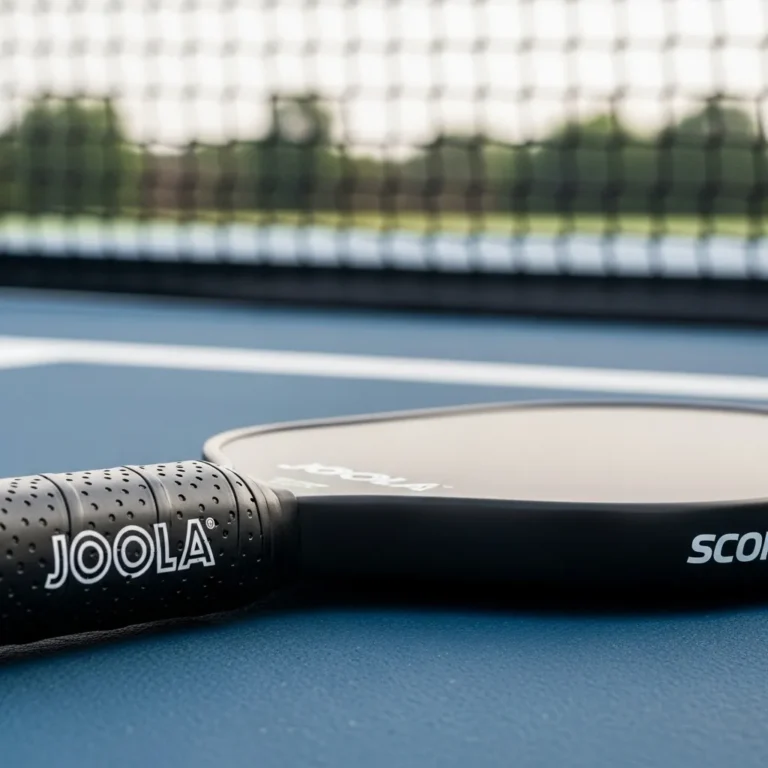
In the current paddle market, 16mm is the “safe” choice. The thicker core offers more plushness, a larger sweet spot, and generally better control for resets and dinks. So, why does Anna stick with the 14mm version of her signature JOOLA Scorpeus?
It comes down to hand speed and “pop.” Anna’s game is predicated on fast hands at the kitchen line. When a ball is sped up at her, she doesn’t just want to block it; she wants to counter-punch it with interest. A 14mm core provides more energy return. It’s crisper.
If you look at reviews for the JOOLA Anna Bright Scorpeus 14mm paddle, you’ll see a common theme: it’s fast. The thinner core makes the paddle more aerodynamic, allowing Anna to maneuver it incredibly quickly during firefights. She trusts her soft hands enough to manage the resets without the crutch of a thicker core, opting instead for the weapon that ends points faster. It’s a confident choice—she’s betting that her hands are faster than yours.
What specific modifications did JOOLA make for the “Scorpeus” specifically for Anna’s two-handed backhand?
The anna bright pickleball paddle isn’t just a stock shape with her name on it. The Scorpeus was engineered to fit her tennis background. The most significant modification is the handle length and the shape of the throat.
Anna hits a punishing two-handed backhand roll and drive. To do this effectively, you need room for your non-dominant hand on the grip. Many standard pickleball paddles have short handles (5 inches or less) that force a player to choke up or overlap fingers. The Scorpeus features a handle length that accommodates a full two-handed grip, similar to a tennis racquet.
Furthermore, the “Scorpeus” shape is wider than the elongated paddles used by players like Ben Johns. This massive sweet spot is crucial for her block volleys. When you are swinging hard with two hands, you need a forgiving face. The specific curvature near the handle also allows for a higher choke-up grip if necessary, giving her versatility that standard elongated paddles often lack.
Check out our guide to The Ultimate Joola Pickleball Paddle Buyer’s Guide 2025
How does Anna Bright’s “eye-guards” preference influence amateur trends?
Anna Bright is rarely seen on a court without her protective eyewear, usually a stylish pair of Oakleys. In a sport where eye injuries are rising but protective gear is still considered “uncool” by many, Anna has single-handedly made eye-guards fashionable.
This isn’t just a fashion statement; it’s a calculated decision based on her style of play. Because she plays a “Spikeball” style—fast hands, close to the net, lots of speed-ups—the ball is traveling at her face at upwards of 40-50 mph from 14 feet away. She knows the risks.
Her influence here is massive. Amateurs look at her and think, “If a pro with lightning-fast reflexes wears them, maybe I should too.” She has shifted the narrative from “glasses are for people who are scared” to “glasses are for people who play hard and smart.” It’s a subtle contribution to the sport’s safety culture that shouldn’t be overlooked.
Background & The “Tennis to Pickleball” Pipeline
How did the Pacific Crest Trail (PCT) hike physically prepare her for professional Pickleball?
Before she was a household name in pickleball, Anna Bright hiked the Pacific Crest Trail. For those unaware, this is a 2,650-mile trek from Mexico to Canada through the mountains of California, Oregon, and Washington.
This isn’t a weekend camping trip. It is months of grueling physical punishment, hunger, exposure to the elements, and mental isolation. When fans ask about anna bright pickleball ethnicity or background, this story often surfaces as the defining element of her character. While she is of Caucasian descent and hails from a supportive family, the grit she displays on the court was forged on that trail.
The PCT taught her endurance. A pickleball tournament day can last 12 hours, with matches spaced out erratically. You have to stay warm, stay focused, and fight through fatigue. Compared to walking 25 miles a day with a pack on your back while running out of water, a third-set tiebreaker is manageable. That tattoo on her leg isn’t just ink; it’s a reminder that she has endured harder things than a bad line call.
What specific skills from her UC Berkeley tennis days hindered her early pickleball game?
We often talk about how tennis helps pickleball players, but for Anna, her time at Cal (University of California, Berkeley) ingrained some habits she had to surgically remove.
The biggest hindrance? The big swing. In Division 1 tennis, you are taught to take a big backswing to generate power from the baseline. In pickleball, a big backswing at the kitchen line means you get hit in the chest with the ball. Anna had to shorten everything. She had to unlearn the muscle memory of the “load and explode” and replace it with “punch and recoil.”
Also, the footwork is different. In tennis, you slide and recover to the middle. In pickleball, you hold the line. Her early matches showed a tendency to retreat—a cardinal sin in pickleball. Watching her evolve from a “tennis player on a pickleball court” to a true pickleball pro was a lesson in humility and neuroplasticity.
Why did she choose the “Gold Card” PPA tour over remaining exclusively with MLP initially?
During the chaotic “Tour Wars” where the PPA (Professional Pickleball Association) and MLP (Major League Pickleball) were battling for talent, Anna made a decisive choice to go with the PPA “Gold Card” (touring pro) status early on, though she loved the team format.
Why? It came down to stability and volume. The PPA offered a guaranteed schedule and, frankly, the highest level of competition in the doubles brackets at that time. Anna is a volume player; she wants to play every weekend. The MLP format was sporadic.
She also recognized that her brand was built on winning medals on Sundays. While MLP is exciting, the PPA tour is where the individual narratives are written. By securing her spot there, she ensured she was playing against the Ann Leigh Waters and the Catherine Parenteaus of the world every single week, which accelerated her development faster than the team-based format alone could have.
Fan Culture & Trivia
If you are a superfan, you know Anna Bright is more than just a forehand drive. She has quirks and routines that make her unique.
What is the significance of the “Hannah Montana” playlist in her warm-up routine?
In a world of serious athletes listening to heavy metal or intense rap to get hyped, Anna Bright’s pre-match vibe is unapologetically Gen Z pop. The “Hannah Montana” playlist is real.
It speaks to her approach to pressure. For Anna, the court needs to be a place of joy. Listening to nostalgic Disney Channel bops helps her keep the mood light. It reminds her not to take the moment so seriously that she tightens up. When you see her bobbing her head before a gold medal match, she’s likely listening to “Best of Both Worlds.” It’s a mental hack to keep the adrenaline from turning into anxiety.
What is the story behind the “Bright Rocket” overhead smash?
Finally, we have to talk about the “Bright Rocket.” This is her signature overhead, and it’s distinct from a standard smash.
Most players plant their feet and snap their wrist. Anna, utilizing her athleticism, often leaves the ground completely, scissoring her legs in the air. It’s a dynamic, full-body motion that generates immense power. The “Rocket” nickname comes from the explosive elevation she gets—she isn’t just hitting the ball down; she is meeting it at its absolute apex. It’s a highlight-reel shot that demoralizes opponents because it signals, “I am more athletic than you, and I am going to finish this point right now.”
Anna Bright is a complex figure in a simple game. She’s a hiker, a tactician, a pop-culture enthusiast, and a fierce competitor. Whether she’s changing partners or changing the meta of the game with her 14mm paddle, she is undeniably one of the most exciting things to happen to pickleball. As we watch her career unfold, one thing is certain: she’s not just hiking the trail anymore; she’s blazing it.