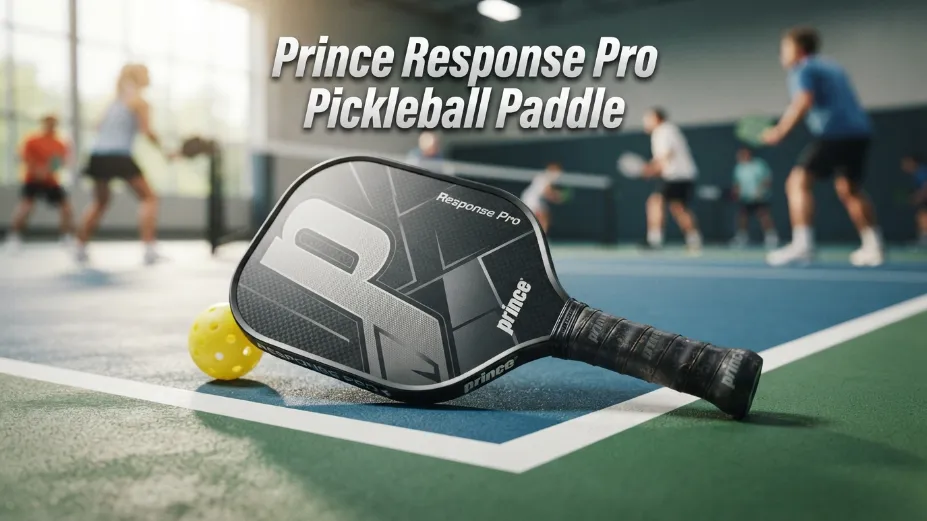
Most pickleball paddles force a compromise between pinpoint control and raw pop, but the prince response pro pickleball paddle earned its legendary status by ignoring that tradeoff entirely. Engineered with a distinct round-shape geometry and an oversized sweet spot, this paddle single-handedly reshaped expectations for playability on courts across the United States. Whether you are aiming to reset high-velocity drives from the dink pad or carve out sharp angle dinks at the kitchen, understanding how the prince response pro holds up against today’s generation of thermoformed paddles is the key to locking in your next competitive edge.
Pickleball Paddle Specifications
Core · Face · Weight · Grip · Sweet Spot · Ratio · Price
For US players seeking an unbeatable balance of touch, forgiveness, and arm safety, the flagship prince response pro paddle remains an outstanding investment, particularly at current clearance and certified used price points under $130. If your play style relies on resetting heavy drives, carving precise dinks, and wielding a two-handed backhand, this classic round shape delivers unmatched sweet spot consistency. However, players who prioritize aggressive topspin drives or explosive thermoformed pop may want to weigh this choice against modern raw carbon fiber models.
Prince Response Pro Pickleball Paddle Review: Technical Anatomy
The engineering core of the prince response pro pickleball paddle review centers upon its non-traditional round head profile. Developed through a high-profile manufacturing partnership between legendary tennis giant Prince and American paddle innovator Paddletek, this signature silhouette was designed specifically to eliminate dead zones near the perimeter corners.
- The Polypropylene Honeycomb Core: Measuring an unusually precise 9/16 of an inch (14.2875 mm), the internal Progressive Core uses high-density polymer cells. When receiving high-velocity drives, the honeycomb structure compresses uniformly, dispersing mechanical energy outward rather than transferring hard shock directly into the player’s wrist and elbow.
- The Textured UV Fiberglass Face: Unlike modern unibody carbon paddles, the outer surface features a thick, composite Fiberglass Layer protected by a UV-cured textured coating. This material selection provides a springboard effect upon impact, maximizing ball dwell time for soft touch maneuvers while maintaining structural resilience under direct sunlight across outdoor US venues.
- The Extended 5.5-Inch Handle Mechanics: Designed with tennis converts in mind, the 5.5-inch octagonal handle provides ample surface area for a full two-handed backhand grip. This longer shaft leverages rotational torque, allowing players to snap through low balls at the kitchen line without cramping their non-dominant hand.
The overall construction is wrapped with a low-profile 1/8-inch overlapping edge guard that protects the internal polymer matrix against ground scrapes during low defensive digs. For players analyzing control-focused gear options across the broader market, evaluating the structural nuances in our dedicated guide to the best pickleball paddle for control provides valuable performance context before committing to a specific shape.
Standard Weight vs. Lightweight: Deciding on Your Prince Response Pro Paddle
Navigating the product family requires a clear understanding of the mechanical differences between the two factory weight classes offered for the prince response pro paddle. Selecting your specific setup dictates both your reaction speed in fast kitchen exchanges and your kinetic plow-through against aggressive baseliners.
The Weight Variance and Swing Dynamics
The standard weight model ranges from 7.8 to 8.3 ounces, providing natural mass behind every swing. This extra structural weight stabilizes the paddle during off-center hits, allowing players to block heavy 50-mph drives with minimal wrist torque. Conversely, the lightweight model drops the scale to between 7.1 and 7.7 ounces. This lighter version favors quick hand battles at the net, enabling rapid re-positioning for soft pop-ups, though it yields slightly more feedback during heavy baseline rallies.
Vibration Control and Handle Dimensions
Both weight variants share the identical 9/16-inch polymer core, but the extra mass of the standard weight model enhances structural dampening. The vibration frequency generated at ball impact is absorbed more completely by the heavier frame, making it a favorite for players managing joint soreness. Additionally, players can choose between two grip circumferences: a 4 1/8-inch small grip wrapped in a flat, tacky surface for maximum hand feedback, and a 4 3/8-inch standard grip featuring a perforated cushion wrap that absorbs sweat during humid outdoor summer sessions.
If you are exploring how legacy composite designs stack up against unibody cold-pressed or hot-pressed manufacturing techniques, our comprehensive breakdown of thermoformed pickleball paddles breaks down the structural evolution of core stiffness and pop in modern court gear.
The Critical Customization Guide: Why Lead Tape Transforms the Prince Response Pro
A major missing angle across mainstream retail reviews is how dramatically the prince response pro responds to strategically applied perimeter weighting. Because the round head shape inherently features a wide 8.25-inch body, adding tungsten or lead tape turns this forgiving paddle into a high-powered weapon.
Out of the box, the lightweight edition can occasionally feel head-light for advanced players who demand aggressive drive depth from the baseline. By adding 0.1 to 0.2 ounces of lead tape at the 3 o’clock and 9 o’clock positions on the edge guard, you expand the perimeter mass. This modification increases the Twistweight rating, preventing the paddle face from twisting when a fast ball strikes the outer two inches of the surface.
For players seeking extra pop without compromising control, placing a strip of lead tape at the top apex (12 o’clock position) raises the center of percussion. This raises the overall Swingweight, imparting extra momentum on overhead smashes and deep third-shot drives while maintaining the soft, shock-absorbing characteristics of the progressive polymer core beneath.
Exposing the Information Gaps: Real-World Durability Under the Microscope
While promotional literature highlights the championship pedigree earned by US Open Triple Crown winner Simone Jardim using the prince response pro pickleball model, deep analysis across long-term playing groups reveals specific wear patterns that prospective buyers should monitor.
- Textured UV Surface Wear: The surface texture relies on a factory-applied UV spray coat over smooth fiberglass. While highly effective during the first several months of play, this tactile layer gradually wears down from continuous ball friction, reducing spin generation over 6 to 12 months of heavy play.
- Edge Guard Seam Separation: Because the protective bumper overlap measures a slender 1/8 of an inch to maximize playable surface area, hard ground impacts against court surfaces can break the adhesive seam over time. Applying a strip of electrical tape over the top edge guard provides cheap, effective preventive protection.
- Polymer Core Softening: Over 18+ months of daily match play, the progressive polypropylene honeycomb cells directly behind the main sweet spot experience subtle mechanical flexing. This creates a softer pocketing feel that enhances touch for dinking, but subtly diminishes punch volume on fast put-away volleys.
Understanding these long-term physical characteristics ensures players maintain realistic expectations regarding gear lifespans, balancing immediate comfort against long-term cosmetic wear.
Head-to-Head: Prince Response Pro vs. Prince Spectrum Pro & Modern Carbon Fiber
For players trying to decide whether to purchase the prince response pro pickleball paddle or consider sister models and modern carbon fiber alternatives, the choice comes down to handle length requirements and surface friction technology.
The table and detailed comparisons below highlight how key structural characteristics compare against competing designs:
- Prince Response Pro vs. Prince Spectrum Pro: Both paddles feature the identical 8.25-inch wide round head, 9/16-inch polymer core, and fiberglass surface. The single defining difference lies in handle geometry: the Response Pro incorporates a long 5.5-inch handle (reducing face length slightly), whereas the Spectrum Pro utilizes a shorter 5.0-inch handle, extending the vertical face dimensions for single-handed players.
- Sweet Spot & Off-Center Forgiveness: The round head shape of the Response Pro comfortably outperforms traditional narrow carbon paddles (7.5 to 7.75 inches wide) in off-center forgiveness. Mis-hits that would dead-ended near the corners of rectangular frames bounce cleanly off the perimeter of the Response Pro.
- Spin Capability vs. Raw Carbon Fiber: Modern Gen 2 raw carbon fiber paddles (such as T700 carbon models) generate significantly higher ball rotation (RPM) due to raw grit friction. While the Response Pro provides ample spin for intermediate control, dedicated spin players will notice the raw grip difference on aggressive roll dinks.
To see how this legendary round paddle stacks up against the newest industry releases across all weight and shape classes, take a moment to explore our definitive list of top pickleball paddles currently dominating courts across North America.
Buying Advice in the US: Prices, Retailers, and Clearance Deals
Tracking down this model across the United States involves navigating clearance options and secondary equipment markets. Originally launching with a retail MSRP between $128.99 and $149.99, current market shifts make it one of the most cost-effective performance paddles available.
Major online retailers like Pickleball Central, Tennis Express, and specialized regional pro shops regularly feature brand-new clearance stock priced between $99.99 and $129.95. Furthermore, certified used-return outlets offer inspected units starting as low as $64.99, making elite-level core technology accessible to budget-conscious players.
When purchasing, ensure the unit displays the official USA Pickleball Approved seal printed on the lower face near the throat. This stamp guarantees tournament eligibility across all sanctioned USAPA events and local club leagues nationwide.
Verdict: Is the Prince Response Pro Worth Your Money?
The final decision on investing in this iconic silhouette depends on your individual mechanics, arm health priorities, and court strategy.
- Who Should Buy: Intermediate control players, former tennis players utilizing two-handed backhands, players recovering from tennis elbow seeking high shock absorption, and anyone who wants a massive sweet spot under $130.
- Who Should Avoid: Power-hungry singles players who rely on explosive thermoformed pop, and advanced players who demand extreme surface grit for high-RPM topspin drives.
Frequently Asked Questions (FAQ)
Is the Prince Response Pro paddle manufactured in the United States?
Yes. The paddle is designed and manufactured in the USA through a strategic partnership with Paddletek, ensuring high standards for structural quality control and material integrity.
Is this paddle legal for sanctioned USA Pickleball tournaments?
Yes. The model is fully tested and approved by USA Pickleball (formerly USAPA) for all sanctioned club leagues, regional qualifiers, and national tournament events across the United States.
How does the 5.5-inch handle benefit tennis converts?
The 5.5-inch extended length matches the handle feel of traditional tennis racquets, providing comfortable spacing for a two-handed backhand grip without crowding hand placement during fast kitchen exchanges.