Choosing a pickleball paddle used to be simple, but JOOLA’s engineering matrix has turned it into a game of millimeters. Buying the wrong thickness doesn’t just cost you eighty bucks; it actively kills your third-shot drop or leaves your resets dead in the kitchen. If you are staring at the joola seneca pickleball paddle lineup trying to decipher whether carbon grit or fiberglass flex fits your baseline game, you are not alone. The truth is, the 14mm and 16mm versions are built for two entirely different players. Let’s break down the lab specs and court performance so you don’t end up with a paddle that fights your natural swing.
JOOLA Seneca CDS 16 vs FDS 14
Side-by-Side Technical Parameter Comparison
Comprehensive Joola Seneca review: Technical Anatomy
The engineering core of the joola seneca review centers upon its non-thermoformed, traditional multi-piece setup. While flagship tournament paddles rely on raw friction sheets and injected edge foam, this lineup bridges basic recreational ease of use with the rigorous dampening needs of developing club players.
- The Core Matrix: Utilizing a standard Response Honeycomb Polymer layout, the primary structural body offers a highly predictable bounce. When striking the ball directly in the center, the cells compress evenly to absorb shock and provide a soft, plush sensation through the palm.
- Surface Technology: The series splits its face materials cleanly to accommodate opposing play styles. The Carbon Drive Surface focuses on mechanical energy absorption, while the Fiberglass Drive Surface optimizes flex and snapback behavior for deep court depth.
- Grip Engineering: Both models incorporate the premium Feel-Tec Pure grip wrap, which minimizes moisture buildup and dampens vibrational feedback up the handle during off-center contact. This traditional handle geometry is tailored for a standard, comfortable hand placement.
The overall paddle face geometry maintains a classic 16-inch by 7.9-inch wide-body profile, offering a generous hitting area. For players trying to understand how this family positions itself against competitive brands in the broader market space, evaluating our analytical look at the joola pickleball paddle catalog provides clear context before making a purchasing decision.
CDS vs. FDS: Deciding on your Joola Seneca 16mm pickleball paddle Options
Navigating this specific product family requires an intricate understanding of the mechanical differences between the 16mm carbon layout and its thinner, more aggressive counterpart. Selecting your specific model of the joola seneca 16mm pickleball paddle family dictates your defensive reset capabilities, unforced error rates, and overall kinetic velocity.
The Cushioning and Thickness Variance
The 16mm option utilizes the specialized joola seneca cds pickleball paddle layout, which prioritizes a thick polymer honeycomb core to maximize physical dwell time. This extra thickness causes incoming pace to disperse widely through the honeycomb matrix, allowing defensive players to drop fast volleys smoothly into the non-volley zone. Conversely, the 14mm variant relies on the joola seneca fds 14 pickleball paddle structure, where a thinner core decreases the depth of indentation, producing a faster dynamic energy return that aids baseline drives.
Surface Flex and Launch Speed Discrepancies
The Carbon Drive Surface is inherently stiffer and smooth, designed to let the core do the dampening work during soft kitchen exchanges. The fiberglass face on the 14mm version acts as a flexible composite trampoline, returning high rebound speed with minimal physical arm effort. This fundamental split is a major focus in any comprehensive joola seneca fds 14 pickleball paddle review, highlighting why hard-hitting baseline sprinters gravitate toward the thinner model while control-oriented doubles players stick to the 16mm variant.
If you are a developing competitor looking to match your paddle mechanics with deeper structural knowledge of court geometry, exploring our technical breakdown of the definitive 14mm vs 16mm pickleball paddle comparison will ensure your gear alignment functions perfectly on court.
The Critical Control Guide: Overcoming Baseline and Net Pop-Up Challenges
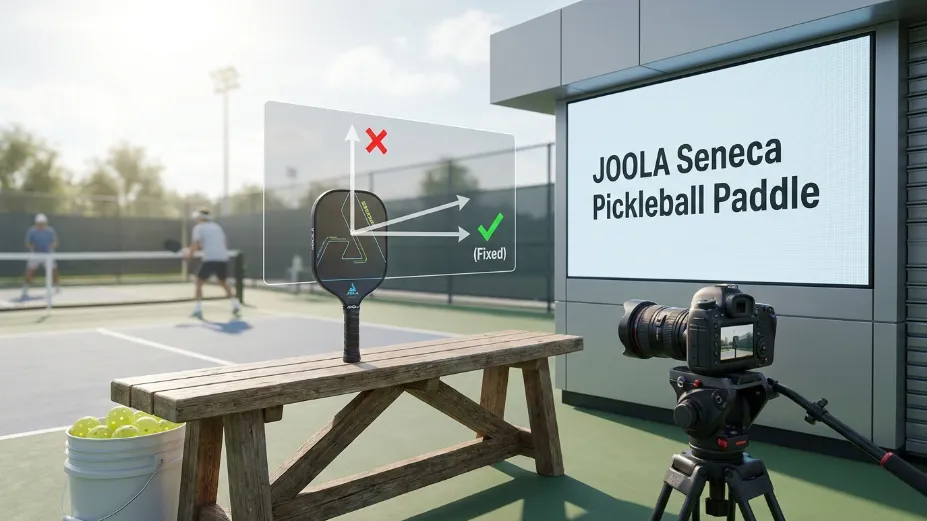
A major missing angle across mainstream e-commerce review spaces is how the Seneca series behaves during off-center impacts. When playing with the 16mm control variant, players frequently encounter an unexpected tendency to pop the ball high over the net or past the baseline, which seems to contradict its dampening label.
This physical anomaly is governed by the coefficient of restitution (e), which determines the ball’s rebound velocity based on the incoming energy and your paddle stroke. Because this line features a traditional, non-thermoformed core without carbon perimeter walls, its sweet spot is highly concentrated in the absolute center of the face. When a player strikes the ball cleanly in this central zone, the dynamic energy return is exceptionally efficient.
Beginners transitioning from low-grade starter paddles often swing too hard out of habit. When they hit the Seneca’s efficient central sweet spot with that excessive force, the ball jumps off the face with unexpected speed. Conversely, off-center contact causes uneven honeycomb deformation, dropping the coefficient of restitution significantly and leaving shots short or dead in the net.
To stabilize your shots and eliminate high pop-ups, you must adjust your technical mechanics. Instructors recommend adopting a loose, consistent grip style to absorb raw pace naturally. Keeping your paddle face neutral or slightly closed at the point of contact reduces the upward launch angle. Furthermore, players must lock their wrist joints and use a smooth, compact swing path powered by the shoulders and lower body legs rather than erratic hand flicking. For a deeper look at maximizing hand control, consult our guide on mastering the continental grip pickleball technique.
Exposing the Information Gaps: Real-World Spin Generation Under the Microscope
While official marketing specifications assign an impressive “90” spin rating to both models, independent play testing across US club groups reveals a massive discrepancy regarding surface texture and actual rotational ball RPM.
- The Smooth Face Friction Deficit: Modern high-tier paddles utilize an abrasive raw carbon fiber or peel-ply overlay that uses mechanical friction to grip the plastic ball shell. The Seneca series features an almost completely smooth-to-the-touch finish, lacking the micro-grit required to bite into the ball upon impact.
- Rotational Slippage and Skidding: Due to this lack of physical texture, the ball tends to slide or skid upward across the paddle face during brushed strokes. This rotational slippage prevents forward kinetic energy from converting efficiently into heavy topspin or sharp backspin.
- Limitations for Advancing Intermediates: While beginners can easily execute flat, basic groundstrokes, intermediate players who rely on aggressive dipping spin to keep hard drives inside the baseline will find their tactical options limited. To generate passable spin, you must dramatically accelerate your upward swing path, which introduces extra unforced error risks.
Understanding these surface limitations is vital for proper gear pairing. If your tactical focus relies on cutting-edge face textures to dictate ball rotation, reviewing our comprehensive evaluation of specialized premium fiberglass pickleball paddles and high-friction carbon fiber pickleball paddle options will guide you toward a better mechanical match.
Structural Integrity Gaps: Real-World Durability Analysis
Deep engineering analysis reveals that the multi-piece manufacturing approach of the Seneca line presents specific structural vulnerabilities under continuous, heavy use by hard-hitting intermediate players.
Unlike modern unibody paddles where the face and handle are thermoformed from a single continuous carbon sheet, the Seneca series joins the handle to the face at the throat using standard industrial adhesives. This joint acts as a primary point of stress concentration. Over months of rapid volley exchanges, the repeated dynamic load from ball impacts can trigger micro-fractures within the inner throat area, occasionally causing the handle to break or snap entirely under heavy load.
Another common durability concern involves edge guard delamination. The Edge-Shield plastic rim is glued along the perimeter to protect the exposed polymer core from ground scrapes. However, thermal changes from storing gear in warm trunks, combined with light court contact during low kitchen dinks, can break down the adhesive bond. Once this guard separates at the corners, moisture and court debris easily penetrate the inner honeycomb matrix, breaking down the core walls and creating permanent dead spots that diminish the paddle’s operational lifespan.
Navigating the JOOLA Warranty Framework and the NFC Chip Discrepancy
There is widespread confusion across online player forums regarding warranty registration and coverage lengths for mid-tier JOOLA gear, specifically regarding the utilization of mobile app verification.
JOOLA employs a tiered warranty framework across its equipment divisions. The standard limited warranty provides 6 months of coverage from the original date of purchase, protecting against clear manufacturing defects such as core delamination, structural throat failures, or faulty edge assemblies. For its flagship tournament lines, JOOLA embeds an electronic NFC chip within the handle grip, allowing players to scan their paddle via the Infinity mobile app within 14 days of purchase to unlock a 12-month extension.
Because the Seneca line is strictly engineered as a mid-tier recreational offering, it completely lacks an embedded NFC chip. Consequently, it is entirely ineligible for the 12-month app extension and remains locked into the standard 6-month consumer window. This policy is non-transferable, requires valid proof of purchase from an authorized dealer, and restricts consumers to a maximum of two warranty replacement units within the active coverage timeline.
Head-to-Head: JOOLA Seneca CDS 16 vs. Vatic Pro Prism Flash
For US players trying to choose between the traditional JOOLA Seneca and modern value-tier alternatives, the comparison comes down to a fundamental split between legacy branding and modern unibody thermoforming technology at similar price points.
The primary performance and structural differences are outlined in the comparison matrix below:
- Surface Texture and Spin: The Vatic Pro Prism Flash features an abrasive, raw Toray T700 carbon fiber face with a textured finish that grips the ball cleanly. The Seneca CDS 16 features a smooth face that results in significant ball skidding, giving the Prism Flash a massive advantage in total rotational ball RPM.
- Structural Layout and Durability: The Prism Flash utilizes a continuous unibody carbon fiber frame with foam-injected edge walls, expanding the sweet spot to the perimeter and eliminating throat breakage. The Seneca relies on a multi-piece glued assembly, making it more prone to handle failure under continuous hard use.
- Sweet Spot and Feel: The Seneca CDS 16 excels in delivering a soft, classic non-thermoformed feel that intermediate touch players appreciate for simple dinking. The Prism Flash provides a crisper, more modern response with a more forgiving sweet spot across the outer edges of the face.
For a complete overview of the competitive marketplace under the hundred-dollar threshold, take a moment to explore our curated guide to the best pickleball paddles under 100 alongside our independent evaluation of the vatic pro pickleball paddle to find your ideal fit.
Buying Advice: Sourcing Clearance Value Across US Channels
Tracking down this specific lineup across the United States involves navigating a mix of big-box sporting goods chains and direct manufacturer clearance outlets. At its original retail launch price of $89.95 to $99.95, the series faced intense competition from highly advanced raw carbon fiber entries.
However, as manufacturers shift focus to newer product lines, budget-conscious consumers can source final sale clearance opportunities on the Official JOOLA Website, where prices have dropped as low as $44.98. At this lower price point, the Seneca becomes an incredibly affordable entry into a major brand name for recreational weekend players who want a lightweight, comfortable feel without a massive financial investment.
Be aware that inventory levels on authorized clearance platforms fluctuate rapidly, and final sale items are typically ineligible for standard commercial returns. Ensure you verify the seller’s status to preserve your 6-month manufacturing warranty coverage before completing your purchase.
Verdict: Is the JOOLA Seneca Worth Your Money?
The final evaluation of this traditional paddle series depends entirely on your personal development goals, physical swing style, and budget approach to court gear.
- Who Should Buy: Recreational club players who prioritize a soft, comfortable feel, individuals who prefer a lightweight wide-body shape for casual doubles play, and value hunters sourcing the paddle on deep final sale clearance.
- Who Should Avoid: Advancing intermediate players who rely heavily on topspin or underspin to control hard drives, hard-hitting competitors prone to snapping multi-piece handles, and anyone expecting a 12-month warranty via app registration.
JOOLA Seneca Pickleball Paddle – FAQ
Are these court paddles constructed entirely within the US?
No. While all conceptual industrial design work, play testing, and player prototyping are managed at JOOLA’s corporate headquarters in the United States, production components and final core assemblies are handled by primary manufacturing partners in Asia, matching standard practices across the sports equipment industry.
Can I safely utilize a liquid grip cleaner or abrasive eraser on the face?
It is highly discouraged. Because the Carbon Drive Surface and Fiberglass Drive Surface lack an integrated, raw textured weave, utilizing abrasive cleaning erasers or harsh chemical liquids will degrade the smooth composite finish, permanently altering the ball launch characteristics without adding any extra spin.
How does the overall multi-piece throat joint impact handle flex compared to unibody variants?
The glued joint configuration introduces a minor amount of natural flex at the throat area during high-velocity impacts. While this flex can add a slight whip effect to baseline drives, it limits raw torsional stability during off-center blocks at the kitchen line compared to stiff, continuous carbon unibody designs.