pickleball drills
We all know the feeling. You walk onto the court, paddle in hand, hearing that distinct pop-pop-pop echoing in the distance. It’s addictive, isn’t it? When I first started playing, I just wanted to play games. The idea of standing there and hitting the same shot over and over seemed, well, a little boring compared to the adrenaline of a close match.
But then, I hit a wall. I was stuck at a certain level, losing to players who didn’t seem faster or stronger than me, but who were just… more consistent. That’s when the realization hit: the magic doesn’t happen during the game; it happens during the practice.
If you are looking to transform your game from “recreational fun” to “court wizard,” you have to fall in love with pickleball drills. Whether you are looking for beginner pickleball drills to get your feet wet or advanced strategies to dominate the kitchen line, the secret sauce is repetition.
In this guide, we’re going to walk through everything you need to know. We will look at how to practice alone, how to maximize time with a partner, and how to fix those nagging errors that keep popping up. We will also address the mechanics of practice—specifically, how are pickleballs drilled repeatedly to build muscle memory without burning you out.
Let’s grab a basket of balls and get to work.
Getting Started: General Practice & Routines
Before we start sweating, we need a plan. It’s easy to waste an hour “hitting around” without actually accomplishing anything. To really see pickleball drills for beginners and intermediates pay off, you need intentionality.
How often should I practice drills versus playing actual games?
This is the golden question. We all want to play, but if you play 100% of the time, you will likely reinforce bad habits.
If you are serious about improving, aim for a 50/50 split. I know, it sounds like a lot. But think of it this way: in a typical rec game, you might hit a specific shot—let’s say, a backhand dink down the line—maybe three times in 15 minutes. If you drill that same shot for 15 minutes, you might hit it 200 times. That is months of “game experience” compressed into a quarter of an hour.
If 50/50 feels like too much work and not enough play, try the 70/30 rule. Spend 30% of your court time drilling before you start keeping score. Your game (and your partner) will thank you.
What is a good 30-minute practice routine for players short on time?
We are all busy, and sometimes you only have a sliver of time before work or before the lights go out. You don’t need two hours to get better; you just need a focused half-hour. Here is a routine that covers the essentials:
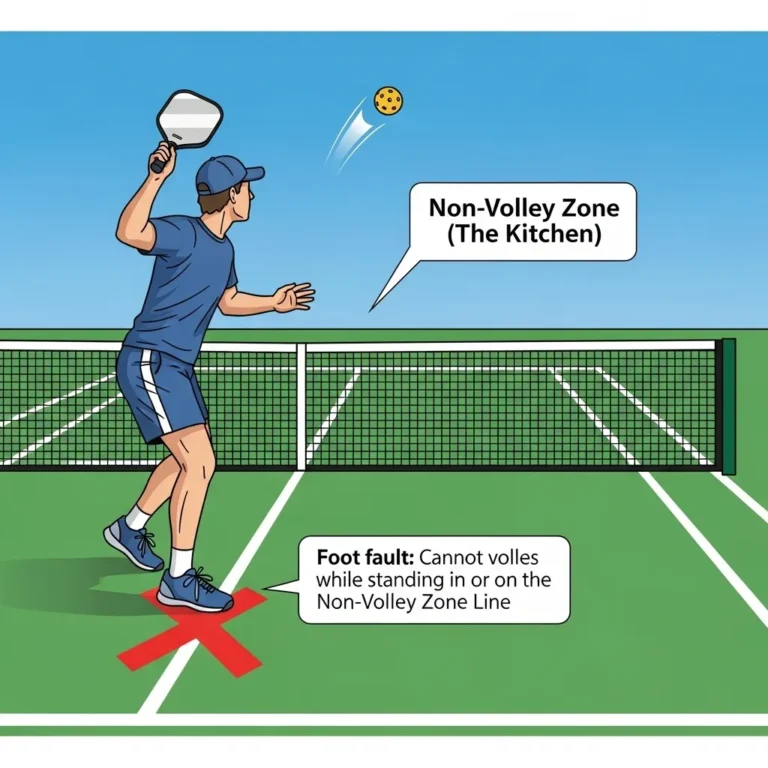
- Dinking (5 Minutes): Start at the kitchen line. Go straight across for 2.5 minutes, then cross-court for 2.5 minutes. Focus on footwork, not winning the point.
- Volleys/Fast Hands (5 Minutes): Both players stay at the line. Volley back and forth, keeping the ball in the air but controlled. This wakes up your reflexes.
- The Drop (10 Minutes): One player stays at the net (feeding), the other goes to the baseline. The baseline player works on hitting third shot drops into the kitchen. Switch roles after 5 minutes.
- Serves and Returns (10 Minutes): Never skip this! Spend the last chunk hitting deep serves and deep returns.
This routine is tight, efficient, and hits every major stroke.
Do I need a ball machine to drill effectively?
I often get asked if spending a thousand dollars on a machine is necessary. The honest answer? No. It’s a luxury, not a requirement.
While a ball machine is fantastic for grooving strokes when you have zero friends available, it lacks the chaotic reality of a human opponent. A human partner is always better because you can see their paddle angle and body language.
However, if you don’t have a partner, a wall is your best friend. In fact, some of the best players in the world swear that wall drills are superior to machines because the wall returns the ball at the speed you hit it—forcing you to react faster.
What are the most essential skills to drill for a beginner?
When looking at pickleball drills for beginners, it is easy to get distracted by fancy spin shots or ATPs (Around the Post). Ignore those for now. If you want to win, you need to master three things:
- The Deep Serve: If you can’t get the point started, you can’t win.
- The Deep Return: This keeps your opponents back and buys you time to get to the kitchen.
- Basic Dinking: You need to be comfortable sustaining a rally at the net without panicking.
Focus 80% of your energy here, and you will skyrocket past other beginners.
Solo Practice (No Partner Needed)
Sometimes, everyone is busy, or you just want some “me time” to work on your strokes without the pressure of an audience. Solo practice is where technique is solidified.
How can I practice pickleball alone without a court?
You don’t need a net to get better. You need a flat surface and a ball.
Find a brick wall, a garage door, or even a smooth concrete basement wall. Tape a line 34 inches from the ground (net height) and another line 7 feet back from the wall (the kitchen line).
Now, just hit. Practice dinking against the wall, trying to keep the ball above the “net” tape but low enough that it doesn’t bounce high. It’s hypnotic. You can also practice your volleying. The wall never misses, and it never gets tired. It is the ultimate training partner for consistency.
What are the best wall drills to improve hand speed and reaction time?
If you feel like you are getting beat in fast hands battles at the net, the wall is the cure.
Stand about 4 to 5 feet away from the wall. Start volleying the ball against the wall without letting it bounce. As you get comfortable, step one foot closer. The closer you get, the faster the ball comes back.
Try to hit 50 forehand volleys in a row, then 50 backhand volleys. Then, alternate: Forehand, Backhand, Forehand, Backhand. This creates “soft hands” and drastically improves your reaction time because the rebound off a wall is usually faster than a hit from an opponent.
How do I practice my serve consistency by myself?
Serving is the only shot in pickleball you have 100% control over. To drill this, you need a basket of balls and some targets.
Go to the court alone. Set up targets on the other side—use cones, water bottles, or towels. Place them deep in the corners of the service box.
Your goal is to hit those targets. Don’t just hit the ball over the net; aim for the back 2 feet of the court. When considering how are pickleballs drilled for serving, it’s about repetition with a visual goal. Hit 50 serves. If you miss the box, it doesn’t count. If you hit the net, subtract one. Make it a game against yourself.
Partner Drills & Games
This is where the fun begins. When you have a drilling partner, you can simulate real game scenarios without the pressure of keeping score (well, mostly).
What is the “7-11” drill and why is it so popular?
If you walk past a court where two people are practicing seriously, they are probably playing “7-11.” It is the gold standard for practicing the transition game.
Here is how it works:
- Player A stands at the net (Kitchen line).
- Player B stands at the baseline.
- Player B feeds the ball to start. The point is live.
- The Goal: Player A (net) wants to win the point. Player B (baseline) wants to win the point or successfully work their way up to the kitchen line.
- Scoring: Because the net player has the advantage, they have to score 11 points to win the game. The baseline player only needs to score 7 points.
This forces the baseline player to hit drops and resets, and it forces the net player to practice putting balls away.
Are there any effective drills for odd numbers of players (e.g., 3 people)?
We have all been there—someone didn’t show up, and now you have three people staring at each other. Don’t just sit one person out!
Try the “2 vs. 1” Drill. Put the strongest player alone on one side, and the two others on the opposite side.
- The single player has to cover the whole court, which is a massive workout and improves court coverage.
- The two players focus on moving the single player around, working on angles and placement.
Rotate the single player every 10 minutes. It’s exhausting, but incredible for conditioning.
What are “Skinny Singles” and how does it help my doubles game?
Skinny Singles is played using only half the court (either down the line or cross-court).
Why does this help doubles? Because in doubles, you are responsible for half the court! Playing Skinny Singles forces you to hit accurate passing shots and engage in cross-court dinking battles without the risk of “poaching.”
If you play Cross-Court Skinny Singles (e.g., Even side to Even side), you are essentially drilling the exact shots you hit 80% of the time in a doubles match.
How can we practice “dinking” without it becoming boring?
Let’s be honest, dinking for 20 minutes can feel like watching paint dry if you don’t spice it up.
Gamify it. Play a game called “Dink or Die.”
- You and your partner start dinking.
- If anyone hits the ball into the net or out of bounds, they lose a point.
- If anyone pops the ball up high enough that the opponent can smash it (attack it), they lose a point.
- Play to 10.
This adds pressure. Suddenly, that lazy dink matters because you don’t want to lose the game. It mimics the tension of a real match.
Skill-Specific Troubleshooting
Every player has “leaks” in their game—specific errors that happen over and over. Let’s plug them.
What drills fix “popping the ball up” too high?
The “pop-up” usually happens because of two things: gripping the paddle too tight (panic) or hitting the ball when it’s behind your body.
The Fix: The “Catch” Drill.
Have your partner stand at the kitchen line and toss balls to you. Instead of hitting them back, practice catching the ball on your paddle face. You have to absorb the energy.
Once you get that feeling, transition to hitting. Focus on loosening your grip. Imagine you are holding a baby bird—tight enough so it doesn’t fly away, but loose enough so you don’t crush it.
How do I improve my Third Shot Drop consistency?
This is the hardest shot in pickleball, so don’t get discouraged.
Use a Progression Drill.
- Start just a few feet behind the kitchen line. Have your partner feed you balls. Drop them gently into the kitchen.
- Take two big steps back. Repeat.
- Take two more steps back (Mid-court). Repeat.
- Finally, move to the baseline.
By starting close, you get the “feel” of the arc before moving back to the difficult distance.
What exercises help with resetting the ball in the “transition zone”?
The “Transition Zone” (or No Man’s Land) is where points die. You are caught in the middle, and the opponents are smashing at your feet.
Drill this by standing in the middle of the court. Have your partner stand at the net and hit balls at your feet. Your goal is simply to block the ball softly into the kitchen. Do not swing! Just block. Think of your paddle as a shield. This builds the confidence to stand your ground when the ball is flying at you.
How can I drill to stop backing up when I should be moving forward?
We have a natural instinct to back away from fast objects. In pickleball, that kills you.
Place a cone or a towel about 2 feet behind your heels when you are at the kitchen line. If you step back, you’ll feel it (or trip—so be careful!). This gives you immediate feedback.
Alternatively, play a game where if you step back off the kitchen line while dinking, you automatically lose the point. It forces you to take the ball out of the air (volley) rather than retreating to let it bounce.
Advanced Strategy & Movement
For those looking to break through the 4.0 barrier, it’s not just about hitting the ball; it’s about moving as a unit.
How do I practice “stacking” and switching with a partner?
Stacking (where players line up on the same side to manipulate who takes the forehand) is confusing at first.
Do a “Shadow Drill” without a ball.
- Stand in the stacking position.
- Pretend to serve.
- Immediately slide over to your correct position.
- Pretend to return.
- Move to the net.
Do this dance over and over until your feet know where to go without thinking. Then, introduce the ball. It’s like choreography; you have to learn the steps before you perform the dance.
What drills improve communication to avoid clashing paddles in the middle?
The dreaded middle ball! Who takes it?
Play the “Call It” Game.
Rally with your partner against another team (or wall). Every single time the ball comes to your side, one of you must shout “MINE” or “YOURS.” Even if it’s an obvious shot.
If you hit the ball without saying a word, you lose the point. This trains your brain to vocalize instantly, clearing up the confusion on those 50/50 balls down the middle.
Conclusion: Trust the Process
Improving at pickleball isn’t a straight line. You will have days where your drills feel perfect, and days where you can’t hit the broad side of a barn. That is completely normal.
The key is consistency. By incorporating these pickleball drills into your routine—whether you are grinding through beginner pickleball drills or perfecting your advanced stacking motion—you are building a foundation that won’t crack under pressure.
Remember, the players winning the gold medals aren’t just the ones playing the most games; they are the ones who spent those quiet 30 minutes at the wall, or the ones who played “7-11” until their legs burned. So, next time you head to the courts, take a friend, grab a basket, and drill. Your game will never be the same.