Lobster Pickleball Machine Review: Beyond the Specs and Real User FAQs
The exponential growth of pickleball has created a unique problem that every avid player eventually faces. You have the drive to improve, the new paddle you want to test, and the court time booked, but you lack the one thing required for a high-repetition workout: a consistent partner. While the community is friendly, sometimes you need to hit 500 backhand dinks in a row without boring a human opponent to tears. This is where the drilling machine becomes essential.
Lobster Sports is a titan in the tennis world, known for their iconic red machines that have populated country clubs for decades. Naturally, their transition into the pickleball market was met with high expectations. However, for a player considering dropping a significant amount of money on a Lobster pickleball machine, the standard product descriptions are often insufficient. You likely have deep, technical questions about battery chemistry, trunk capacity, and oscillation mechanics that generic sales pages do not cover.
This guide serves as a comprehensive lobster pickleball machine review, moving beyond the brochure to answer the specific, real-world questions asked by players in forums and on the courts. Whether you are looking to refine your soft game or handle heavy topspin drives, understanding the nuances of these machines is critical to your investment. If you are looking for specific regimens to run with these machines, you can explore various pickleball drills that focus on repetition and muscle memory.
Choosing the Right Model: The Pickle vs. The Pickle Two vs. Champion
Navigating the Lobster product line can be confusing because the machines look nearly identical from the outside. The primary differences lie in the internal logic board and the oscillation motors.
The most common question buyers face is determining the practical difference between The Pickle and the lobster 2 pickleball machine (often called The Pickle Two). The base model, The Pickle, offers random horizontal oscillation. This means it throws balls to the forehand, then the backhand, and then the center in a random left-to-right pattern. The Pickle Two introduces 2-Line Oscillation. This is distinct from random oscillation because it alternates shots to two specific spots on the court, which is superior for structured fitness drills or practicing footwork transition. While both machines offer similar topspin and backspin capabilities, The Pickle Two gives you that structured left-right drilling capability that coaches often prefer.
Moving up the ladder, players often ask if The Pickle Champion justifies the price jump. The Champion is the only unit in this specific lineup that offers fully random oscillation, mixing both horizontal and vertical variations simultaneously. This means one ball might be a short dink to the left, and the next might be a deep lob to the right. For intermediate to advanced players trying to simulate match play rather than just groove a stroke, the Champion is the only model that truly mimics a chaotic point.
A frequent technical question concerns cross-compatibility: Is the Lobster Elite tennis machine compatible with pickleballs? Physically, a pickleball will fit through the throwing wheels of a Lobster tennis machine. However, using a tennis model for pickleball is rarely a good experience. The hopper on the tennis version is designed for the smaller diameter of a tennis ball, leading to frequent bridging where pickleballs get stuck in the throat of the machine. Furthermore, the speed calibration and spin mechanics on the tennis version are tuned for a much heavier, fuzzy ball. For a reliable experience, you strictly need the pickleball-specific version to avoid constant jamming and inconsistent feeds.
Finally, buyers often hope to save money by buying a base model and upgrading it later. Can the basic Lobster model be upgraded with software? Generally, no. The difference between the models involves internal control boards and sometimes additional oscillation motors that are hardwired. Unlike the Erne pickleball machine, which is often praised for modern tech integration, the Lobster series relies on established, proprietary hardware configurations that are not designed for user-side firmware upgrades to unlock new features.
Portability & Design: Is it Actually User-Friendly?
The Lobster design is polarizing. It uses an inverted hopper system where the red case turns over to become the ball basket.
Transport and Trunk Space
One of the most practical logistical questions involves transport: How does the inverted hopper design actually affect transporting the machine in a standard sedan trunk? The machine collapses into a relatively compact, albeit boxy, cube. In a standard sedan, the machine fits, but the height is often the limiting factor. You usually have to lay it on its side or wiggle it through the trunk opening. Unlike soft-sided machines or the Slinger Bag, the Lobster is a rigid plastic shell. It protects the internals incredibly well, but it has zero give when you are trying to jam it into a packed car.
Wheels and Terrain
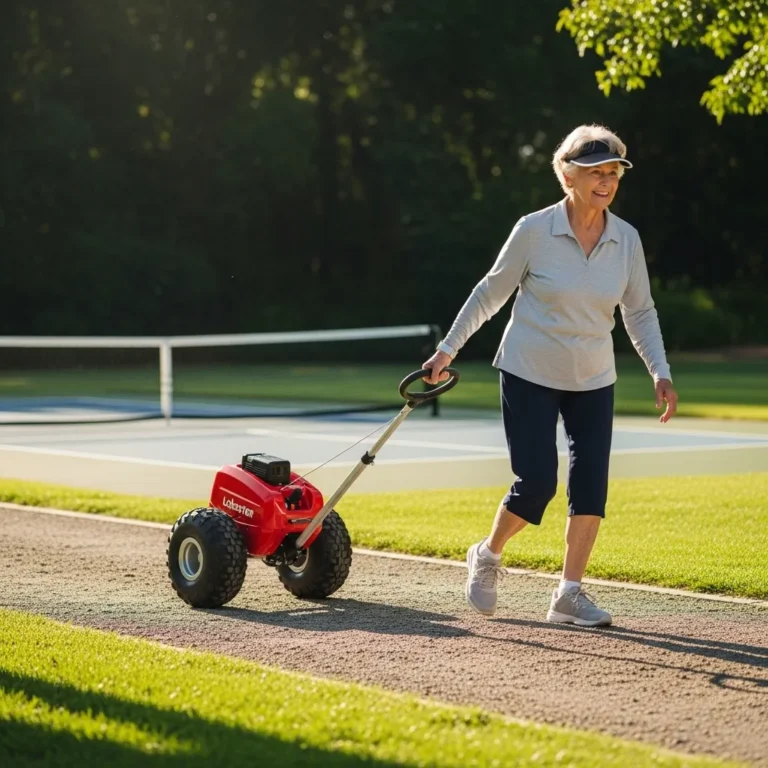
Once you are out of the car, the terrain matters. Are the large oversized wheels effective on gravel or grass paths? This is where the Lobster shines. The 8-inch wheels are significantly better than the rollerblade-style casters found on many competitors. If your local courts require you to walk over a park lawn, a gravel parking lot, or a bumpy path to get to the gate, the Lobster behaves like a hand truck. It rolls over obstacles that would cause other machines to tip over.
The folding handle is another point of scrutiny. Is it sturdy enough for long-term use? The metal handle is robust, but the locking pins can develop play over time. It is vital to ensure the pins are fully engaged before tilting the machine back. If you are gentle, it lasts forever; if you yank it around while fully loaded with 135 balls, you might bend the telescoping tubes.
Then there is the weight. How difficult is it to lift the 35 to 42 lb machine for a senior player? The weight itself is manageable for many, but the lack of ergonomic lift points can be tricky. Because the machine is a smooth plastic box when folded, getting a good grip to hoist it over a high trunk lip can be a strain for seniors or those with back issues. It is often recommended to lift with a partner or use a ramp if you have an SUV.
Power & Battery: The Critical Deep Dive
Battery life is the single most discussed topic in lobster pickleball machine reviews. The standard machine comes with a heavy lead-acid battery, technology that is reliable but dated.
Real-World Longevity
What is the real-world battery life? Lobster advertises up to 4 hours. However, if you are running the machine at high speed, with heavy topspin, and having the oscillation motor running constantly, you should realistically expect 2 to 2.5 hours of solid performance. As the lead-acid battery drains, you may notice a slight dip in ball speed towards the very end of the session.
This leads to the debate over the external battery pack. Is it worth the extra cost? For many users, absolutely. If you live in an apartment or park your car on the street, hauling a dirty, 40-pound machine into your living room just to charge it is a hassle. The external battery pack allows you to leave the machine in the trunk and just bring the small battery bag inside to charge.
Lithium Upgrades and Charging
Tech-savvy users frequently ask: Can I replace the stock lead-acid battery with a Lithium Iron Phosphate (LiFePO4) battery? While discussions about aftermarket lithium upgrades are common in online forums, Lobster Sports generally advises against modifying the internal power system. Altering the battery chemistry typically voids the warranty and carries potential safety risks regarding charging compatibility. For safety and longevity, we recommend sticking to the official battery replacements or the external battery pack options provided by the manufacturer.
Regarding charging habits, does leaving the machine plugged into the Fast Charger continuously damage the battery memory? Modern smart chargers are designed to switch to a trickle maintenance mode. However, lead-acid batteries do degrade if left uncharged for long periods. A major cause of battery failure is leaving the machine empty in a cold garage for months during winter. Always keep it charged according to the manual.
On-Court Performance: Spin, Speed, and Dinks
When you finally get the machine on the court, the performance is generally excellent, but it has quirks.
A major concern for training is the short game. Does the Lobster machine struggle with feeding soft dinks realistically? The machine generates speed through spinning wheels. To get a soft dink, the wheels must spin slowly. The Lobster can do it, but it often requires you to manually adjust the elevation angle drastically downward. If you do not angle it down, the “dink” setting often floats too deep, landing mid-court.
Regarding spin, how consistent is the topspin vs. backspin at lower speeds? Topspin is the Lobster’s strength. It can generate heavy, dipping drives that simulate a 4.5+ level player. Backspin at low speeds can be a bit more temperamental. Because the wheels need friction to impart spin, very slow backspin shots can sometimes feel “knuckleball-ish” or floaty rather than having a biting slice.
Jamming is the enemy of rhythm. Does the machine jam when using outdoor balls mixed with indoor balls? Yes, it will. The tolerances on the throwing wheels are precise. Outdoor balls and indoor balls have slightly different hardness and surface friction. Mixing them confuses the feed mechanism. Furthermore, cheap or cracked balls can cause jams. It is highly recommended to use a consistent set of balls. If you are unsure about what you are loading into the hopper, understanding the difference between indoor and outdoor pickleballs is crucial. Always aim for high-quality pickleball balls for machine longevity.
For those looking at the Pickle Two, can the 2-line oscillation drill be adjusted for narrow skinny singles training? On the analog models, the width of the oscillation is often fixed or has limited adjustment. It typically throws to the standard singles sidelines. If you want to practice “skinny singles” (using only half the court), you may have to physically reposition the machine to the corner of the court rather than the center T to get the angles right.
Troubleshooting & Maintenance
Even the best machines have hiccups. Being prepared for them saves your practice session.
- Remote Connection: Why does the remote control sometimes lose connection? The standard remote uses a radio frequency that can be blocked by the machine’s own internal metal components or the battery if the angle is wrong. Users find that standing directly behind the machine is where dropouts happen most. Standing across the net usually provides a clearer line of sight for the signal.
- Elevation Slip: What is the fix for the elevation bar slipping during play? The Lobster uses a manual knob to lock the elevation. The vibration of the machine can sometimes cause this knob to vibrate loose. A simple fix used by many owners is adding a rubber washer or a lock washer to the threading of the knob to provide extra friction.
- Cleaning Wheels: How do I clean the throwing wheels? Over time, plastic residue from the balls builds up on the throwing wheels, making them slick. This kills your spin and accuracy. To clean them, use a coarse grit sandpaper or a specialized “cleaning stone” only when the machine is powered off and unplugged. Never attempt to clean the throwing wheels while they are in motion.
Comparison & Final Verdict
The Lobster pickleball machine is a workhorse. Its primary advantages over competitors like the Slinger Bag or the Simon X are its massive wheels and the inverted hopper design that protects the vitals during transport. It is built like a tank and uses proven technology that, while not cutting-edge, is incredibly reliable.
If you are a tech enthusiast who wants app-controlled drills and custom sequences, the Lobster might feel a bit analog. However, if you are a player who wants a machine that will survive being dragged across a gravel parking lot and can fire heavy topspin drives for three years without failing, the Lobster is the superior choice.
If you are a tech enthusiast who wants app-controlled drills and custom sequences, the Lobster might feel a bit analog. However, for players who prioritize a machine that can withstand rough transport and consistent usage, the Lobster remains a strong contender in the market.
In conclusion, the Lobster fits the needs of serious players who value durability. For many, it is a tool that assists significantly in building muscle memory. For more ways to utilize your new training partner, check out our guide on general pickleball tips to structure your practice effectively.
For official specifications and safety warnings, always refer to the Lobster Sports Support Page.