Pickleball Dink
If you’ve spent more than five minutes on a court, you’ve probably realized that while power might sell tickets (or at least turn heads at the local park), the soft game wins the gold. There is a specific rhythm to this sport that separates the beginners from the intermediate and advanced players, and it almost always comes down to one subtle, frustrating, yet beautiful shot: the pickleball dink.
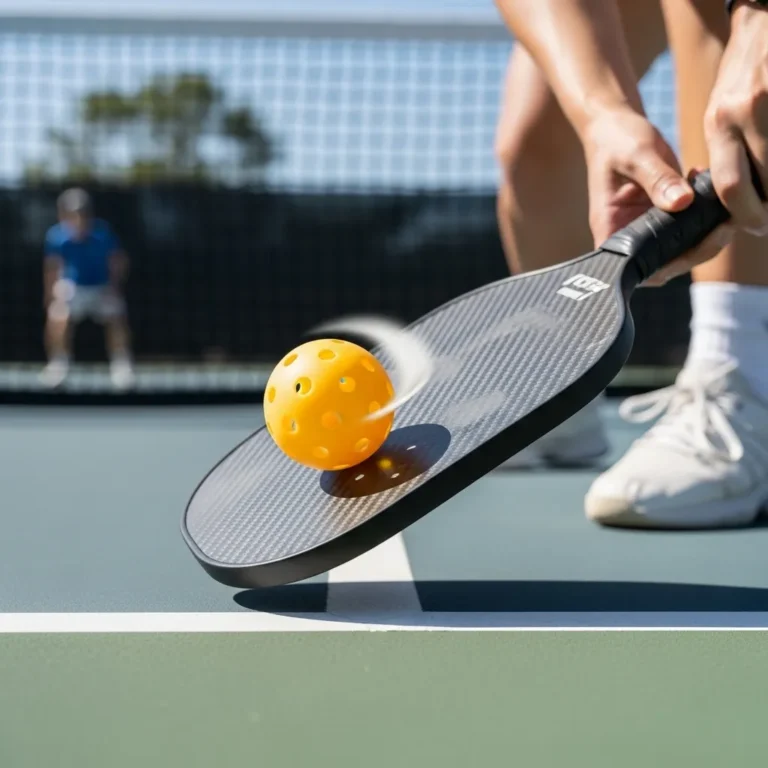
For the uninitiated asking, “what is a dink in pickleball?”, picture a high-stakes chess match played at the speed of ping-pong, but with a plastic ball and a whole lot of patience. It’s a soft shot, hit from near the non-volley zone (kitchen) line, intended to land in your opponent’s kitchen. It sounds simple, right? You just tap the ball over. But as anyone who has popped a ball up high enough to get smashed into the next zip code knows, there is nothing “simple” about maintaining a dink rally.
We are going to walk through the art of dinks pickleball players need to master—not just how to hit them, but how to think about them. We’ll strip away the stiff technical jargon and talk about how your body, your brain, and your paddle need to work together. Whether you are drilling “dinko pickleball” games (a popular variation to practice patience) or just trying to survive a heated rally, this guide is designed to transform your soft game.
Let’s get into the nitty-gritty of the pickleball dink and turn you into the player everyone wants as a partner—and fears as an opponent.
The Physics & Mechanics of a Perfect Dink
When we talk about mechanics, it’s easy to get lost in angles and degrees. But let’s keep it real: mechanics are just the way we convince the ball to go where we want it to. Most errors in the soft game aren’t because you aren’t athletic enough; they happen because you’re fighting physics.
What is the ideal “Apex Height” for an unattackable dink?
If you listen to most courtside coaching, you’ll hear people screaming, “Keep it low! Keep it low!” While well-intentioned, this advice can actually hurt your game. If you aim for the tape of the net, your margin for error is zero. You hit the net, you lose the point.
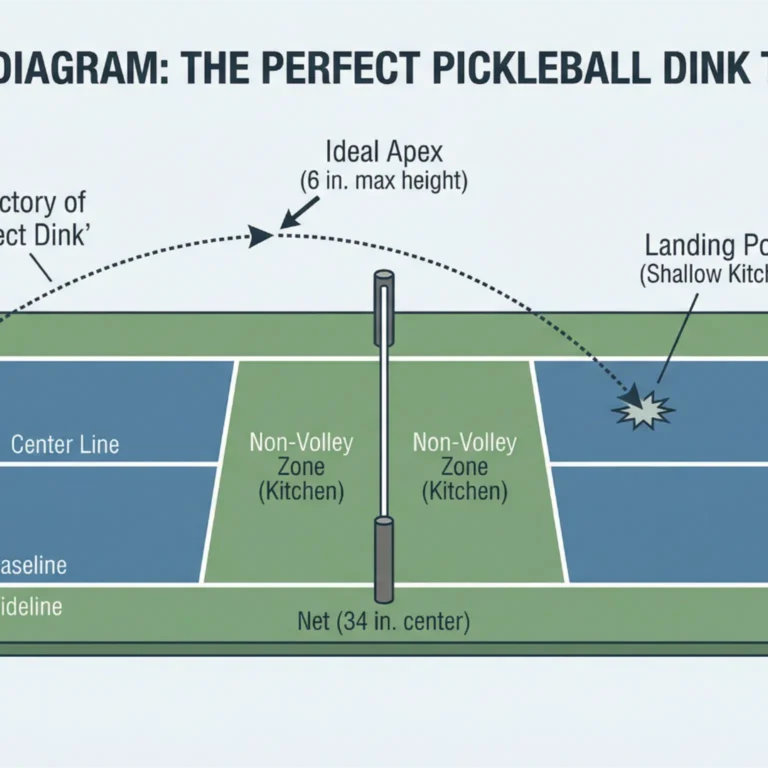
The secret isn’t just low; it’s about the apex. The apex is the highest point of the ball’s arc.
For a truly unattackable dink pickleball shot, the apex needs to be on your side of the net. Visualize a small rainbow. If the rainbow peaks directly over the net, the ball carries momentum forward and lands deep in the opponent’s kitchen, often bouncing high enough to be attacked.
However, if you push the ball so that the peak of that rainbow is roughly six inches to a foot on your side of the net, gravity takes over before the ball even crosses the plane. The ball is already on its downward trajectory as it crosses the net. This means it lands shallow (close to the net) on their side. A shallow dink forces your opponent to reach forward and hit up, meaning they can’t smash it. So, stop aiming for the net tape. Aim to lift the ball slightly so it peaks early, then dies as it crosses over.
Why is “Grip Pressure” the #1 silent killer of dink consistency?
I see this all the time. A player gets tense because the score is tight. Their knuckles turn white. They are gripping the paddle like they are trying to strangle it. This is the “Death Grip,” and it is the enemy of the soft game.
Think of your paddle as a trampoline. If the springs are tight (a hard grip), the ball bounces off instantly and explosively. That’s great for a smash, but terrible for a dink. You want the paddle to absorb the energy of the incoming ball, deadening it so you can place it gently.
We need to talk about the “3/10 scale.” If 1 is holding a feather and 10 is squeezing a stress ball until it pops, your dinking grip should be a 3. It should feel almost dangerously loose. A loose grip softens your hands. When the ball hits your paddle, a loose grip allows the paddle face to give slightly, absorbing pace. If you are popping balls up, check your knuckles. If they are white, breathe, relax your fingers, and trust the 3/10 scale.
Should I lock my wrist or snap it? The “Floppy Wrist” debate.
There is a time and place for wrist action in pickleball—usually on speed-ups or overheads. In the dink game, however, a “floppy wrist” is a liability.
The wrist is a small hinge with a lot of variables. If you use your wrist to flick the ball, you introduce inconsistent angles. Maybe you flick it perfectly three times, but the fourth time, you flick it two degrees too high, and boom—pop-up.
Instead, focus on the shoulder. Think of your arm as a pendulum swinging from the shoulder socket. Your wrist should remain relatively firm (not rigid, but stable). The movement comes from the shoulder pushing the arm forward. This removes the variable of the wrist snapping and ensures a smooth, predictable lift. It’s a push, not a flick. Stability in the wrist equals consistency in the dink.
Recommended Reading
Top Pickleball Gifts 2025:From Stocking Stuffers to Pro Gear
Looking for unique pickleball gifts? We break down practical gear, funny apparel, and budget-friendly ideas to help you surprise the player in your life.
How does the “Imaginary Wall” visualization prevent backswing errors?
One of the biggest reasons players hit dinks too hard or lose control is a massive backswing. You see the ball coming, and instinctively, you pull your arm back to “hit” it. But you don’t hit dinks; you lift them.
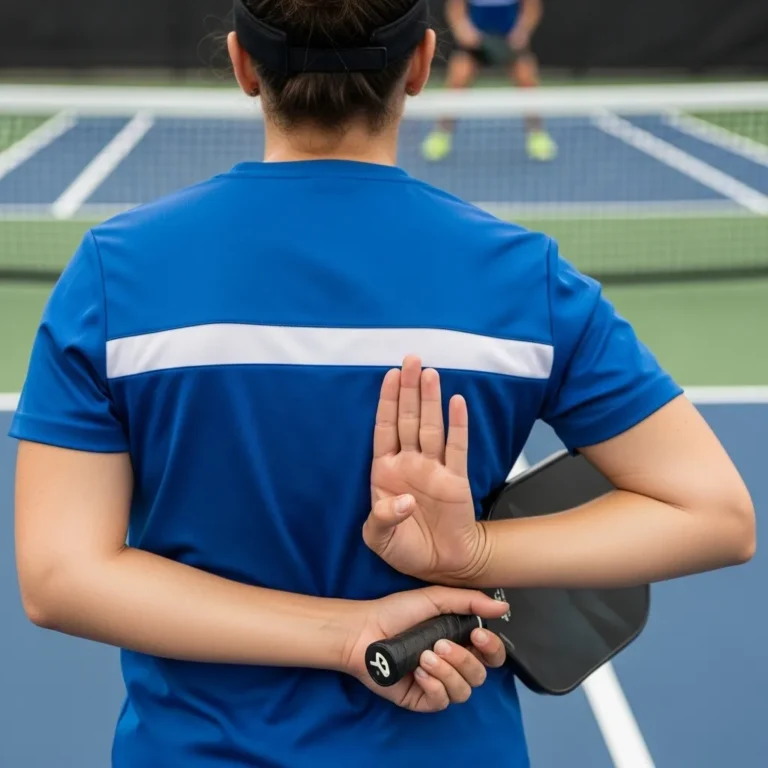
I want you to imagine you are standing with your back against a wall. If you pull your paddle back past your hip, you’d smash your knuckles into that wall.
This “Imaginary Wall” visualization is crucial. Your paddle should effectively start out in front of your body and stay there. When the ball arrives, you just push forward. By eliminating the backswing, you eliminate the variable of speed. You aren’t generating power; you are guiding the ball. If you catch yourself winding up, visualize that wall right behind your heels.
Continental vs. Eastern Grip: Which offers better disguise for the dink?
This is a hot topic, but if we are looking for the gold standard, the Continental Grip usually wins the debate for dinking.
The Continental grip (like shaking hands with the hammer) allows you to handle both forehand and backhand dinks without changing your grip. This is vital for speed. But more importantly, it offers disguise.
With an Eastern grip (often used for forehand drives), your wrist position often telegraphs what you are about to do. The Continental grip keeps the paddle face relatively open and neutral. You can hit a flat dink, a slice dink, or a lob volley all from the exact same look. In high-level play, deceiving your opponent is just as important as placing the ball. If they can’t predict where you are going because your grip looks the same for every shot, you’ve already won half the battle.
Tactical Footwork & Positioning
We often obsess over paddles and arm mechanics, but pickleball is played from the ground up. If your feet are wrong, your hand has to compensate, and that’s where errors happen. You can have the best hands in the world, but if you are off-balance, you’re toast.
What is the “Anchor Foot” technique, and how does it stop you from lunging?
Lunging is the desperate act of a player who wasn’t ready. When you lunge, your eyes bounce up and down, changing your perspective of the ball, and your balance falls forward.
Enter the “Anchor Foot.” The idea is that for every shot, one foot should be planted and stable—your anchor—while the other foot might pivot or step for reach. You never want to be in a position where both feet are moving or off the ground when you make contact.
For a right-handed player hitting a forehand dink wide, the left foot stays anchored while the right foot steps out. You hit, then push off that right foot to return to center. By keeping one foot anchored, your head stays level. A level head means your eyes see the ball clearly, drastically improving your contact.
Why is dinking “Crosscourt” geometrically safer than dinking “Down the Line”?
If you watch the pros, you’ll notice the vast majority of dinks pickleball rallies happen crosscourt (diagonal). This isn’t just habit; it’s geometry.
First, the net is lowest in the middle. A pickleball net is 36 inches high at the posts but drops to 34 inches in the center. When you dink crosscourt, the ball travels over the lowest part of the net. That two-inch difference is huge when you are working with tight margins.
Second, the diagonal court is longer than the straight line. You have about 6 to 7 more feet of court to work with when hitting diagonally. This gives you a bigger target area. If you hit a down-the-line dink a little too long, it goes out or sets up an Erne (where the opponent jumps around the kitchen to smash it). If you hit a crosscourt dink a little long, it usually just lands safely in the back of the kitchen.
How to master the “Step-Slide” recovery to avoid opening gaps in the middle.
A common mistake is crossing your feet when trying to get back to the middle of the court. You hit a wide dink, turn your body, and run back to the center. The problem? If your opponent hits the ball back immediately behind you, you are tangled up.
The “Step-Slide” (or shuffle) is the fix. After you step out to hit a dink, you push off that outside leg and slide back to neutral, keeping your chest facing the net the entire time. You never cross your feet. This keeps you “wide” and ready to react to the next shot instantly. It also ensures the middle of the court—the “divorce line” between you and your partner—stays closed.
When should I retreat to let a deep dink bounce vs. taking it out of the air (volley dink)?
This is the split-second decision that defines advanced play. The general rule of thumb relies on the color zones of your strike zone.
Imagine a traffic light. If the ball is high (Green Zone—chest/shoulder height), you take it out of the air and attack. If it’s in the middle (Yellow Zone—waist/thigh), you can usually volley dink it to keep the pressure on.
However, if the ball is dropping toward your shoelaces (Red Zone), taking it out of the air is risky. You would have to pop it up to clear the net. In this case, the smart move is to retreat a half-step, let the ball bounce, and hit it just after the peak of its bounce.
Taking the ball out of the air (volley dink) is generally preferred because it robs your opponent of time. It rushes them. But never sacrifice your balance to do it. If you have to reach down awkwardly, let it bounce.
Advanced Strategy & Mind Games
Once you can hit the ball over the net consistently, the game changes. Now, you aren’t just trying to survive; you’re trying to dismantle the person across from you. This is where the mental chess match begins.
What is the difference between a “Dead Dink” and an “Aggressive Push Dink”?
A “Dead Dink” is a defensive shot. It has no spin, no pace, and lands safely in the middle of the kitchen. It says, “I am just keeping the ball in play.” There is nothing wrong with this, but it won’t win you points.
An “Aggressive Push Dink,” on the other hand, has intention. You are pushing the ball deep to the opponent’s feet. You might be adding a little slice to keep it low. The goal of an aggressive dink isn’t necessarily to hit a winner, but to make the opponent uncomfortable. You want to force them to take a step back or hit off-balance. If you are only hitting dead dinks, you are a backboard. If you hit push dinks, you are a predator waiting for a mistake.
Targeting the “Inside Foot”: Why is this specific placement a nightmare for opponents?
If you want to jam your opponent, aim for their “Inside Foot.” For a right-handed player, this is their left foot (the one closest to the center line).
Why is this spot so awful to deal with? It is the transition point between a forehand and a backhand. If you aim for their outside foot, they have an easy forehand or backhand reach. But if you put the ball at their inside foot, they have to decide instantly: “Do I shuffle around to hit a forehand? Do I cramp up to hit a backhand?”
That split-second of indecision is often enough to cause a pop-up. It physically jams them, preventing a full, clean swing.
How do I recognize the “Yellow Zone” (Trigger Moment) to switch from dinking to a speed-up?
Dinking is patience, but you can’t dink forever. You are waiting for a “Trigger Moment.” This usually happens when your opponent hits a ball that floats into your “Yellow Zone”—a ball that is slightly high and perhaps a bit too deep.
The trigger is when you see the opponent is off-balance or their paddle is down. If you see them stumbling back or reacting late, that dink doesn’t need to be returned softly. That is your green light to flick the ball (speed-up) right at their dominant hip or shoulder (the “chicken wing” spot).
However, be careful. If they are balanced and holding their paddle up, a speed-up will likely come back at you twice as fast. Only attack when you sense weakness.
The “Dink by Numbers” System: How to create patterns that force an error.
Don’t just hit the ball. Construct a point. The “Dink by Numbers” concept involves assigning zones to the opponent’s kitchen.
- Zone 1: Far left.
- Zone 2: Middle.
- Zone 3: Far right.
A great pattern to force an error is moving the opponent laterally. Hit to Zone 1, then Zone 1 again (making them think you are stuck there), and then suddenly switch to Zone 3.
Humans are pattern-seeking creatures. If you hit two shots to the same spot, they will subconsciously lean that way for the third. By breaking the pattern, you catch them leaning the wrong way. The goal is to open up a gap between the partners or force them to stretch.
How to read the opponent’s paddle face to anticipate a spin dink (Slice vs. Topspin)?
You can predict the future if you watch the paddle, not the ball.
If your opponent’s paddle starts high and moves low (a chopping motion) with the face open to the sky, they are hitting a slice. Expect the ball to check up (stop) or skid upon landing. You need to move your feet closer to the ball because it won’t bounce toward you as much.
If their paddle starts low and brushes up the back of the ball with a slightly closed face, that’s topspin. This ball will dive down fast but jump forward at you when it bounces. You need to give this ball space; if you stand too close, it will jam you.
Troubleshooting Common “Pop-Up” Disasters
We have all been there. You try to be soft, and instead, you serve up a juicy meatball that your opponent smashes down your throat. Let’s fix the most common reasons why dinks turn into disasters.
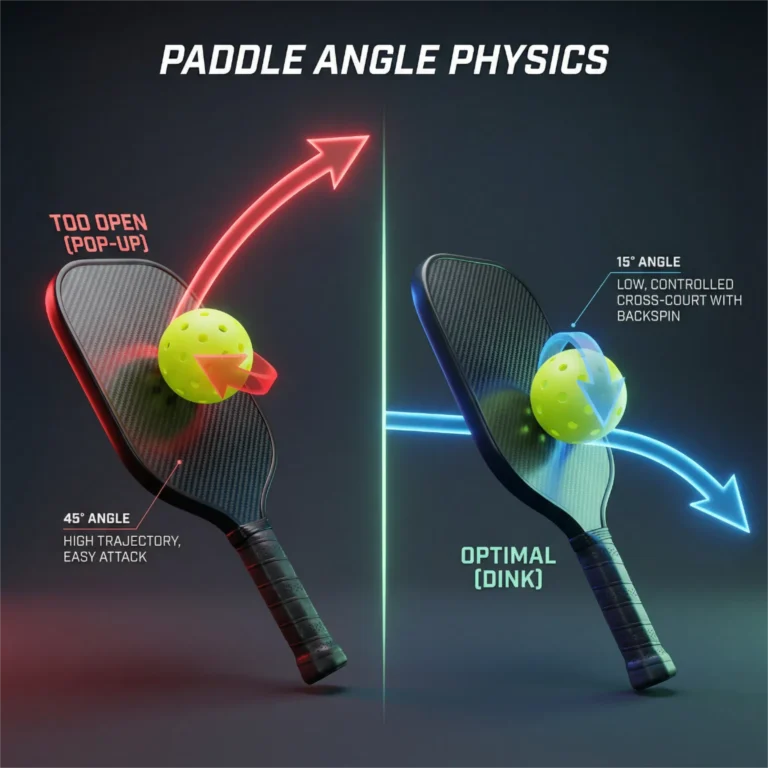
Why do my dinks pop up when I try to add backspin?
Backspin (slice) is great, but it’s dangerous. The most common error is the “Chopping” motion. Players think that to get backspin, they have to chop down aggressively like they are slicing a vegetable.
When you chop down sharply, the ball hits the angled paddle and shoots up before it goes forward. It’s simple physics.
To fix this, think “U” shape, not “V” shape. Your swing path should be a gentle shallow “U”. You slide the paddle under the ball with a slightly open face, rather than chopping down on it. It’s a caress, not a cut. This keeps the trajectory lower.
How to fix the “Bending from the Waist” error that ruins stability?
This is a back-killer and a game-killer. When you bend from the waist (like taking a bow), your head drops. When your head drops, your perspective shifts, and you lose the ability to judge depth. Plus, it limits your mobility. You can’t move sideways quickly if you are bent over at the waist.
The fix is simple but physically demanding: Bend your knees. Drop your butt. Keep your chest up. Imagine you are sitting on a high stool. When your eyes are level and your spine is relatively straight, your hand-eye coordination improves instantly. If your lower back hurts after pickleball, you are bending wrong. If your quads burn, you are doing it right.
What is the “Recoil” mistake, and why does it cause balls to hit the net?
The “Recoil” is when a player hits the ball and immediately jerks their paddle back, as if the ball was hot to the touch.
When you recoil, you stop the energy transfer prematurely. You interrupt the guidance of the ball. This usually results in the ball dying and hitting the net.
You must finish the stroke. It’s a small stroke, yes, but it still needs a follow-through. Push through the ball toward your target. Hold that finish for a split second. It ensures the ball goes where you aimed it, rather than falling short.
How to “Reset” a hard shot into the kitchen instead of popping it up?
This is the ultimate defensive skill. Your opponent blasts a ball at you. How do you turn that missile into a soft dink?
The secret is “Soft Hands” and absorbing pace. When the hard ball comes, do not swing at it. If you swing forward at a fast ball, it will fly out or pop up.
Instead, you almost want to catch the ball with your paddle. loosen your grip (back to that 3/10 scale). Block the ball, but let your paddle “give” slightly upon impact, moving backward just a fraction of an inch. This acts like a shock absorber. You are stealing the energy from the ball, killing its speed, and dropping it harmlessly into the kitchen. It takes practice, but mastering the reset is what separates the 3.5 players from the 4.5+ players.
Final Thoughts
Mastering the pickleball dink isn’t something that happens overnight. It requires a shift in mindset from “hit hard” to “hit smart.” It’s about understanding that the soft game is actually the aggressive game—it’s just aggression in disguise.
Next time you are on the court, don’t just go through the motions. Think about your anchor foot. Check your grip pressure. visualize that apex on your side of the net. Whether you are playing a fun game of dinko pickleball with friends or fighting for a gold medal, remember: the player who controls the kitchen, controls the game. Now, go out there and dink responsibly!
Check out our guide to pickleball tips: 7 Key Pickleball Mistakes to Avoid
You May Also Like