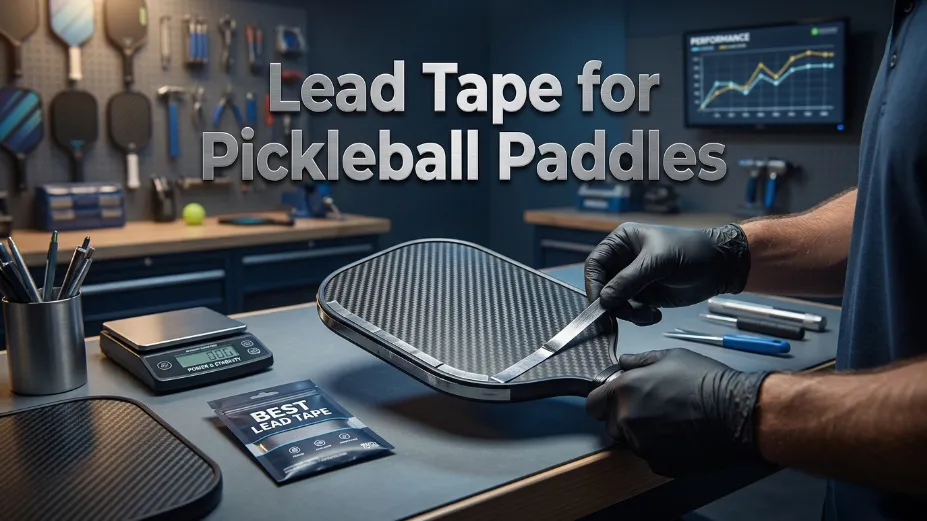
A few grams of strategically placed adhesive can be the difference between a fluttery reset and a rock-solid kitchen dink. Customizing your gear with lead tape for pickleball paddles isn’t just about adding mass; it’s about re-engineering your swing weight to match the specific demands of your power or control game.
Best Lead Tape for Pickleball Paddles: Pro-Grade Options in 2026
When searching for the best lead tape for pickleball paddles, you need an adhesive that won’t fly off mid-rally and a density that allows for precise tuning. Here are the industry standards:
- Gamma Lead Tape (1/4 inch): The most popular choice for edgeless pickleball paddles. Its thin profile fits perfectly under edge guard tape.
- Tourna Lead Tape (Rolls): Ideal for players who like to measure and cut their own lengths. Each inch is calibrated to a specific gram weight (usually 0.25g or 0.5g).
- Selkirk Tungsten Tape: The premier non-toxic alternative. If you are concerned about handling lead, Selkirk offers pre-cut 3g strips that are safe and highly durable.
- Pickleball Effect Tuning Tape: A rubberized, weighted tape that provides both mass and a layer of edge protection in one sleek package.
If you are using a JOOLA pickleball paddle, we recommend using pre-cut 3g strips to avoid covering the NFC chip area located near the handle, which is vital for warranty verification.
What Does Lead Tape Do for Pickleball Paddles? The Physics of Performance
Adding a lead tape for pickleball paddle setup is not “bro-science”; it is applied physics. When you modify the mass distribution of your gear, you are primarily altering two scientific variables: Swing Weight and Twist Weight. Understanding these concepts is the first step toward mastering your top pickleball paddles.
The 10 and 2 o’clock V-Pattern
Modern players like Anna Leigh Waters often utilize a V-pattern. This setup provides a hybrid benefit—increasing swing weight for more pop on serves while maintaining enough balance to keep the pickleball kitchen rules in mind during delicate dinking rallies.
The Power Peak at 12 o’clock
This is arguably the best place for lead tape on pickleball paddle if you play primarily doubles. By placing weight at the mid-sides, you maximize the twist weight. This is crucial for “kitchen battles” where fast-moving balls often strike the edges of the paddle. Instead of the paddle twisting and sending the ball into the net, the added mass keeps the face stable, returning the ball with authority.
The “Golden Zone” at 3 and 9 o’clock
Finding the best place for lead tape on pickleball paddle depends entirely on your tactical weaknesses. Most pros use the “Clock System” to communicate these adjustments precisely.
Best Place for Lead Tape on Pickleball Paddle: Mapping Your Game
Most carbon fiber pickleball paddle models come from the factory with a balanced profile, but elite players often find them too light for high-level “banger” exchanges. By using lead, you bridge the gap between a lightweight control paddle and a heavy-duty power weapon.
- Swing Weight: This measures how heavy the paddle feels when in motion. Adding weight to the 12 o’clock position increases the “pendulum effect,” giving you more plow-through on deep drives and serves.
- Twist Weight (M.O.I): This refers to the paddle’s resistance to rotating in your hand when you hit the ball off-center. High twist weight effectively expands the sweet spot, making your blocks and 3rd shot pickleball drops more consistent.
Head-to-Head: Lead Tape vs. Tungsten vs. Weighted Putty
Choosing your weighting medium is about more than just grams. Here is how the top options compare in 2026:
- Lead Tape: Pros: Highest density (thinnest profile), cheapest, very malleable. Cons: Toxic if handled without care; creates lead dust if scraped on the court.
- Tungsten Tape: Pros: 100% non-toxic, professional aesthetic, often comes in easier-to-use 3g strips. Cons: More expensive than lead; slightly thicker.
- Pickle Putty: Pros: Allows for infinite micro-adjustments during a practice session. Cons: Can shift under high-impact smashes; not ideal for permanent tournament play.
The “Missing Angles”: Warranty Traps and Advanced Adhesion
While most sites tell you “where” to put tape, they miss the warranty nuances. For instance, brands like Selkirk pickleball paddles are incredibly modification-friendly. However, if you remove the original factory grip to add weight to the handle of a Gearbox or JOOLA paddle, you may void your warranty immediately.
Pro-Tip for Adhesion: Many players complain that tape won’t stick to raw carbon fiber or textured edges. To solve this:
- Clean the edge with Isopropyl Alcohol to remove factory oils.
- Warm the lead tape with a hair dryer for 10 seconds before applying.
- Always cover lead tape with a layer of electrical tape or edge guard tape to prevent the metal from oxidizing or peeling.
USA Pickleball Regulations & Safety (2025-2026)
According to the USAP Equipment Standards, lead tape is a legal modification under Rule 2.E.5.a. However, there are limits:
- Placement Limits: Tape cannot extend more than 1.0 inch above the top of the grip or 0.5 inches into the hitting face of the paddle.
- Health Safety: To avoid environmental contamination, always wash your hands after handling lead. Many clubs in the US now mandate that lead tape be covered by a protective layer to prevent “lead dust” from accumulating on the court surface.
Conclusion: Finding Your “Butter Zone”
Customizing your paddle with the best lead tape for pickleball paddles is a journey of trial and error. We suggest starting with 3g at the 3 and 9 o’clock positions—this is the safest starting point for 90% of players. From there, you can move weight toward the head if you lack power, or toward the throat if you need more stability without the “hefty” feel.
Don’t forget to pair your newly weighted paddle with the best shoes for pickleball to ensure your footwork can keep up with your enhanced swing speed!
Frequently Asked Questions (FAQ)
Does lead tape increase the sweet spot?
Yes. By placing lead tape at the 3 and 9 o’clock positions, you increase the paddle’s twist weight. This stabilizes the paddle on off-center hits, effectively expanding the usable sweet spot toward the edges.
Is lead tape toxic for pickleball players?
Lead is a heavy metal and can be toxic if ingested or inhaled as dust. It is highly recommended to cover all lead tape with electrical tape and wash your hands thoroughly after the application process.
Will adding lead tape cause “Tennis Elbow”?
Actually, the opposite is often true. A paddle that is too light can vibrate excessively on impact, stressing the tendons. Adding weight to the throat (4 and 8 o’clock) can act as a shock absorber, potentially reducing the risk of injury.
Can I put lead tape on an edgeless paddle?
Yes, but you should use 1/4 inch lead tape rather than the standard 1/2 inch. This ensures the tape stays on the thin perimeter and doesn’t bleed onto the hitting surface, which would violate USAP rules.
You May Also Like