Pickleball is the only sport where shouting three random numbers at a stranger is considered polite conversation. Mastering how do you keep score in pickleball is the ultimate rite of passage that separates the “parking lot watchers” from the actual players. It’s not just about the math; it’s about knowing exactly where you stand before the ball even leaves your paddle.
Official USA Pickleball Scoring Standards Updated for 2026
Official USA Pickleball Scoring Standards Updated for 2026
- Score Components
- 3 Numbers
- Server · Receiver · Server #
- Calling Sequence
-
Server Score → Receiver Score → Server #
- Winning Condition
- First to 11 · Win by 2
- Side-Out scoring system
- Score Components
- 2 Numbers
- Server · Receiver only
- Calling Sequence
-
Server Score → Receiver Score
- Winning Condition
- First to 11 · Win by 2
- Side-Out scoring system
- Score Components
- 2 Numbers
- Server · Receiver only
- Calling Sequence
-
Server Score → Receiver Score
- Winning Condition
- First to 21 · Win by 2
- No Freeze Rule applies
- Score Components
- 2 Numbers
- Server · Receiver only
- Calling Sequence
-
Server Score → Receiver Score
- Winning Condition
- First to 11 · Win by 2
- Cross-court & Line play only
The Definitive Guide: How Do You Keep Score in Pickleball Like a Pro
For many Americans joining the nearly 36 million players in the US, the “three-number system” feels like a secret language. However, the logic is rooted in fairness and positioning. Unlike tennis, where scores like “Love” and “40” define the game, pickleball uses a transparent numerical progression that forces players to track not just the tally, but their physical location on the court.
Understanding the pickleball scoring systems requires a mindset shift. In traditional play, the receiving team is effectively “on defense”—they cannot score; they can only win the right to serve (a “Side-Out”). This dynamic makes the game highly psychological, as a team can win ten rallies in a row on defense without moving their score a single digit.
Deep Dive: How Do You Keep Score in Pickleball Doubles
In the doubles format, which accounts for the vast majority of play in the United States, the third number is the “Server Number.” This number (1 or 2) tells the court which partner is currently in the service rotation. Every pickleball rules for doubles session highlights that each team gets two chances to serve (two “outs”) before the ball goes back to the other side.
- Server #1: The player on the right side of the court when their team wins the serve back.
- Server #2: The partner who takes over after the first server loses a rally.
- The Switch: Partners only switch sides of their own court after winning a point while serving.
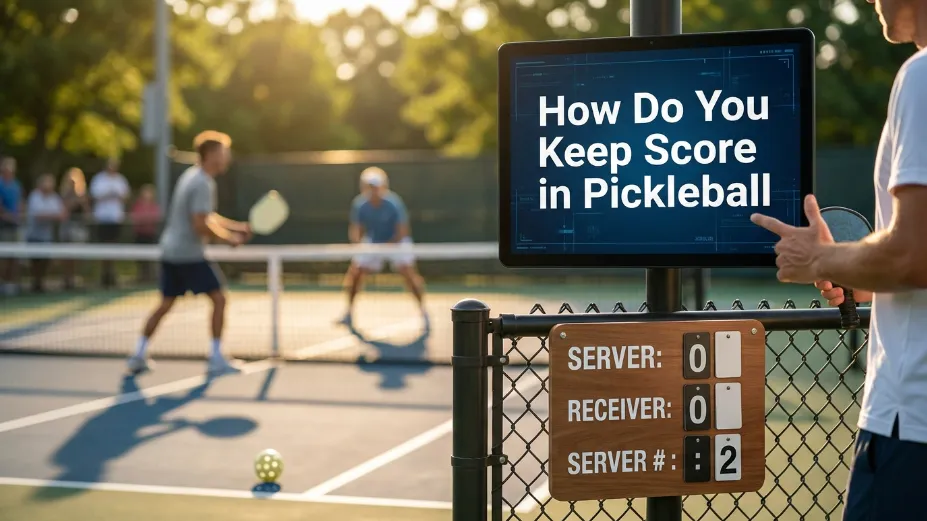
When asking how do you keep score in pickleball doubles, players must remember the “Me-You-Who” mnemonic: My Score (Serving Team), Your Score (Receiving Team), and Who is serving (1 or 2). A common point of confusion is the start of the game. To mitigate the advantage of serving first, the starting team is only allowed one server. This is why the opening score is always 0-0-2.
Pro Strategies: How Do You Keep Track of Score in Pickleball
If you have ever been in a 20-shot rally and completely blanked on the numbers, you aren’t alone. Even professionals occasionally lose the thread. Learning how do you keep track of score in pickleball often comes down to the Anchor Player Technique. At the start of every game, note who began serving on the right side. That player is the “Even” player. Whenever that player is on the right side, your team’s score must be even (0, 2, 4, 6…). If they are on the left, your score is odd.
Another essential tool is the 10-Second Rule (Rule 4.E). Once the server calls the score, they have 10 seconds to initiate the serve. This prevents stalling and keeps the momentum fluid. If you realize the score called is wrong, you must speak up immediately. Under Rule 4.K, you can stop a rally to correct a score, but only before the return of serve is hit. If you stop the rally after the return to argue the score, you commit a fault and lose the point.
Advanced Tactics: How Do You Keep Score in Doubles Pickleball During Stacking
As you progress to a 3.5 or 4.0 skill level, you will encounter Stacking. This is a strategy where partners stand on the same side of the court to preserve their preferred forehand/backhand positions. When exploring how do you keep score in doubles pickleball during a stack, remember that the legal server is still determined by the score, even if they aren’t standing in a “traditional” spot.
For example, if the score is 4-3-1, the “Even” player must serve from the right side. They can serve and then immediately run to the left side while their partner slides right. This “unwinding” of the stack is legal as long as the ball is struck by the correct player from the correct court. Most teams use hand signals (like a closed fist for “stay” or an open palm for “switch”) to manage these rotations while keeping the score accurate.
2026 Rule Updates and Their Impact on Scoring
USA Pickleball has introduced several “common-sense” revisions for 2026 that directly affect the scoreboard. One of the most significant is the removal of the “Freeze” in Rally Scoring (Rule 14.a.2). Previously, teams could only win the game point while serving. Now, match point can be won by either the serving or receiving team, preventing those endless 20-20 stalemates often seen in pro matches.
Additionally, the “Clearly” Legal Serve (Rule 7.C) now places the burden on the server. If a serve is borderline (too high or sidearm), referees are instructed to call a fault rather than give the benefit of the doubt. For recreational players, this means your pickleball rules compliance is now more strictly tied to your score—if you lose your serve due to a “not clear” motion, your second server takes over immediately.
Etiquette and Behavioral Points: The Spirit of the Game
In the United States, pickleball is as much a social contract as a competitive sport. Rule 13.G outlines a progressive penalty system that can actually change the score. A Technical Foul results in the immediate deduction of one point from the offending team (or adding one point to the opponent if the offender is at zero). This can be issued for paddle abuse, extreme profanity, or “gamesmanship.”
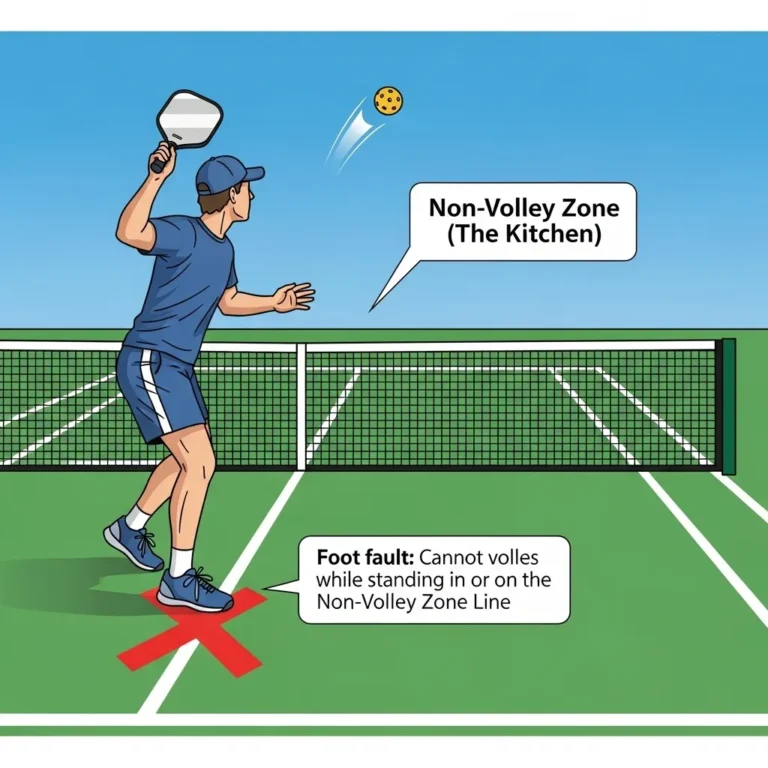
Under the new 2026 “Post-Match” clause, behavior doesn’t stop being penalized when the match ends. If a player engages in unsportsmanlike conduct after the final point, the Tournament Director can apply a Technical Foul to their next match, meaning they start down 0-1. Always respect the pickleball kitchen rules and offer a paddle tap at the end, regardless of the score.
Frequently Asked Questions
Pickleball Scoring FAQ: 2026 Edition
Q: Why does the game start at 0-0-2 instead of 0-0-1?
A: This is to prevent the first serving team from having too much of an advantage. By starting as “Server 2,” they only get one opportunity to serve before the ball sides out to the opponents.
Q: What happens if I call the wrong score?
A: Any player can stop the play to correct the score before the return of serve is hit. If the rally has already progressed past the return, the rally must be completed, and the score is corrected afterward.
Q: Can you win a game on a technical foul?
A: Yes. If the receiving team is at 10 points (game point) and the serving team commits a technical foul, the receiving team is awarded a point, ending the game 11-x.
Q: Does the “win by 2” rule still apply in 2026?
A: Absolutely. Whether you are playing to 11, 15, or 21, you must lead by at least two points to conclude the match. If the score hits 10-10, the game continues until one team leads by two (e.g., 12-10).
For more official guidance on tournament standards, you can view the Official USA Pickleball Rulebook.
Mastering how do you keep score in pickleball is less about arithmetic and more about rhythm. Once you internalize the three-number sequence and the even/odd positioning, the game opens up. You stop worrying about the math and start focusing on that perfect third-shot drop. See you on the court!